Learning Outcomes
By the end of this article, you will be able to explain the impact of clientele effects on dividend policy, outline how different taxation regimes influence shareholder preferences, and evaluate the practical considerations of payout decisions in a global context. You will also be able to analyse how management can align payout policy with shareholder value while factoring in varied investor requirements and tax constraints.
ACCA Advanced Financial Management (AFM) Syllabus
For ACCA Advanced Financial Management (AFM), you are required to understand how dividend and payout policy decisions are influenced by investor clientele and taxation. You should be able to recommend suitable payout strategies in given contexts and identify the effects of taxation on policy effectiveness.
- Explain the factors influencing dividend and payout policy, including clientele effects and tax implications
- Assess how investor preferences and tax regimes affect distribution and retention policy
- Advise on appropriate payout strategies for companies with diverse shareholder profiles
- Evaluate the impact of multinational operations and host country tax rules on dividend payment capacity
Test Your Knowledge
Attempt these questions before reading this article. If you find some difficult or cannot remember the answers, look more closely at that area during your revision.
-
Which statement best describes the “clientele effect” in relation to dividend policy?
- a) Management sets dividend policy based on only financial performance.
- b) Investors group by their dividend preferences, influencing corporate payout policy.
- c) Taxation has no impact on dividend preferences.
- d) Companies always pay the highest possible dividend.
-
In a country where dividends are taxed at a higher rate than capital gains, what is the most likely preference for most investors?
- a) Preference for immediate cash dividends
- b) Preference for retention and share price growth
- c) Indifference to payout method
- d) Preference for stock splits only
-
True or false? A change in a company’s dividend policy may lead to changes in its shareholder base.
-
Briefly explain how withholding taxes can affect a multinational company’s dividend remittance strategies.
Introduction
Dividend and payout policy is a critical area of financial management and a recurring topic in the ACCA AFM syllabus. The decisions surrounding how much profit to distribute to shareholders, and in what form, must go beyond simple financial ratios. Effective policies consider the varied preferences of investors, known as the clientele effect, and the practical implications of different taxation regimes. For multinational companies, additional complexity arises from varying host country tax rules and regulatory barriers. This article examines how investor requirements and tax factors guide payout decisions and how best to structure policies to support shareholder value.
CLIENTELE EFFECTS IN DIVIDEND POLICY
Management must recognise that shareholders have different preferences regarding the form and timing of returns. This has a direct impact on how companies structure their payout policies.
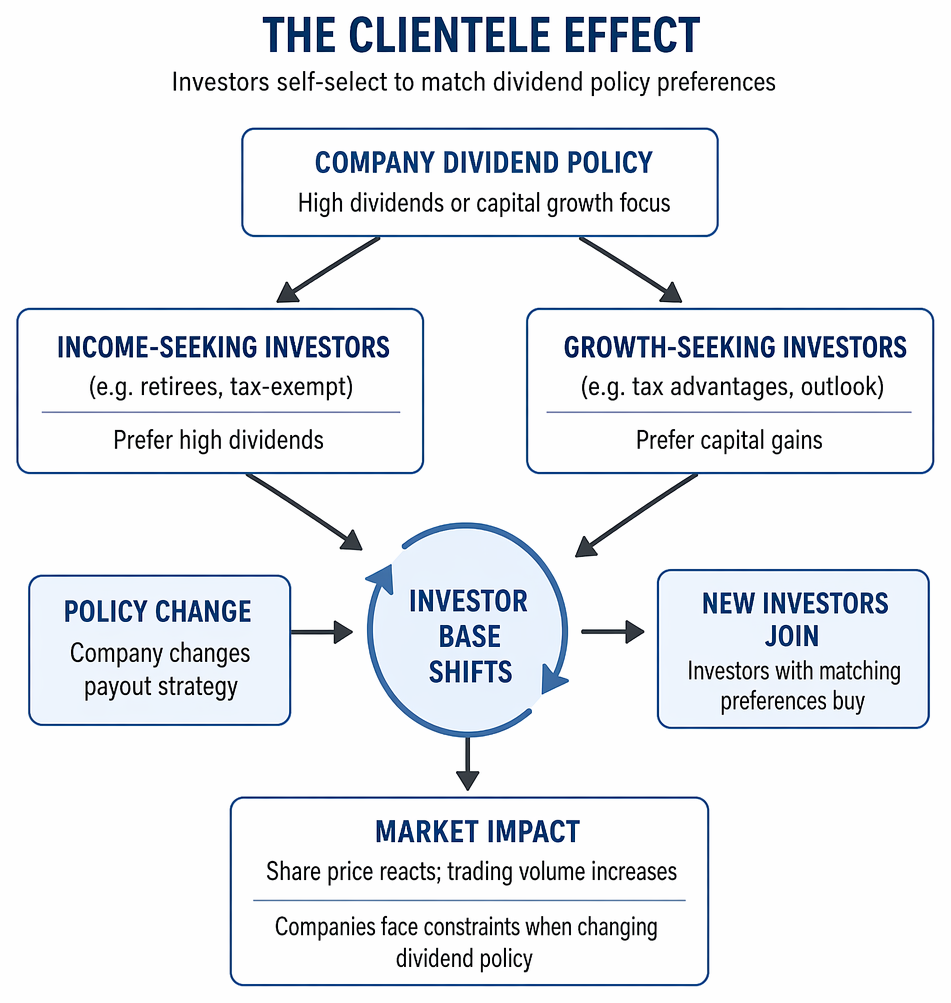
Relative tax rates on dividends and capital gains determine whether shareholders prefer earnings retention, dividend income, or indifference between payout methods.
Key Term: clientele effect
The tendency for investors to self-select into companies with a dividend policy matching their preference for income or capital gains. Companies attract and retain shareholders whose tax status or income requirements align with the company’s distribution strategy.
Why Does the Clientele Effect Arise?
Investor groups—such as retirees seeking regular income, or tax-exempt institutions—may favour high dividends, while other investors may prefer capital growth due to more favourable tax treatment of capital gains. When companies change their payout strategy, they may see shifts in their shareholder base as some investors sell shares and others buy, seeking alignment with their payout preferences.
Practical Implications
The clientele effect constrains a company’s ability to change dividend policy without impacting the share price. Stable, predictable payout patterns often attract certain types of investors, while irregular or volatile policies may deter them.
Worked Example 1.1
A listed company has paid a stable dividend for several years. The board decides to reduce the dividend and retain more earnings for investment, which leads to an initial drop in share price, followed by an increase in daily trading volume.
Answer:
The decline in share price and increase in trading reflect a shift in the investor base. Shareholders preferring high income are selling their shares, while those seeking future capital gains (possibly due to tax or investment outlook) are buying. This is the clientele effect in action.
TAXATION CONSIDERATIONS IN PAYOUT POLICY
Taxation can have a significant effect on the relative attractiveness of dividends versus capital gains. Companies must be aware of the personal tax circumstances of their investor base and the corporate taxes applicable to payouts.
Key Term: withholding tax
A tax deducted at source on dividends paid to shareholders, particularly relevant for international investors, reducing the amount received from distributions. Key Term: double taxation
The situation where company profits are taxed at corporate level and again as shareholder income when paid out as dividends.
How Taxation Shapes Payout Decisions
- When dividends are taxed more heavily than capital gains, investors commonly prefer earnings retention, expecting the benefit of future share price appreciation.
- Tax-exempt investors or those benefiting from imputation credits favour cash dividends.
- Multinational companies must also consider differences in tax regimes across countries and the effect of tax treaties on cross-border dividend payments.
Worked Example 1.2
Consider a company operating in two countries: Country A taxes dividends at 35% and capital gains at 15%; Country B applies no discrimination between the two. Which shareholder base is more likely to favour a high-dividend company?
Answer:
Investors resident in Country B are indifferent since both forms of income are taxed equally. Investors in Country A prefer lower dividends and higher capital growth to reduce their overall tax burden, potentially selling shares to realise capital gains instead.Exam Warning: Always distinguish between company-level and investor-level tax. Misunderstanding who bears which tax may lead to incorrect policy recommendations.
MULTINATIONAL PAYOUT POLICY CONSIDERATIONS
Dividend policy for companies with cross-border operations involves additional complexity due to taxation, regulations on dividend repatriation, and local profit retention requirements.
Taxation and Remittance Restrictions
Some countries impose withholding taxes on dividends paid to foreign shareholders or restrict the percentage of profits that may be remitted to the parent company, impacting group-level dividend capacity.
Key Term: remittance restriction
Legal or administrative limits imposed by a country on the movement of profits or dividends to foreign parent companies.
Practical Management of Blocked Dividends
Where profits are “trapped” due to remittance restrictions or penal tax rates, companies may use alternative mechanisms, such as management fees, royalties, or adjusting transfer prices, to extract value legally.
Worked Example 1.3
A multinational parent in the UK owns a subsidiary in Country Z. Country Z has a 10% withholding tax on cross-border dividend payments and caps annual remittances at 60% of after-tax profit. The parent requires a stable dividend flow.
Answer:
The subsidiary can remit only a portion of profit each year, with a further reduction due to withholding tax. Management may structure other allowed payments to extract funds or retain the profits for future distribution. This framework must be factored into the group’s overall dividend planning.
ALIGNING POLICY WITH SHAREHOLDER VALUE
While tax and clientele effects shape payout decisions, management’s task is to maximise shareholder value over the long term by ensuring funds are allocated efficiently. In practice, this often involves balancing immediate shareholder returns with reinvestment needs and long-term growth.
Revision Tip: Always identify the investor groups predominant in the shareholder register before recommending a change in payout policy in a scenario-based exam question.
Summary
Dividend and payout policy decisions must be based on a clear understanding of investor clientele and tax implications. Shifts in policy can alter the shareholder base and may affect the share price. Multinational companies face extra complexity from differing tax regimes and cross-border distribution controls. An effective policy is one that maximises long-term shareholder value and reflects the needs of the company’s actual or targeted investors.
Key Point Checklist
This article has covered the following key knowledge points:
- Explain the clientele effect and its impact on dividend policy decisions
- Recognise how investor taxation influences payout preferences
- Identify the impact of withholding tax and remittance restrictions for multinational companies
- Advise on payout policy options balancing investor needs and firm investment requirements
Key Terms and Concepts
- clientele effect
- withholding tax
- double taxation
- remittance restriction