Learning Outcomes
After reading this article, you will understand how to incorporate real options into investment appraisal, especially when competitive rivalry and strategic interactions exist. You will be able to identify types of real options, explain the relevance of game influences on project value, and describe practical ways to use real option analysis when appraising investments in uncertain, competitive markets.
ACCA Advanced Financial Management (AFM) Syllabus
For ACCA Advanced Financial Management (AFM), you are required to understand how real options and competitive behaviour affect investment decisions. In particular, this article relates to:
- The evaluation and classification of embedded real options within capital projects
- The influence of competition and game theory on project analysis and value
- The application of option pricing to investment decisions and real asset valuation
- The strategic use of real options in response to market uncertainty and competitor actions
- How competitive timing and first/second mover advantages impact project appraisal
Test Your Knowledge
Attempt these questions before reading this article. If you find some difficult or cannot remember the answers, look more closely at that area during your revision.
- What is a real option in the context of capital investment appraisal?
- How might the potential for future competition affect the value of a project with growth opportunities?
- Briefly explain how game theory can influence the timing of investment decisions between competing firms.
- Outline two ways strategic competitive behaviour can modify the value or exercise of real options.
Introduction
Investment appraisal usually focuses on static cash flow forecasts, discounting expected values to determine project net present value (NPV). However, in practical situations, managers often have the ability to alter the scale, direction, or timing of a project in response to uncertainty and competitive behaviour. These forms of managerial flexibility are real options. When rivals can also act strategically, project valuation must consider their possible actions as well as your own, using concepts from game theory. This article explains how to factor in real options and competitive interaction to produce better investment decisions.
REAL OPTIONS IN PROJECT APPRAISAL
The real options approach recognises the value of flexibility embedded in many projects. For example, a firm can delay a project, abandon it if conditions worsen, expand if demand exceeds expectations, or switch resources between markets.
Key Term: real option
A real option is the right, but not the obligation, to make certain business decisions—such as deferring, expanding, or abandoning a project—typically in response to future, uncertain developments.
Projects with real options are generally more valuable than those where all decisions are fixed in advance, especially in volatile or competitive environments.
Types of Real Options
Common types relevant to competitive contexts include:
- Option to delay: Deferring an investment until uncertainty resolves.
- Option to expand: Increasing scale if market demand is strong.
- Option to contract or abandon: Cutting losses or withdrawing if performance is poor.
- Option to switch use: Redeploying assets or changing output in response to market changes.
- Option to respond to competitor's moves: Reacting strategically when rivals act.
Key Term: option to delay
The right to postpone a project until conditions are more favourable, enabling the firm to observe market or rival actions first. Key Term: game theory
Game theory is the study of strategic interactions between rational decision-makers, often used to model and predict competitor behaviour in economic environments.
Option Value under Competition
In markets with multiple firms, traditional discounted cash flow (DCF) analysis may significantly understate or overstate project value. Competition can increase uncertainty over future cash flows and influence the best time to exercise real options.
COMPETITION AND GAME INFLUENCES
The Role of Competitive Interaction
When more than one firm is considering similar investments, each must anticipate rival reactions. For example, if one company invests early, it could capture market share or deter rivals (first-mover advantage), but may also face risks if the market fails to develop or rivals later quickly copy improvements.
Game Theory in Appraisal
Game theory provides a toolkit to analyse the potential moves and countermoves between firms. It helps identify optimal strategies—such as whether to invest immediately, delay until a competitor acts, or commit to pre-emption.
Pricing and Entry Games
Suppose two firms are considering entering a new market with limited demand. Each must decide whether to enter now, wait, or not enter at all. Entering first may yield extra profits (monopoly period), but waiting could avoid losses if conditions decline.
Option Exercise Timing
Exercise timing of real options becomes strategic: waiting may be optimal in isolation (to resolve uncertainty), but in a competitive setting, waiting too long could mean losing market share.
Worked Example 1.1
Scenario: Two companies, Viva and Nova, are competing to introduce a new technology. Both estimate the NPV is positive if introduced alone, but drops if both invest due to price competition. Each has an option to invest this year or wait and possibly be pre-empted.
Question: How does competition affect the value and exercise strategy of the option to invest?
Answer:
The presence of a rival reduces the value of waiting because of the risk of being pre-empted and losing the first-mover advantage. Each firm may invest earlier, even in face of some remaining uncertainty, to capture market share. The real option's value, which depends on the ability to delay, is reduced by competitive threat.
VALUATION OF REAL OPTIONS UNDER COMPETITION
The value of real options is affected by both market uncertainty and competitive forces. Traditional models like Black-Scholes assume the holder is the only potential exerciser; under competition, strategic behaviour means the opportunity may be lost if a rival moves first.
Impact on Option Value
- The threat of pre-emption reduces the time value of waiting.
- The option to expand becomes less valuable if rivals can copy moves quickly.
- The value of abandoning can increase if competitors are expected to flood the market, reducing profitability.
Worked Example 1.2
Scenario: A pharmaceutical firm owns a patent allowing it to launch a new drug anytime in the next five years. It can observe competitor actions and market size before deciding.
Question: What real options exist and how does competitor threat change their value?
Answer:
The firm has real options to delay, expand if sales are promising, or abandon if side effects appear. If competitors are likely to launch alternatives, the incentive to delay decreases, and investing earlier may be justified to establish a brand, reducing option value from waiting.
PRACTICAL APPLICATION: STRATEGIC OPTIONS AND MARKET ENTRY
Strategic real options are highly valuable when:
- Entry barriers exist, and rivals cannot immediately act.
- First-mover advantages provide sustainable profits.
- The ability to respond to rivals can influence market equilibrium.
However, in perfectly competitive or fast-following markets, these options may be worth less or even be best ignored.
Worked Example 1.3
Scenario: Techtron plans to construct a data centre. The business case is marginal if the company is the only operator, but negative if a competitor enters at the same time.
Question: How would option analysis and game influences inform Techtron's decision?
Answer:
Techtron should incorporate the probability of competitor entry and its timing. Game theory may suggest strategies—such as strategic delay, investment acceleration, or commitment—that influence the competitor's response. In some cases, forming a partnership or staged entry may be optimal.Exam Warning: Be cautious: neglecting competitor response in real options valuation can lead to incorrect investment timing and value estimates. Always assess whether rivals may pre-empt or retaliate against a planned move.
VALUING REAL OPTIONS WITH COMPETITIVE INTERACTION
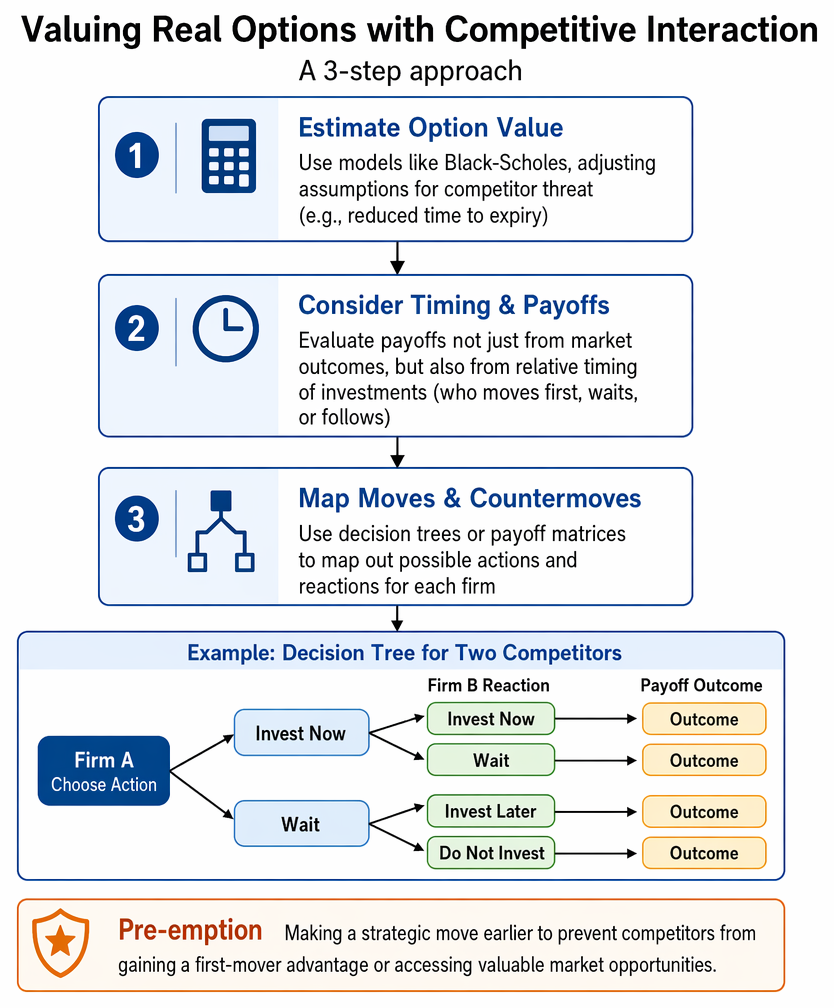
To value real options in the presence of competitive behaviour:
Timing strategy for a real investment option links elevated pre-emption risk to immediate commitment and lower risk to deferral.
- Estimate the value of options using models like Black-Scholes but adjust assumptions for competitor threat (e.g., reduced time to expiry).
- Consider payoffs not just from market outcomes, but also from relative timing of investments (who moves first, waits, or follows).
- Use decision trees or payoff matrices to map out moves and countermoves.
Key Term: pre-emption
Pre-emption refers to making a strategic move earlier to prevent competitors from gaining a first-mover advantage or accessing valuable market opportunities.Revision Tip: When appraising real options in competitive markets, diagram possible actions and reactions for each firm. This helps clarify whether to invest early, delay, or pursue other strategic actions.
Summary
Projects in competitive markets require more than standard DCF appraisal. Real options, like the ability to delay or expand, must be adjusted for the possibility of competitor action. Game theory provides a framework for analysing these interactions, giving a more accurate estimation of project value and the best-timed strategic moves.
Key Point Checklist
This article has covered the following key knowledge points:
- Recognise the types of real options found in investment projects
- Explain how competition and game theory influence real option value and decision timing
- Apply option pricing and strategic analysis to project appraisal under competitor threat
- Identify scenarios where traditional DCF undervalues projects due to omission of strategic flexibility
Key Terms and Concepts
- real option
- option to delay
- game theory
- pre-emption