Learning Outcomes
This article explains how to incorporate risk into investment appraisal, focusing on risk-adjusted discount rates and certainty equivalent methods. You will learn the fundamental differences, the rationale behind each technique, and how to apply them to project evaluation. By the end, you should be able to calculate and critically discuss both approaches, identify when each is suitable, and avoid common exam errors.
ACCA Advanced Performance Management (APM) Syllabus
For ACCA Advanced Performance Management (APM), you are required to understand how uncertainty and risk affect project appraisals and how to account for risk when assessing capital investment decisions. You should focus your revision on the following areas:
- The effect of risk and uncertainty on investment appraisal results
- Ways to incorporate risk into project evaluation, including risk-adjusted discount rates and certainty equivalents
- Differences between these two approaches and their application in assessing investment projects
- The practical implications of choosing one method over another
- Critically discussing the strengths and weaknesses of each approach
Test Your Knowledge
Attempt these questions before reading this article. If you find some difficult or cannot remember the answers, look more closely at that area during your revision.
- In which scenario would a certainty equivalent approach be preferable to using a risk-adjusted discount rate?
- True or false? Increasing the discount rate is a way to reflect higher risk in a project’s projected cash flows.
- Calculate the net present value (NPV) of a project with expected cash inflows of $1,000 per year for 3 years using a risk-adjusted discount rate of 12%.
- Briefly explain what is meant by a certainty equivalent coefficient and how it is used in project appraisal.
Introduction
In project appraisal, future outcomes are always uncertain—sales, costs, and other factors can vary due to risk. Ignoring risk may lead to poor decisions, so ACCA exam questions often require you to show how risk can be included in investment evaluation. The two main methods for incorporating risk into discounted cash flow (DCF) appraisals are the risk-adjusted discount rate and the certainty equivalent approach. It is essential you understand when and how each is applied.
Key Term: risk-adjusted discount rate
A discount rate set higher than the risk-free rate to reflect the additional risk in a project’s expected cash flows. Key Term: certainty equivalent
An amount of cash considered as valuable as a risky expected cash amount; it adjusts forecasted cash flows for risk before discounting at the risk-free rate.
RISK-ADJUSTED DISCOUNT RATES
Organisations can allow for risk in project appraisals by increasing the discount rate above the risk-free rate. The more risky a project, the higher the discount rate chosen.
How it works
Each project's future net cash flows are discounted using a rate that reflects both the time value of money and risk premium. This reduces the present value of higher-risk projects, making risky projects less likely to be accepted.
Example rates
- Government bonds ("risk-free"): 4%
- Standard company project: 10%
- High-risk new venture: 13%
Exam Warning: A common exam error is to apply the risk-adjusted discount rate to both expected and worst-case cash flows in scenario analysis. Only one set of risk-adjusted projected cash flows should be used in each appraisal.
Pros and cons
- Simple and widely used.
- Different projects, with different risk, can be ranked using different discount rates.
- Hard to determine appropriate adjustment for risk—too high a rate may reject worthwhile projects.
CERTAINTY EQUIVALENTS
The certainty equivalent method provides a more precise adjustment for risk. Instead of adjusting the discount rate, it reduces each forecasted cash flow to its "certain" equivalent and then discounts all flows at the risk-free rate.
How it works (certainty equivalents)
For each cash flow period, the manager assesses what amount of certain cash today would be as attractive as the expected risky future amount. This results in a certainty equivalent coefficient (between 0 and 1) applied to expected cash flows before discounting.
Certainty equivalent calculation
Certainty equivalent cash flow = Expected cash flow × certainty equivalent coefficient
Discount all certainty equivalent cash flows at the risk-free rate.
Key Term: certainty equivalent coefficient
The proportion of an expected cash flow that the decision-maker considers as certain; reflects risk attitude and project-specific uncertainty.
Worked Example 1.1
A project will pay $5,000 in year 1, $8,000 in year 2, and $10,000 in year 3. The certainty equivalent coefficients are 0.90, 0.75, and 0.65, respectively. The risk-free discount rate is 5%. What is the NPV if the initial investment is $18,000?
Answer:
Certainty equivalent cash flows:
- Year 1: $5,000 × 0.90 = $4,500
- Year 2: $8,000 × 0.75 = $6,000
- Year 3: $10,000 × 0.65 = $6,500 Discount factors at 5%: Year 1: 0.952, Year 2: 0.907, Year 3: 0.864 Present values:
- Year 1: $4,500 × 0.952 = $4,284
- Year 2: $6,000 × 0.907 = $5,442
- Year 3: $6,500 × 0.864 = $5,616 NPV = ($4,284 + $5,442 + $5,616) – $18,000 = $15,342 – $18,000 = –$2,658 (project not viable).
COMPARISON: RISK-ADJUSTED RATE VS CERTAINTY EQUIVALENT
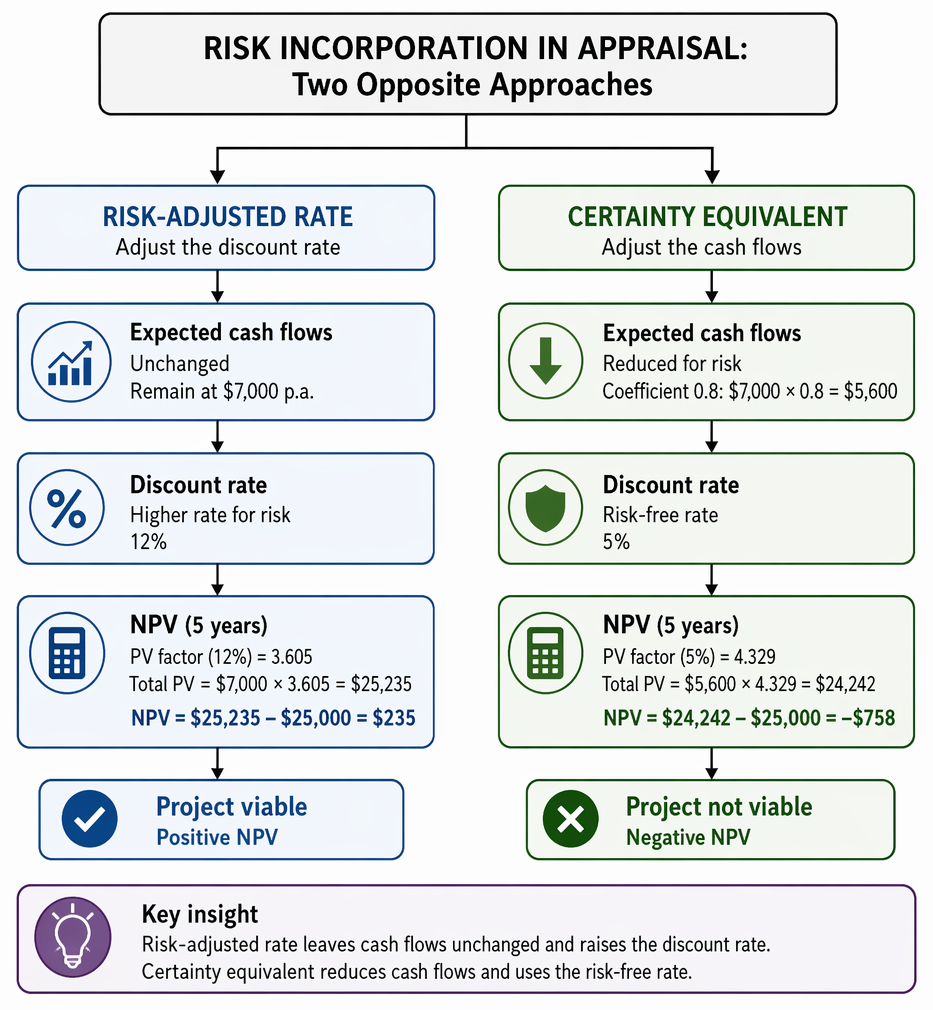
Both approaches account for risk but in opposite ways:
Risk-adjusted discount-rate appraisal maps expected cash flows, risk identification, present value calculation, initial outlay deduction, and acceptance based on positive NPV.
- Risk-adjusted rate: leaves expected cash flows unchanged; applies a higher discount rate for risk.
- Certainty equivalent: reduces expected cash flows; discounts at risk-free rate.
The certainty equivalent approach separates attitudes to risk for each period (coefficients can differ each year), offering more flexibility. It is more data intensive and subjective, but theoretically more accurate for risk-averse decision makers.
Worked Example 1.2
Project Alpha has expected annual cash inflows of $7,000 for 5 years; the initial cost is $25,000.
- (A) Using a risk-adjusted discount rate of 12%, is the project viable?
- (B) If certainty equivalent coefficients are all 0.8 and the risk-free rate is 5%, what is the NPV?
Answer:
(A) PV factor (5 years at 12%) = 3.605. Total PV = $7,000 × 3.605 = $25,235. NPV = $25,235 – $25,000 = $235. (B) Adjusted cash flows = $7,000 × 0.8 = $5,600. PV factor (5 years at 5%) = 4.329. Total PV = $5,600 × 4.329 = $24,242. NPV = $24,242 – $25,000 = –$758.
COMBINING RISK ADJUSTMENT WITH OTHER APPRAISAL TOOLS
Either method can be used alongside scenario analysis or sensitivity analysis for a fuller risk assessment.
Revision Tip: In exams, always clearly state which risk method you are using, show full workings, and justify your discount rate or certainty equivalent selection.
Summary
Risk-adjusted discount rates and certainty equivalents are two accepted ways to account for risk in investment appraisals. Risk-adjusted rates increase the rate used for discounting, lowering the value of riskier projects. Certainty equivalents directly reduce risky cash flows, which are then discounted at the risk-free rate. Both approaches have strengths and limitations—choose according to available data and the company’s risk preferences.
Key Point Checklist
This article has covered the following key knowledge points:
- Distinguish between risk-adjusted discount rates and certainty equivalents
- Calculate NPVs for both approaches using relevant discount rates and coefficients
- Explain the role of certainty equivalent coefficients in risk appraisal
- Critically discuss the advantages and drawbacks of each method
- Select and justify appropriate risk adjustment techniques in ACCA-style scenarios
Key Terms and Concepts
- risk-adjusted discount rate
- certainty equivalent
- certainty equivalent coefficient