Learning Outcomes
After reading this article, you will be able to explain the Cultural Web as a model for analysing organisational culture, define the concept of organisational mindset (schema), distinguish visible and hidden aspects of culture, and assess how shared assumptions shape daily behaviour and resistance to change. You will also be able to apply the Cultural Web to practical business situations, a skill required in the ACCA exam.
ACCA Business and Technology (BT) Syllabus
For ACCA Business and Technology (BT), you are required to understand key models of organisational culture, how culture is shaped and described, and the practical use of the Cultural Web and core mindsets in business scenarios. In particular, revision for this section should cover:
- The definition and analysis of organisational culture
- The elements of the Cultural Web: routines, rituals, stories, symbols, control systems, power structures, and organisational structure
- The concept of the organisational mindset (schema) and its effect on collective behaviour
- Identification of visible (artefacts) and invisible (assumptions and values) features of culture
- How culture can support or obstruct change and strategy implementation
Test Your Knowledge
Attempt these questions before reading this article. If you find some difficult or cannot remember the answers, look more closely at that area during your revision.
-
Which one of the following is NOT a component of the Cultural Web?
- a) Rituals
- b) Control systems
- c) Job descriptions
- d) Symbols
-
What does an organisational mindset primarily reflect?
- a) Formal job titles
- b) Standard procedures only
- c) Deeply-held assumptions and shared beliefs
- d) Visible artefacts
-
True or false? Control systems in the Cultural Web include both formal and informal monitoring.
-
Briefly describe how stories and routines can affect the way employees behave in an organisation.
Introduction
Organisational culture governs the shared beliefs, assumptions, and practices that guide how employees think and act at work. While some elements—like logos, office layout, or dress code—are easy to spot, much of culture operates invisibly, shaping behaviour through unspoken rules and common understandings.
The Cultural Web is a model used to analyse and describe culture in a structured way. At the centre of this model is the organisational mindset (also called schema): the collective, mostly unspoken, 'logic' or "the way we do things here." This shared view underpins daily routines, rituals, stories, symbols, how power is used, what is measured, and how the organisation is structured.
Key Term: Cultural Web
The Cultural Web is a framework for analysing organisational culture that identifies core elements through which culture is expressed—routines, rituals, stories, symbols, power structures, organisational structure, and control systems.
The Cultural Web: Mapping Organisational Culture
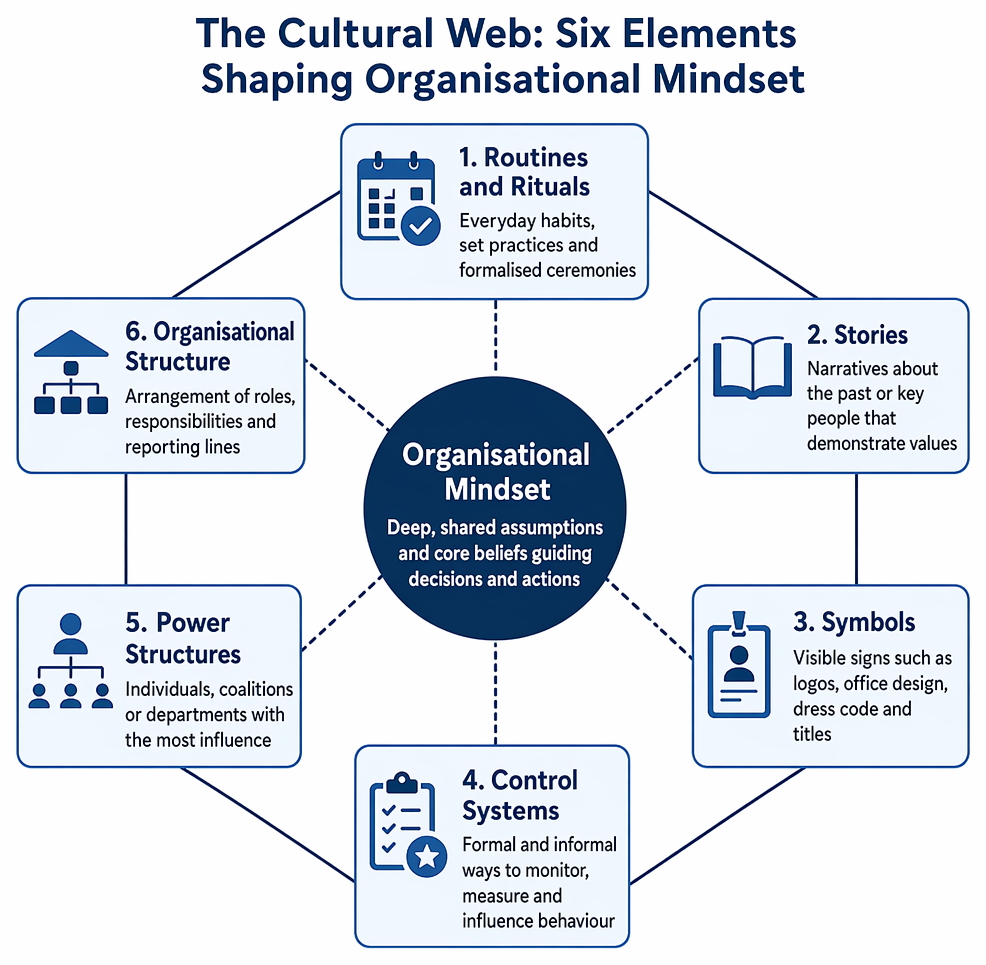
The Cultural Web model focuses on six key elements, each influencing and reflecting the organisational mindset:
Organisational culture review sequence from strategic issue definition to evidence gathering, element prioritisation, intervention design, and behavioural reinforcement.
- Routines and rituals – everyday working habits, set practices, and formalised ceremonies.
- Stories – narratives about the past or key people that demonstrate what the organisation values.
- Symbols – visible signs such as logos, office design, dress code, and titles.
- Control systems – the formal and informal ways in which performance or behaviour is monitored and rewarded.
- Power structures – the individuals, coalitions, or departments with the most influence.
- Organisational structure – how roles, responsibilities, and reporting lines are arranged.
Key Term: Artefact
A visible or tangible feature of organisational culture—such as rituals, language, symbols, or office layout—signal what is considered important. Key Term: Control system
The mechanisms (formal or informal) used to monitor, measure, and influence behaviour and performance within an organisation.
Routines and Rituals
Routine behaviours (such as how meetings are run, decision processes, or greetings) set expectations for what is normal and acceptable. Rituals include induction events, annual conferences, or performance reviews.
Stories
Frequently told stories about successes, failures, or legendary employees serve to strengthen core values and guide behaviour.
Symbols
These include external branding, dress codes, reserved parking spaces, and distinctions in offices—each symbolising status or preferred behaviours.
Power Structures
Power may be formal (senior managers) or informal (influential teams or technical experts). Where power sits determines which voices shape policy and working practices.
Organisational Structure
Hierarchies and reporting lines reflect (and affect) information flow, autonomy, and which roles are deemed important.
Control Systems
Formal controls include targets, performance appraisals, and compliance checks. Informal controls might involve peer approval or unwritten expectations.
Key Term: Organisational mindset
The set of deep, shared assumptions and core beliefs about how the organisation operates—which guide decisions and actions, often unconsciously.
The Organisational Mindset (Schema): The Core of Culture
The organisational mindset ties the Cultural Web together. It consists of the shared, taken-for-granted assumptions that determine “how things are done” and justify daily behaviour. This mindset is learned over time, strengthened through socialisation, and rarely questioned unless the organisation faces major disruption.
Key Term: Assumption
An unspoken, widely held idea or belief within an organisation that is accepted as true without explicit discussion.
Interaction between Visible and Invisible Culture
Most culture operates below the surface. While artefacts and routines are easy to notice, the real motive force is in collective assumptions, values, and the mindset itself. New policies that ignore these hidden beliefs often fail, as staff continue behaving according to the existing mindset.
Key Term: Value
A core belief or priority that shapes what is considered “the right thing to do” in an organisation.
Using the Cultural Web in Practice
Analysing the Cultural Web helps explain why some changes are accepted and others resisted, and reveals potential obstacles for new strategies.
Worked Example 1.1
Scenario: SpeedyBank wants to become more customer-focused. They introduce online chat and retrain staff, but complaints remain high. Stories still circulate about “impressing head office,” symbols of status (like exclusive lifts for executives) remain, and routines centre on daily performance targets.
Question: Which elements of the Cultural Web might be blocking customer focus?
Answer:
Routines (focus on internal targets), stories (valuing head office obsession), and symbols (status barriers) all strengthen the old mindset. Unless these are addressed, behaviour is unlikely to change.
Worked Example 1.2
Scenario: TechTeams Inc. merges with a start-up. The start-up is informal, while TechTeams has clear hierarchies and control systems. After the merger, innovation drops and key start-up staff leave.
Question: How might differences in mindsets explain this outcome?
Answer:
Start-up staff are used to autonomy and informal power structures. TechTeams’ formal controls and rigid hierarchy conflict with their assumptions. The mindset mismatch leads to loss of engagement and resignations.
Culture Change: Why Mindsets Matter
Organisational change requires more than new procedures—it often demands shifting deep assumptions and the mindset itself. If change initiatives challenge core beliefs (e.g., risk-taking in a risk-averse culture), resistance will be strong.
Key Term: Core Mindset
The overall pattern of shared, taken-for-granted assumptions—synonymous here with organisational schema. Key Term: Schema
The deeply held mental map that guides how organisational members interpret events and behave, shaping expectations around what is “normal.”
Culture and Performance: Alignment or Obstruction
When culture and strategy align, organisations find it easier to execute plans and adjust. Misalignment (e.g., a formal, control-focused culture trying to pursue creativity and innovation) leads to conflict, resistance, and failed initiatives.
Revision Tip: When using the Cultural Web, examine not only visible rituals or symbols, but also the hidden values and assumptions. Consider which elements would need to change for a new strategy to succeed.
Exam Warning: Organisational charts show formal structures, but real power may rest elsewhere. Informal influence—such as opinion leaders or long-serving staff—can override official roles.
Summary
The Cultural Web offers an effective approach for analysing the tangible and hidden elements composing organisational culture. Its focus on routines, rituals, stories, symbols, control systems, power structures, and organisational structure helps reveal the core mindset shaping collective behaviour. For successful strategy or change, both visible artefacts and deeper assumptions must be considered to avoid resistance and encourage acceptance.
Key Point Checklist
This article has covered the following key knowledge points:
- Define and explain the Cultural Web model for organisational culture
- List and describe the six core elements: routines, rituals, stories, symbols, control systems, power structures, organisational structure
- Explain the organisational mindset (schema) and its influence on behaviour
- Distinguish between artefacts, values, and assumptions
- Apply the Cultural Web to diagnose cultural barriers to change
- Assess why deep-seated assumptions and the mindset may obstruct strategic initiatives
Key Terms and Concepts
- Cultural Web
- Artefact
- Control system
- Organisational mindset
- Assumption
- Value
- Core mindset
- Schema