Learning Outcomes
After reading this article, you will be able to explain and distinguish between Handy’s four organisational culture types: power, role, task, and person. You will understand their characteristics, typical organisational settings, and effects on behaviour and performance. You should be able to identify these cultures in scenarios and evaluate their practical implications, advantages, and drawbacks for the ACCA Business and Technology (BT) exam.
ACCA Business and Technology (BT) Syllabus
For ACCA Business and Technology (BT), you are required to understand how organisational culture affects business behaviour and outcomes. You should be familiar with Handy’s four culture types and be able to compare and evaluate them for different organisational contexts. Focus your revision on:
- The definition of organisational culture and why it matters for business performance
- Handy’s four organisational culture types: power, role, task, and person cultures
- The characteristics, advantages, and disadvantages of each culture type
- The impact of culture type on communication, motivation, change, and effectiveness
- The relevance of Handy’s model for identifying and describing culture within real organisations
Test Your Knowledge
Attempt these questions before reading this article. If you find some difficult or cannot remember the answers, look more closely at that area during your revision.
- According to Handy, which culture type typically relies on a central figure or small group exercising authority?
- In which Handy culture is formal procedure and bureaucracy most likely to be found?
- State one strength and one risk associated with task culture.
- Match the following organisational features to Handy’s culture types:
- a) Emphasis on personal autonomy
- b) Clear job descriptions and rules
- c) Flexible teams focused on projects
Introduction
Every business develops a culture—a shared pattern of values, beliefs, and practices. Culture shapes how people behave, how decisions are made, and how effectively objectives are met. Charles Handy identified four main types of organisational culture: power, role, task, and person. Knowing these types enables you to spot common strengths and problems, and to suggest suitable management and structural approaches for each.
Key Term: organisational culture
The shared set of assumptions, values, and norms that guide people’s behaviour, beliefs, and interactions within an organisation.
Handy’s Four Culture Types
Handy’s model distinguishes culture types by the sources and distribution of power, rules, emphasis on tasks or people, and approaches to work.
Power Culture
Power culture is organised around a central leader or a small group—with authority closely held and personal influence key to decision making.
Features:
- Central source of power, e.g. a founder or chairperson
- Few rules and procedures; high autonomy for those close to the centre
- Decisions made quickly and often informally
- Suits small entrepreneurial businesses
Strengths:
- Fast decision making
- Clarity of direction
- Adaptable to change when leader directs
Risks:
- Dependent on strength of leader
- Lack of consultation or challenge
- Can feel arbitrary or unfair to staff not in the leader’s circle
Key Term: power culture
A culture where control and influence are concentrated around a central source; political behaviour and networking play a major role.
Role Culture
Role culture structures the business by defined rules, jobs, and procedures. Authority is delegated through official job descriptions and a clear hierarchy.
Features:
- Clear roles, responsibilities, and reporting lines
- Rules and procedures guide behaviour
- Bureaucratic; organisation charts matter
- Suits government bodies and large corporations
Strengths:
- Consistency and stability
- Role clarity helps training and performance
Risks:
- Change is slow and can meet resistance
- Innovation and initiative discouraged
- Can become inefficient and inflexible
Key Term: role culture
A culture governed by rules, policies, and formal hierarchies where authority is attached to positions rather than individuals.
Task Culture
Task culture forms around solving specific problems or delivering projects. Teams are typically cross-functional and empowered to make decisions.
Features:
- Teams formed for tasks or projects
- Authority based on specialist knowledge, not position
- Cooperation and flexibility valued
- Common in consultancies, agencies, and project-driven firms
Strengths:
- Responsive to new challenges; encourages innovation
- Strong teamwork and job satisfaction
Risks:
- May cause conflict over resources if demands overlap
- Can feel unstable if teams constantly form and disband
- Coordination problems if overall direction is unclear
Key Term: task culture
A culture built around teams or groups focused on completing tasks or projects, with authority determined by specialist knowledge.
Person Culture
Person culture places the individual at the centre. The organisation exists primarily to serve the members, not vice versa.
Features:
- Individuals control their own work and set personal goals
- Minimal hierarchy; decisions made collectively or individually
- Common in partnerships (e.g. law, accountancy) and academic settings
Strengths:
- High autonomy and self-direction
- Attracts and retains expert professionals
Risks:
- Difficult to agree collective goals or make joint decisions
- Limited growth or strategic coordination
- Organisational needs may be ignored
Key Term: person culture
A culture where individuals’ interests and autonomy take priority over organisational structures and collective objectives.
Worked Example 1.1
Question: A small creative agency has no formal job descriptions and the company’s founder makes all key decisions directly. Employee rewards depend mainly on keeping the founder happy. What type of Handy culture is this?
Answer:
This is a power culture. Authority is centralised, decisions are personal and fast, and loyalty to the founder is highly valued.
Worked Example 1.2
Question: A government department has detailed policies for every process. Promotion occurs mainly by years of service, and major changes require many approvals. Which Handy culture best fits this scenario?
Answer:
This describes a role culture, with strict rules, clear hierarchies, and a stable but bureaucratic environment.
Worked Example 1.3
Question: A biotechnology firm forms teams from R&D, marketing, and production staff to deliver new product launches. Teams are given substantial independence and dissolve once the project is complete. What culture type is this?
Answer:
Task culture—empowered, project-based teams focused on achieving specific goals, authority based on specialist knowledge.
Comparing Handy’s Culture Types
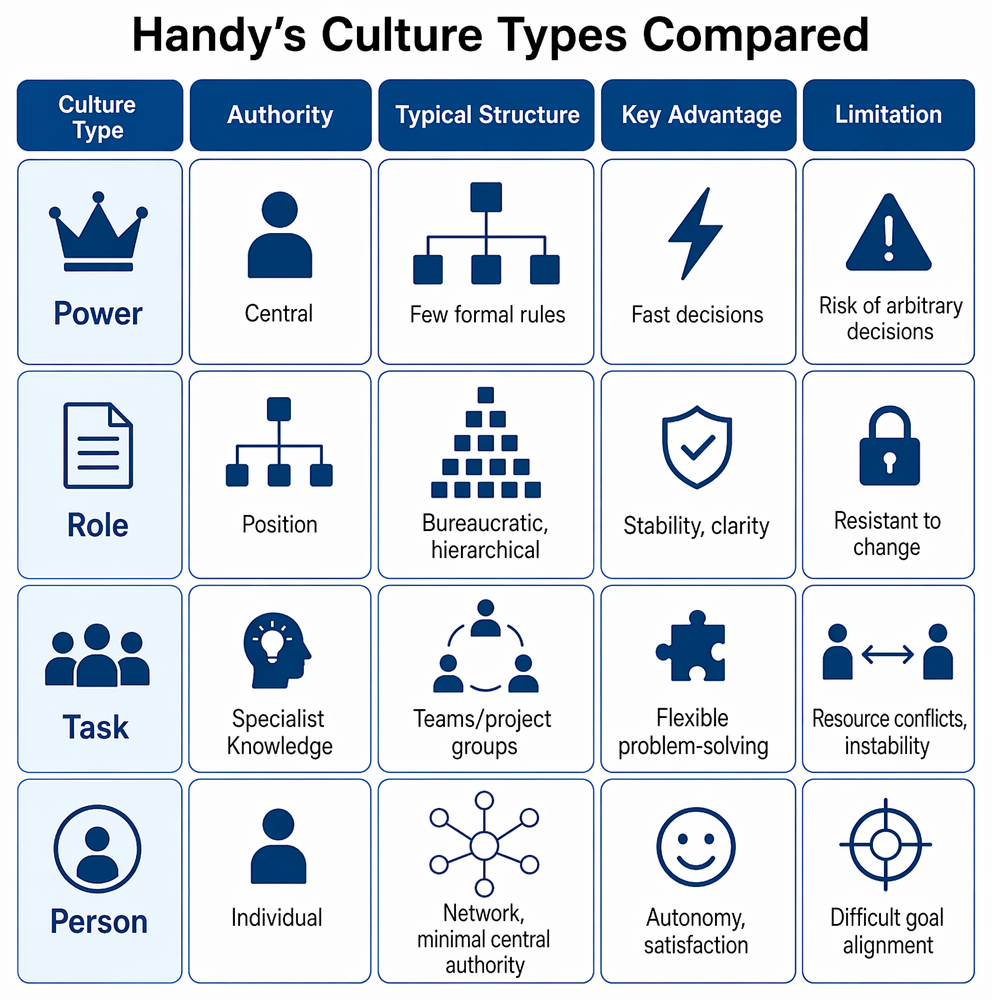
Handy's model maps scenario indicators to power, role, task, and person cultures using authority, bureaucracy, expertise, and individual priority.
| Culture Type | Authority | Typical Structure | Key Advantage | Limitation |
|---|---|---|---|---|
| Power | Central | Few formal rules | Fast decisions | Risk of arbitrary decisions |
| Role | Position | Bureaucratic, hierarchical | Stability, clarity | Resistant to change |
| Task | Specialist Knowledge | Teams/project groups | Flexible problem-solving | Resource conflicts, instability |
| Person | Individual | Network, minimal central authority | Autonomy, satisfaction | Difficult goal alignment |
Exam Warning: Handy’s culture types are ideal forms. Real organisations often show features of more than one culture. In exam scenarios, focus on the dominant feature for classification.
Revision Tip: For multiple-choice questions, match culture clues: “Central leader = power”, “rules/procedures = role”, “project teams = task”, “independent professionals = person”.
Summary
Handy’s four culture types—power, role, task, and person—offer a framework for understanding how authority, structure, and control operate in organisations. Each type brings strengths and weaknesses in areas like decision speed, adaptability, employee satisfaction, and resistance to change. Recognising these cultures helps in analysing workplace behaviour and suggesting appropriate management strategies for business effectiveness.
Key Point Checklist
This article has covered the following key knowledge points:
- Definition of organisational culture and its importance
- Handy’s four culture types: power, role, task, and person
- Features, strengths, and weaknesses of each culture
- Impact of culture on communication, motivation, and change
- Typical organisational examples for each culture type
- Application of Handy’s model to scenario analysis in exams
Key Terms and Concepts
- organisational culture
- power culture
- role culture
- task culture
- person culture