Learning Outcomes
After reading this article, you will be able to explain the differences between centralised and decentralised organisational structures, identify the advantages and disadvantages of each, and describe how span of control impacts tall versus flat organisations. You will also understand key terminology and be able to apply these principles to typical ACCA exam scenarios.
ACCA Business and Technology (BT) Syllabus
For ACCA Business and Technology (BT), you are required to understand key organisational structure concepts for effective management. This article addresses:
- Centralisation and decentralisation: definitions, benefits, drawbacks, and practical application in business
- Span of control: meaning, factors influencing span, implications for tall and flat organisational forms
- The relationship between organisational structure and decision-making efficiency
- Effects of centralisation and decentralisation on motivation, flexibility, and organisational control
Test Your Knowledge
Attempt these questions before reading this article. If you find some difficult or cannot remember the answers, look more closely at that area during your revision.
-
Which of these is a likely consequence of increased decentralisation in an organisation?
- a) Faster local decision-making
- b) Stricter uniformity in processes
- c) Reduced training needs
- d) Tighter central financial control
-
True or false? A wide span of control usually results in a flat organisational structure.
-
List two factors that might influence the optimum span of control for a manager.
-
Briefly explain one advantage and one disadvantage of centralising decision-making authority.
Introduction
Organisational effectiveness depends greatly on where decision-making authority rests and how managers oversee their teams. Deciding how centralised or decentralised to make decisions shapes the speed and suitability of business responses, while the span of control determines managerial workload, the shape of the organisation, and staff motivation. Recognising the balance between centralised efficiency and local flexibility is critical for sound business management.
Key Term: centralisation
The concentration of decision-making authority at higher levels of the organisational hierarchy. Key Term: decentralisation
The distribution of decision-making authority to lower levels in the organisational structure. Key Term: span of control
The number of subordinates who report directly to a single manager.Test Tip: When revising Centralisation decentralisation and span of control, connect each definition, method, or rule to the kind of question the assessment is likely to ask.
Centralisation
In a centralised structure, decisions are mostly made at the top or by a central team. This helps maintain strict oversight, reduce risks of inconsistent practice, and streamline processes across the business. Centralisation is often seen in organisations facing regulatory pressures or where uniformity is essential.
Advantages of Centralisation
- Uniform policies and procedures across the organisation
- Clear lines of authority and accountability
- Easier aggregation of data for strategic decisions
- Lower risk of divergent practices or conflicting objectives
Disadvantages of Centralisation
- Slower response to local conditions or issues
- May discourage initiative and motivation among lower-level staff
- Increased risk of decision overload at senior management level
- Can lead to lack of adaptation in rapidly changing environments
Worked Example 1.1
A manufacturing company operates from a single head office. All major spending, hiring, and product decisions must be signed off by the CEO. Local factory managers have little say over day-to-day purchases or adapting products for local clients.
Answer:
This company has a centralised structure. The CEO retains a narrow span of control for decision-making, providing consistent oversight but possibly slowing responses to operational issues in the factories.
Decentralisation
A decentralised structure pushes authority down the organisation, empowering division, branch, or departmental managers to make key decisions relevant to their area. This enables faster adaptation and can motivate managers by giving them ownership of results.
Advantages of Decentralisation
- Local managers can react quickly to market or customer needs
- Enhances motivation and engagement in middle and lower management
- Reduces bottlenecks caused by senior management decision delays
- Can encourage innovation and entrepreneurial thinking in divisions
Disadvantages of Decentralisation
- Risk of inconsistent policies or procedures
- Duplication of activities and resources in different parts of the business
- Potential for loss of grip by central management on strategic aims
- Training costs for less experienced managers making key decisions
Worked Example 1.2
An international retailer has different regional managers who independently decide on product ranges, prices, and marketing activities in their stores. The head office sets overall financial targets but does not intervene in local decisions.
Answer:
This retailer is decentralised. Regional managers can quickly react to local customer preferences, but may create diverging brand images or inefficiencies due to duplicated marketing efforts.
Span of Control
Span of control defines how many people report directly to each manager. It affects organisational shape (tall or flat), communication speed, and managerial workload.
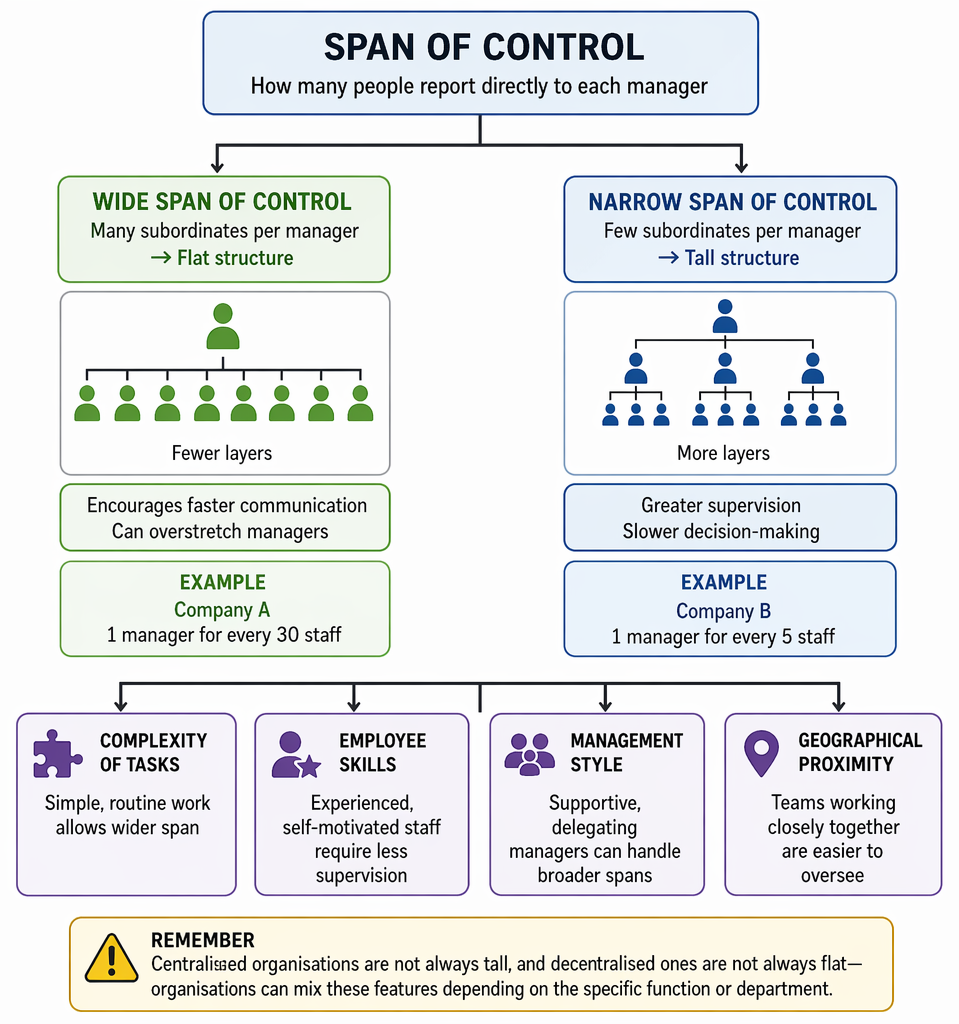
Span of control determines whether organisations are flat or tall, affecting communication speed, delegation, supervision intensity, and management-layer costs.
- Wide span of control: many subordinates per manager → flat structure
- Narrow span of control: few subordinates per manager → tall structure
Factors Affecting Span of Control
- Complexity of tasks: simple, routine work allows wider span
- Employee skills: experienced, self-motivated staff require less supervision
- Management style: supportive, delegating managers can handle broader spans
- Geographical proximity: teams working closely together are easier to oversee
Tall vs Flat Structures
Tall structure: Many management layers, narrow spans of control. Greater supervision but slower decision-making.
Flat structure: Few layers, wide spans of control. Encourages faster communication but can overstretch managers.
Worked Example 1.3
Company A’s customer support department has one manager for every 30 staff, while Company B’s department has one manager for every 5 staff.
Answer:
Company A has a wide span of control (flat structure), with each manager monitoring more staff. Company B has a narrow span (tall structure), offering more individual oversight but resulting in more management tiers.Exam Warning: Remember, centralised organisations are not always tall, and decentralised ones are not always flat—organisations can mix these features depending on the specific function or department.
Balancing Centralisation and Decentralisation
Most organisations use a combination of both, centralising decisions where consistency and control are key (e.g. finance, legal) and decentralising functions that benefit from local initiative (e.g. marketing, customer service).
When to Centralise
- Need for uniform processes
- High risk or regulation
- Cost control priorities
When to Decentralise
- Rapidly changing markets
- Diverse customer needs
- Empowering managers and innovation
Summary
Centralisation and decentralisation are two ways of structuring decision authority in organisations. Each has strengths and weaknesses, and the right approach depends on organisational size, nature of activities, and environmental complexity. Span of control shapes how managers relate to teams, affecting organisational effectiveness and staff motivation.
Key Point Checklist
This article has covered the following key knowledge points:
- Define and distinguish between centralisation and decentralisation
- List and explain benefits and drawbacks of each approach
- Describe the meaning of span of control and factors influencing it
- Recognise features of tall and flat organisational structures
- Apply understanding to identify appropriate structures for given scenarios
Key Terms and Concepts
- centralisation
- decentralisation
- span of control