Learning Outcomes
After reading this article, you will be able to explain the purpose and scope of competition policy, identify anti-competitive practices, and recognise the role of regulation in national and global markets. You will understand how market regulation balances consumer protection with efficient business activity and be able to evaluate key consequences of globalisation for competition and macroeconomic policy.
ACCA Business and Technology (BT) Syllabus
For ACCA Business and Technology (BT), you are required to understand policies and regulatory systems that affect how businesses compete in national and international markets. Focus your revision on:
- The objectives of competition policy and its impact on business conduct
- Common forms of anti-competitive behaviour (e.g. cartels, abuse of dominant position)
- The roles of regulatory bodies and legislation in shaping market practices
- How regulation affects market entry, pricing, and innovation
- The influence of globalisation on competition policy and economic regulation
- The macroeconomic significance of effective market regulation
Test Your Knowledge
Attempt these questions before reading this article. If you find some difficult or cannot remember the answers, look more closely at that area during your revision.
- What is the primary goal of competition policy in most economies?
- Which of the following actions could be considered abuse of a dominant market position?
- a) Price fixing between companies
- b) Exclusive dealing that blocks competitors
- c) Predatory pricing to drive out rivals
- d) All of the above
- Name one way globalisation can challenge the effectiveness of national competition policy.
- Briefly describe the role of a regulatory body in market regulation.
Introduction
Modern economies rely on effective competition to drive innovation, improve efficiency, and provide consumers with fair choices. However, not all market behaviour is competitive or benefits society. Competition policy and market regulation have developed to prevent and remedy anti-competitive conduct, protect consumers, and maintain trust in the economic system. In a global economy, regulatory challenges have increased, requiring coordination across borders and robust enforcement at home and abroad.
Key Term: Competition policy
Policies and laws aimed at fostering fair competition, preventing anti-competitive practices, and encouraging efficient markets to benefit consumers and businesses.Test Tip: When revising Competition policy and market regulation, connect each definition, method, or rule to the kind of question the assessment is likely to ask.
Purpose and Scope of Competition Policy
Governments implement competition policy to encourage rivalry and deter practices that restrict competition in goods and services markets. Primary objectives include preventing collusion, blocking monopolisation, and ensuring markets remain open to new entrants.
Key objectives of competition policy
- Advance consumer welfare through lower prices and choice
- Prevent abuse of economic power by dominant firms
- Support economic growth and innovation
- Encourage access to markets for new and smaller businesses
Key Term: Anti-competitive practice
Business actions that restrict or distort competition, such as price fixing, market sharing, bid rigging, or unfair exclusion of competitors.
Forms of Anti-Competitive Behaviour
Most competition policy focuses on identifying and addressing types of conduct that harm market outcomes. Typical anti-competitive behaviour includes:
-
Collusion and Cartels: Agreements between firms to fix prices, allocate markets, or control output.
-
Abuse of Dominance: Companies with substantial market power may exploit their position, e.g., through predatory pricing (deliberate low prices to eliminate rivals), exclusive supply contracts, or refusing access to essential facilities.
-
Mergers and Acquisitions: Transactions that reduce the number of major players and may lead to excessive concentration of economic power.
Key Term: Abuse of dominant position
When a business with substantial market power uses it to prevent competition, limit consumer choice, or unfairly disadvantage competitors.
Worked Example 1.1
Question: A national telecommunications company controls 85% of the market and starts offering below-cost prices in regions targeted by a new competitor. Is this action a possible abuse of dominance?
Answer:
Yes. Selling below cost to eliminate a competitor is a classic form of predatory pricing and may be investigated as abuse of a dominant position by regulators.
Regulatory Frameworks and Enforcement
Market regulation applies rules and oversight to ensure that competition policy objectives are met. Regulation can take many forms:
- Legislation (e.g., laws against cartels)
- Regulatory authorities with investigative and enforcement powers
- Market access rules (e.g., licensing, transparency requirements)
National authorities and sometimes supranational bodies (e.g., the European Commission) oversee enforcement. Penalties for infringement can include substantial fines, unwinding of mergers, or orders to change business conduct.
Key Term: Regulatory body
An organisation established by government to monitor, supervise, and enforce rules in specific sectors or markets.
Worked Example 1.2
Question: A group of construction firms are found to have secretly agreed not to compete with each other when bidding for public contracts. What regulatory response is likely?
Answer:
The regulatory body would likely investigate, and if collusion is proven, impose fines and prohibit the firms from future collusive practices.Exam Warning: Collusive agreements need not be written to be illegal—oral or even implicit arrangements can breach competition law.
Impact of Regulation on Markets
Regulation affects businesses by setting standards, controlling entry, monitoring pricing, and shaping competitive strategies.
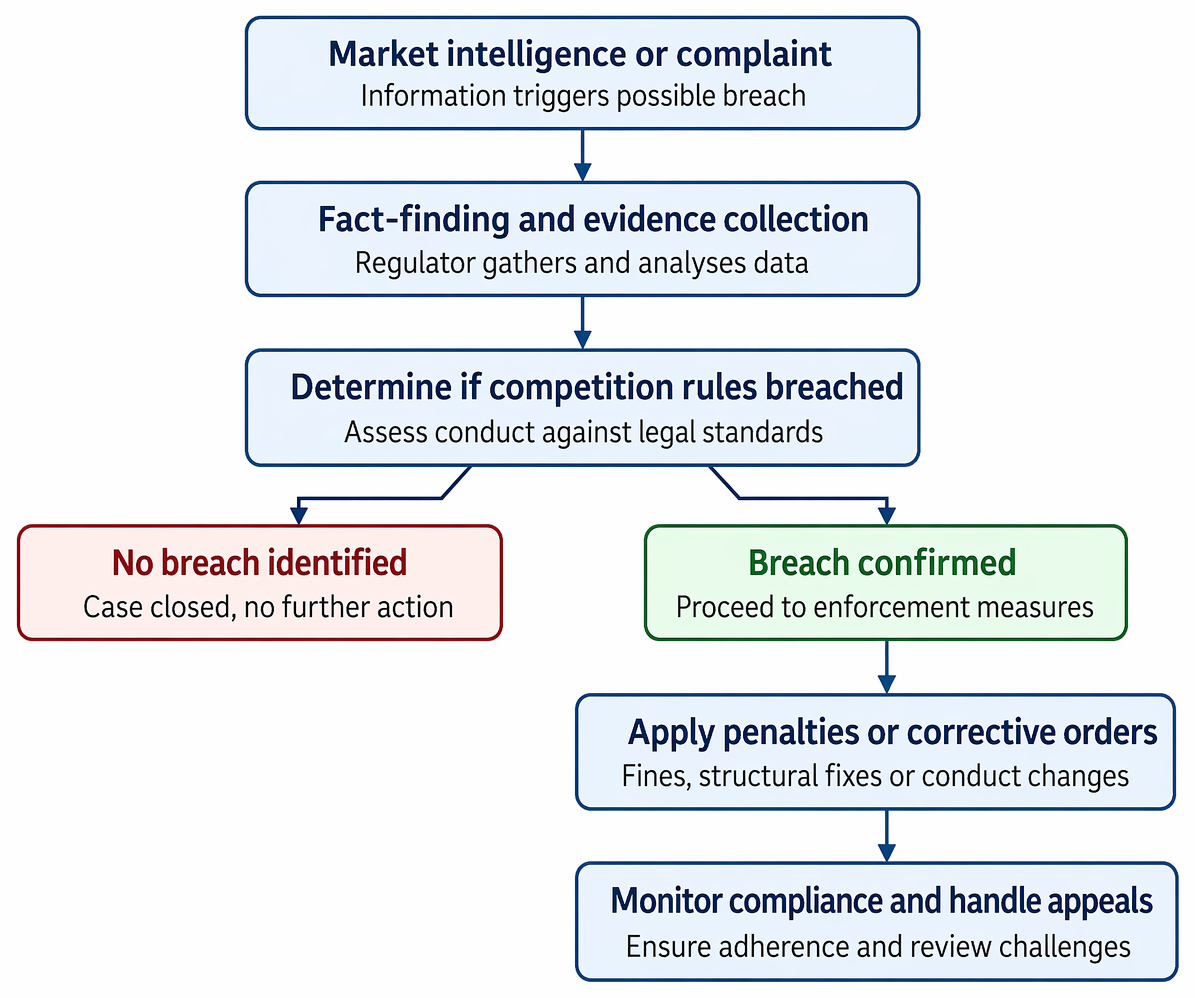
Competition law enforcement sequence showing initiation, evidence gathering, decision on infringement, regulatory sanctions or structural remedies, and subsequent oversight.
- Price controls may prevent excessive charges in essential services (e.g., utilities).
- Market access rules encourage diversity and reduce barriers to new providers.
- Transparency obligations help prevent misleading or deceptive conduct.
Over-regulation, however, can stifle innovation and impose high costs, so achieving the right balance is key.
Globalisation and Cross-Border Regulation
Globalisation means businesses and competition increasingly cross national borders. This creates challenges such as:
- Multinational firms operating in several regulatory environments
- Anti-competitive behaviour by foreign companies affecting domestic markets
- Coordinating enforcement across jurisdictions
Many countries cooperate through international agreements or set up cross-border information sharing to improve enforcement.
Key Term: Globalisation
The increasing interconnection of global economies, where goods, services, capital, and businesses operate beyond national borders.
Worked Example 1.3
Question: A global tech platform is accused by several countries of using its size to prevent local startups from succeeding. National regulators struggle to enforce penalties. What risk does this pose for effective competition policy?
Answer:
Without international cooperation or harmonised enforcement, multinational firms may escape effective oversight, undermining national competition policy.
Macroeconomic Effects of Effective Market Regulation
Robust competition policy strengthens markets, encouraging productivity and investment. Benefits can include:
- Greater economic efficiency and growth
- Lower inflation due to competitive pricing
- Higher employment as new businesses can enter and expand
Conversely, weak regulation risks monopoly power, reduced consumer welfare, and economic inefficiency.
Summary
Competition policy and market regulation are essential in shaping fair, efficient markets that benefit both consumers and businesses. Effective enforcement prevents abuses, supports innovation, and fosters growth. In a global economy, cross-border cooperation and adaptive policymaking ensure that competition remains robust and markets stay trustworthy.
Key Point Checklist
This article has covered the following key knowledge points:
- The aims and benefits of competition policy
- Main forms of anti-competitive practices (cartels, abuse of dominance)
- Role, powers, and functions of regulatory bodies in market oversight
- Effects of regulation on market operation and business strategy
- How globalisation challenges the reach and enforcement of regulation
- The macroeconomic impact of effective market regulation
Key Terms and Concepts
- Competition policy
- Anti-competitive practice
- Abuse of dominant position
- Regulatory body
- Globalisation