Learning Outcomes
After reading this article, you will be able to explain how global regulation and macroeconomic policy affect businesses. You will understand the key goals of fiscal and monetary policies, the main tools governments use to influence economic activity, and how these measures impact inflation, employment, and growth. You will be able to distinguish between expansionary and contractionary policies and identify their consequences for individuals and organisations.
ACCA Business and Technology (BT) Syllabus
For ACCA Business and Technology (BT), you are required to understand how regulation and macroeconomics influence business operations, particularly in a global context. Focus your revision on:
- The objectives and types of macroeconomic policy: fiscal and monetary
- The instruments used by governments to manage the economy, including taxation, government spending, and interest rates
- The impact of regulation and global economic forces on business activity
- The effects of fiscal and monetary measures on inflation, employment, and economic growth
- The distinction between expansionary and contractionary economic policies
Test Your Knowledge
Attempt these questions before reading this article. If you find some difficult or cannot remember the answers, look more closely at that area during your revision.
- What are the main objectives of government macroeconomic policy?
- Name two tools used in fiscal policy and two in monetary policy.
- State whether the following policy is expansionary or contractionary: a government increases income tax rates.
- How does an increase in the central bank's interest rate typically affect consumer spending and business investment?
- Briefly describe one effect of global economic regulation on international business.
Introduction
Modern economies operate in a regulated environment shaped by both national governments and international bodies. Regulation aims to control business practices, encourage fair competition, and protect economic stability. At the same time, governments use macroeconomic policies—fiscal and monetary—to manage the overall performance of their economies, particularly within an interconnected global system.
Regulatory frameworks increasingly extend beyond borders, requiring businesses to adjust to standards set by international organisations as well as national laws. Macroeconomic policy, on the other hand, involves decisions affecting the level of economic activity, the stability of prices, and employment levels.
Key Term: regulation
Rules, standards, and laws established by governments or international bodies to govern economic and business activities and ensure orderly markets.Test Tip: When revising Fiscal and monetary policy basics, connect each definition, method, or rule to the kind of question the assessment is likely to ask.
Exam Warning: Do not rely on keyword recognition alone; check the precise condition, exception, calculation step, or evidence the question requires.
Globalization and Economic Regulation
The globalisation of business has led to increased cross-border trade, financial flows, and investments. As a result, international organisations—such as the World Trade Organization (WTO), International Monetary Fund (IMF), and supranational bodies like the European Union—set regulations that affect companies operating across different jurisdictions.
Businesses must comply with a range of legal and regulatory requirements, from competition law and anti-money laundering rules to environmental standards.
Key Term: globalization
The process whereby national economies become interconnected, leading to increased trade, investment, and regulatory harmonisation worldwide.
Macroeconomic Policy: Overview
Macroeconomic policy refers to government actions aimed at managing the performance and stability of the whole economy. The two main types are fiscal policy and monetary policy.
Key Term: macroeconomic policy
A set of strategies and instruments used by a government or central authority to influence the overall level of economic activity, growth, inflation, and employment.
Policy Objectives
Governments generally pursue four key macroeconomic objectives:
- Economic growth—stimulating an increase in the production of goods and services
- Full employment—ensuring that as many people as possible who wish to work can find jobs
- Price stability—avoiding rapid inflation or deflation
- Balance of payments equilibrium—achieving a sustainable relationship between exports and imports
Fiscal Policy
Fiscal policy involves government decisions on taxation and public spending to affect overall economic activity.
Key Term: fiscal policy
The use of government expenditure and revenue collection (mainly taxes) to control economic activity, manage demand, and pursue macroeconomic objectives.
Tools of Fiscal Policy
- Government Spending: Direct expenditure on goods and services, infrastructure, welfare, and investment.
- Taxation: Taxes on income, profits, goods, and services influence disposable incomes and business costs.
Expansionary vs. Contractionary Fiscal Policy
- Expansionary fiscal policy: Involves reducing taxes or increasing public spending, aimed at boosting economic activity, usually during periods of low growth or recession.
- Contractionary fiscal policy: Entails increasing taxes or cutting public spending to slow down an overheating economy and control inflation.
Worked Example 1.1
Question: A government increases its investment in national infrastructure and cuts personal income taxes. What type of fiscal policy is this, and what outcome is it likely to achieve?
Answer:
This is expansionary fiscal policy. It aims to stimulate economic growth and reduce unemployment by raising demand.
Monetary Policy
Monetary policy is the control of a country's money supply and interest rates by a central bank or monetary authority to influence economic activity.
Key Term: monetary policy
The process by which a central bank manages the money supply and interest rates to influence inflation, economic growth, and employment levels.
Main Instruments
- Interest Rates: Central banks can raise or lower base interest rates, affecting borrowing and spending.
- Money Supply: Actions such as quantitative easing (buying financial assets to inject money into the economy) or open market operations.
- Reserve Requirements: The percentage of deposits banks must hold as reserves, influencing their ability to lend.
Expansionary vs. Contractionary Monetary Policy
- Expansionary monetary policy: Lowering interest rates or increasing the money supply to encourage lending, investment, and spending.
- Contractionary monetary policy: Raising interest rates or reducing the money supply to dampen demand and control inflation.
Worked Example 1.2
The central bank raises its policy interest rate from 2% to 4%. What are the likely effects on borrowing and inflation?
Answer:
Borrowing will become more expensive, reducing demand in the economy. This typically slows inflation but may also reduce economic growth.
Policy Impact on Business and Households
Fiscal and monetary policy directly affect the commercial environment:
- Lower interest rates can stimulate borrowing and investment but may lead to higher inflation.
- Government spending boosts demand for goods and services but may lead to higher public debt if not matched by revenues.
- Changes in tax rates alter consumer spending and corporate profitability.
Worked Example 1.3
Question: A country reduces corporate tax rates while maintaining strict monetary policy with high interest rates. How might this combination influence businesses?
Answer:
Lower corporate taxes improve profitability, but high interest rates make financing more costly, potentially limiting new investment.
Economic Cycles and Policy Responses
Economic activity fluctuates in cycles of growth (booms) and contraction (recessions or slumps). Governments use fiscal and monetary tools to smooth out extremes in these cycles.
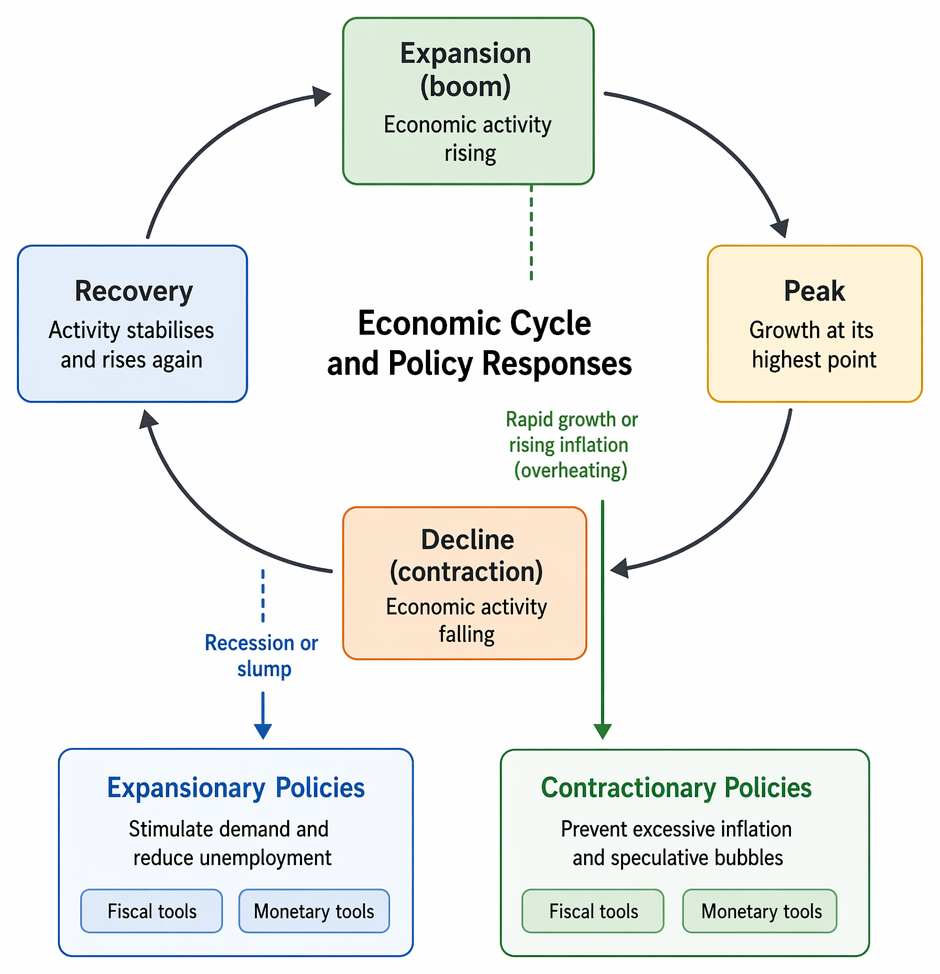
Fiscal policy responses allocate spending increases and tax cuts to weak activity, and spending cuts and tax rises to inflation control.
During a recession, expansionary policies may be used to stimulate demand and reduce unemployment. In periods of rapid growth and rising inflation (overheating), contractionary policies help prevent excessive inflation and speculative bubbles.
Key Term: economic cycle
The recurring pattern of expansion and contraction in overall economic activity, including periods of growth, peak, decline, and recovery.
Global Challenges and Coordination
Globalization means that economic shocks, inflation, and regulatory issues can quickly spread between countries. International coordination of fiscal and monetary measures is increasingly common to maintain economic stability, particularly during global crises.
Regulatory convergence—such as adoption of international financial reporting standards or coordinated banking rules—aims to reduce risks and facilitate cross-border business.
Summary
Regulation and macroeconomic policy shape the environment in which businesses operate. Fiscal and monetary policy are essential tools for stabilising economies, managing growth, and controlling inflation and unemployment. As economies become more global, regulatory harmonisation and coordinated policy responses are increasingly important for maintaining business confidence and market stability.
Key Point Checklist
This article has covered the following key knowledge points:
- Explain the meaning of regulation and globalization in a business and macroeconomic context
- List the main objectives of macroeconomic policy and the instruments of fiscal and monetary policy
- Distinguish between expansionary and contractionary policy
- Identify the business impacts of fiscal and monetary measures
- Explain the importance of global regulation and policy coordination in a connected economy
Key Terms and Concepts
- regulation
- globalization
- macroeconomic policy
- fiscal policy
- monetary policy
- economic cycle