Learning Outcomes
After reading this article, you will be able to explain how new systems are introduced in an organisation, describe the main steps of system implementation, and identify the key purposes and methods of user training. You will understand the concept of resistance to change and be able to outline the principles and practical techniques of change management in supporting successful system adoption.
ACCA Business and Technology (BT) Syllabus
For ACCA Business and Technology (BT), you are required to understand the process of systems implementation and how to ensure a smooth transition to new ways of working. In your revision, focus particularly on:
- The key activities involved in implementing new or changed systems
- The main types and purposes of user training during systems change
- The barriers to effective implementation, including staff resistance
- The concept and strategies of change management during systems development and change
- The relationship between system changes and organisational behaviour
Test Your Knowledge
Attempt these questions before reading this article. If you find some difficult or cannot remember the answers, look more closely at that area during your revision.
- What are two essential activities in the implementation of a new information system?
- Why is staff training necessary when rolling out a new business system?
- Name one typical reason for employee resistance when introducing a new process, and suggest a solution.
- True or false? Change management only concerns the technical aspects of a system upgrade.
Introduction
Implementing a new system is more than a technical project—it affects people, processes, and the daily operation of an organisation. Success relies on proper planning, effective user training, and careful management of the transition. Managing resistance and helping staff accept new ways of working are as important as meeting technical requirements.
Test Tip: When revising Implementation training and change management, connect each definition, method, or rule to the kind of question the assessment is likely to ask.
SYSTEM IMPLEMENTATION
After designing and developing a new system, the next step is implementation—making the system operational and integrating it into the business.
Main activities in system implementation
- Planning the transition from old to new processes or software
- Installing hardware, software, and infrastructure as required
- Migrating or converting existing data to the new system
- Conducting thorough system testing under real conditions
- Establishing procedures for backups and security
- Supporting users and monitoring initial operations for issues
Key Term: implementation
The stage of introducing and making operational a new or changed system within an organisation, ensuring it is fully functional.
Careful scheduling is required so that business disruption is minimised. Many organisations choose to implement new systems during periods of lower activity or use phased approaches.
USER TRAINING FOR SYSTEMS CHANGE
Training ensures users can work confidently and accurately with the new system. Even the best-designed software or processes will fail if users do not know how to operate them or misunderstand new procedures.
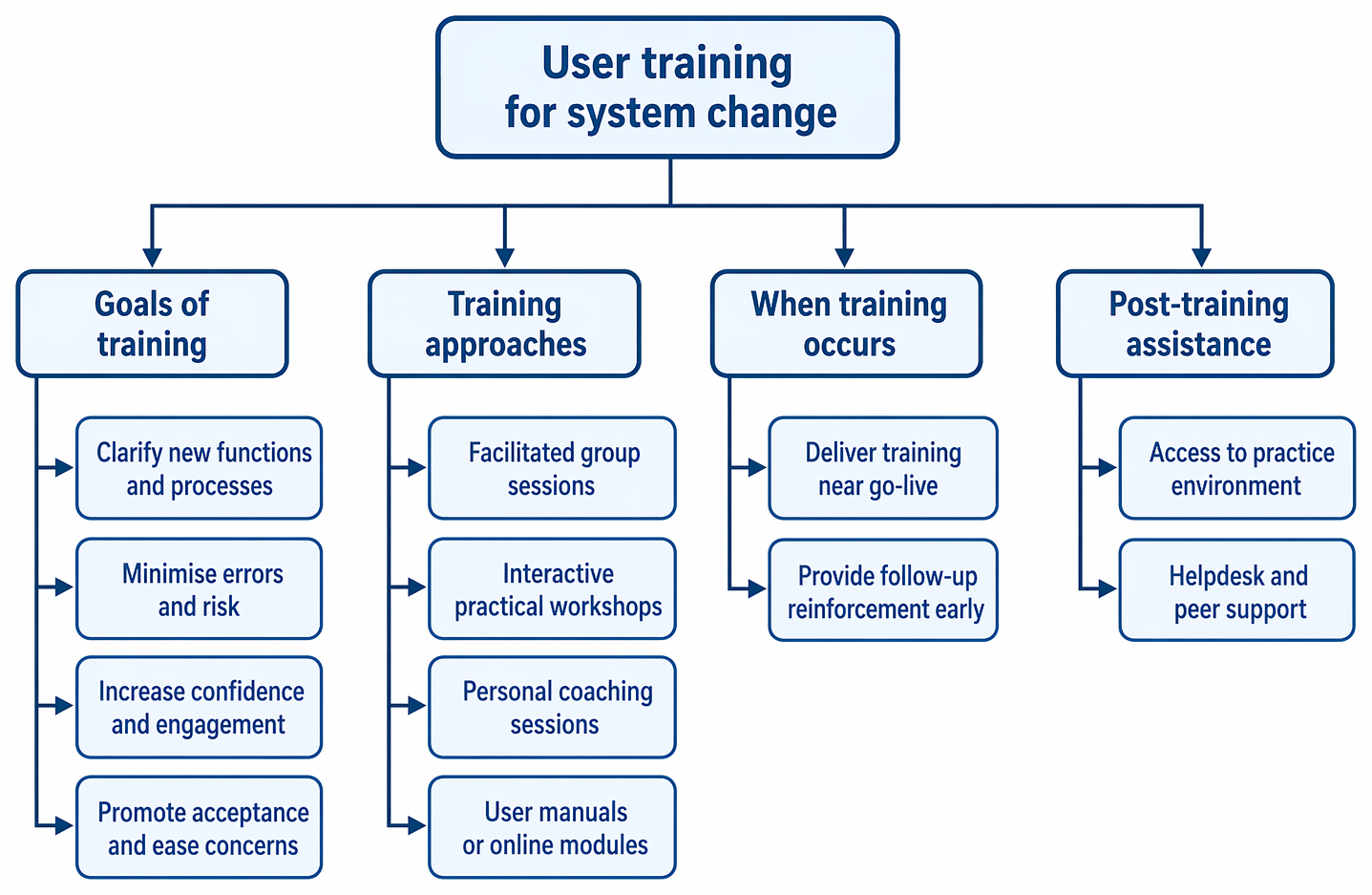
User training for system implementation groups objectives, training formats, launch timing, and post-launch support to facilitate accurate and confident adoption.
Purposes of user training
- Explaining new system features and workflows
- Reducing mistakes and operational risk
- Boosting user confidence and motivation
- Encouraging acceptance and reducing anxiety
Effective training programmes consider the range of users, from technical support staff to end-users with varying levels of experience.
Key Term: user training
A structured process to teach employees how to use new or modified systems, enabling effective and error-free operation.
Training methods
- Instructor-led group sessions (either face-to-face or live online)
- Hands-on workshops using a practice version of the system
- One-to-one coaching for key roles
- Step-by-step written guides or e-learning modules
Scheduling training close to the system launch helps retention and confidence. Ongoing support during the early stages reinforces learning.
Worked Example 1.1
Question: ABC Ltd is deploying a new accounting system across its branches. How can management make sure every finance team member is ready to use the system?
Answer:
Management should arrange structured group training sessions featuring demonstrations and supervised practice. They should distribute clear written instructions, allow access to a training environment before launch, and offer onsite assistance when the system goes live.
ADDRESSING BARRIERS TO IMPLEMENTATION
Successful implementation is often challenged by a range of barriers. Anticipating and addressing these can reduce project risk.
Common barriers
- Staff resistance due to apprehension, confusion, or fear of redundancy
- Inadequate communication about the need and benefits of the new system
- Insufficient skills or confidence following poor or limited training
- Technical faults delaying or disrupting operations
Key Term: resistance to change
The reluctance or refusal by individuals or groups to support or adjust to new systems, procedures, or ways of working. Key Term: change management
The structured approach to preparing, supporting, and guiding individuals and teams through organisational changes.
Typical reasons for resistance include job security fears, lack of involvement in decision-making, and perceived increase in workload.
Managing resistance
- Explain why the change is necessary and how it benefits users and the organisation
- Involve key staff early in discussions and testing
- Encourage questions, listen to concerns, and clearly address them
- Provide reassurance and support during the transition period
Worked Example 1.2
The IT department introduces a new helpdesk ticket system, but staff are hesitant to use it. What practical steps could reduce resistance?
Answer:
IT should demonstrate the new system and its advantages, offer comprehensive training, involve representatives from affected departments in pilots, respond to staff feedback, and provide accessible help during rollout.
PRINCIPLES OF CHANGE MANAGEMENT
Change management seeks to ensure that transitions—such as switching to a new system—deliver expected benefits with minimal disruption and opposition.
Key principles include:
- Open, consistent communication about the change and what to expect
- Early involvement of staff at all levels, encouraging ownership of the system
- Assessment of potential issues and targeted actions to prevent or resolve them
- Providing support resources such as peer mentors, helpdesks, or FAQs
- Monitoring implementation progress and adjusting plans if unexpected issues arise
Change management techniques
- Pilot testing: Introducing the system in one department or with a small group before wider adoption allows problems to be identified and solved early.
- Phased implementation: Staggering the rollout over time (e.g., by department or site) reduces risk and learning pressure.
- Parallel running: Operating old and new systems simultaneously for a set period maintains business continuity during the switchover.
Worked Example 1.3
Question: J Smith Retail is switching from manual inventory records to a digital system. Staff are worried about making mistakes. What can management do to support staff and ensure a smooth transition?
Answer:
Management should provide reassurance that errors made during training will not be penalised, arrange demonstration sessions with opportunity for practice, assign experienced staff as points of contact, and clearly communicate where help or clarification can be obtained.Exam Warning: Be prepared to distinguish between user training (teaching staff how to use new systems) and change management (preparing people and processes for change, encouraging acceptance, and addressing resistance). Proficiency in both is required for effective implementation.
Summary
Introducing a new system requires detailed planning, a focus on both technical and human factors, and careful management of the transition. Staff training is essential to reduce errors and increase user confidence. Anticipating and mitigating resistance—through communication, involvement, and support—greatly improves the likelihood of successful system change.
Key Point Checklist
This article has covered the following key knowledge points:
- The main steps and activities in system implementation
- The role, objectives, and methods of user training
- Typical barriers to successful implementation, with approaches to overcome them
- The nature of resistance to change and strategies to reduce it
- Key principles and techniques of effective change management in systems development
Key Terms and Concepts
- implementation
- user training
- resistance to change
- change management