Learning Outcomes
After reading this article, you will be able to explain how transactions move from source documents into day books and then into ledger accounts using double-entry. You will be able to describe the general ledger, receivables ledger and payables ledger, and how balances are produced. You will also be able to prepare and interpret a trial balance report, state what it checks (and what it cannot check), and describe how system reports support checking and an audit trail.
ACCA Recording Financial Transactions (FA1) Syllabus
For ACCA Recording Financial Transactions (FA1), you must understand...
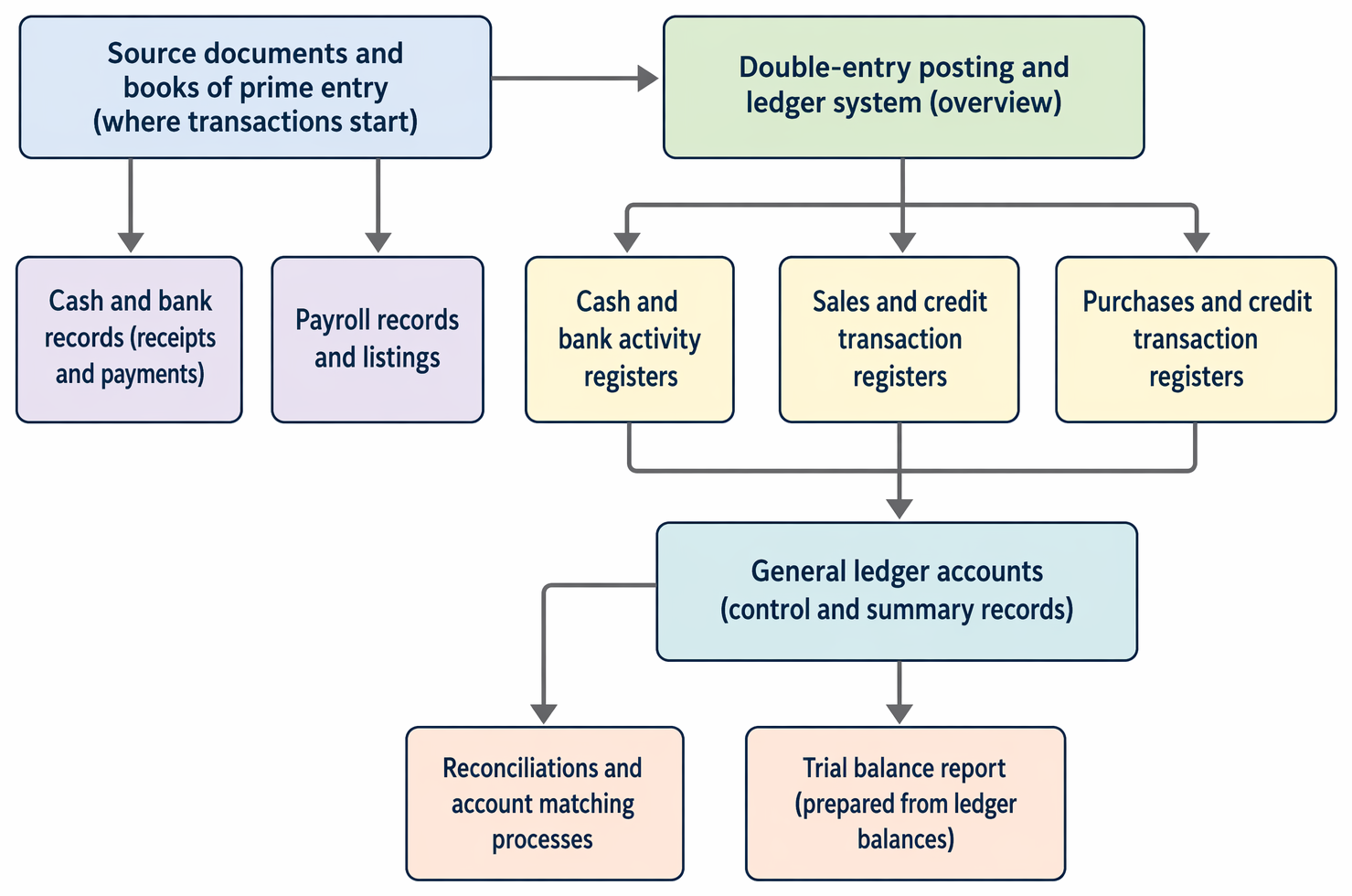
Posting sequence links coded documents, books of prime entry, general ledger totals, subsidiary ledgers, and trial balance balances for audit tracing.
- how documents are coded and entered into an accounting system for posting to accounts
- how transactions move from books of prime entry (day books) into the double-entry system
- the purpose and structure of general ledger accounts and how balances are carried forward
- the role of receivables and payables ledgers and their link to general ledger control accounts
- how to extract an initial trial balance and what it does (and does not) prove
- how computerised systems produce reports that support checking and tracing transactions
Test Your Knowledge
Attempt these questions before reading this article. If you find some difficult or cannot remember the answers, look more closely at that area during your revision.
-
Which record is primarily a chronological listing that supports posting to the ledger?
- A. Trial balance
- B. Day book (book of prime entry)
- C. Statement of account
- D. Statement of financial position
-
True or false? The trial balance includes the balances on each individual customer’s account from the receivables ledger.
-
A credit purchase invoice for £960 (including sales tax at 20%) is entered correctly. State the three general ledger accounts that would normally be affected.
-
Which statement best describes a trial balance?
- A. A part of the double-entry system that records every transaction
- B. A report that lists general ledger balances as debit or credit totals
- C. A list of unpaid supplier invoices only
- D. A report that proves there are no errors in the ledger
Introduction
In FA1, many questions test whether you can follow the “paper trail” (or screen trail) from a business document to the accounting entries, and then to reports. This is not only about doing the double-entry correctly; it is also about knowing where the entry first appears and how it is later summarised.
Day books, ledgers and the trial balance sit in a simple chain: transactions are captured in date order, summarised by account, and then listed as balances in a report. If you can trace that chain forwards and backwards, you can answer most system and reporting questions quickly and accurately.
Day books and source documents (where entries begin)
Key Term: Source document
A document that provides evidence of a transaction and supports the accounting entry (for example, an invoice, credit note, bank receipt listing or payroll summary). Key Term: Day book (book of prime entry)
A record where transactions are first captured in date order before being posted to ledger accounts.
A day book is not the same as a ledger account. Day books list transactions of a similar type (for example, all sales invoices) in date order. Ledgers then summarise those transactions by account (for example, “Sales”, “Trade receivables”, “Rent expense”).
Common day books you should recognise
In exam questions, day books may be described as “lists”, “registers”, or “modules” in accounting software. Typical day books include:
- Sales day book: sales invoices issued (credit sales)
- Purchases day book: supplier invoices received (credit purchases)
- Sales returns day book: credit notes issued to customers
- Purchases returns day book: supplier credit notes received
- Cash book / bank receipts and payments listings: money in and out
- Petty cash record: small cash payments
- Journal: entries that do not fit the standard day books (corrections, accrual-type adjustments in later studies, reclassifications)
Coding and references (the start of the audit trail)
A source document is normally coded with:
- date, document number, customer/supplier details
- amount (and sales tax split where relevant)
- general ledger account codes (often at least two accounts, sometimes three when sales tax applies)
Those codes and references matter because they let you trace from a ledger entry back to the exact invoice or credit note that created it.
Ledgers (where double-entry is stored and totals are built)
Key Term: General ledger
The complete set of ledger accounts used to record assets, liabilities, capital, income and expenses; it is the main record used to produce the trial balance. Key Term: Receivables ledger
A listing of individual customer accounts showing amounts owed and payments received; in many systems it is treated as a memorandum record supported by the general ledger. Key Term: Payables ledger
A listing of individual supplier accounts showing amounts owed and payments made; in many systems it is treated as a memorandum record supported by the general ledger. Key Term: Control account
A general ledger account that summarises a set of related detailed accounts, such as total trade receivables or total trade payables. Key Term: Memorandum account
A record kept for detailed monitoring and control that does not form part of the double-entry system totals (for example, individual customer or supplier accounts in some computerised systems).
General ledger vs “personal” ledgers
For FA1, the key idea is:
- The general ledger contains the double-entry totals used for the trial balance (assets, liabilities, capital, income and expenses).
- The receivables and payables ledgers store detail by customer and supplier for credit control and payment planning.
- The trade receivables and trade payables accounts in the general ledger act as control accounts (summary totals).
Balancing ledger accounts (why “b/d” and “c/d” appear)
At a period end, each ledger account is balanced to find the closing balance. In manual form, you total both sides and insert:
- Balance c/d (carried down) to make totals agree
- then Balance b/d (brought down) as the opening balance next period
In computerised systems this is usually automatic, but the exam still expects you to understand what the balance represents (debit for many assets/expenses; credit for many liabilities/income/capital).
Posting routes and the audit trail (how you trace transactions)
Key Term: Audit trail
The ability to trace a figure from a report back through the ledgers to the original source document, and to trace forwards from the document to the final reports.
A good audit trail answers two exam-style questions:
- “Where did this trial balance figure come from?”
- “If I start with this invoice, where will it appear in the accounts?”
Typical posting routes you should learn
Credit sale
- Source document: sales invoice
- Day book: sales day book
- Postings:
- Customer account in receivables ledger (detail)
- General ledger: trade receivables control, sales, and sales tax (if used)
Credit purchase
- Source document: supplier invoice
- Day book: purchases day book
- Postings:
- Supplier account in payables ledger (detail)
- General ledger: purchases/expense/non-current asset, trade payables control, and input sales tax (if used)
Cash/bank receipt
- Source document: remittance information/bank receipt listing
- Day book: cash book (receipts)
- Postings:
- General ledger: cash at bank and (for example) trade receivables control
Worked Example 1.1
On 10 June, a business issues Sales Invoice SI104 to a credit customer for £1,000 plus sales tax at 20%. The invoice is coded:
- Sales £1,000
- Sales tax (output) £200
- Trade receivables £1,200 (gross)
Answer:
Day book entry (sales day book): SI104 net £1,000, tax £200, gross £1,200. General ledger double-entry:
- Debit Trade receivables (control) £1,200
- Credit Sales £1,000
- Credit Sales tax payable (output tax) £200 Receivables ledger: customer account is debited £1,200 as the amount now owed.
Trial balance reports (what they show and what they prove)
Key Term: Trial balance
A report listing all general ledger account balances at a point in time, shown as debit or credit balances, where total debits should equal total credits.
A trial balance is a report produced from the general ledger balances. In many exam questions, it is produced “as at” a date (month end or year end). In a computerised system, it can usually be printed at any time.
What the trial balance checks
If double-entry has been processed with equal debits and credits, then:
If the totals do not agree (in a manual setting), it suggests an arithmetical posting error, omission of a balance from the listing, or a one-sided entry.
What is included (and excluded)
- Included: general ledger balances (assets, liabilities, capital, income, expenses)
- Excluded: memorandum records such as individual customer and supplier accounts (in many systems), because the trial balance is produced from double-entry totals only
Worked Example 1.2
A business has these general ledger balances at 31 July:
- Cash at bank £4,900 Dr
- Trade receivables £1,200 Dr
- Purchases £2,700 Dr
- Rent expense £400 Dr
- Sales £3,800 Cr
- Trade payables £900 Cr
- Capital £4,500 Cr
Prepare the trial balance totals.
Answer:
Account Debit (£) Credit (£) Cash at bank 4,900 Trade receivables 1,200 Purchases 2,700 Rent expense 400 Sales 3,800 Trade payables 900 Capital 4,500 Total 9,200 9,200 The trial balance agrees because the debit and credit totals match. Exam Warning: A balanced trial balance does not prove the accounts are correct. For example, posting to the wrong account (right value, wrong place) can still leave the trial balance totals equal.
Reports produced by the accounting system (and how they support checking)
A computerised system can produce many reports from the same stored postings and references. Common examples include:
- Aged receivables analysis (who owes money and how long it is overdue)
- Aged payables analysis (what is owed to suppliers and when it is due)
- Customer statements of account (summary sent to a customer)
- Transaction listings (for example, all sales invoices entered today)
- Registers (for example, a list of non-current assets)
- Payment due listings (supporting payment runs)
- Payroll summaries and payslips
- Inventory movement/usage summaries
Each report is stronger when it includes clear references (document number, batch number, customer/supplier code, date/time, user ID). Those references allow you to trace amounts from reports back to postings and then back to source documents.
Revision Tip: Practise tracing in both directions:
- Forward: invoice → day book listing → ledger postings → trial balance line
- Backward: trial balance line → ledger account entries → day book listing → source document
Key Point Checklist
This article has covered the following key knowledge points:
- day books record similar transactions in date order, supported by source documents
- ledgers summarise transactions by account and store the double-entry totals
- receivables and payables ledgers store detail by customer/supplier and link to control accounts
- coding and references on documents support tracing and checking
- a trial balance lists general ledger balances as debit or credit, and totals should agree
- the trial balance is a report and does not include memorandum-only records
- a balanced trial balance does not guarantee that all postings are correct
- system reports (aged analyses, statements, listings) support control and tracing
Key Terms and Concepts
- Source document
- Day book (book of prime entry)
- General ledger
- Receivables ledger
- Payables ledger
- Control account
- Memorandum account
- Audit trail
- Trial balance