Learning Outcomes
After reading this article, you will be able to define compensating errors, recognise how they occur in bookkeeping, explain why the trial balance may still balance despite the presence of these errors, and apply the concept to typical double-entry examples. You will also distinguish compensating errors from other types of accounting errors as assessed in the ACCA FA1 exam.
ACCA Recording Financial Transactions (FA1) Syllabus
For ACCA Recording Financial Transactions (FA1), you are required to understand the occurrence and impact of different types of errors within the bookkeeping process. In this article, you will cover:
- The identification of errors that do not affect the agreement of the trial balance totals
- The nature and examples of compensating errors
- The implications of compensating errors for double-entry bookkeeping and financial records
- The importance of investigating errors despite a balanced trial balance
Test Your Knowledge
Attempt these questions before reading this article. If you find some difficult or cannot remember the answers, look more closely at that area during your revision.
- Which type of error occurs when two separate mistakes cancel each other's effects, leaving the trial balance totals equal?
- True or false? Compensating errors will be revealed by extracting a trial balance.
- If a sales account is understated by $200 and the purchases account is also understated by $200, will the trial balance totals agree? Briefly explain why.
- Provide your own example of a compensating error using two expense accounts.
Introduction
In the process of preparing accounts, errors sometimes go unnoticed. While many errors cause an immediate imbalance in the trial balance, some mistakes are harder to spot. One such type is the compensating error, which occurs when two or more errors, by coincidence, have equal and opposite effects. The outcome is that the total debits still equal the total credits, and the trial balance appears correct—even though inaccuracies exist in the accounts. Understanding compensating errors is essential for accurately evaluating the reliability of financial records and for answering typical ACCA bookkeeping exam questions.
Key Term: compensating error
An error where two (or more) mistakes are made in the accounts but, by chance, the errors offset each other so that the trial balance differences are eliminated.
TYPES OF ERRORS: COMPENSATING ERRORS
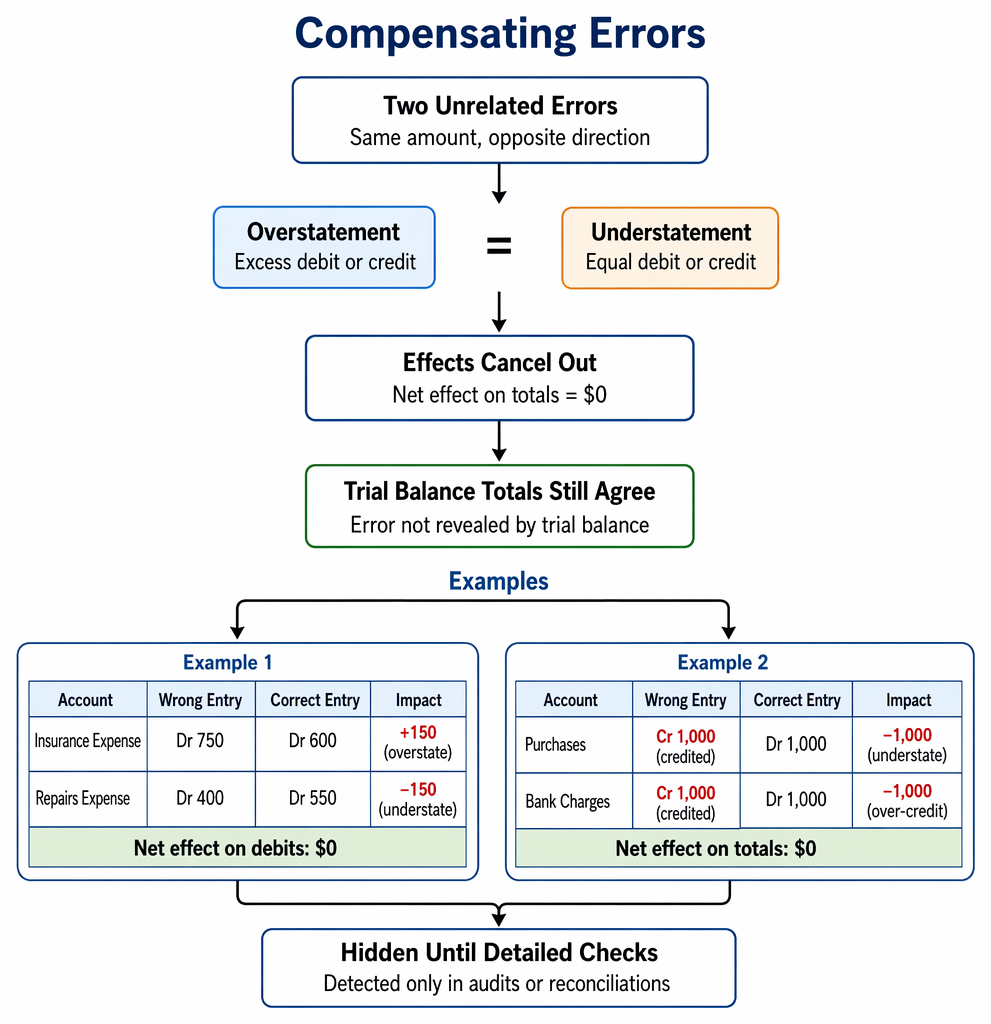
Compensating errors are one of several types of bookkeeping mistakes that do not disturb the agreement of a trial balance. These errors arise when a mistake is made in one account and another, unrelated mistake of the same amount and in the opposite direction is made in another account. The two errors cancel each other out in terms of the overall totals.
Trial balance outcomes direct either error correction when totals differ or further reconciliation when matching totals may conceal compensating errors.
How Do Compensating Errors Occur?
Such errors can happen for different reasons. They may involve completely separate accounts, or transactions in different places, but the erroneous amounts just happen to match numerically.
Examples of Common Scenarios
Compensating errors typically involve:
- Both errors being of exactly the same monetary value
- One being an overstatement (excess debit or credit), the other being an understatement (equal debit or credit in the opposite account)
- Errors relating to different types of expenses, or income and expenses, where the effects happen to cancel out
Why Are Compensating Errors Difficult to Detect?
Because compensating errors result in the trial balance totals still matching, they are not highlighted at the stage of extracting a trial balance. As a result, they can remain hidden and only come to light during more detailed audits or reconciliations.
Worked Example 1.1
Scenario: A business accidentally overstates the insurance expense by $150, debiting the insurance account with $750 instead of the correct figure of $600. In the same period, the repairs expense is understated by $150, with only $400 debited instead of the correct $550.
Question: Will the trial balance totals still agree? Explain and show the impact on both accounts.
Answer:
The insurance account is overstated (excess debit of $150), while the repairs account is understated (debit $150 too little). The net effect on total debits is $0, so the trial balance totals will still agree and the error will not be revealed by the trial balance.
Worked Example 1.2
Scenario: A sales transaction for $1,000 is correctly recorded. However, a purchasing transaction is mistakenly credited to the purchases account instead of being debited, resulting in a $1,000 understatement in expenses. Meanwhile, bank charges of $1,000 are recorded as a credit, rather than a debit. Both errors are for $1,000 but in opposite directions.
Question: Explain how these two errors affect the trial balance and whether they offset each other.
Answer:
The $1,000 over-credit in purchases is offset by the $1,000 over-credit in bank charges. As their effects on the trial balance cancel out, the totals still match and no imbalance is shown.
Other Types of Errors
It is worth noting that compensating errors are just one category of errors that may not be apparent from the trial balance. Other examples include errors of omission, errors of commission, and errors of principle.
Key Term: trial balance
A listing of all general ledger accounts and their balances at a specific point in time, with total debits and total credits shown for checking the arithmetical accuracy of the books. Key Term: error of omission
An error where a transaction is completely omitted from the accounts, so neither a debit nor a credit entry is made.
Why Is It Important to Investigate Further?
A balanced trial balance does not guarantee that all the accounts contain the correct amounts. Compensating errors can distort reported profits or losses. Careful checks, reconciliations, and reviews of supporting documentation are needed to identify and correct them.
Exam Warning: It is a common mistake to assume that a balanced trial balance guarantees correct accounts. Compensating errors may still affect financial statements even when the trial balance totals match.
Revision Tip: Always review individual account balances and reconcile to source documents, especially if reported figures seem unusual—even if the trial balance agrees.
Summary
Compensating errors involve two or more mistakes that, by coincidence, cancel out each other's effect on the trial balance totals. These errors do not cause an imbalance and can only be found through detailed review, not through trial balance extraction. You should never rely solely on the trial balance to confirm accuracy: further checks are essential.
Key Point Checklist
This article has covered the following key knowledge points:
- Define what a compensating error is and when it arises
- Recognise that compensating errors do not cause the trial balance totals to disagree
- Identify typical examples of compensating errors in bookkeeping
- Explain why further checking is important even if the trial balance balances
- Distinguish compensating errors from other types of accounting errors
Key Terms and Concepts
- compensating error
- trial balance
- error of omission