Learning Outcomes
After reading this article, you will be able to identify, explain, and distinguish between original entry errors, reversal errors, and transposition errors in accounting. You will learn to recognize how each affects ledger balances, detect them using a trial balance, and understand the correct approach to rectification as required for the ACCA FA1 exam.
ACCA Recording Financial Transactions (FA1) Syllabus
For ACCA Recording Financial Transactions (FA1), you are required to understand how common errors occur in the recording of accounting data, their impact on the trial balance, and their correction. The points below highlight key syllabus areas addressed in this article:
- The types of errors that may occur in the accounting system
- How errors of original entry, reversal, and transposition arise
- The effect of these errors on the trial balance totals
- How to correct these errors with appropriate journal entries
- The identification of errors during the extraction of the trial balance
Test Your Knowledge
Attempt these questions before reading this article. If you find some difficult or cannot remember the answers, look more closely at that area during your revision.
- A payment to a supplier of $345 was entered in both the cash and supplier accounts as $354. What kind of accounting error does this represent?
- If the amount for purchases was accidentally debited to sales and credited to cash, which error type is this?
- True or false? Reversal errors always cause an imbalance in the trial balance.
- An invoice for $420 was entered as $240 in both accounts. What is the impact on the trial balance?
Introduction
Errors are a frequent occurrence in manual and computerised accounting systems. Understanding the main types—original entry errors, reversal errors, and transposition errors—is essential for accurate financial reporting and for performing corrections where necessary. Not all these errors affect the agreement of the trial balance, but all must be identified and rectified to produce reliable accounts.
Key Term: error of original entry
An error where the incorrect amount is first recorded in the books of prime entry and both corresponding ledger accounts are updated with this wrong figure. Key Term: reversal error
An error where the correct amount and correct accounts are used, but debits and credits are recorded the wrong way around. Key Term: transposition error
An error occurring when two digits in an amount are switched, resulting in an incorrect posting.Test Tip: When revising Original entry, reversal, and transposition, connect each definition, method, or rule to the kind of question the assessment is likely to ask.
Types of Errors
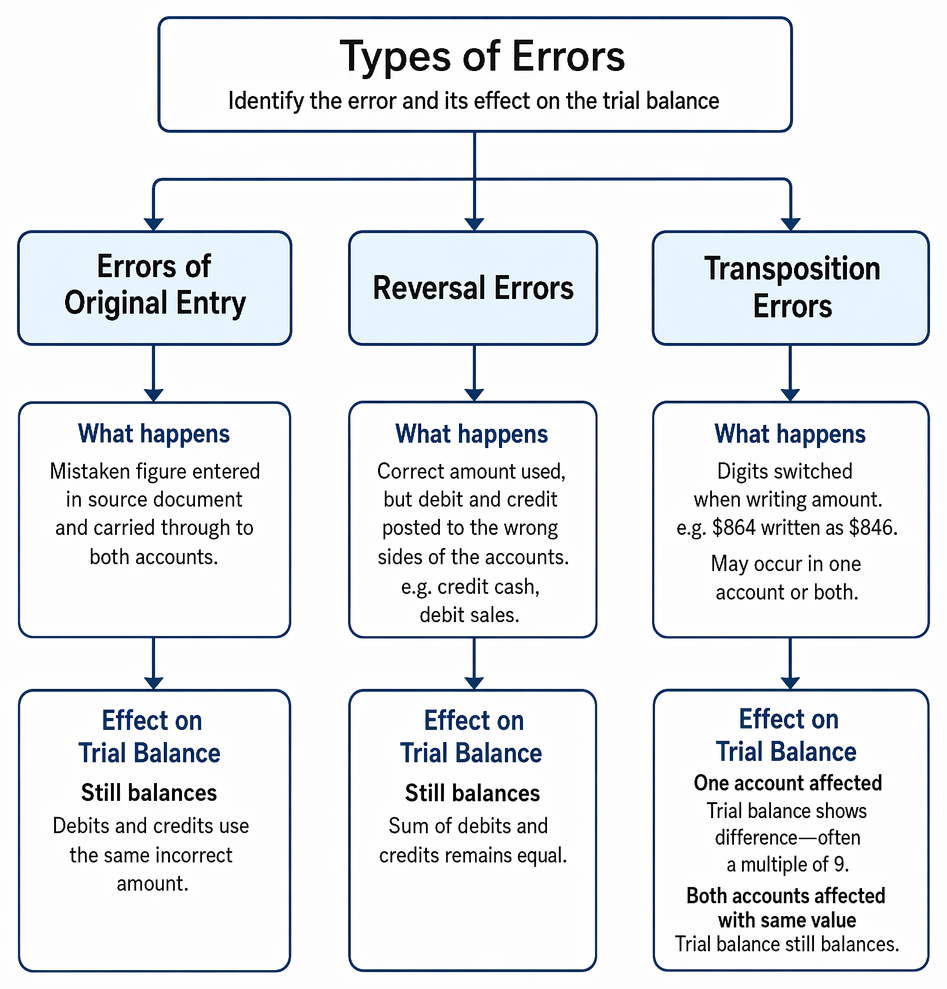
Reversal error correction is presented as a posting workflow ending with ledger review and verification that debit and credit totals agree.
Errors of Original Entry
An error of original entry arises when the mistaken figure is entered in the source document or book of prime entry and then carried through to both accounts in the double entry. As both debit and credit use the same incorrect amount, the trial balance will still balance, making the error harder to detect.
Reversal Errors
Reversal errors occur when the debit and credit entries are made for the correct amount but are posted to the wrong sides of the respective accounts. For example, a cash sale may be credited to cash and debited to sales. Like errors of original entry, this will not disturb the trial balance because the sum of debits and credits remains equal.
Transposition Errors
A transposition error involves switching digits when writing an amount: for example, writing $864 as $846. The error may occur in one account or both. If only one account is affected, the trial balance will show a difference—often a multiple of 9 (e.g., $18, $27). If both accounts are transposed with the same value, the trial balance still balances.
Identifying and Correcting the Errors
Errors of original entry and reversal do not cause an imbalance between total debits and credits, as both entries are affected equally. Transposition errors only cause an imbalance if they are made in one account only. Corrections typically require journal entries, either to record the omitted value or to reverse incorrect postings.
Worked Example 1.1
A payment of $540 to a supplier was written as $450 in the cash book and supplier account.
Required: What is this type of error and does it affect the trial balance?
Answer:
This is an error of original entry, as the incorrect figure from the source document was used in both accounts. The trial balance will still agree, but both cash and payables are understated by $90.
Worked Example 1.2
A receipt of $800 from a customer was entered as Debit Sales $800 and Credit Bank $800.
Required: Identify the error and explain how to correct it.
Answer:
This is a reversal error: the correct accounts are involved, but the entries are on the wrong sides. To correct, reverse the original entry and post the correct debit and credit.
Worked Example 1.3
A purchases invoice for $1,284 was entered as $1,248 only in the purchases account.
Required: What type of error is this and what is the effect on the trial balance?
Answer:
This is a transposition error in a single account. The trial balance will show a $36 difference, likely detected at period end.Exam Warning: Be cautious: not every error impacts the agreement of the trial balance. Especially with original entry and reversal errors, the trial balance may still appear correct, making review and control procedures essential.
Summary
Errors of original entry, reversal errors, and transposition errors are frequent in bookkeeping. Only transposition errors in a single account are likely to throw the trial balance out. To detect and correct errors, careful checking of records and reconciliations is essential. Where an error is identified, correction must be made with a journal entry that reverses the error and records the transaction correctly.
Key Point Checklist
This article has covered the following key knowledge points:
- Understand what an error of original entry is and recognise its impact
- Recognise reversal errors and identify how they arise
- Identify transposition errors and their typical effect on the trial balance
- Determine which errors affect the trial balance and which do not
- Know how to make correcting journal entries for each error type
Key Terms and Concepts
- error of original entry
- reversal error
- transposition error