Learning Outcomes
After studying this article, you will be able to identify and explain compensating and transposition errors, understand why these errors may or may not affect the agreement of the trial balance, and apply techniques to detect and correct such errors within accounting records for the ACCA FA2 exam.
ACCA Maintaining Financial Records (FA2) Syllabus
For ACCA Maintaining Financial Records (FA2), you are required to understand how errors can arise in the double-entry bookkeeping system and how such errors affect the trial balance. Focus your revision on:
- The preparation and interpretation of a trial balance
- The recognition of errors that do not cause the trial balance to disagree (including compensating and transposition errors)
- The identification and correction of errors through appropriate journal entries
- Understanding the limitations of the trial balance in detecting certain types of errors
Test Your Knowledge
Attempt these questions before reading this article. If you find some difficult or cannot remember the answers, look more closely at that area during your revision.
-
Which of the following errors will NOT cause the trial balance totals to disagree?
- a) An error of omission
- b) A transposition error
- c) An error in addition
- d) A single-sided entry
-
A payment of $670 for repairs is entered as $760, while insurance of $1,100 is entered as $1,010. What type of error does this illustrate?
-
True or false? A transposition error always leads to a trial balance difference divisible by 9.
-
Briefly explain, with an example, what is meant by a compensating error.
Introduction
Accuracy in recording accounting transactions is essential for reliable financial information. However, some errors may still occur even within a balanced double-entry system. Two frequent types are compensating errors and transposition errors. Both can allow the trial balance to agree deceptively, making error detection harder. For the ACCA FA2 exam, you need to understand how these errors arise, their characteristics, and practical ways to spot and correct them.
Key Term: compensating error
A compensating error occurs when two (or more) mistakes are made in such a way that the net effect cancels out, leaving the trial balance totals unaffected. Key Term: transposition error
A transposition error arises when two digits within a number are accidentally reversed when entering data, such as writing $963 instead of $396.
Compensating Errors
Compensating errors are pairs or groups of errors that offset each other's impact. For example, if one expense is overstated and another is understated by the exact same amount, the total debits and credits remain equal. These errors do not show up as differences in the trial balance, making them more difficult to detect.
Features of Compensating Errors
- Both errors may affect statement of profit or loss items, statement of financial position items, or any combination.
- Not all errors can compensate – only those where opposite effects occur by equal amounts.
- The presence of a compensating error means the accounts are not correct, even though the trial balance agrees.
Worked Example 1.1
A purchase invoice for repairs of $720 is posted as $270 (understated by $450). At the same time, an electricity bill for $540 is posted as $990 (overstated by $450).
Question: Will these errors cause an imbalance in the trial balance? Why or why not?
Answer:
No imbalance will occur. The repairs expense is understated by $450, while electricity is overstated by $450—these errors are equal and opposite. The net effect on total debits and credits is nil.Revision Tip: If the trial balance agrees but reported profit appears incorrect, look for possible compensating errors between similar accounts.
Transposition Errors
A transposition error happens when the digits of a number are reversed accidentally. For instance, entering $294 as $249. This affects both the debit and credit entries, or just one.
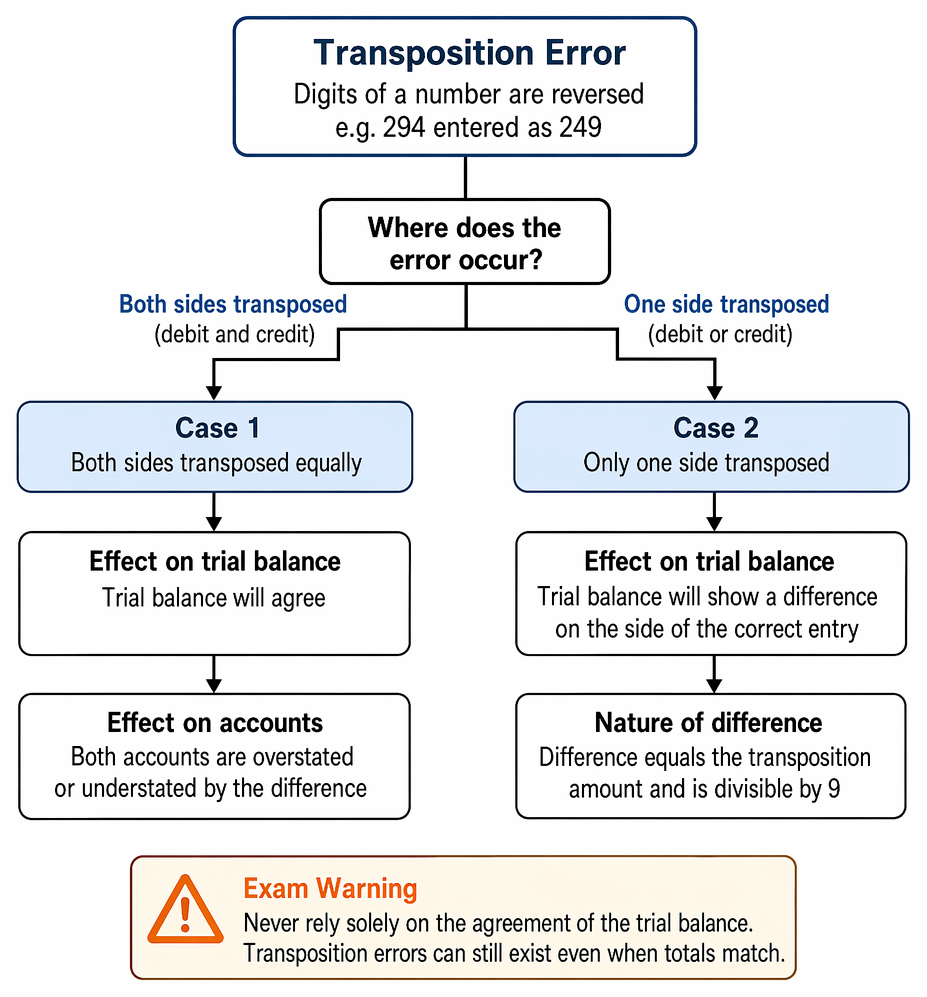
Trial balance discrepancy classification links divisibility by 9 to reversed-digit entries and non-divisible differences to alternative bookkeeping errors.
Features of Transposition Errors
- The difference created by a transposition error is usually divisible by 9 (e.g., $72 - $27 = $45; $45 / 9 = 5).
- If both the debit and credit are entered with the same transposed figure, the trial balance will still agree.
- If the error is only made in one side (debit or credit), the difference will show in the trial balance, often as an unusual number.
Worked Example 1.2
A cash receipt of $564 was entered as $546 in the cash at bank account, while the other entry (sales revenue) was recorded correctly at $564.
Question: What effect will this error have on the trial balance, and what is the nature of the resulting trial balance difference?
Answer:
The cash at bank account is understated by $18 ($564 - $546). Since the sales account is correct, the trial balance will show a $18 difference on the credit side. $18 divided by 9 equals 2, suggesting a possible transposition error.
Worked Example 1.3
Both the debit and credit entries for a transaction of $813 are transposed and entered as $831 in purchases and payables accounts.
Question: Will the trial balance agree? What error has been made?
Answer:
Yes, the trial balance will agree, as both sides were transposed equally. However, both purchases and payables are overstated by $18.Exam Warning: Never rely solely on the agreement of the trial balance to confirm accuracy. Compensating and transposition errors can still exist even when totals match.
Limitations of the Trial Balance
The trial balance is a key tool for error detection but is not foolproof. The following errors will not cause an imbalance:
- Complete omission of a transaction
- Compensating errors
- Equal and opposite errors in different accounts
- Matching debit and credit entries with the same transposed figure
Key Term: trial balance
A listing of all general ledger account balances at a point in time, showing total debit and credit balances, used as a preliminary check on the accuracy of double-entry bookkeeping.
Summary
- Compensating errors are offsetting mistakes where equal and opposite errors cancel each other out, leaving the trial balance totals unaffected.
- Transposition errors involve the reversal of digits within a figure, commonly resulting in a difference divisible by 9 if only one side is affected, or no difference if both sides contain the transposed number.
- Both types of error make the trial balance unreliable as the sole means of checking accuracy.
- Careful review and independent checks are required to detect these hidden errors.
Key Point Checklist
This article has covered the following key knowledge points:
- Define and identify compensating errors in the accounting records
- Define and identify transposition errors in bookkeeping
- Explain why these two error types often do not affect the trial balance agreement
- Understand how to use divisibility by 9 to help spot transposition errors
- Recognize the trial balance as a tool with limitations and the need for additional checks
Key Terms and Concepts
- compensating error
- transposition error
- trial balance