Learning Outcomes
After reading this article, you will be able to prepare correcting journal entries for errors of omission, commission, and principle. Building on basic error identification, you will analyse how each error type impacts the statement of profit or loss and statement of financial position, determine when a suspense account is required, and draft the journal entries needed to rectify errors and restore accurate financial records. This article assumes familiarity with basic double-entry bookkeeping and trial balance preparation.
ACCA Maintaining Financial Records (FA2) Syllabus
For ACCA Maintaining Financial Records (FA2), you are required to understand the different types of bookkeeping errors and the process of correcting them. The points below outline the key syllabus areas covered in this article:
- Explain the main types of bookkeeping errors: omission, commission, and principle
- Identify whether each type of error will be revealed by the extraction of a trial balance
- Describe the impact of each error on the statement of profit or loss and the statement of financial position
- Prepare correcting journal entries for errors and update the accounting records
- Understand the limitations of the trial balance in detecting all types of errors
Test Your Knowledge
Attempt these questions before reading this article. If you find some difficult or cannot remember the answers, look more closely at that area during your revision.
-
Which type of error occurs when a transaction is completely left out of the accounting records?
- a) Error of principle
- b) Error of commission
- c) Error of omission
- d) Error of transposition
-
True or false? An error of principle always affects the agreement of the trial balance.
-
If an electricity bill paid by cash is debited to the gas expense account, what type of error is this?
-
Briefly state whether an error of omission will require the use of a suspense account in a computerised accounting system.
Introduction
In double-entry bookkeeping, errors may arise when transactions are not recorded correctly. Not all mistakes affect the trial balance, and even a balanced trial balance can hide significant issues. The three most common error types encountered at this stage—omission, commission, and principle—are regularly tested in the ACCA FA2 exam. Being able to define, recognise, and correct these errors is essential for accurate financial statements.
Key Term: error of omission
Failing to enter a transaction completely into the accounting records, so neither debit nor credit is made. Key Term: error of commission
Recording a transaction in the correct category (e.g., expenses) but in the wrong account within that category. Key Term: error of principle
Entering a transaction in the wrong type of account (e.g., recording an asset purchase as an expense).
Types of Errors Explained
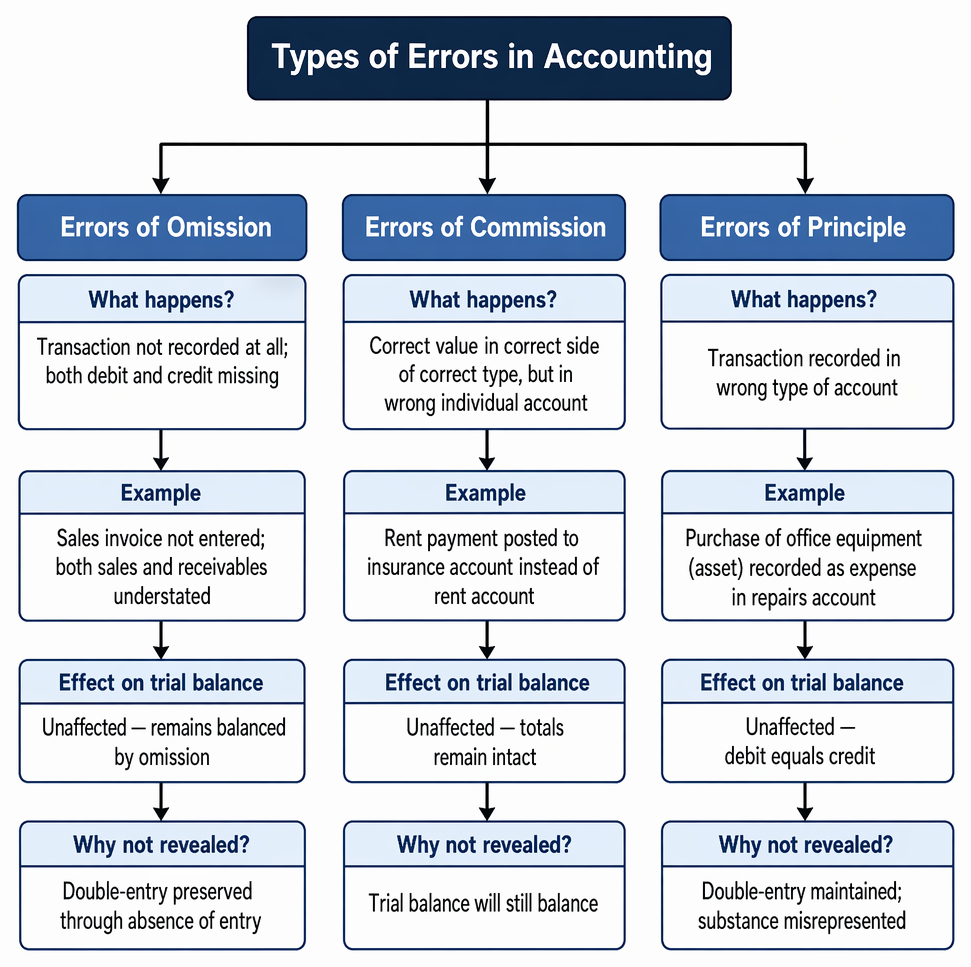
Error rectification sequence classifies omission, commission, and principle errors before preparing correcting journals, updating ledgers, and reviewing financial statements.
Errors of Omission
An error of omission occurs when a transaction is not recorded at all. Both the debit and the credit entries are missing. For example, if a sales invoice is not entered into the books, both sales and receivables will be understated. The trial balance remains unaffected because double-entry is preserved—by omission.
Errors of Commission
Errors of commission occur when the correct value is entered in the correct side (debit or credit) of the correct type of account, but in the wrong individual account. For example, payment for rent is entered into the insurance account rather than the rent account. The totals in the trial balance remain intact, so the error will not be revealed by extracting the trial balance.
Errors of Principle
An error of principle arises when the transaction is entered into the wrong type of account. For instance, purchasing office equipment (an asset) is recorded as an expense in the repairs account. This misclassification leads to incorrect statement of profit or loss and statement of financial position figures. Although double-entry is maintained (debit and credit values equal), the transaction's substance is misrepresented, so the trial balance will still balance.
Impact on Accounting Records and Financial Statements
- Errors of omission: Do not affect the trial balance totals or suspense account, but lead to understatement of both accounts involved.
- Errors of commission: Do not create an imbalance in the trial balance but may result in misstatement of specific account balances.
- Errors of principle: Can misstate asset, expense, income, or liability categories, but trial balance totals remain unaffected.
Worked Example 1.1
A company buys a new computer for $1,800, but the amount is debited to office expenses instead of office equipment.
Question: What type of error has occurred, and what is the effect on the financial statements?
Answer:
This is an error of principle. The purchase should have increased non-current assets, but was instead classified as an expense. As a result, expenses are overstated and non-current assets are understated; profit is understated, and assets are understated in the statement of financial position. However, the trial balance will still balance.
Worked Example 1.2
A telephone bill is paid by cheque for $200 but is recorded in the electricity account rather than the telephone account.
Question: What type of error is this, and will it affect the trial balance?
Answer:
This is an error of commission. The transaction was posted to the same side (expense) but in the wrong account. The trial balance will still balance, but the telephone expense will be understated and electricity expense overstated.
Worked Example 1.3
A purchase invoice for $500 from a supplier is not recorded at all.
Question: Identify the error type and explain its effect on the accounts.
Answer:
This is an error of omission. Both purchases and payables are understated by $500. The trial balance totals will still agree, so the omission is not detected by producing the trial balance.Revision Tip: Errors of omission, commission, and principle do not affect the trial balance totals. Always review account classifications and postings, even when the trial balance agrees.
Exam Warning: Remember: Not all errors will be detected by the trial balance. Be able to explain in an exam why these errors do not cause a suspense account to be created, and the financial statement areas each error affects.
Summary
Many errors in double-entry bookkeeping go undetected by the trial balance. Errors of omission, commission, and principle are common. Each leads to incorrect financial information, but since equal debits and credits are missing or misplaced, the trial balance still agrees. Understanding how to identify and correct these errors is essential for maintaining the integrity of accounting records.
Key Point Checklist
This article has covered the following key knowledge points:
- Define and recognise errors of omission, commission, and principle
- Recognise that these errors do not cause the trial balance to disagree
- Identify the financial statement effects of each error type
- Prepare appropriate correcting journal entries for each error
- Understand why some errors require adjusting entries even when the trial balance agrees
Key Terms and Concepts
- error of omission
- error of commission
- error of principle