Learning Outcomes
After reading this article, you will be able to identify, describe, and correct original entry and reversal errors in double-entry bookkeeping. You will understand how these errors affect the trial balance and the financial statements, differentiate between error types, and prepare the appropriate correcting journal entries as required in the ACCA FA2 exam.
ACCA Maintaining Financial Records (FA2) Syllabus
For ACCA Maintaining Financial Records (FA2), you are required to understand different types of errors that may occur in double-entry systems and their impact on the trial balance and financial statements.
- Distinguish between errors detected by the trial balance and those not detected
- Explain and correct original entry errors and reversal errors
- Prepare necessary correcting journal entries for these errors
- Assess the impact of correcting these errors on profit and the statement of financial position
Test Your Knowledge
Attempt these questions before reading this article. If you find some difficult or cannot remember the answers, look more closely at that area during your revision.
- An invoice for purchases of $2,400 is recorded in both the purchases and payables accounts as $4,200. What type of error has occurred?
- What is the double-entry required to correct a cash payment for rent of $180 that was debited to rent and credited to cash at bank as $810?
- True or false? A reversal error will always cause the trial balance totals to differ.
- Briefly explain how an original entry error affects financial statements.
Introduction
Errors in recording transactions are common in bookkeeping, especially where manual entries are involved. Understanding the nature of original entry and reversal errors is key for detecting mistakes, correcting them efficiently, and ensuring accurate financial reporting. These error types are tested frequently in the ACCA FA2 exam, both in multiple-choice and journal preparation questions.
Key Term: original entry error
An error where the wrong amount is recorded in both the debit and credit entries of a transaction. Key Term: reversal error
An error where the correct amount is entered, but the debit and credit entries are posted to the opposite accounts to those intended.Test Tip: When revising Original entry and reversal errors, connect each definition, method, or rule to the kind of question the assessment is likely to ask.
Types of Errors Not Affecting the Trial Balance
Certain errors will not be revealed by extracting a trial balance because they do not disturb the equality of total debits and credits, even though the actual figures may be incorrect.
Original Entry Errors
Original entry errors (also called error of original entry) arise when a transaction is recorded at the wrong value in both accounts. This may occur due to a misreading of a document, an arithmetic slip, or a typographical mistake.
For example, if an invoice totals $270 but is mistakenly recorded as $720 in both purchases and payables, the total debits and credits remain balanced, but both accounts are inaccurate. The error is carried through to the financial statements unless found and corrected.
Key Term: error of original entry
An error resulting when the same incorrect amount is posted to both sides of the double-entry (debit and credit).
Reversal Errors
A reversal error happens when the accounts affected are correct, the amount is correct, but the direction of the entries (debit/credit) is switched. This generally occurs if the accountant posts a transaction, swapping the debit and credit positions. Reversal errors typically cause an imbalance in the trial balance of twice the transaction amount.
For example, suppose cash sales of $650 are recorded. The correct entry is to debit cash at bank and credit sales. If the bookkeeper credits cash at bank and debits sales, both postings are reversed.
Key Term: reversal error
An error where the double-entry is made to the correct accounts with the correct amount, but the debit and credit are the wrong way round.
The Effect of Errors on the Trial Balance
Original entry errors do not affect the trial balance because both sides are equally misstated. Reversal errors do affect the trial balance—usually resulting in an imbalance, as the accounts are posted to the incorrect side, doubling the error's impact.
Worked Example 1.1
A business purchases office supplies for $325. The entry is recorded in both the purchases and payables accounts as $235.
Question: What type of error has occurred? What is its likely impact on the trial balance?
Answer:
This is an original entry error because the wrong amount was posted to both the purchases and payables accounts. The trial balance will still balance, but both accounts will be $90 too low.
Worked Example 1.2
A cash payment of $450 for repairs is debited to cash and credited to repairs.
Question: Identify the error and state the effect on the trial balance.
Answer:
This is a reversal error. Both the correct accounts and correct amount were used, but the entries are on the wrong side. The trial balance will differ by $900 ($450 × 2).
Correction of Errors
Errors must be corrected using journal entries to ensure the correct accounts show the accurate final values.
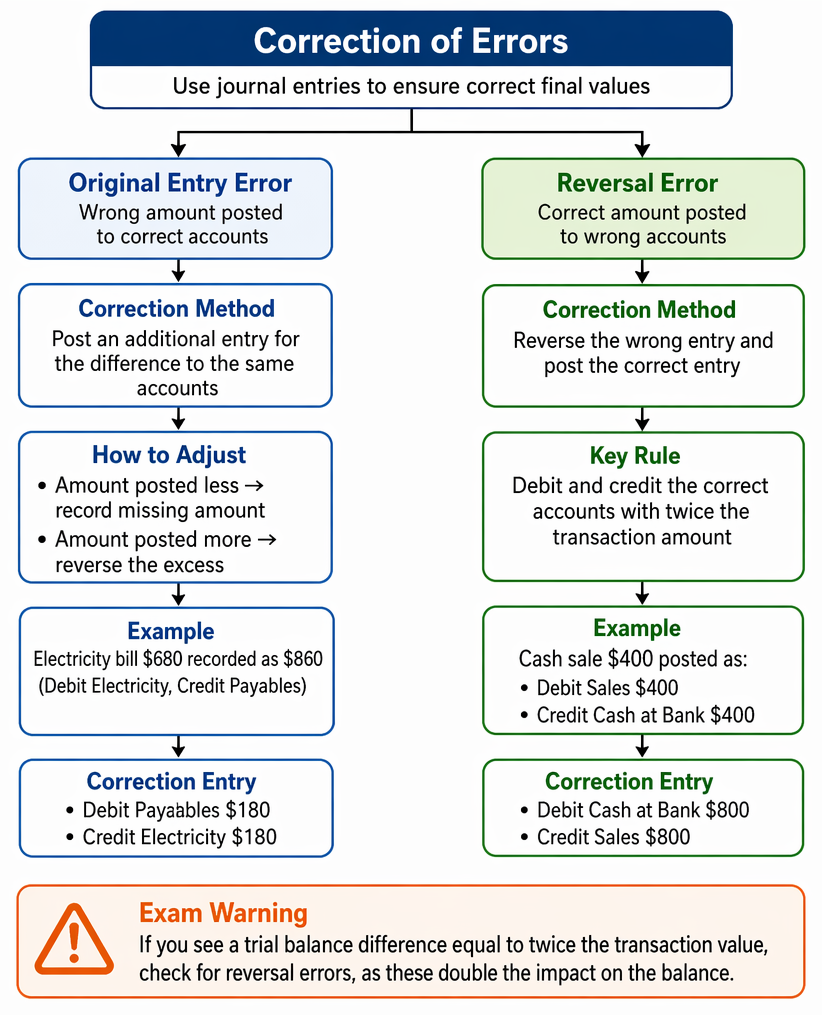
Original entry error correction requires identifying the correct source amount, calculating the difference, and adjusting both original accounts accordingly.
Correction of Original Entry Error
To correct an original entry error, post an additional entry for the difference to the same accounts originally used. If the amount posted was less than it should have been, record the missing amount. If it was more, reverse the excess.
Example: If an electricity bill of $680 was originally recorded as $860 (both debit electricity and credit payables), post an entry for $180 to reduce both accounts:
- Debit payables $180
- Credit electricity $180
Correction of Reversal Error
To correct a reversal error, the entry must be reversed and then the correct entry posted. This means:
- Debit and credit the correct accounts with twice the transaction amount.
Example: Suppose a cash sale of $400 was posted as: Debit sales $400 Credit cash at bank $400
The correction required is:
- Debit cash at bank $800
- Credit sales $800
Exam Warning: If you see a trial balance difference equal to twice the transaction value, check for reversal errors, as these double the impact on the balance.
Summary
Original entry errors involve the right accounts, but an incorrect amount is posted to both sides, so the trial balance agrees but is inaccurate. Reversal errors occur when the debit and credit are swapped, causing twice the transaction value to appear as an error in the trial balance. Both error types must be corrected by specific journal entries before preparing financial statements.
Key Point Checklist
This article has covered the following key knowledge points:
- Recognise original entry errors and reversal errors in bookkeeping
- Understand their impact on the trial balance and accounts
- Prepare correcting journal entries for both error types
- Assess effects on profit and financial position for the ACCA FA2 exam
Key Terms and Concepts
- original entry error
- reversal error
- error of original entry