Learning Outcomes
After reading this article, you will be able to explain the purpose and application of substantive procedures for key balance sheet areas required for the ACCA FAU exam. You will identify assertions tested by these procedures, describe how sampling is used, and outline typical substantive tests for major assets and liabilities. You will understand the auditor’s approach to verifying existence, completeness, valuation, and rights or obligations for important balances.
ACCA Foundations in Audit (FAU) Syllabus
For ACCA Foundations in Audit (FAU), you are required to understand the aims and techniques of substantive procedures for balance sheet items. Focus your revision on:
- The objectives of substantive procedures
- Using assertions to structure audit tests on account balances and related disclosures
- Applying sampling and selecting substantive procedures for audit evidence
- Designing and explaining procedures for verifying inventory, non-current assets, receivables, cash and bank balances, payables, accruals, and provisions
- Addressing risks specific to inventory, provisions, and high-judgement areas
- Linking audit work to assertions: existence, completeness, valuation, and rights/obligations
Test Your Knowledge
Attempt these questions before reading this article. If you find some difficult or cannot remember the answers, look more closely at that area during your revision.
- What is the primary objective of substantive procedures on financial statement balances?
- Which assertion is most relevant when testing for unrecorded liabilities?
- Name two common substantive procedures for verifying the valuation of inventory.
- Why might an auditor circularise trade receivable balances?
- Which key term describes evidence obtained directly from third parties?
Introduction
Once the auditor has assessed internal controls and determined the audit approach, evidence must be collected to support the balances and disclosures in the financial statements. Substantive procedures are performed to detect material misstatements at the assertion level. These tests are typically applied through sampling to key balance sheet areas such as inventory, non-current assets, receivables, bank and cash, payables, and accruals.
It is essential for the auditor to link substantive procedures to specific financial statement assertions to ensure that each risk of misstatement is addressed.
Key Term: substantive procedure
An audit procedure designed to detect material misstatements at the assertion level by obtaining direct evidence related to amounts and disclosures in the financial statements.Test Tip: When revising Procedures for key balance sheet areas, connect each definition, method, or rule to the kind of question the assessment is likely to ask.
ASSERTIONS FOR BALANCE SHEET ACCOUNTS
Assertions describe the representations made by management about account balances and disclosures in the financial statements. Substantive procedures should be tailored to these assertions to ensure each is properly tested:
- Existence: Do the assets, liabilities, and equity interests exist at the reporting date?
- Completeness: Are all assets, liabilities, and equity interests that should be recorded actually included?
- Valuation and allocation: Are balances valued accurately and recorded at the appropriate amounts?
- Rights and obligations: Does the entity own or control the rights to assets, and are liabilities the obligations of the entity?
- Presentation and classification: Are balances presented and classified correctly in the accounts?
Key Term: assertion
A statement by management, explicit or implied, regarding the recognition, measurement, presentation, and disclosure of items in the financial statements.
PLANNING SUBSTANTIVE PROCEDURES
The auditor plans substantive procedures based on the results of risk assessment and consideration of materiality. Testing is performed primarily by sampling.
Key Term: audit sampling
The application of audit procedures to less than 100% of items in a relevant population to provide a basis for drawing conclusions about the whole.
Substantive procedures may include:
- Inspection (examining records, documents, or tangible assets)
- Observation (watching a process being performed)
- Inquiry (seeking information from knowledgeable persons)
- External confirmation (seeking direct responses from third parties)
- Recalculation (checking mathematical accuracy)
- Reperformance (independently carrying out procedures)
- Analytical procedures (comparing data for consistency, trends, and plausibility)
Worked Example 1.1
A client has a large year-end cash balance. The auditor wants to obtain sufficient, appropriate evidence that this balance is real and accurately stated.
Required: Which assertions are most relevant, and what substantive procedures should the auditor perform?
Answer:
The main assertions are existence (does the cash balance exist at year end?), rights and obligations (does the client have rights to the cash?), and valuation (is the balance stated correctly?). Substantive procedures include obtaining direct confirmations from the client's bank (external confirmation), reviewing bank reconciliations, inspecting the cashbook and bank statements, and, if material, attending and counting any cash held on site.
SUBSTANTIVE PROCEDURES FOR MAJOR BALANCE SHEET AREAS
Substantive tests are organised by account balance assertions, including confirmation, search procedures, recalculation, document inspection, and disclosure review.
1. Inventory
Main Risks: Overstatement (fictitious or obsolete inventory), incorrect valuation, incomplete or misstated quantities.
Assertions: Existence, completeness, valuation, rights and obligations.
Key Procedures:
- Attend physical inventory count to observe procedures and perform test counts
- Trace items from inventory listing to warehouse (existence) and vice versa (completeness)
- Identify and test the valuation of slow-moving, damaged, or obsolete items
- Agree costs to recent purchase invoices; assess the method used for allocating overheads
- Compare inventory records to final count sheets and test cut-off for receipts and dispatches
Worked Example 1.2
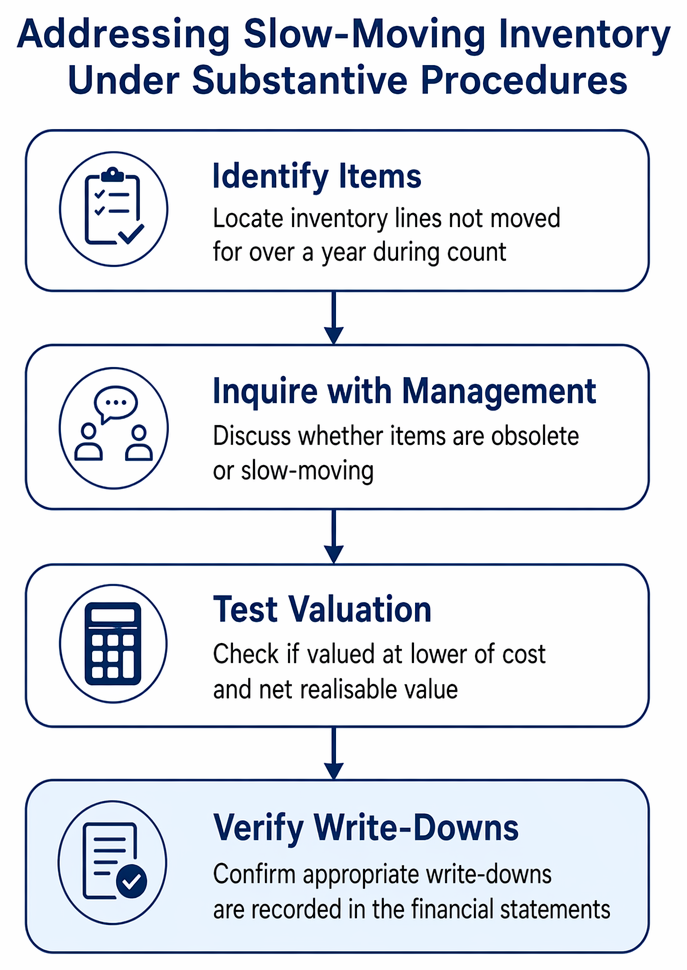
An auditor at a manufacturing company notes that some inventory lines have not moved for over a year. How should this be addressed under substantive procedures?
Answer:
Auditor should identify such items during the inventory count and inquire of management whether these items are obsolete or slow-moving. Test for valuation by checking if these items are valued at the lower of cost and net realisable value, and verify if appropriate write-downs are recorded.
2. Non-Current Assets
Main Risks: Fictitious assets, unrecorded disposals, incorrect depreciation, over-valuation.
Assertions: Existence, rights and obligations, completeness, valuation.
Key Procedures:
- Physically inspect a sample of tangible assets from the register (existence)
- Trace assets from physical location back to register (completeness)
- Review supporting documentation for additions and disposals (authorisation)
- Examine title deeds or purchase contracts (ownership)
- Recalculate depreciation for a sample of assets and review useful lives
- For revalued assets, review independent valuers’ reports
3. Trade Receivables
Main Risks: Overstatement (irrecoverable debts), fictitious receivables, cut-off errors, completeness of allowance for doubtful debts.
Assertions: Existence, valuation, rights, completeness.
Key Procedures:
- Obtain direct confirmation from a selection of customers (circularisation)
- Review subsequent cash receipts after the year end (recoverability)
- Inspect aged receivables analysis; discuss overdue or disputed items with management
- Test cut-off by comparing last sales invoices to goods dispatched near year end
- Review calculation of allowances for doubtful debts
Worked Example 1.3
The auditor does not receive replies from some receivables after a circularisation. What should the auditor do?
Answer:
Perform alternative procedures such as testing subsequent settlements (look for payments after year end), or check supporting documentation (orders, delivery notes, invoices) to confirm the existence and amount of the receivable.Exam Warning: It is a frequent error to focus substantive procedures only on existence for assets or on completeness for liabilities, forgetting that valuation and rights/obligations are also essential. Ensure your procedures test all assertions relevant to the balance.
4. Cash and Bank Balances
Assertions: Existence, completeness, rights, valuation.
Key Procedures:
- Obtain direct confirmation from banks for all accounts (balance, facilities, liens)
- Review and test year-end bank reconciliations: trace reconciling items to later statements
- If significant, attend and count petty cash balances
- Test for any unrecorded or unusual bank accounts
5. Trade Payables and Accruals
Main Risks: Understatement (unrecorded liabilities), misclassification.
Assertions: Completeness, existence, valuation, obligations.
Key Procedures:
- Obtain supplier statements and reconcile to payables ledger
- Select post year-end payments and match them to payables at the year end (search for unrecorded liabilities)
- Inspect unmatched goods received notes at year end for unrecorded invoices
- Review client accrual calculations and supporting documentation
- Test for accuracy and completeness of year-end accruals
6. Provisions
Risks: Omissions, under- or over-statement due to judgmental estimates.
Assertions: Completeness, valuation, obligations.
Key Procedures:
- Review management's basis for calculation, agreements, or contracts
- Inspect legal correspondence and board minutes for evidence of claims or contingent liabilities
- Test subsequent events for settlement or changes in the obligation
- Consider obtaining written representations from management
Summary
Substantive procedures for key balance sheet areas are tailored to address the relevant assertions—existence, completeness, valuation, and rights/obligations. The auditor combines sampling with procedures such as inspection, confirmation, recalculation, and analytical review to obtain sufficient evidence for each material balance. Each procedure should clearly identify the assertion it tests and the risk it addresses.
Key Point Checklist
This article has covered the following key knowledge points:
- Understand the purpose and timing of substantive procedures for financial statement balances
- Link each procedure to the relevant assertion, such as existence, completeness, valuation, or rights/obligations
- Identify appropriate sample-based tests for assets and liabilities
- Outline common substantive procedures for inventory, non-current assets, receivables, cash and bank, payables, accruals, and provisions
- Recognise the need to confirm assertions using third-party evidence (e.g., bank letters, customer confirmations)
- Acknowledge the importance of alternative procedures when direct evidence cannot be obtained
Key Terms and Concepts
- substantive procedure
- assertion
- audit sampling