Learning Outcomes
By reading this article, you will be able to distinguish between the cost of equity and the cost of debt, calculate each in a basic scenario, and explain how these costs affect a company's overall capital structure and financing decisions. You will also identify the key implications of using debt versus equity finance from an ACCA exam standpoint.
ACCA Foundations in Financial Management (FFM) Syllabus
For ACCA Foundations in Financial Management (FFM), you are required to understand how different sources of finance impact the costs for a business and the implications for financial management. In particular, focus on:
- The concept and basic calculation of cost of equity
- The concept and basic calculation of cost of debt
- The difference between debt and equity finance, including key implications for the business and its owners
- The effect of capital structure on overall financing costs
- Understanding the impact of tax on the cost of debt
Test Your Knowledge
Attempt these questions before reading this article. If you find some difficult or cannot remember the answers, look more closely at that area during your revision.
-
Which of the following types of finance typically offers tax-deductible interest payments?
- a) Ordinary shares
- b) Bank loans
- c) Retained earnings
- d) Share premiums
-
True or false? The cost of equity represents the minimum return required by shareholders for investing in the business.
-
Briefly state one reason why the cost of debt is usually lower than the cost of equity.
-
A company issues $100,000 of 8% bonds. The company pays tax at 25%. What is the annual after-tax cost of debt in dollars?
-
What is meant by a company’s "weighted average cost of capital" (WACC), in simple terms?
Introduction
Businesses need finance to operate and grow. The choice between raising money through debt or equity has a direct impact on how much it costs a business to obtain funds, as well as on risks taken by owners and creditors. Understanding the typical "costs" attached to each source, and the associated implications for decision-making, is fundamental in financial management.
This article explains, with clear definitions and practical examples, the basic concepts of cost of equity and cost of debt, their calculation, and how they influence business finance decisions.
Key Term: cost of equity
The minimum return shareholders require to compensate them for the risk of investing in a company’s equity.
WHAT IS THE COST OF EQUITY?
The cost of equity is the expected rate of return that a business must offer current and potential shareholders to retain and attract their investment. Because equity holders take on more risk than lenders—the company is not contractually obliged to pay dividends or return their investment—the required return is usually higher than for debt.
This minimum acceptable return reflects both the time value of money and a risk premium for uncertainty.
Calculating the Cost of Equity
At a basic level, the cost of equity can be estimated using the dividend growth model:
In early-stage or exam-type questions, the cost of equity may be presented as a given figure or asked to be calculated using provided amounts.
Worked Example 1.1
A company pays $2 per share in dividends, with current shares trading at $20. Dividends are expected to grow by 4% annually.
Question: What is the company’s cost of equity?
Answer:
Cost of equity = (2 / 20) + 0.04 = 0.10 + 0.04 = 0.14 or 14%
WHAT IS THE COST OF DEBT?
The cost of debt refers to the effective interest rate a business pays on its borrowings, after accounting for any tax relief. Interest paid on debt is usually a tax-deductible expense, making the true cost to a business lower than the nominal (stated) rate.
Key Term: cost of debt
The effective rate a company pays on its borrowings, taking into account tax deductions on interest payments. Key Term: capital structure
The mix of debt and equity finance used by a business.
Calculating the Cost of Debt
For irredeemable (perpetual) debt, the after-tax cost is:
For example, if interest is 8% and the tax rate is 25%, the after-tax cost is 8% × (1 - 0.25) = 6%.
Worked Example 1.2
A company issues bonds with a par value of $100,000 at an annual interest rate of 6%. The corporate tax rate is 30%.
Question: What is the company’s annual after-tax cost of debt?
Answer:
After-tax cost of debt = 6% × (1 - 0.30) = 4.2% per year.
COMPARING DEBT AND EQUITY FINANCE
Using debt (such as bank loans or bonds) requires the business to make regular interest payments and repay the principal. Failure to do so can result in legal action or insolvency. However, debt is attractive because interest payments are tax-deductible and the cost is usually lower.
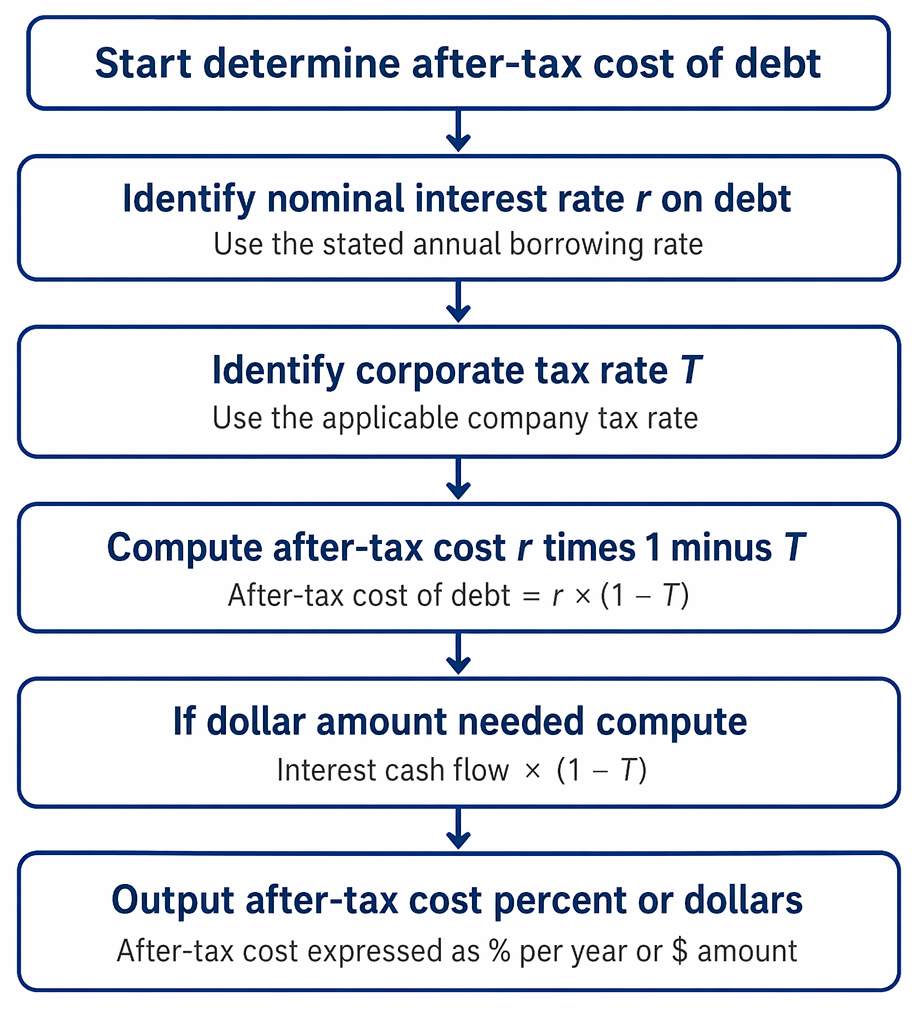
After-tax debt cost is obtained by adjusting the nominal interest rate for tax and, where required, converting to net interest dollars.
Equity finance (issuing shares) involves giving a stake in the business to investors, who may or may not receive dividends, depending on profitability. There is no legal obligation to pay dividends or repay the funds raised—but shareholders expect higher returns because their risk is greater.
Advantages and Disadvantages
| Feature | Debt | Equity |
|---|---|---|
| Cost (after tax) | Generally lower; interest is tax-deductible | Generally higher; dividends not tax-deductible |
| Repayment obligation | Yes – scheduled interest and capital | No – permanent capital |
| Risk to owner | Increases with more debt (gearing) | Dilutes control but no mandatory repayments |
| Impact on control | None | May dilute owners’ voting rights |
THE IMPLICATIONS OF FINANCING CHOICES
The combination of debt and equity chosen by a business is known as its capital structure. The right mix depends on balancing risk and cost to achieve optimal value.
- Too much debt increases financial risk (possibility of insolvency) and may deter investors.
- Too little debt may mean the business is not taking advantage of cheaper finance.
The overall average cost of capital (often referred to as WACC—Weighted Average Cost of Capital) is influenced by both the cost and proportion of debt and equity used.
Worked Example 1.3
A company is financed 40% by debt (after-tax cost 4%) and 60% by equity (cost 10%).
Question: What is its weighted average cost of capital (WACC)?
Answer:
WACC = (0.4 × 4%) + (0.6 × 10%) = 1.6% + 6% = 7.6%
Implications of Tax
Tax relief on interest makes debt attractive for companies in higher tax brackets. This tax benefit does not apply to dividends paid to shareholders.
Exam Warning: Be careful: Only the interest expense on debt is tax-deductible, not capital repayments or dividends paid to equity holders.
Revision Tip: When calculating cost of debt, always apply the tax adjustment if the exam question specifies a corporate tax rate.
Summary
The cost of finance is a critical factor in business decisions. Debt finance is usually cheaper due to tax relief on interest, but increases financial risk. Equity is more expensive but does not add to legal repayment obligations. The correct balance depends on cost considerations, risk tolerance, and control issues—key knowledge for ACCA exams.
Key Point Checklist
This article has covered the following key knowledge points:
- Distinguish between cost of equity and cost of debt, and calculate each in basic scenarios
- Recognize how tax affects the true cost of debt finance
- Identify the main implications for a business when choosing debt versus equity financing
- Understand the effect of capital structure mix on a company’s overall cost of finance
Key Terms and Concepts
- cost of equity
- cost of debt
- capital structure