Learning Outcomes
After reading this article, you will be able to explain the main factors influencing dividend policy and retention decisions in companies for the ACCA FFM exam. You will identify the key legal, financial, and practical considerations affecting whether profits are distributed or retained. You will also understand the implications for capital structure and stakeholder interests.
ACCA Foundations in Financial Management (FFM) Syllabus
For ACCA Foundations in Financial Management (FFM), you are required to understand the regulatory, financial, and practical issues that determine how companies decide between paying dividends and retaining earnings. In particular, revision should focus on:
- The definition and significance of dividend policy for limited companies
- Common approaches to dividend payment and their impact on shareholders and the company
- Factors influencing the choice between distributing profits as dividends or retaining them
- Legal constraints and practical limitations on making distributions
- The relationship between dividend policy and capital structure
- The effect of retention decisions on shareholder value and business growth
Test Your Knowledge
Attempt these questions before reading this article. If you find some difficult or cannot remember the answers, look more closely at that area during your revision.
-
Which factor is least likely to influence a company’s dividend policy?
- a) Legal restrictions
- b) Availability of cash
- c) Shareholder preferences
- d) The company’s registered office location
-
True or false? A company can declare dividends in excess of its retained profits if it has sufficient cash available.
-
Briefly state two reasons why a profitable company might choose to retain earnings instead of paying dividends.
-
What is the impact on capital structure if a company retains all of its profits?
Introduction
Many companies must decide how much of their annual profits to distribute to shareholders as dividends, and how much to retain for future growth. Dividend policy shapes these decisions and directly affects shareholder returns, reinvestment opportunities, and business stability. The choice between immediate cash payout and retention for reinvestment is influenced by law, financial conditions, and the business’s long-term goals. Understanding these aspects is essential for anyone working with company accounts or advising on financial management.
Key Term: Dividend Policy
The board’s established set of rules and principles determining the proportion of profits distributed to shareholders versus profits retained within the business.Test Tip: When revising Dividend policy basics and retention decisions, connect each definition, method, or rule to the kind of question the assessment is likely to ask.
DIVIDEND POLICY BASICS
Dividend policy determines how often, when, and to what extent profits are distributed to shareholders. Most companies pay dividends annually or semi-annually, based on available distributable profits and existing policy.
Dividends cannot exceed “distributable profits”—accumulated realized profits less accumulated realized losses—according to company law.
Key Term: Distributable Profits
The portion of accumulated profits legally available for distribution to shareholders as dividends, after deducting any accumulated realized losses.
INFLUENCES ON DIVIDEND DECISIONS
Several factors shape the board’s dividend policy and retention decisions:
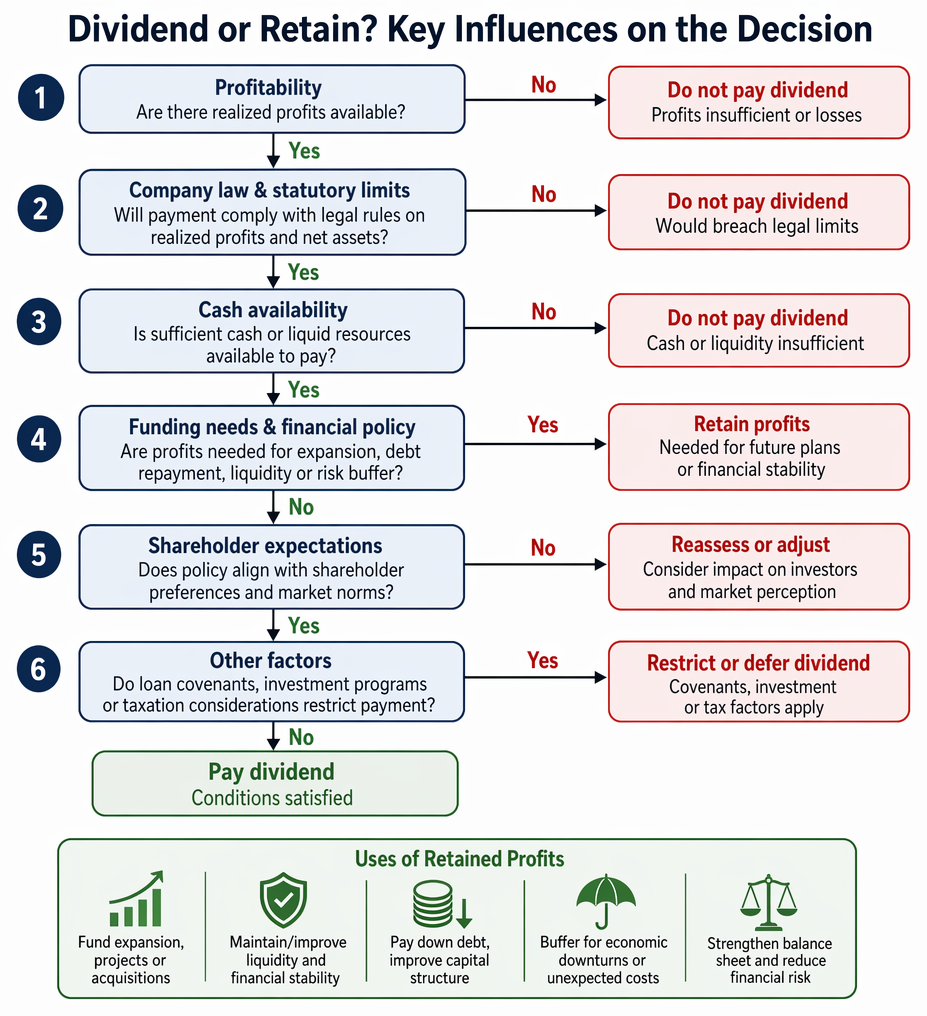
Dividend approval proceeds only if legal reserves, covenant restrictions, and cash resources permit payment, followed by directors’ rationale and shareholder notification.
Profitability
Dividends can only be paid from profits. Retained losses or insufficient profits legally restrict payments.
Company Law and Statutory Limits
National laws (such as the Companies Act 2006 for UK companies) impose rules:
- Only realized profits can be distributed.
- Dividends must not reduce net assets below the total aggregate of called-up share capital and non-distributable reserves.
Key Term: Retained Earnings
Accumulated profits after dividends are paid; these can be reinvested in the company or used to strengthen the balance sheet.
Cash Availability
Even if distributable profits exist, a company must have sufficient cash or liquid resources to pay dividends. Profitable businesses facing cash shortages (e.g., tied up in inventory or receivables) may need to defer distributions.
Liquidation Policy and Future Funding Needs
Directors may retain profits to:
- Fund expansion, new projects, or acquisitions
- Maintain or improve liquidity ratios and financial stability
- Pay down debt, improving capital structure
- Provide a buffer for economic downturns or unexpected expenses
Shareholder Expectations and Market Norms
Some companies, especially in mature sectors, are expected to pay steady dividends. Others, especially fast-growing businesses, often retain most profits to reinvest.
Shareholder preference is key—some investors value income, others prefer capital growth.
Other Factors
- Loan covenants may limit or prevent dividend payments when debts are outstanding.
- Recent or pending investment programs may call for profit retention.
- Taxation: Shareholder taxation on dividends and potential tax advantages/disadvantages from retention.
Worked Example 1.1
A profitable manufacturing company has realized profits of $100,000 in the current year but is also planning a major equipment upgrade costing $80,000 next year. Its directors are considering paying out the entire profit as a dividend. Should they proceed?
Answer:
Paying out the entire profit would leave the company unable to fund the planned upgrade without external finance. It is advisable to retain part of the profits so necessary investment can be funded internally, reducing reliance on borrowing.
Dividend Policy Models
While actual policies vary, several broad approaches exist:
- Constant Dividend: A fixed or steadily rising dividend paid each year, regardless of profits.
- Constant Payout Ratio: A percentage of earnings always distributed.
- Residual Dividend: Profits are retained to finance capital projects; any leftover distributed.
Worked Example 1.2
Company Z pays a fixed dividend of $0.20 per share each year, even when profits fluctuate between $1 million and $1.6 million. What dividend model is this?
Answer:
This is a “constant dividend” policy, where the company pays a stable dividend regardless of profit levels.Exam Warning: Dividends must not exceed distributable profits under the law, even if the business has surplus cash. Calculation of distributable profits requires adjustment for unrealized gains and specific reserves.
Implications for Capital Structure
Retaining profits increases equity, reducing the company’s reliance on external debt. Over time, this strengthens the business’s balance sheet, potentially lowering financial risk. However, retaining too much profit may reduce returns to shareholders if not reinvested successfully.
Key Term: Capital Structure
The mix of equity and debt financing used by a company to fund its operations and growth.
Retention Decisions and Stakeholder Interests
Profit retention can:
- Provide funds for expansion, increasing future returns
- Smooth dividend payments during lean years
- Affect ownership dilution, reducing the need to issue new shares
However, shareholders expecting regular dividends may be dissatisfied if profits are routinely retained. Communication of policy is therefore essential.
Worked Example 1.3
A company enjoys strong profits but faces economic uncertainty. To safeguard jobs and essential operations, it retains earnings for two years instead of paying dividends. How might this affect key stakeholders?
Answer:
Shareholders receive less immediate income, but the retained profits improve the company’s robustness, potentially preserving jobs and long-term returns.
Summary
Dividend policy dictates how profits are split between shareholder distribution and retention. Deciding factors include legal restrictions, profitability, liquidity, future investment plans, and shareholder expectations. Retained profits bolster capital structure and allow for business development, but balancing payouts and retention is key to satisfying all major stakeholders.
Key Point Checklist
This article has covered the following key knowledge points:
- Define dividend policy and its role in business management
- Identify key legal and practical constraints on dividend payments
- Outline the major factors influencing payout versus retention decisions
- Recognize common dividend policy models in practice
- Explain the impact of retention on capital structure and stakeholder outcomes
Key Terms and Concepts
- Dividend Policy
- Distributable Profits
- Retained Earnings
- Capital Structure