Learning Outcomes
After studying this article, you will be able to explain credit policy options and their practical effects, identify and calculate both direct and indirect costs and benefits of credit policy changes, and assess the overall impact on profitability and liquidity. You will also be able to apply quantitative methods to support decisions and interpret the results for ACCA FFM exam context.
ACCA Foundations in Financial Management (FFM) Syllabus
For ACCA Foundations in Financial Management (FFM), you are required to understand how credit policies affect business profitability and risk. In particular, you should be able to:
- Explain the purpose and main elements of a credit policy
- Identify the costs and benefits resulting from changes in credit terms
- Calculate and interpret the financial impact of offering, extending, or tightening credit to customers
- Evaluate methods for assessing customers’ creditworthiness
- Apply relevant calculations to justify credit policy decisions
Test Your Knowledge
Attempt these questions before reading this article. If you find some difficult or cannot remember the answers, look more closely at that area during your revision.
-
Which of the following is a potential benefit of extending credit terms to customers?
- a) Reduced sales revenue
- b) Increased bad debts
- c) Higher customer loyalty
- d) Higher finance costs
-
When a company tightens its credit policy, which effect is most likely in the short term?
- a) Increase in sales
- b) Decrease in inventory
- c) Reduction in average receivables
- d) Rise in bad debts
-
True or false? Offering longer credit periods always increases overall company profit.
-
What is one method used to evaluate whether a change in credit policy is financially worthwhile?
Introduction
Every business selling goods or services on credit must decide what credit policy to adopt. Credit policy decisions directly affect both profitability and cash flow. Managers need to balance the potential benefits of increased sales and customer goodwill against the risks of bad debts and higher costs. Adjusting credit policy—either making it more generous or more restrictive—has measurable financial consequences. This article examines how to assess credit policies and use cost–benefit analysis to inform changes, a key requirement for the ACCA FFM exam.
Key Term: credit policy
The set of rules and practices that govern how a business offers credit to customers, including payment periods, discounts, and procedures for assessing new accounts.Test Tip: When revising Cost–benefit of policy changes, connect each definition, method, or rule to the kind of question the assessment is likely to ask.
Exam Warning: Do not rely on keyword recognition alone; check the precise condition, exception, calculation step, or evidence the question requires.
WHAT IS CREDIT POLICY AND HOW IS IT ASSESSED?
Components of Credit Policy
Credit policy controls how customers are allowed to delay payment for goods or services. Main components include:
- Credit period (how long customers have to pay)
- Cash and settlement discount terms
- Procedures for assessing creditworthiness
- Actions on overdue accounts
Objectives of Credit Assessment
The key aim is to encourage profitable sales while minimizing overdue debts and losses from non-payment. Businesses must ensure that policies neither restrict sales opportunity excessively nor expose the business to unacceptable credit risk.
Key Term: cost–benefit analysis (CBA)
A method of comparing the expected financial gains (benefits) and expenses (costs) resulting from a particular course of action—such as a change in credit policy.
COST–BENEFIT ANALYSIS OF CREDIT POLICY CHANGES
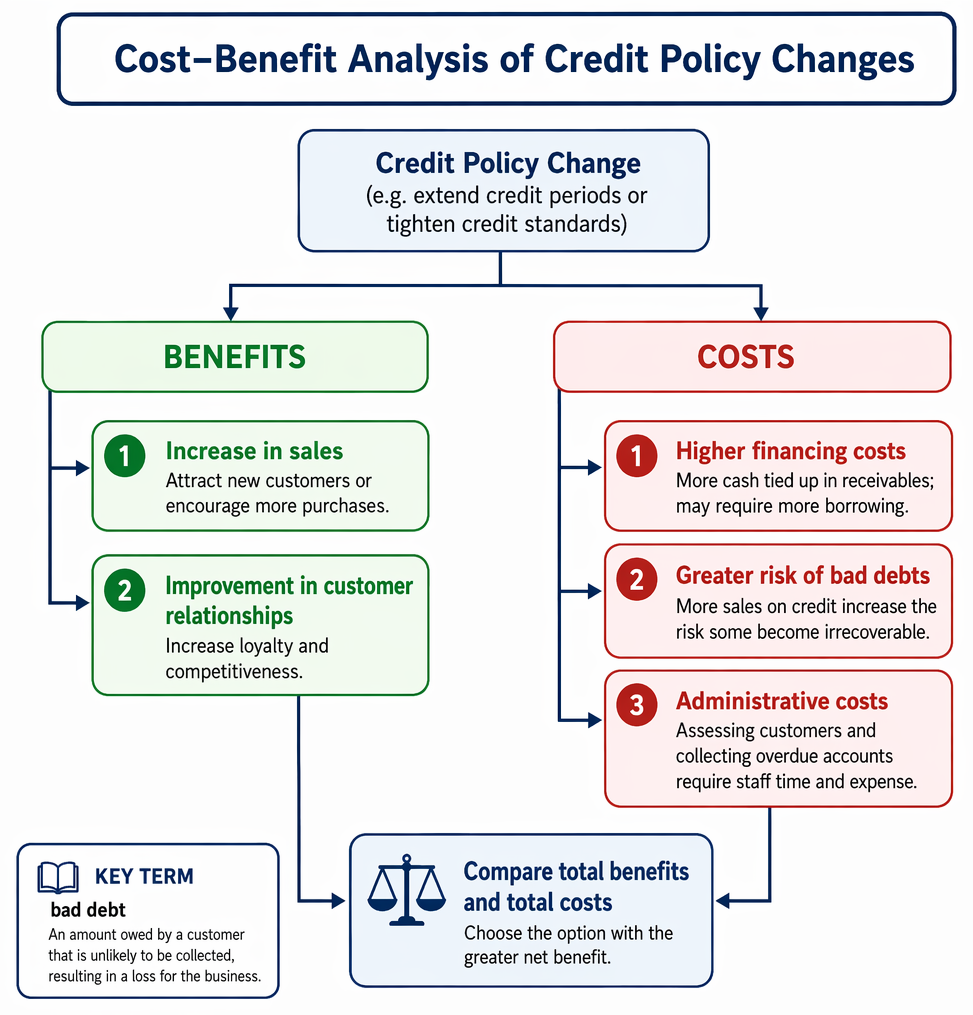
When management considers changing credit policy (for example, extending credit periods or tightening credit standards), a structured cost–benefit analysis should be applied. The main areas to analyse are:
Credit policy is grouped into credit terms, collection procedures, sales and liquidity objectives, relaxation trade-offs, and customer assessment techniques.
Benefits
- Increase in sales: More generous credit terms may attract new customers or encourage existing customers to purchase more.
- Improvement in customer relationships: Flexible credit may increase loyalty and competitiveness.
Costs
- Higher financing costs: Longer credit periods mean more cash is tied up in receivables, possibly leading to increased borrowing.
- Greater risk of bad debts: More sales on credit can lead to greater risk that some will become irrecoverable.
- Administrative costs: Assessing customers and collecting overdue accounts require staff time and expense.
Key Term: bad debt
An amount owed by a customer that is unlikely to be collected, resulting in a loss for the business.
METHODS FOR ASSESSING POLICY IMPACT
To decide whether a credit policy change is justified, the anticipated increase in gross profit from extra sales must be compared with any rise in costs. The analysis usually requires estimated figures for:
- Additional contribution from higher sales
- Extra losses from bad debts
- Additional financing costs due to higher receivables
Worked Example 1.1
A company currently offers 30-day credit. Management is considering extending this to 60 days, expecting sales to rise by $50,000 per year. The gross margin is 40%. Bad debts are forecast to increase from 1% to 2% of sales, and the average receivables balance would increase by $8,000. Finance costs on funds tied up in receivables are 10% per annum.
Should the policy be changed?
Answer:
Calculate additional annual gross profit: $50,000 × 40% = $20,000 Additional bad debts: New (2% × $100,000 + $50,000) = $3,000 Old (1% × $100,000) = $1,000 Increase = $3,000 − $1,000 = $2,000 Extra finance cost: $8,000 × 10% = $800 Net gain = $20,000 − $2,000 (bad debts) − $800 (finance) = $17,200 As the net benefit is positive, the policy change may be justified.
Additional Considerations
While increased sales and profits are attractive, non-financial aspects—such as customer expectations, competitive pressures, and collection efficiency—should also be weighed. Policy changes may affect customer mix, working capital needs, and risk.
Worked Example 1.2
The finance manager proposes tightening approval criteria, expecting a 5% drop in sales but a halving of bad debts and a 20% decrease in receivables. Gross margin on lost sales is $10,000. Saving from lower bad debts is $8,000 and finance cost savings are $1,000.
Should the company tighten policy?
Answer:
Loss of gross profit: $10,000 Savings from reduced bad debts: $8,000 Savings from financing: $1,000 Net change: $8,000 + $1,000 − $10,000 = -$1,000 The net effect is a $1,000 decrease in profit, so the change may not be justified based on these figures.
CREDITWORTHINESS AND CUSTOMER ASSESSMENT
Assessing the risk of non-payment is essential. Methods include:
- Reviewing customer financial statements
- Credit scoring and external ratings
- Monitoring payment history
A balanced approach means not turning away profitable sales without good reason, but also not exposing the business to undue loss.
Key Term: receivables
Amounts owed to a business by customers arising from credit sales.
Summary
Businesses must carefully balance the benefits of increased credit sales against the risks and costs from higher receivables and bad debts. Structured cost–benefit analysis provides a framework for objective decision-making. Financial maths should be supported by practical and competitive considerations.
Key Point Checklist
This article has covered the following key knowledge points:
- Identify typical components of a business credit policy
- List major benefits and costs of changing credit terms
- Use cost–benefit analysis to compare the effects of credit policy adjustments
- Calculate and interpret the impact on profit and cash flow for exam-style scenarios
- Explain the role of customer assessment in minimizing credit losses
Key Terms and Concepts
- credit policy
- cost–benefit analysis (CBA)
- bad debt
- receivables