Learning Outcomes
After studying this article, you will be able to outline key steps in collecting overdue debts, explain the typical procedures for monitoring accounts and escalating collection, and describe methods for resolving disputes. You will also be able to identify common legal actions available for debt recovery and match these procedures to best practice and ACCA exam requirements.
ACCA Foundations in Financial Management (FFM) Syllabus
For ACCA Foundations in Financial Management (FFM), you are required to understand the practical measures organisations undertake to collect overdue debts and manage disputes. In particular, you should be confident in:
- The key steps in monitoring customer accounts and identifying overdue balances
- The procedures for issuing reminders, demands, and escalating to legal action for debt recovery
- The methods available for resolving disputes, including negotiation and mediation
- The legal remedies available to creditors in the event of non-payment
- The impact of dispute resolution and collection actions on the accounting records
Test Your Knowledge
Attempt these questions before reading this article. If you find some difficult or cannot remember the answers, look more closely at that area during your revision.
-
What is the usual first step when a payment from a customer becomes overdue?
- a) Instantly commence legal proceedings
- b) Write off the balance
- c) Send a polite reminder requesting payment
- d) Report to the credit reference agency
-
Briefly name two options available to a business if a customer formally disputes their invoice.
-
True or false? Legal action is always required to resolve an overdue account.
-
What effect does a bad debt write-off have on the statement of profit or loss?
Introduction
Organisations selling goods or services on credit must routinely monitor customer payments and take action when debts become overdue. Prompt and effective collection procedures are important, both to maintain cash flow and manage financial risk. Sometimes, customers may dispute part or all of an invoice, which adds complexity to collection. Understanding the sequence of actions for both collecting accounts and resolving disagreements is essential for ACCA exam success.
MONITORING ACCOUNTS AND IDENTIFYING OVERDUE DEBTS
The first step in effective collection is to systematically monitor accounts. Many organisations use an aged receivables analysis to highlight overdue balances and identify slow-paying customers.
Key Term: aged receivables analysis
A report breaking down outstanding customer debts by the length of time overdue, used for monitoring and prioritising collection efforts.
When a customer misses a payment deadline, clear procedures guide how the business should respond.
STANDARD COLLECTION PROCEDURES
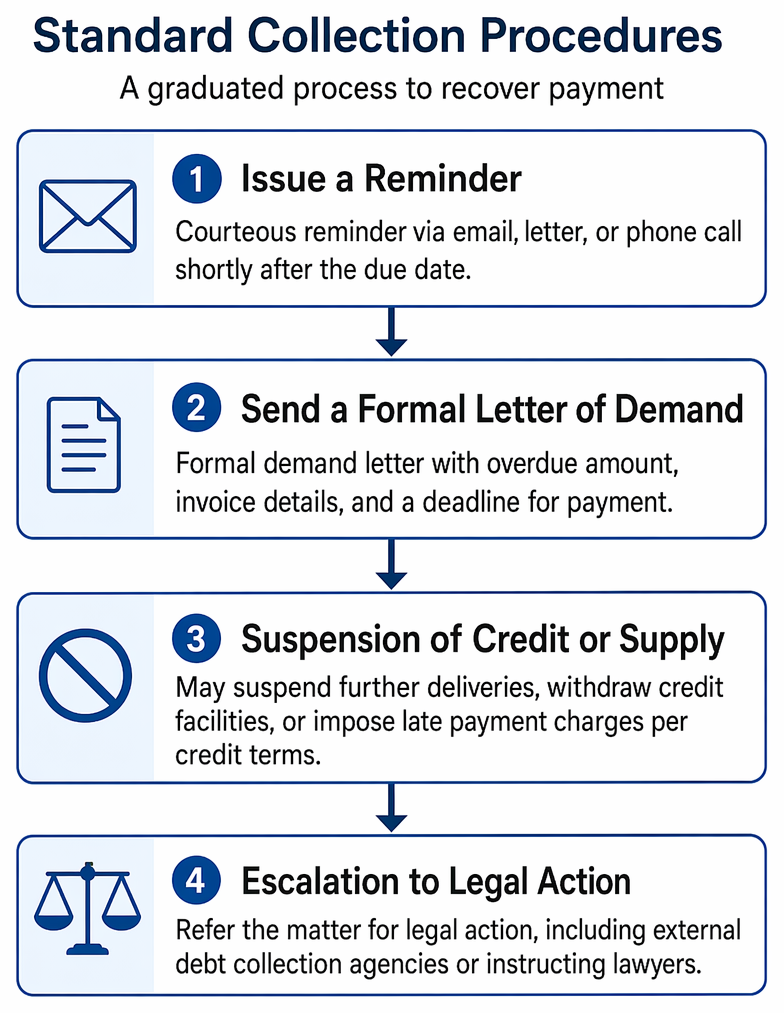
Collection typically follows a graduated process, increasing in urgency at each step. The aim is to recover payment while preserving the commercial relationship if possible.
Overdue account disputes are addressed through clarification, supporting documentation, negotiated settlement, optional mediation, and legal action where unresolved.
Step 1: Issue a Reminder
A courteous reminder is sent shortly after the due date. This contact may be an email, letter, or phone call, giving the customer an opportunity to pay or to explain the delay.
Step 2: Send a Formal Letter of Demand
If the account remains unpaid, a formal demand letter is issued. This includes details of the overdue amount, the relevant invoice(s), and a deadline for payment.
Key Term: letter of demand
A formal written communication requesting payment of an overdue debt, usually specifying the consequences of non-payment.
Step 3: Suspension of Credit or Supply
Continued non-payment may lead to suspension of further deliveries, withdrawal of credit facilities, or imposition of late payment charges according to the original credit terms.
Step 4: Escalation to Legal Action
If payment is still not received, the business may refer the matter for legal action. This can include involving external debt collection agencies or instructing lawyers.
Key Term: debt recovery
The process of collecting unpaid debts, which may escalate from internal procedures to legal remedies in court.
RESOLVING DISPUTED ACCOUNTS
Sometimes, a customer disputes an invoice or denies liability for all or part of a debt. Disputes should be addressed promptly to avoid unnecessary delays and costs.
Internal Resolution
The usual first step is to clarify the nature of the dispute. This may involve reviewing records, discussing the customer’s concerns, and providing supporting documentation. Many issues can be settled bilaterally through open communication.
Key Term: dispute resolution
The processes used to resolve disagreements between parties, such as negotiation, mediation, or formal legal proceedings.
Alternative Dispute Resolution
If direct negotiation is unsuccessful, parties may use alternative dispute resolution (ADR) such as mediation. This is a structured, non-binding process led by a neutral third party, aiming to help both sides reach a mutually acceptable solution.
Key Term: mediation
A voluntary process in which a neutral mediator assists disputing parties to reach agreement, without imposing a binding decision.
TAKING LEGAL ACTION OVER NON-PAYMENT
If standard collection and negotiation fail, legal action is an option. This usually involves issuing a claim in the courts for the debt. The court can order the customer to pay and, if necessary, enforce the judgment by seizing assets or income.
Key Term: judgment
A formal decision issued by a court requiring the debtor to pay the overdue amount, which can be enforced if payment is still not received.
Legal proceedings should be a last resort due to their cost and potential to harm customer relationships.
Worked Example 1.1
A company supplies goods to Epsilon Ltd, offering 30 days’ credit. Two weeks after the due date, Epsilon Ltd has not paid and does not respond to initial reminders. What practical steps should the company take before considering legal action?
Answer:
The company should first send a formal letter of demand outlining the overdue amount, the invoice details, and a final deadline for payment. They may then suspend further deliveries or credit if the account remains unpaid. If Epsilon Ltd still fails to respond, and all internal and negotiation options have been exhausted, legal action or referral to a collection agency may be considered.
Worked Example 1.2
MegaSales Ltd’s customer, EcoHome, claims that an invoice includes goods which were never delivered, but the delivery receipt is signed. How should MegaSales Ltd respond?
Answer:
MegaSales Ltd should contact EcoHome to discuss the claim and provide copies of delivery documentation. If the issue remains unresolved, both parties could agree to mediation before escalating further. Only after all other avenues are exhausted should legal action be contemplated, as it may be time-consuming and costly.Exam Warning: Be careful: The exam may ask you to distinguish between the process of collection (for undisputed debts) and dispute resolution (where the customer contests liability). Merely sending repeated payment reminders will not resolve a genuine dispute and is not a substitute for addressing any reasoned complaint.
RECORDING BAD DEBT AND SETTLEMENT
When a debt is determined to be irrecoverable, it must be written off in the accounts. This reduces receivables and is recognised as an expense in the statement of profit or loss.
Key Term: bad debt write-off
An accounting entry that removes an amount from trade receivables because recovery is no longer expected, with the expense recorded in profit or loss.
Partial settlements or agreed compromises should also be recorded, with supporting documentation verifying the outcome.
Revision Tip: For the exam, ensure you know the required documentation at each stage—reminders, demand letters, evidence for disputes, and legal proceedings. Clear records support accurate accounting and may be required as evidence in court.
Summary
Effective monitoring and prompt action are essential to recover overdue debts and minimise losses. Collection typically escalates from reminders to formal demands, credit withdrawal, and finally legal action. Disputes must be investigated and resolved through communication or mediation before considering the courts. Written-off bad debts are expensed and reduce receivables.
Key Point Checklist
This article has covered the following key knowledge points:
- The steps in monitoring accounts and issuing reminders for overdue debts
- The graduated collection process, including formal demands and legal action
- Methods for dispute resolution, such as negotiation and alternative dispute resolution
- The recording of irrecoverable debts in the accounting records
- The differences between collection procedures for undisputed and disputed debts
Key Terms and Concepts
- aged receivables analysis
- letter of demand
- debt recovery
- dispute resolution
- mediation
- judgment
- bad debt write-off