Learning Outcomes
After reading this article, you will be able to calculate the cost of debt for both irredeemable and redeemable instruments, explain the post-tax adjustment, and integrate these calculations into the weighted average cost of capital (WACC). You will also be equipped to define and apply relevant terms, describe investor and company viewpoints, and avoid common calculation errors in the ACCA FM exam context.
ACCA Financial Management (FM) Syllabus
For ACCA Financial Management (FM), you are required to understand the computation and significance of the cost of debt and its role in the overall cost of capital. Specifically, you should focus your revision on:
- Calculating the cost of irredeemable and redeemable debt, post-tax, for the company and for investors
- Distinguishing between pre-tax and post-tax debt yields
- Understanding the effect of tax relief on interest payments
- Calculating WACC using correct market or nominal value weightings
- Recognising the place of different debt instruments in WACC construction
Test Your Knowledge
Attempt these questions before reading this article. If you find some difficult or cannot remember the answers, look more closely at that area during your revision.
-
Which of the following formulas correctly gives the post-tax cost of irredeemable debt to a company?
- a) Coupon rate / Market value
- b) Coupon rate × (1 – tax rate) / Market value
- c) Market value / Coupon rate
- d) Coupon rate × (1 + tax rate) / Market value
-
True or false? The market value of redeemable debt is the present value of all future interest payments and the redemption payment, discounted at the investor’s required return.
-
Briefly explain why tax must be considered when calculating the cost of debt for WACC purposes.
-
What distinguishes irredeemable from redeemable debt in terms of valuation and cost of capital calculation?
-
A company issues 10% loan notes redeemable at nominal value in 5 years, trading ex-interest at $96. If the corporate tax rate is 25%, outline the key steps to find the post-tax cost of debt.
Introduction
For ACCA Financial Management, calculating the cost of debt and integrating it into WACC is an essential exam skill. Debt can take different forms—some pay interest forever (irredeemable), while others are eventually repaid (redeemable). Understanding both how tax impacts these costs and how to calculate WACC is fundamental: the correct formula and a clear understanding of investor and company viewpoints are just as important as the numbers themselves. Mistakes here often cost valuable marks.
Key Term: cost of debt
The effective rate a company pays to service its debt, expressed as a percentage, either pre- or post-tax, and used in WACC calculation. Key Term: irredeemable debt
Debt that pays a constant stream of interest payments in perpetuity, with no scheduled repayment of principal. Key Term: redeemable debt
Debt that is repaid on a specified future date, with periodic interest payments until that point. Key Term: weighted average cost of capital (WACC)
The average rate a company must pay to all its long-term finance providers, weighted by the market values of each source.
Cost of Debt: Investor’s Return vs. Company’s Cost
Debt providers and companies view the cost of debt differently:
- The investor focuses on the yield or return received.
- The company’s true cost is reduced by tax relief, as interest payments are generally tax-deductible.
Always distinguish between:
- Pre-tax cost of debt (investor’s required return/yield)
- Post-tax cost of debt (cost to the company, used in WACC)
Key Term: pre-tax cost of debt
The yield or required return received by the debt investor, not accounting for any tax relief available to the company. Key Term: post-tax cost of debt
The actual cost to the company after accounting for tax relief on interest payments.
The effect of tax
Because interest is tax-deductible, companies benefit from lower effective costs. The adjustment is always:
However, for redeemable debt, the full calculation requires discounting post-tax interest flows.
Calculating the Cost of Irredeemable Debt
Irredeemable debt pays fixed interest forever with no repayment of principal.
-
For investors, the yield is:
-
For the company, after tax relief:
Worked Example 1.1
Question: A company issues $100,000 8% irredeemable loan notes trading at $75 ex-interest. The corporation tax rate is 30%. What is the (a) pre-tax, and (b) post-tax cost of this debt?
Answer:
(a) Pre-tax cost = $8 / $75 = 10.67% (b) Post-tax cost = $8 × (1 – 0.3) / $75 = $5.60 / $75 = 7.47%Exam Warning: When calculating the company’s cost of debt for WACC, always use the post-tax cost of debt. The investor’s yield is NOT relevant for WACC.
Calculating the Cost of Redeemable Debt
Redeemable debt is repaid at a fixed date in the future; the investor receives interest and then principal.
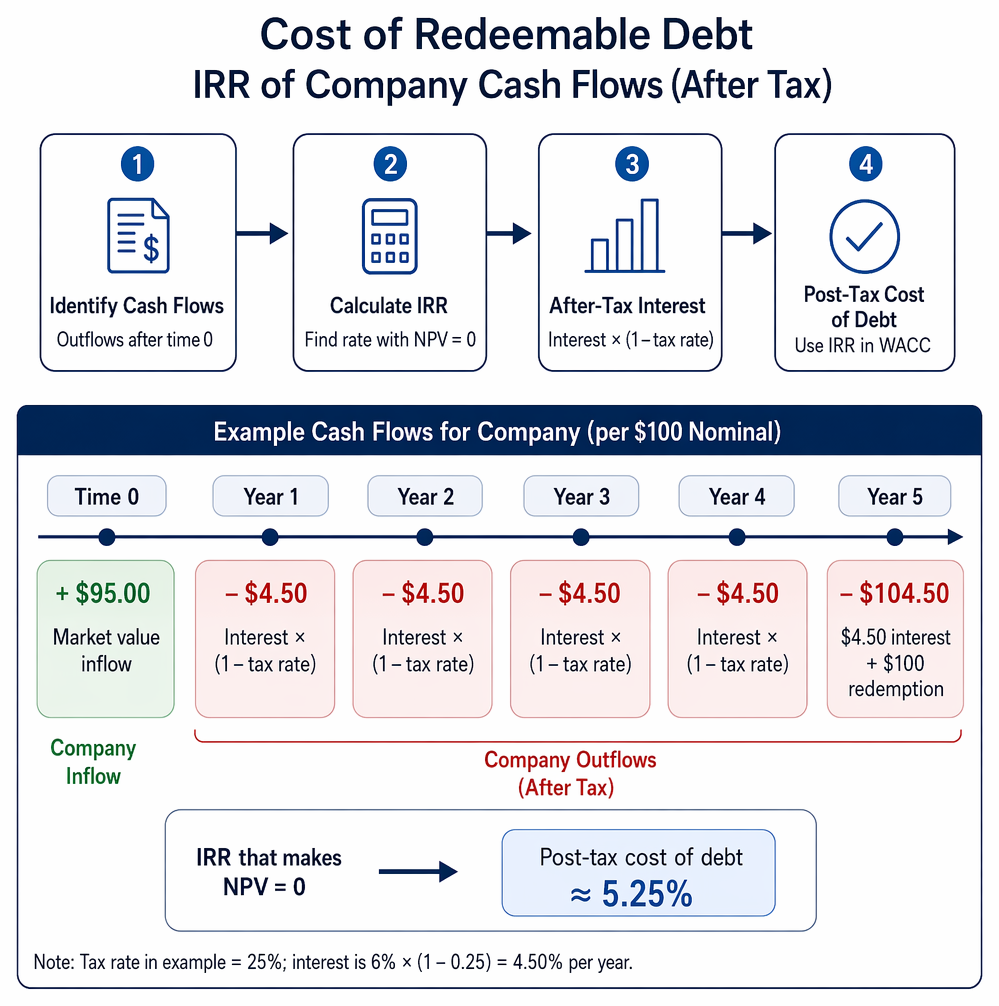
Redeemable debt calculation presents input collection, post-tax cash-flow construction, IRR estimation, NPV checking, and cost of debt derivation for WACC.
The cost is found by calculating the internal rate of return (IRR) on the net cash flows:
- At time 0: market value (cash outflow from investor’s viewpoint)
- At each period: annual interest (or annual interest × (1 – tax rate) for company’s post-tax cost)
- At redemption: repayment amount
For the company, use the after-tax interest in the calculation.
Step-by-step for redeemable debt
-
Identify cash flows:
- Time 0: Outflow = amount received from sale of debt (market value)
- Years 1–n: Inflows = annual interest (multiply by (1–tax rate) for company cost)
- Year n: Inflow = redemption value
-
Calculate the IRR yielding NPV = 0.
Worked Example 1.2
Question: A company issues $1,000,000 6% five-year loan notes at $95 per $100 nominal, redeemable at par. Corporate tax is 25%. What is the post-tax cost of debt?
Answer:
- Cash flows for company (per $100 nominal):
- Time 0: +$95 (market value inflow)
- Years 1–5: –$4.50 (interest × (1–0.25) = $6 × 0.75)
- Year 5: –$100 (redemption at nominal value)
- Calculate IRR using these flows (spreadsheet or two-guess linear interpolation). Suppose IRR = 5.25% (shown for illustration). This is the post-tax cost to use in WACC.
The Weighted Average Cost of Capital (WACC)
WACC combines the cost of all sources of long-term finance, weighted by their market values. For WACC:
- Use post-tax cost of debt
- Use market values where possible
where: E = market value of equity D = market value of debt = cost of equity = cost of debt (yield or IRR) T = tax rate
Worked Example 1.3
A company has $2 million equity (market value), $1 million 8% irredeemable debt (market value $80 per $100 nominal), and pays tax at 20%. Cost of equity is 12%. Calculate WACC.
Answer:
Cost of debt (post-tax) = $8 × (1–0.2) / $80 = $6.40 / $80 = 8.0% WACC = [$2m / $3m] × 12% + [$1m / $3m] × 8.0% = 8% + 2.67% = 10.67%Revision Tip: For exam efficiency, learn to set out debt cost calculations clearly, explicitly noting tax adjustments, especially for redeemable instruments.
Summary
Calculating the cost of debt for WACC relies on correctly identifying the instrument type, applying post-tax adjustments, and reflecting the market value of outstanding debt. Irredeemable debt uses a perpetuity formula; redeemable debt requires IRR techniques. Always use post-tax costs in WACC, not investor yields.
Key Point Checklist
This article has covered the following key knowledge points:
- Calculate the cost of irredeemable and redeemable debt for both investors and companies
- Adjust for tax relief when finding the company’s true cost of debt
- Use the appropriate formula for each debt type, including IRR for redeemable debt
- Apply post-tax cost of debt in WACC calculations
- Weight equity and debt using market values to compute WACC
Key Terms and Concepts
- cost of debt
- irredeemable debt
- redeemable debt
- weighted average cost of capital (WACC)
- pre-tax cost of debt
- post-tax cost of debt