Learning Outcomes
After reading this article, you will be able to define and distinguish the four main cost behaviour types: fixed, variable, semi-variable, and stepped costs. You will interpret cost behaviour from tables and graphs, calculate cost per unit at different activity levels, and apply the high-low method to separate mixed costs into their fixed and variable components. This foundational understanding of cost behaviour prepares you for more advanced applications in budgeting and cost-volume-profit analysis.
ACCA Management Accounting (MA) Syllabus
For ACCA Management Accounting (MA), you are required to understand how costs are classified and behave with changes in activity. Focus revision on the following syllabus points:
- The concept of cost and cost objects, cost units, and cost centres
- Classification of costs by behaviour: fixed, variable, semi-variable, and stepped costs
- The importance of cost behaviour in planning, budgeting, and decision making
- Interpretation of cost behaviour using tables and graphical methods
- Differentiation between direct, indirect, production and non-production costs
- Use of high-low and other methods to split costs into their elements
Test Your Knowledge
Attempt these questions before reading this article. If you find some difficult or cannot remember the answers, look more closely at that area during your revision.
-
Which of the following best describes a stepped fixed cost?
- a) Stays absolutely constant regardless of output
- b) Increases in direct proportion with every unit output
- c) Is fixed only within certain activity ranges, then jumps to a new fixed level
- d) Falls per unit as output increases, but total remains constant
-
Classify the following as fixed, variable, semi-variable, or stepped cost:
- Factory supervisor salaries (one supervisor per 50 staff)
- Electricity bill with monthly standing charge plus usage fee
- Raw material costs (no discounts)
-
True or false? The variable cost per unit changes as output increases.
-
You observe the following costs for two production levels: 100 units, $3,000; 300 units, $5,400. What is the variable cost per unit using the high-low method?
Introduction
Cost classification is essential for decision making, budgeting, control, and inventory valuation. Understanding how costs behave in response to changes in activity allows you to predict, analyse, and control costs effectively. Costs are typically classified as fixed, variable, semi-variable, or stepped, each with unique attributes. ACCA exam questions often require you to recognise these behaviours in tables or graphs and to apply your knowledge to practical scenarios.
Test Tip: When revising Fixed, variable, semi-variable, and stepped costs, connect each definition, method, or rule to the kind of question the assessment is likely to ask.
TYPES OF COST CLASSIFICATION
Cost classification involves grouping costs according to shared characteristics. The main bases used by management accountants are:
- By element: materials, labour, expenses
- By function: production, administration, selling, finance
- By nature: direct or indirect
- By behaviour: how cost changes with activity
This article covers cost behaviour, focusing on fixed, variable, semi-variable, and stepped costs.
Key Term: cost behaviour
The way in which a cost changes in response to changes in an activity level, such as production output.
FIXED COSTS
Fixed costs remain constant in total within a defined range of activity (known as the relevant range), regardless of changes in output. As output increases, fixed cost per unit falls because the same total is spread over more units.
Examples: Factory rent, salaried managers, insurance premiums.
Graphical Representation
- Total fixed cost: horizontal line across activity levels.
- Fixed cost per unit: downward curve as output rises.
Key Term: fixed cost
A cost that does not change in total as activity increases or decreases within the relevant range.
Worked Example 1.1
A company pays $12,000 annually for machine depreciation, regardless of production. What is the fixed cost per unit if 1,000 units are produced? What if production rises to 3,000 units?
Answer:
At 1,000 units: $12,000 / 1,000 = $12 per unit At 3,000 units: $12,000 / 3,000 = $4 per unit
VARIABLE COSTS
Variable costs increase or decrease in direct proportion to changes in activity. The total variable cost rises as each additional unit is produced, but the cost per unit remains constant.
Examples: Direct materials, wages for production workers paid per unit.
Graphical Representation (Variable Costs)
- Total variable cost: straight, upward-sloping line.
- Variable cost per unit: horizontal line (cost per unit does not change).
Key Term: variable cost
A cost that changes in total in direct proportion to changes in output or activity, but remains constant per unit.
Worked Example 1.2
A product uses a raw material that costs $5 per unit. What is the total variable cost at outputs of 100, 200, and 400 units?
Answer:
At 100 units: $5 × 100 = $500 At 200 units: $5 × 200 = $1,000 At 400 units: $5 × 400 = $2,000
SEMI-VARIABLE COSTS
Semi-variable costs (also called mixed costs) have both a fixed and a variable component. The cost increases as activity rises, but not in direct proportion.
Examples: Utility bills with a fixed standing charge plus usage charges, sales rep salaries plus commission.
Key Term: semi-variable cost
A cost containing both fixed and variable elements, changing with activity but not strictly in proportion.
Worked Example 1.3
A telephone plan charges $30 per month plus $0.10 per call. If a business makes 300 calls in June, what is the total and per-call cost?
Answer:
Total = $30 + (300 × $0.10) = $60 Cost per call = $60 ÷ 300 = $0.20
Splitting Semi-variable Costs
The high-low method is a common exam technique for splitting a semi-variable cost into its components using two data points.
- Variable cost per unit = (Cost at high output – Cost at low output) / (High output – Low output)
- Fixed cost = Total cost at high (or low) activity – (Variable cost per unit × activity level)
STEPPED FIXED COSTS
Stepped (step) fixed costs are fixed within certain ranges of activity. When activity exceeds a threshold, the cost jumps up to a new, higher fixed amount.
Examples: Needing an extra supervisor for every 40 workers, renting another warehouse after reaching capacity.
Key Term: stepped fixed cost
A cost that remains fixed over a certain level of activity, but increases in steps when capacity limits are reached.
Worked Example 1.4
A business pays $20,000 per year for a production supervisor for every 300 units produced. If 650 units are produced, what is the total supervisor cost?
Answer:
650 units means 3 supervisors (as 601–900 units requires 3), so cost is 3 × $20,000 = $60,000.Exam Warning: Stepped costs may appear fixed until a capacity threshold is crossed. Always check output levels in questions to see if a step change applies.
COST GRAPHS AND INTERPRETATION
Exam questions often display cost information in table or graph form and ask you to identify cost behaviour. Remember:
- Fixed cost: total cost is horizontal, per unit cost falls as output increases.
- Variable cost: total cost is a straight upward line from zero, per unit cost is flat.
- Semi-variable cost: total cost line starts at a fixed point and rises (but not strictly proportionally).
- Stepped cost: total cost remains horizontal, then jumps at certain points.
RELEVANCE OF COST BEHAVIOUR TO DECISION MAKING
Cost behaviour informs:
- Budgeting: anticipating how costs will change with activity
- Forecasting: estimating profit at different volumes
- Identifying cost drivers: targeting areas for savings
- Decision support: costing new products, pricing, make-or-buy analysis
Key Term: relevant range
The level of activity over which cost behaviour assumptions remain valid, such as the range before a stepped fixed cost changes.
COMPARISON SUMMARY TABLE
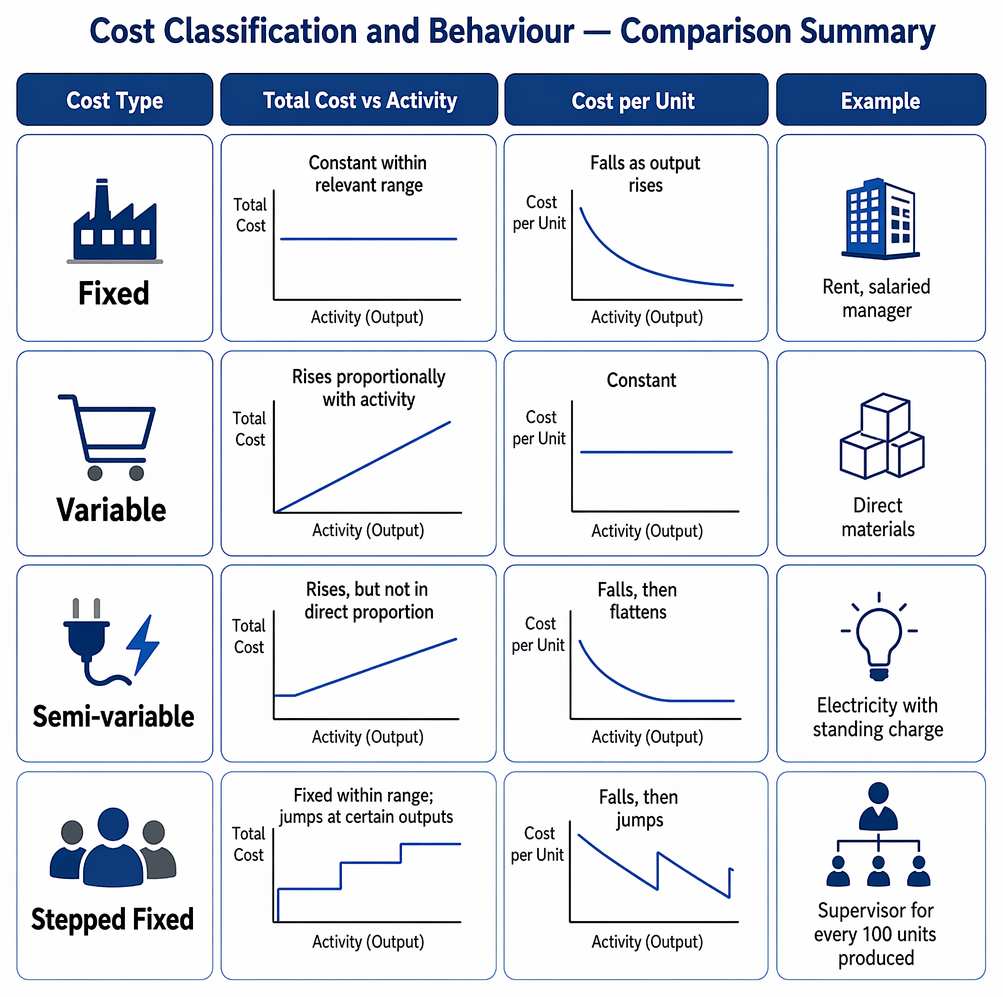
High-low cost estimation calculates variable cost, derives fixed cost, formulates total cost, and supports planning, control, and decisions.
| Cost Type | Total Cost vs Activity | Cost per Unit | Example |
|---|---|---|---|
| Fixed | Constant within relevant range | Falls as output rises | Rent, salaried manager |
| Variable | Rises proportionally with activity | Constant | Direct materials |
| Semi-variable | Rises, but not in direct proportion | Falls, then flattens | Electricity with standing charge |
| Stepped Fixed | Fixed within range; jumps at certain outputs | Falls, then jumps | Supervisor for every 100 units produced |
Key Point Checklist
This article has covered the following key knowledge points:
- Fixed, variable, semi-variable, and stepped cost classifications
- Calculation and interpretation of cost behaviour in tables and graphs
- The impact of cost behaviour on budgeting and decision making
- Use of the high-low method to split semi-variable costs
- The concept of relevant range and its importance
- Typical examples of each cost behaviour type
Key Terms and Concepts
- cost behaviour
- fixed cost
- variable cost
- semi-variable cost
- stepped fixed cost
- relevant range