Learning Outcomes
After reading this article, you will be able to explain why organisations use budgets and identify the main types of budgets used for planning and control. You will be able to recognise the significance of budget assumptions, the content and function of a budget manual, and how timetables structure the budget process. You should be able to outline the steps of budget preparation and identify good budgeting practice as required by the ACCA syllabus.
ACCA Management Accounting (MA) Syllabus
For ACCA Management Accounting (MA), you are required to understand the role of budgets in planning and control, recognise different types of budgets, and explain the administrative procedures that support the budgeting process. Revision should focus on:
- Explaining the purpose of budgeting within organisations
- Describing the main types of budgets (such as sales, production, and cash)
- Outlining key supporting documents: budget assumptions and budget manuals
- Understanding the significance of budget timetables in coordinating the budgeting cycle
- Detailing the steps required in preparing functional and consolidated budgets
- Recognising good practices in budget preparation and control cycles
Test Your Knowledge
Attempt these questions before reading this article. If you find some difficult or cannot remember the answers, look more closely at that area during your revision.
- What is the main purpose of a budget manual within an organisation?
- Which of the following best describes a budget timetable?
- a) A summary of budgeted income and expenditure
- b) A schedule for when each budget should be prepared and reviewed
- c) A set of assumptions used for preparing budgets
- d) A report of actual versus budgeted results
- True or false? All budgets are financial forecasts, and must always be expressed in monetary terms.
- List two typical sections found in a functional budget.
Introduction
Budgeting is a fundamental tool used by organisations to plan for the future, control resources, and coordinate activities across departments. Budgets transform organisational goals into actionable plans by expressing targets for income, expenditure, and resource use. Effective budgeting relies not only on preparing figures, but also on using standard processes, widely communicated instructions, and clear assumptions.
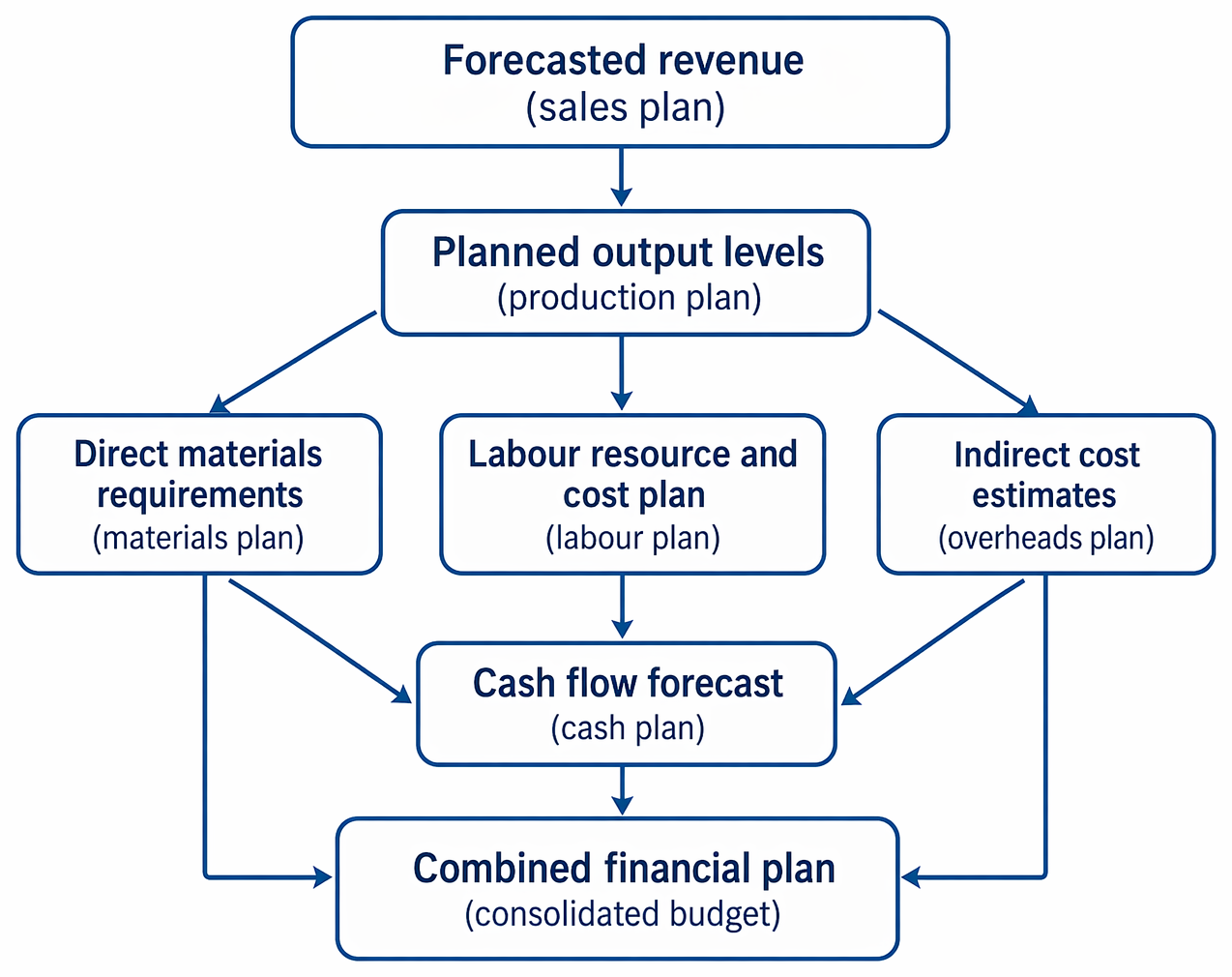
Sales, production, and functional budgets feed the cash budget and aggregate into the consolidated budget in a standard budget hierarchy.
Test Tip: When revising Budget assumptions, manuals, and timetables, connect each definition, method, or rule to the kind of question the assessment is likely to ask.
Purpose of Budgeting
Budgets serve multiple roles in organisational management:
- Planning: They provide a quantitative plan to achieve objectives.
- Coordination: Departmental activities are aligned towards the overall strategy.
- Resource allocation: Budgets help prioritise and assign resources where most needed.
- Control: Actual results can be compared with budgets to monitor performance.
- Motivation: Clearly set targets can drive performance if managed correctly.
- Communication: Budgets communicate expectations and objectives throughout the organisation.
Key Term: budget
A quantitative plan, prepared and agreed in advance, that sets out the expected income, expenditure, and use of resources for a specific period.
Types of Budgets
There are several major types of budgets, each suited to different functions and levels within the organisation:
Sales Budget
This forecasts sales volumes and prices for selected periods, forming the basis for all other functional budgets.
Production Budget
This sets out planned output levels based on expected sales and inventory policies to ensure availability of finished goods and efficient use of manufacturing resources.
Materials Usage and Purchases Budgets
These derive from production requirements, specifying the quantities of each material needed, factoring in inventory changes.
Labour Budget
This estimates workforce requirements and associated costs, based on production schedules and efficiencies.
Overheads Budget
Covers indirect costs such as utilities, maintenance, and support services for the budget period.
Cash Budget
Projects cash inflows and outflows to ensure liquidity and the capability to meet obligations.
Consolidated Budget
Brings together all functional budgets into a consolidated plan, typically presented as a budgeted income statement, statement of financial position, and cash flow summary.
Key Term: consolidated budget
The consolidated financial plan for the organisation, incorporating all subsidiary budgets, expressing expected profit, financial position, and cash flows for the period.
Budget Assumptions
Budgets are built on a set of foundational assumptions. These include forecasted sales, expected input prices, inflation rates, anticipated efficiency levels, and market trends. Stating assumptions explicitly ensures consistency between budgets and transparency for all involved.
Key Term: budget assumptions
Documented estimates and expectations about key drivers (such as sales volumes, input costs, inflation) supporting the figures in the budgets.
Worked Example 1.1
Question: A company is preparing next year's budget. They expect sales growth of 5%, labour costs to rise by 3%, and material prices to be stable. How should these be incorporated?
Answer:
The expected 5% sales growth, 3% labour cost increase, and stable material prices should be documented as formal budget assumptions and communicated to all budget preparers for consistency.
Budget Manuals
A budget manual is a key reference document in the budgeting process. It sets out the instructions, principles, and procedures for preparing budgets, detailing responsibilities, forms, submission deadlines, and approval hierarchy.
Key Term: budget manual
A written document describing budget procedures, roles, responsibilities, standard forms, timetables, and instructions for all staff involved in the budgeting process.
Budget manuals support:
- Standardisation of budgeting practices
- Clear allocation of responsibilities
- Efficient communication and coordination among departments
- Consistent application of assumptions and procedures across business units
Key Sections of a Budget Manual
Typically, a budget manual contains:
- Introduction and objectives of budgeting
- Deadlines and budget timetable
- Roles and responsibilities (including a list of budget holders and the budget committee)
- Instructions on how to prepare and submit budgets (include standard forms)
- Key assumptions and guidelines to be followed
- Procedures for reviewing, revising, and approving budgets
- Reporting templates for comparing actual to budget
Worked Example 1.2
Question: Middle managers are unsure when they should submit their budget estimates for the next year and what format to use. What should they consult?
Answer:
They should consult the budget manual for instructions, standard forms, and the submission timetable specific to their department.
Budget Timetables
A budget timetable is a schedule that specifies the sequence and deadlines for each stage of the budget preparation process. It helps ensure that budgets are prepared in the correct order—starting with principal budgets such as sales or resource-limited factors, followed by all functional budgets, and concluding with the consolidated budget.
Key Term: budget timetable
A documented schedule that sets out the timing and sequence for preparation, review, and approval of all budgets in the organisational cycle.
A typical timetable provides:
- Start and submission dates for each budget
- Coordination points between departments
- Review dates by the budget committee or senior management
- Final approval date before budgets are active
A clear timetable ensures:
- Completeness—no steps or budgets are missed
- Timeliness—budgets are ready before the period starts
- Coordination—departments align their plans for consistency
Worked Example 1.3
Question: The company's consolidated budget must be approved by November, but the sales budget is incomplete. Why is this a problem, and how does the timetable help?
Answer:
Functional budgets depend on the sales budget; without it, other departments cannot finalise their own budgets. The timetable ensures all critical steps occur in the correct order and deadlines are met for timely approval.Exam Warning: Budget questions frequently ask about the role and content of the budget manual or require you to outline the typical budget process. Never confuse a budget timetable (which is a schedule) with the budget manual (which is a process guide).
Steps in the Budget Process
The standard stages for preparing organisational budgets are:
- Issue budget timetable and instructions (Refer to the budget manual)
- Define key assumptions (State and agree core forecasts supporting the budget)
- Prepare functional budgets (Sales, production, materials, labour, overheads, cash, etc.)
- Review and coordination (Departments discuss interdependencies and resolve conflicts)
- Prepare the consolidated budget (Finance function consolidates all budgets)
- Review, approval, and adoption (Senior management or budget committee approves the final budget)
- Communicate and implement (Budgets are distributed to managers/budget holders)
Good Budgeting Practice
Effective budgeting requires:
- Use of up-to-date and realistic assumptions
- Clear and accessible budget manuals
- Well-structured timetables
- Engagement from all responsible staff
- Regular review and coordination among departments
- Clarity in roles and lines of responsibility
Key Point Checklist
This article has covered the following key knowledge points:
- The main purposes and roles of budgets in organisational management
- The principal types of budgets and their interrelationships
- The importance and documentation of budget assumptions
- The content and purpose of a budget manual in guiding procedures
- How budget timetables structure and coordinate the budgeting process
- The step-by-step procedure for preparing and approving budgets
- Good practices for effective budget preparation and use
Key Terms and Concepts
- budget
- consolidated budget
- budget assumptions
- budget manual
- budget timetable