Learning Outcomes
After completing this article, you will be able to calculate and explain simple and weighted index numbers, including the Laspeyres and Paasche indices. You will distinguish between different types of indices, understand when each is used, and interpret changes in index values. You will practise adjusting figures for price changes using indices and apply these calculations to support business analysis and ACCA exam questions.
ACCA Management Accounting (MA) Syllabus
For ACCA Management Accounting (MA), you are required to understand the role of index numbers and time series analysis in adjusting, interpreting, and comparing quantitative business data over time. Focus your revision on the ability to:
- Calculate and interpret simple index numbers for prices and quantities
- Calculate and explain weighted (multi-item) indices, including Laspeyres and Paasche indices
- Choose and apply appropriate indices for restating financial data at constant price levels
- Evaluate the advantages and limitations of different index number methods
- Adjust historical or forecast costs and revenues for price movements using indices
Test Your Knowledge
Attempt these questions before reading this article. If you find some difficult or cannot remember the answers, look more closely at that area during your revision.
- What is the formula for a simple price index, and what does a value of 140 mean if the base year index is 100?
- A business’s costs are $200,000 in Year 1 (index 120) and $240,000 in Year 3 (index 160). Has the cost increased in real terms?
- Explain the difference between the Laspeyres and Paasche index formulas.
- When would you prefer to use a weighted index number instead of a simple index?
Introduction
Business data often needs to be compared across different time periods. However, changes in prices, quantities, and economic conditions mean that direct comparisons may mislead. Index numbers allow you to track changes, adjust figures for inflation, and compare like for like. Understanding how to use index numbers—both simple and weighted, including the Laspeyres and Paasche methods—is essential for accurate analysis and effective decision making in both practical business contexts and ACCA assessments.
Key Term: index number
A statistical measure expressing a value (price or quantity) as a percentage of its value in a chosen base period.
What Are Index Numbers and Why Are They Used?
Index numbers enable decision makers to compare data over time on a common scale. They are used to:
- Show how a variable (such as price or output) changes compared to a base period
- Adjust accounting numbers for inflation or deflation
- Reveal trends or real growth by removing the effects of price changes
- Support budgeting and forecasting with more meaningful figures
Simple Index Numbers
A simple index tracks the percentage change of a single item’s value (price or quantity) in one period compared to its value in a chosen base period.
Key Term: simple index
An index number comparing a single item's value in the current period to its value in a base period, usually expressed with a base of 100.
The formula for a simple price index is:
A value above 100 means an increase; below 100 means a decrease compared to the base.
Worked Example 1.1
In 2021, the price of a raw material was $40 per unit. In 2023, it rose to $50. What is the simple price index for 2023, using 2021 as the base year?
Answer:
The index is 125, indicating a 25% increase since 2021.
Adjusting Data Using Index Numbers
Index numbers allow managers to remove the effect of price changes when comparing quantities or expenditure across different years.
To adjust a figure from one year to another's price level:
Worked Example 1.2
A company’s revenues in 2020 were $200,000 (index 120). What are these revenues expressed in 2023 terms if the price index in 2023 is 150?
Answer:
In 2023 terms, the 2020 revenue is equivalent to $250,000.
Weighted Index Numbers
Simple indices work well for single items. For a group of items (e.g., a product range or basket of goods), you need a weighted (multi-item) index. This recognises that not all items are equally important; the weight attached to each item often reflects its share of total value or volume.
Key Term: weighted index
An index number that combines changes in several items, each multiplied by a weighting reflecting its relative importance.
The Laspeyres and Paasche Indices
Both the Laspeyres and Paasche formulas are types of weighted indices, but they differ in the weights used:
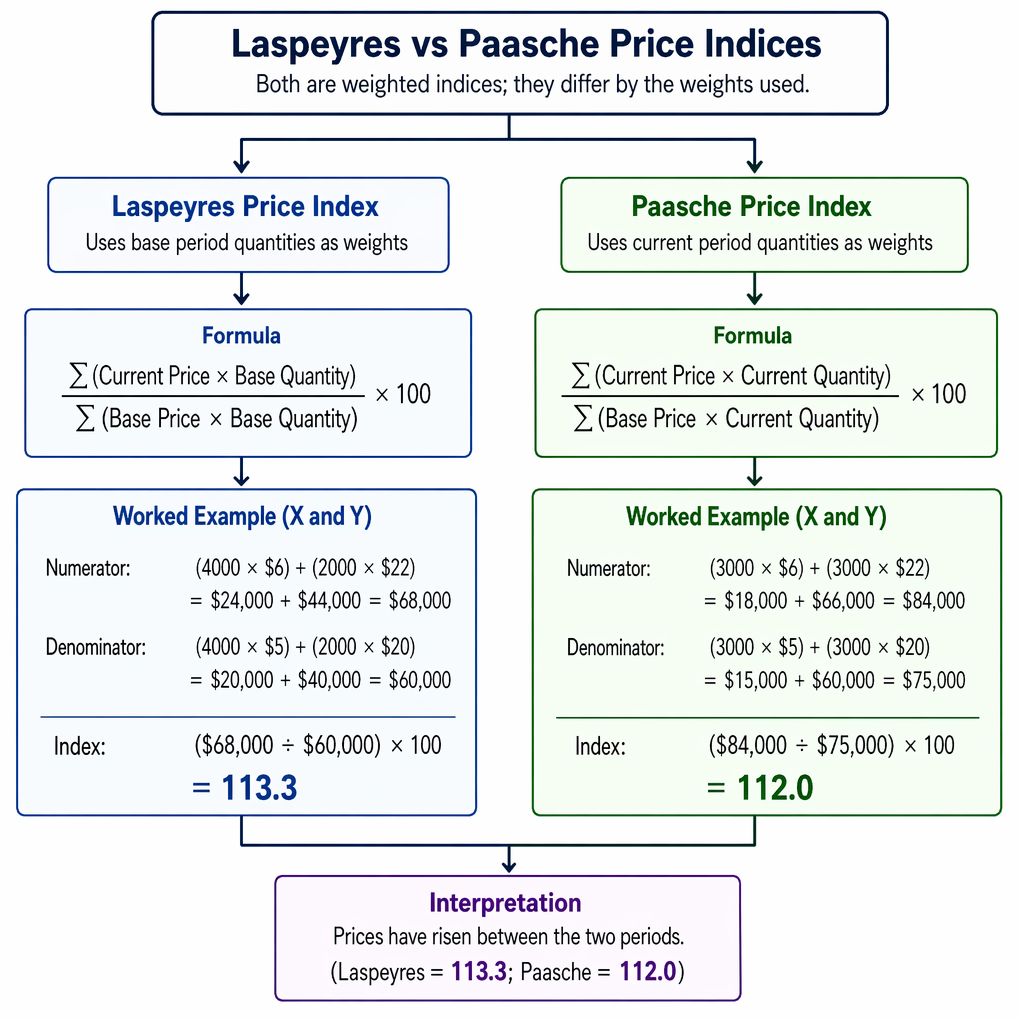
Laspeyres and Paasche index methods are classified by base or current quantity weights, alongside concise notes on their respective biases.
- Laspeyres index: uses base period quantities as weights.
- Paasche index: uses current period quantities as weights.
Key Term: Laspeyres index
A price or quantity index calculated using base period quantities as weights. Key Term: Paasche index
A price or quantity index calculated using current period quantities as weights.
Formulas
Laspeyres Price Index:
Paasche Price Index:
Worked Example 1.3
A factory uses components X and Y. The output and prices are:
| Base Year Quantity | Base Year Price | Current Quantity | Current Price | |
|---|---|---|---|---|
| X | 4000 | $5 | 3000 | $6 |
| Y | 2000 | $20 | 3000 | $22 |
Laspeyres Price Index:
- Numerator: (4000 × $6) + (2000 × $22) = $24,000 + $44,000 = $68,000
- Denominator: (4000 × $5) + (2000 × $20) = $20,000 + $40,000 = $60,000
- Index: ($68,000 ÷ $60,000) × 100 = 113.3
Paasche Price Index:
- Numerator: (3000 × $6) + (3000 × $22) = $18,000 + $66,000 = $84,000
- Denominator: (3000 × $5) + (3000 × $20) = $15,000 + $60,000 = $75,000
- Index: ($84,000 ÷ $75,000) × 100 = 112.0
Answer:
Laspeyres index = 113.3; Paasche index = 112.0. This suggests prices have risen between the two periods.
Why Use Weighted Indices?
- Simple indices ignore how much of each good is purchased—small price changes in high-quantity items can have a big impact overall.
- Weighted indices provide a more realistic measure by factoring in quantities.
Revision Tip: Calculate the numerator and denominator carefully in Laspeyres and Paasche indices. Always check if you are using base or current period quantities for weights.
When to Use Laspeyres vs Paasche
- Laspeyres is easier to calculate since base period weights are already known, but may overstate inflation if consumption changes significantly.
- Paasche uses current period weights, reflecting actual consumption patterns, but requires more data and may understate inflation if people switch to cheaper goods.
Exam Warning: Be clear on which formula is required. Wrongly mixing current and base period quantities will lead to incorrect answers in the exam.
Advantages and Limitations of Index Numbers
Benefits:
- Remove effect of inflation from business performance measures
- Allow comparison of quantities or values over time
- Facilitate real-terms budgeting and forecasting
Limitations:
- Weighted indices require accurate, up-to-date weighting information
- Different formulas can yield different results—never mix methods
- Index numbers are relative values, not absolute
Summary
Index numbers are a core tool for ACCA candidates. You must be able to calculate both simple and weighted indices, including Laspeyres and Paasche, and explain their uses in real analysis. Adjusting financial or operational data for price changes using appropriate indices ensures more meaningful comparisons and effective management decisions.
Key Point Checklist
This article has covered the following key knowledge points:
- Definitions and purpose of simple and weighted index numbers
- Application of index numbers to adjust data for price changes
- Formula and calculation steps for Laspeyres and Paasche indices
- Differences between weighted index methods
- Strengths and weaknesses of each approach
- Common errors and how to avoid them in the exam
Key Terms and Concepts
- index number
- simple index
- weighted index
- Laspeyres index
- Paasche index