Learning Outcomes
By the end of this article, you will be able to explain the consolidation procedures for preparing group financial statements under IFRS 10, determine and account for non-controlling interests (NCI), and apply consolidation steps including elimination of intra-group transactions. You will also be able to identify common exam pitfalls and justify your consolidation choices in ACCA SBR scenarios.
ACCA Strategic Business Reporting (SBR) Syllabus
For ACCA Strategic Business Reporting (SBR), you are required to understand the process of consolidating subsidiaries and the treatment of non-controlling interests. Revision should focus on:
- The requirements to prepare consolidated financial statements under IFRS 10
- Identification of 'control' for group accounting
- Consolidation steps: combining statements, elimination of intra-group balances and transactions, and calculation of goodwill
- Calculation, presentation, and allocation of non-controlling interests (NCI)
- Treatment of consolidation adjustments for fair values, pre-& post-acquisition reserves, and goodwill impairment
- Procedures for attributing profit, total comprehensive income, and equity to both parent and NCI
Test Your Knowledge
Attempt these questions before reading this article. If you find some difficult or cannot remember the answers, look more closely at that area during your revision.
-
Under IFRS 10, which of the following is a necessary condition for an investor to have 'control' over an investee?
- a) Holds more than 50% of voting rights
- b) Has rights to variable returns and can affect those returns through power over the investee
- c) Receives most of the investee’s profits
- d) Makes all key management appointments
-
What two main methods are permitted for measuring non-controlling interest (NCI) at acquisition under IFRS 3/10?
-
True or false? Intra-group sales between a parent and subsidiary must always be eliminated in consolidated statements.
-
Briefly explain how post-acquisition profits of a subsidiary are allocated between the parent and NCI.
Introduction
Consolidated financial statements present the financial position and performance of a parent and its subsidiaries as if they were a single economic entity. IFRS 10 requires consolidation when an entity controls one or more other entities. A key aspect of consolidating financial statements is the proper identification and measurement of the non-controlling interest (NCI). Accurate consolidation ensures that users of group financial statements can fairly assess the resources and results of the whole group, not just the parent.
Key Term: control
The power to govern the financial and operating policies of another entity so as to obtain benefits from its activities, usually evidenced by the ability to direct relevant decisions and exposure to variable returns.Test Tip: When revising Consolidation procedures and NCI, connect each definition, method, or rule to the kind of question the assessment is likely to ask.
The Consolidation Process: Step-by-Step
The consolidation process under IFRS 10 involves a series of logical steps designed to present the group as one entity. You must ensure that group statements reflect only transactions with parties external to the group and present net assets and results as if the group were a single company.
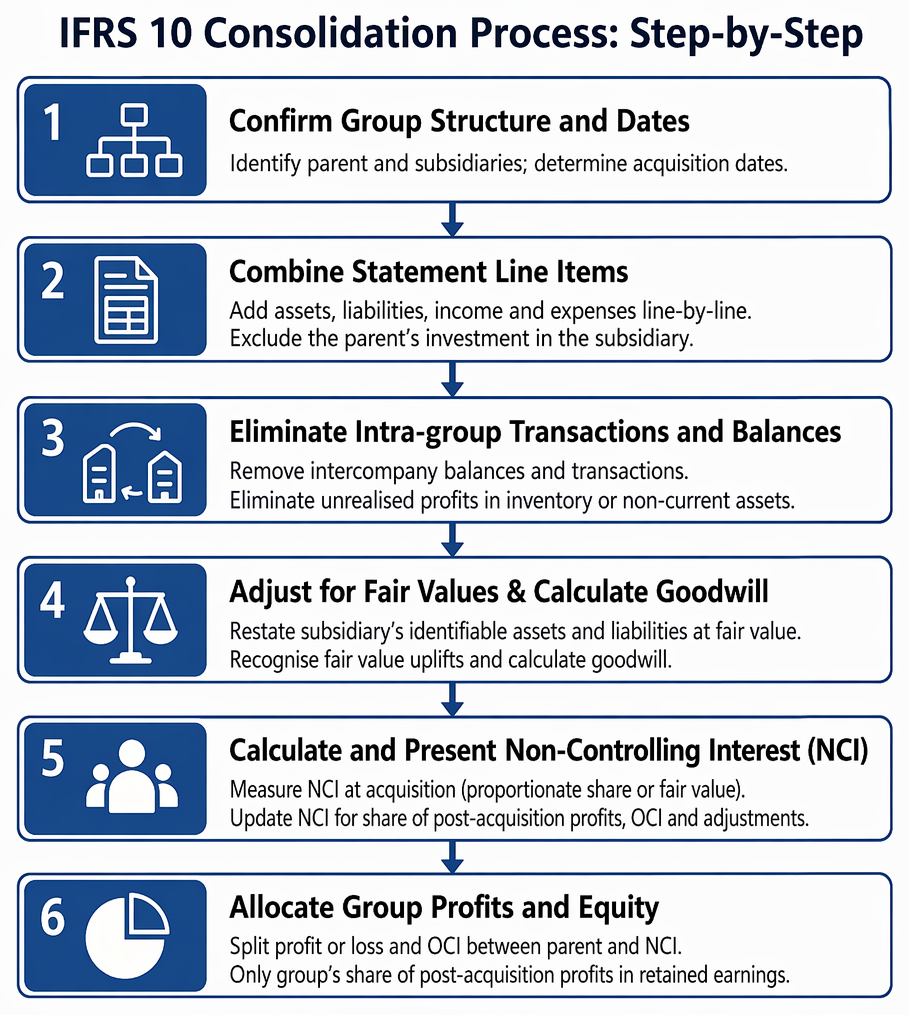
Consolidation procedures include line-by-line combination, intra-group eliminations, fair value adjustments, goodwill calculation, NCI measurement, and profit and OCI attribution.
Step 1: Confirm Group Structure and Dates
- Identify the parent and all subsidiaries based on the definition of control.
- Determine acquisition dates for all subsidiaries to identify pre- and post-acquisition reserves.
Step 2: Combine Statement Line Items
- Add together corresponding assets, liabilities, income, and expenses of the parent and all subsidiaries on a line-by-line basis.
- Exclude the investment in the subsidiary in the parent’s individual statement on consolidation.
Step 3: Eliminate Intra-group Transactions and Balances
- Remove all intercompany balances and transactions (e.g., receivables/payables, sales/purchases, intercompany dividends).
- Eliminate unrealised profits included in inventory or non-current assets due to intra-group sales.
Key Term: intra-group transactions
Transfers of assets, services, or obligations between entities within the same group, which must be eliminated on consolidation.
Step 4: Adjust for Fair Values & Calculate Goodwill
- Restate the identifiable assets and liabilities of the subsidiary at fair value as at the acquisition date for consolidation purposes.
- Recognise any fair value uplifts and associated impacts (such as higher depreciation) in group figures.
Key Term: goodwill
The excess of (a) the aggregate of the consideration transferred, NCI at acquisition, and any previously held interest over (b) the fair value of identifiable net assets acquired.
Step 5: Calculate and Present Non-Controlling Interest (NCI)
-
Measure NCI at acquisition using either:
- Proportionate share of the subsidiary’s identifiable net assets, or
- Fair value method (as stated or given in the exam scenario).
-
After acquisition, update NCI for their share of the subsidiary’s post-acquisition profits and other comprehensive income, and their share of retroactive fair value adjustments and impairments.
Key Term: non-controlling interest (NCI)
The equity in a subsidiary not attributable, directly or indirectly, to the parent.
Step 6: Allocate Group Profits and Equity
- Profit or loss and other comprehensive income must be divided into amounts attributable to the parent and to NCI.
- Only the group’s share of subsidiary post-acquisition profits is included in group retained earnings; NCI’s share increases NCI equity.
Worked Example 1.1
Scenario: ParentCo acquires 80% of SubCo on 1 January 20X1 for $1,000,000. At acquisition, SubCo’s identifiable net assets have a fair value of $1,150,000. NCI is measured using the proportionate method. By 31 December 20X1, SubCo’s equity has increased by $200,000. Calculate goodwill and the NCI at 31 December 20X1.
Answer:
Goodwill: $1,000,000 (consideration) + $230,000 (NCI: 20% × $1,150,000) – $1,150,000 = $80,000 NCI at year end: $230,000 (at acquisition) + 20% x $200,000 (post-acq. increase) = $270,000
Dealing with Intra-group Profits
If a group company sells goods or assets to another group company at a profit, any unsold inventory (or undepreciated asset) at the reporting date will contain unrealised profit. This profit must be eliminated to prevent overstatement.
- For inventory: Reduce group inventory and group profit by the unrealised amount.
- For non-current assets: Adjust depreciation/amortisation to reflect group cost.
Worked Example 1.2
Scenario: During the year, SubCo sold goods to ParentCo for $20,000 at a 25% mark-up on cost. Half the goods remain unsold at year end.
Answer:
Mark-up: 25% of cost, which is 20% of sales price. Unrealised profit = $20,000 × 50% × 20% = $2,000. Group inventory and profits are both reduced by $2,000.
Goodwill Impairment and Allocation
- Goodwill must be tested for impairment at least annually.
- Under the proportionate NCI method, only the parent’s share of goodwill is recognised and written down.
- Under the fair value NCI method, total goodwill is recognised and impairment is allocated between group and NCI based on their shareholdings.
Exam Warning: Many students incorrectly calculate NCI by ignoring the chosen measurement method, or by failing to update NCI for their share of post-acquisition profits and comprehensive income. Always read the scenario and clearly show your NCI workings.
Profit Attribution Between Parent and NCI
- Profits of the subsidiary earned after acquisition are split between the parent and NCI.
- Only post-acquisition profits are consolidated; pre-acquisition profits form part of net assets used in the goodwill calculation.
Worked Example 1.3
Scenario: A parent acquires 70% of a subsidiary mid-year. At year end, the subsidiary reports a profit of $120,000 for the year.
Answer:
Parent includes only 70% of the profit earned after acquisition date. If acquisition was exactly halfway through the year, only $60,000 relates to the group, of which 70% = $42,000 to the parent, $18,000 to NCI, and $60,000 (pre-acquisition) is ignored in profit calculations.
Common Presentation Format
In group financial statements:
- Goodwill shown as a separate asset (less impairment).
- NCI presented within equity.
- Profit for the year and total comprehensive income each attributed to parent and NCI on the face of the statements.
Summary
Group accounts prepared under IFRS 10 involve a set sequence: combine line items, eliminate intra-group amounts, adjust for fair values and unrealised profits, calculate goodwill, and present NCI clearly. Good documentation of NCI workings, correct treatment of intra-group transactions, and careful assessment of goodwill and impairment are key to accurate consolidation.
Key Point Checklist
This article has covered the following key knowledge points:
- Define ‘control’ for group consolidation under IFRS 10
- List and execute the main consolidation procedures (combine, eliminate, adjust, allocate)
- Calculate goodwill and explain the two NCI measurement methods
- Eliminate intra-group balances and unrealised profits from group financial statements
- Attribute post-acquisition profits to parent and NCI
- Present consolidated equity, NCI, and goodwill per IFRS requirements
Key Terms and Concepts
- control
- intra-group transactions
- goodwill
- non-controlling interest (NCI)