Learning Outcomes
- Understand how a counterargument can strengthen, rather than weaken, an argument essay
- Identify the difference between concession, rebuttal, and a qualified claim
- Explain how strategic counterargument improves line of reasoning and commentary on FRQ 3
- Recognise weak counterargument moves, including straw man opposition and formulaic “some people say”
- Build argument paragraphs that acknowledge an opposing view and return clearly to the thesis
- Apply counterargument techniques in ways that support Row B and sometimes Row C of the rubric
AP English Language and Composition Syllabus
For the AP English Language and Composition, you are expected to understand how writers develop arguments through claims and evidence, with a focus on the following syllabus points:
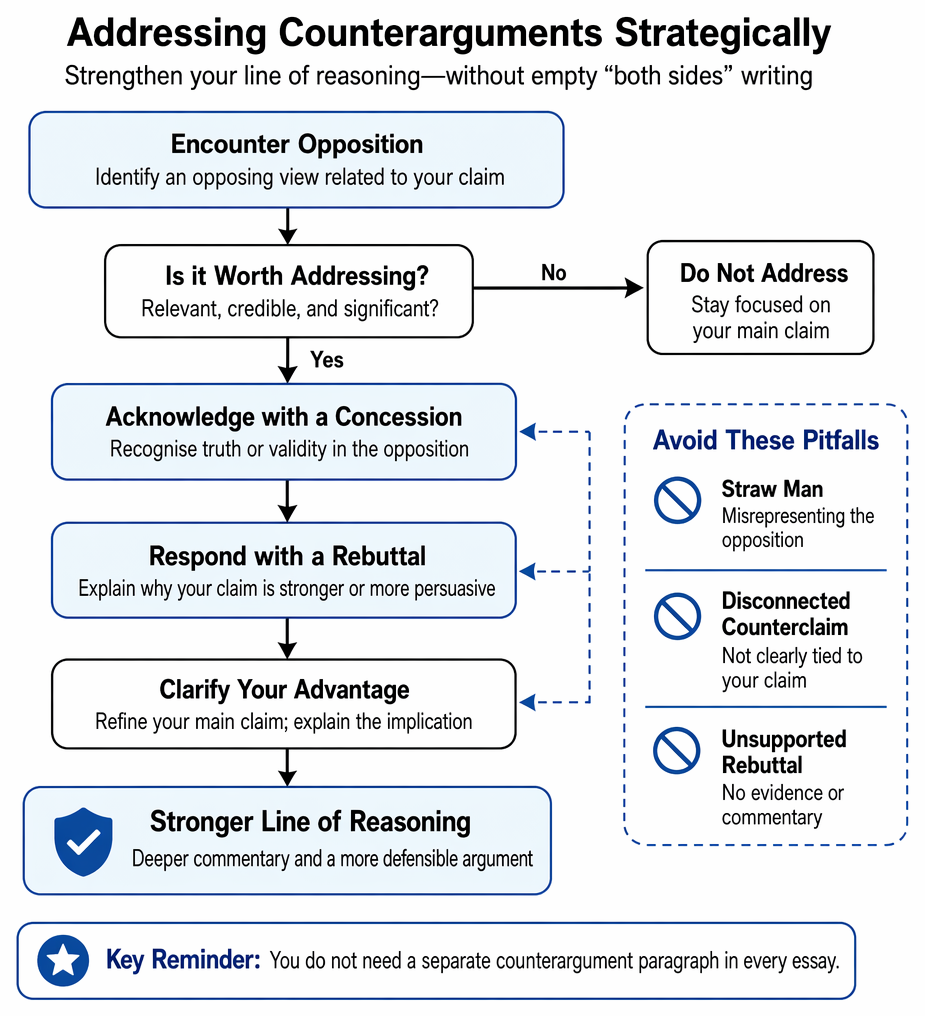
Concession, rebuttal, and qualification are presented as related argumentative moves that refine a claim and reinforce logical development.
- Know that FRQ 3 is the argument essay and is scored by Row A: Thesis (0–1), Row B: Evidence and Commentary (0–4), and Row C: Sophistication (0–1)
- Identify the difference between a counterargument and a writer’s own main claim
- Explain the difference between concession and rebuttal
- Understand how a qualified claim can make an argument more precise and more defensible
- Recognise that AP Lang does not require a separate counterargument paragraph in every essay
- Understand how addressing opposition can strengthen a line of reasoning and improve commentary
- Distinguish strategic engagement with the other side from empty “both sides” writing or neutrality
- Identify common mistakes such as straw man arguments, disconnected counterclaims, and unsupported rebuttals
Test Your Knowledge
Attempt these questions before reading this article. If you find some difficult or cannot remember the answers, look more closely at that area during your revision.
- What is the difference between a concession and a rebuttal?
- Why does simply mentioning the other side not automatically earn sophistication?
- How can a qualified thesis make a rebuttal more convincing?
- Does AP Lang require a separate counterargument paragraph in FRQ 3?
- What makes a counterargument weak or ineffective?
Introduction
Addressing counterarguments strategically is one of the clearest signs that a student understands argument as more than opinion. In AP Lang, the best essays do not pretend the other side does not exist. They show awareness of real objections, answer them fairly, and then return to a defensible claim.
This matters most on FRQ 3, the argument essay. A counterargument is not a separate checklist item on the rubric, but it can improve your essay’s commentary, sharpen your line of reasoning, and sometimes support sophistication if you use it with control.
Key Term: counterargument
An opposing or alternative view that challenges the writer’s main claim.
Introduction to the move: what AP readers want
A common student mistake is to treat counterargument as a decorative extra: one sentence near the end saying “some people disagree.” That usually does very little. AP readers are not rewarding the mere presence of opposition. They reward what you do with it.
A strategic counterargument has a clear function. It can do one or more of these jobs:
- show that your claim is not simplistic
- answer a likely objection before a reader raises it
- narrow an overgeneralised thesis
- make your evidence look more credible
- strengthen the logic of your conclusion
That is why this move belongs under Claims and Evidence. It is not mainly about politeness. It is about argument quality.
Key Term: line of reasoning
The logical sequence that connects a thesis to supporting claims, evidence, and commentary.
If your essay says, “Schools should ban homework because it stresses students,” a strong reader may immediately think: what about practice, revision, or independent study? If you ignore that obvious objection, your argument can seem thin. If you acknowledge it and respond with a limit such as “routine homework can reinforce learning, but excessive homework harms students more than it helps,” your position becomes harder to dismiss.
That is the difference between a blunt claim and a defended claim.
Test Tip: When planning FRQ 3, ask yourself: “What is the smartest objection to my argument?” Do not invent a silly one. The stronger the objection, the stronger your rebuttal can become.
Concession, rebuttal, and qualification
Students often confuse these terms. On the exam, that confusion leads to paragraphs that drift, surrender too much, or never return to the thesis.
Key Term: concession
Acknowledging that part of an opposing argument is valid or reasonable. Key Term: rebuttal
A response that challenges, limits, or answers the opposing view and reasserts the writer’s argument. Key Term: qualified claim
A limited, precise claim that recognises conditions, exceptions, or differences in degree.
A concession says, in effect, “That point has some truth.” A rebuttal says, “Even so, my argument still stands because...” A qualified claim often makes both moves easier.
Consider these versions of a thesis:
- Absolute claim: Social media is harmful to teenagers.
- Qualified claim: Social media can harm teenagers when it replaces sleep, in-person interaction, or concentration, but it can also support connection and identity in moderation.
The second version is better for argument because it gives you room to think. It avoids the trap of defending a statement that is too broad to support in 40 minutes. It also makes your concessions sound deliberate rather than desperate.
Why does this matter for the rubric? Because a qualified claim often leads to better commentary. Instead of forcing all evidence into an extreme position, you can explain conditions, limits, and trade-offs. That is exactly the kind of reasoning Row B rewards.
Why counterarguments strengthen Row B and sometimes Row C
On FRQ 3, Row B is worth the most points. Strong essays provide specific evidence and explain how that evidence supports the argument. A strategic counterargument can improve Row B because it pushes you to explain your reasoning more fully.
For example, a weak paragraph might say:
- Lowering the voting age would improve democracy because more people would participate.
That is a claim, but it is still thin. A stronger version might add:
- Critics argue that sixteen-year-olds lack maturity, yet this objection overlooks the fact that many first-time eighteen-year-old voters also have limited political experience. What matters more is whether citizens are affected by policy and can begin civic habits early. Allowing younger voters to participate while still connected to school and community could increase long-term turnout.
This is better not because it “includes both sides,” but because it explains why the objection is incomplete.
Row C, the sophistication point, is more difficult. The official wording is that the essay “Demonstrates sophistication of thought and/or a complex understanding of the rhetorical situation.” Simply adding “some people say...” does not do that. Sophistication usually comes from meaningful complexity:
- considering assumptions
- acknowledging limitations
- distinguishing contexts
- avoiding false certainty
- following the logic of a claim to a deeper conclusion
A counterargument can help with that, but only if it is real, relevant, and integrated.
Test Tip: Do not write a counterargument paragraph just because you think it is required. Use one only when it helps your argument become more precise, more credible, or more persuasive.
What weak counterargument looks like
Before building strong counterargument, it helps to know what weak versions look like. These are common AP Lang mistakes.
The straw man
A straw man misrepresents the opposition so it becomes easy to defeat.
If your essay argues that schools should reduce standardised testing, a straw man would be: “Some people think students should do nothing all year except take tests.” Almost nobody actually believes that. Beating that claim proves very little.
A strong opposing view would be: “Supporters of testing argue that common assessments create accountability and reveal achievement gaps.” That is a serious objection. If you answer it well, your argument gains force.
The drive-by counterargument
This is the one-sentence mention of opposition with no explanation.
Example: “Some may disagree, but they are wrong.”
That adds almost nothing. There is no concession, no reasoning, and no evidence.
The concession that never returns
Sometimes students concede a strong point and fail to recover. The paragraph ends sounding as if the other side won.
Example: “Homework teaches discipline and responsibility. It can improve achievement. It prepares students for adult life.”
If your thesis was that homework should be reduced, this paragraph now undermines your essay unless you turn back: “However, these benefits depend on quantity and design; once homework becomes repetitive or excessive, it stops reinforcing learning and starts replacing sleep, family time, and meaningful study.”
The neutral essay problem
AP Lang argument essays still need a defensible position. Students sometimes think that presenting both sides equally is more mature. Usually it just makes the thesis unclear.
You are not writing a balanced news report. You are arguing.
Key Term: defensible thesis
A clear position that directly answers the prompt and can be supported with reasoning and evidence.
How to structure a strategic counterargument
A simple and useful pattern is:
Claim → Counterargument → Concession → Rebuttal → Return to thesis
This structure works because it keeps the essay moving. It does not pause the argument; it develops it.
Here is the logic of each step:
-
Claim State your point clearly.
-
Counterargument Present a real objection someone might raise.
-
Concession Grant what is fair or partly true.
-
Rebuttal Explain why the objection is limited, incomplete, or less persuasive in this case.
-
Return to thesis Tie the discussion back to your overall argument.
Here is a short model:
Claim: Public libraries remain essential civic spaces. Counterargument: Critics argue that the internet makes physical libraries outdated. Concession: It is true that many informational tasks now happen online. Rebuttal: However, this view reduces libraries to book storage and ignores their roles as study spaces, technology access points, literacy centres, and public institutions for people who lack quiet, equipment, or reliable internet at home. Return: For that reason, digital access has changed libraries’ functions, not erased their value.
Notice how the rebuttal does the real work. It does not just say “however.” It explains a limitation in the opposing claim.
Where to place the counterargument
AP Lang does not require a separate “counterclaim paragraph.” Placement is flexible, and students often score better when the move is integrated naturally.
Here are three good options:
1. In the thesis itself
This is often the strongest choice when your argument is clearly qualified.
Example: Although ambition can become destructive when it turns into vanity or obsession, it remains necessary for social and personal progress when guided by discipline and purpose.
This approach signals complexity early. It also makes later concessions feel planned.
2. In a body paragraph
This is useful when one of your claims naturally invites an objection.
For instance, in an essay about lowering the voting age, you might address maturity concerns inside the paragraph about civic participation. That keeps the essay focused and prevents a detached “other side” paragraph.
3. In the conclusion
This can work, but only if the argument has already been clearly established. Otherwise it may feel like a last-minute add-on.
Many weaker essays save the thesis or the rebuttal for the end. That usually costs clarity.
A worked mini-example
Prompt idea: Defend, challenge, or qualify the view that adversity is necessary for growth.
Weak version:
Adversity helps people grow. Some people say success can come without adversity, but adversity is better.
Why this is weak:
- the opposition is vague
- there is no concession
- the rebuttal is unexplained
- the line of reasoning does not advance
Stronger version:
Adversity often produces growth because it forces adaptation, self-knowledge, and endurance. Admittedly, not every hardship is beneficial; extreme trauma can damage rather than strengthen a person. Yet this exception does not erase the larger truth that manageable struggle often teaches lessons comfort cannot. Students who revise after failure, athletes who recover from setbacks, and communities that rebuild after crisis all show that growth usually comes not from pain alone, but from the response pain demands.
Why this is stronger:
- “not every hardship is beneficial” is a real concession
- “extreme trauma can damage” prevents overstatement
- the rebuttal distinguishes harmful suffering from “manageable struggle”
- the examples support the refined claim
- the paragraph returns to the thesis
That is what strategic counterargument looks like in practice.
How to write commentary after the counterargument
Students often stop too soon after presenting the other side. They assume the rebuttal is obvious. On AP Lang, that hurts Row B.
After the rebuttal, ask:
- Why is the opposing view incomplete?
- Under what conditions is it true?
- What does it ignore?
- Which assumption does it make?
- How does my evidence change the picture?
Useful sentence frames:
- This objection has force only if...
- While this view recognises..., it overlooks...
- This matters because...
- This limitation weakens the opposing claim since...
- In this context, the stronger point is...
- The counterargument is persuasive up to a point, but...
These frames help you move from naming the objection to analysing it.
Key Point Checklist
This article has covered the following key knowledge points:
- A counterargument is an opposing or alternative view that challenges the writer’s claim
- Counterargument is not a separate scoring category on AP Lang FRQ 3
- Strategic use of opposition can strengthen Row B by improving commentary and line of reasoning
- A concession acknowledges that an opposing point has some validity
- A rebuttal answers, limits, or challenges the opposing view
- A qualified claim is usually stronger than an absolute claim because it allows precision and control
- AP Lang does not require a separate counterargument paragraph in every argument essay
- Weak counterargument often appears as a straw man, a drive-by mention, or a concession that never returns to the thesis
- Simply mentioning “the other side” does not automatically earn the sophistication point
- Strong rebuttal explains why the opposing view is incomplete, limited, or true only in some cases
- A useful structure is claim, counterargument, concession, rebuttal, and return to thesis
- The best opposing view to address is a real, plausible objection, not an easy one to dismiss
Key Terms and Concepts
- counterargument
- line of reasoning
- concession
- rebuttal
- qualified claim
- defensible thesis