Learning Outcomes
- Distinguish between a claim, a counterclaim, and an alternative perspective
- Explain how concession, rebuttal, and qualification strengthen an argument
- Identify when another viewpoint deepens a line of reasoning and when it becomes empty “both sides” listing
- Build argument paragraphs that connect claim, evidence, and reasoning clearly
- Evaluate how considering alternative perspectives can improve both Evidence and Commentary and the sophistication point
- Avoid common errors such as straw-man opposition, vague concessions, and evidence without explanation
AP English Language and Composition Syllabus
For the AP English Language and Composition, you are expected to understand how writers and student essayists consider alternative perspectives within argument, with a focus on the following syllabus points:
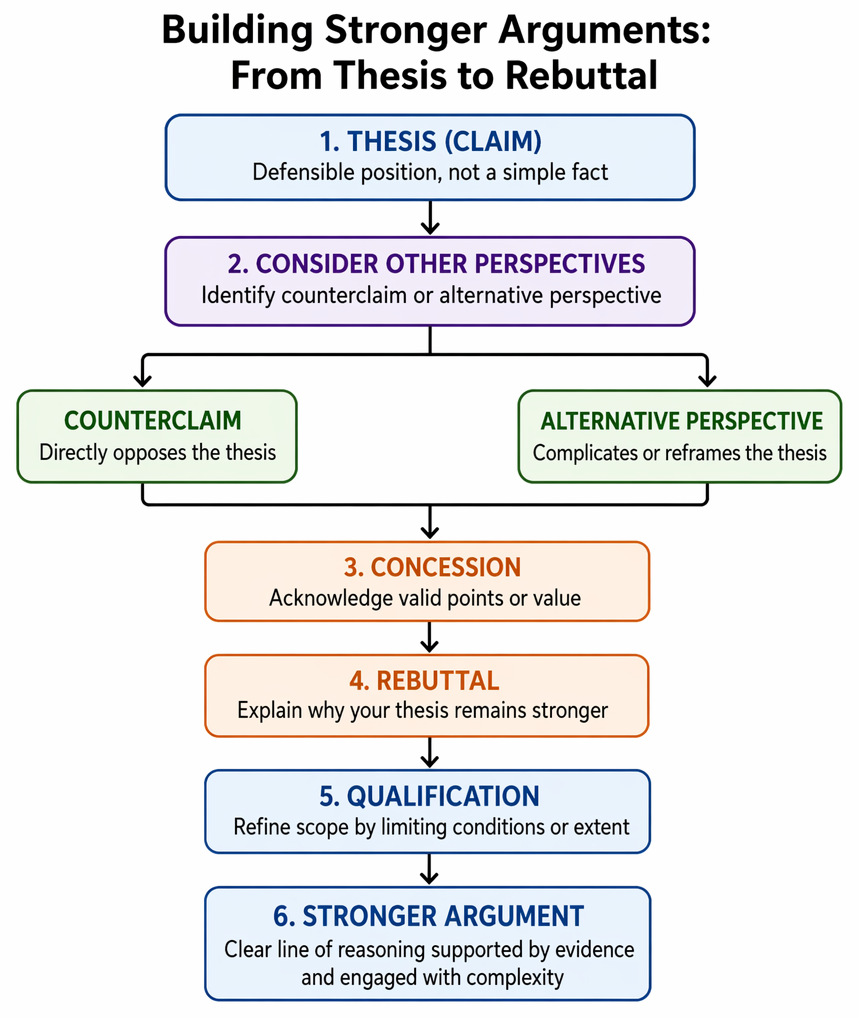
Argument structure distinguishes oppositional and complicating viewpoints and shows how concession and rebuttal refine a qualified thesis.
- Know that a claim is a defensible position, not a simple fact
- Identify the difference between a counterclaim that directly opposes the thesis and an alternative perspective that complicates or reframes it
- Explain how concession and rebuttal work together in argument writing
- Understand that qualification refines a thesis by limiting it to certain conditions or extents
- Recognise that addressing other viewpoints is not a separate scoring category, but can strengthen Evidence and Commentary and may contribute to sophistication
- Distinguish between a genuine engagement with complexity and a formulaic “other side” paragraph
- Apply claim, evidence, and reasoning in argument essays so that evidence supports a clear line of reasoning
Test Your Knowledge
Attempt these questions before reading this article. If you find some difficult or cannot remember the answers, look more closely at that area during your revision.
- What is the difference between a counterclaim and an alternative perspective?
- Why is a concession not the same thing as surrendering your argument?
- How does a qualified claim usually score better than an absolute claim on AP Lang?
- What is wrong with adding a counterargument paragraph that never connects back to the thesis?
- How can considering another viewpoint help an essay earn stronger commentary?
Introduction
In AP English Language, students often think “consider alternative perspectives” means they must present both sides evenly. That is not the real task. The exam rewards a clear, defensible position supported by relevant evidence and explained through a strong line of reasoning. Other viewpoints matter only when they make your argument more accurate, more persuasive, or more precise.
This means you should not add opposition for decoration. You should use it as a tool. A well-handled alternative perspective can help you define terms, anticipate objections, acknowledge a valid concern, and then show why your thesis still stands. Done badly, it becomes filler. Done well, it sharpens the essay.
Key Term: claim
A writer’s main assertion or position that requires support and explanation.
Distinguishing the views: claim, counterclaim, and alternative perspective
A strong AP argument starts with a clear thesis, but not every strong thesis is simple. Students often write absolute claims because they sound confident. In practice, those claims are easier to attack and harder to defend.
Consider this weak thesis:
“Technology always improves education.”
The problem is the word always. One counterexample can damage the claim. A stronger version might be:
“Technology improves education when it supports good teaching and expands access, but it can weaken learning when it increases distraction or replaces meaningful instruction.”
The second version is better because it still takes a position, but it builds in complexity.
Key Term: counterclaim
A claim that directly opposes the writer’s thesis. Key Term: alternative perspective
A different way of viewing the issue that may challenge, complicate, or reframe the thesis without directly opposing it.
A counterclaim says, in effect, “your position is wrong.” An alternative perspective may instead say, “your position is too narrow,” or “another value also matters here.”
For example:
- Thesis: School uniforms improve school culture.
- Counterclaim: Uniforms do not improve school culture and instead suppress individuality.
- Alternative perspective: The issue is not just culture; it is also cost, enforcement, and student identity.
That difference matters on the exam. If you treat every other viewpoint as total opposition, your essay can become simplistic. Some issues are not yes-or-no disputes. They involve competing priorities.
Students also confuse counterclaim with counterargument. A useful distinction is this:
- Counterclaim = what the other side believes
- Counterargument = the reasons and evidence supporting that opposing belief
For instance:
- Counterclaim: Public protest is unruly and should be restricted.
- Counterargument: Protest can interrupt business, create safety concerns, and inconvenience the public.
When you respond, you must answer the reasons, not just label the opposing side as wrong.
Test Tip: On the argument essay, do not force every issue into a strict pro/con format. Ask instead: what other values, audiences, or assumptions shape this issue?
Using concession and rebuttal without weakening your thesis
Many students have heard the formula: “Some people say... however...” That pattern can work, but only if the concession is real and the rebuttal is reasoned.
Key Term: concession
An acknowledgement that an opposing point has some validity or merit. Key Term: rebuttal
A response to an opposing view that explains why the writer’s main position still stands.
A concession builds credibility because it shows fairness. It tells the reader you understand the issue well enough to admit a genuine limitation or concern. But the concession must be specific.
Weak concession: “Some people disagree.”
This earns almost nothing because it says no more than “there is another side.” It does not show understanding.
Stronger concession: “Admittedly, replacing in-person meetings with video calls can weaken first impressions and reduce informal relationship-building.”
Now the reader sees that the writer understands a real concern.
But a concession alone is incomplete. AP readers look for reasoning. The rebuttal must explain why the thesis still holds.
Example: “Admittedly, replacing in-person meetings with video calls can weaken first impressions and reduce informal relationship-building. However, once the initial relationship has been established, the savings in cost and time often outweigh the smaller benefits of repeated travel, especially when regular digital communication can maintain the connection.”
Notice the structure:
- valid concern acknowledged
- limit or condition explained
- thesis re-established with reasoning
This is much stronger than a reflexive “however” sentence because it addresses why the concern matters and why it does not overturn the claim.
A rebuttal should not be a personal attack or a straw man.
Key Term: straw man
A weak or oversimplified version of an opposing argument that is easier to dismiss than the real position.
For example, if your topic is later school start times, do not write: “Opponents just do not care about student health.”
That misrepresents the other side. A fairer version would be: “Opponents often worry that changing start times would disrupt transport schedules, sports, and family routines.”
Now your rebuttal has something real to answer.
Test Tip: A concession helps only if it is specific, fair, and followed by an explanation of why your claim still survives.
Qualification: the move that usually makes arguments stronger
The AP argument essay often rewards a thesis that is neither absolute agreement nor total rejection. That is where qualification becomes powerful.
Key Term: qualification
A refinement or limitation of a claim so that it becomes more precise and defensible.
A qualified thesis does not sound weak. It sounds careful. It recognises that most public issues involve conditions, contexts, and trade-offs.
Compare these theses:
- “Travel is not worth the cost.”
- “Travel is worth the cost only when the purpose depends on face-to-face trust-building or access that technology cannot match.”
The second thesis is stronger because it defines the conditions under which the claim is true. That makes evidence easier to organise. It also shows mature thinking.
Qualification often comes from considering another perspective. You see what the other side values, then adjust your claim to account for it.
For example:
Prompt idea: Is discomfort necessary for growth?
Simple thesis: “Yes, growth requires discomfort.”
Qualified thesis: “Discomfort often leads to growth when it pushes people beyond routine, but not all fear or suffering is productive; growth depends on whether the challenge is meaningful and manageable.”
This thesis is more defensible because it avoids the false idea that all pain is useful. It leaves room for distinctions. That is exactly what stronger AP essays tend to do.
Qualification also protects your line of reasoning. If you make an extreme claim, you spend the rest of the essay defending exceptions. If you qualify early, you can focus on proving a more accurate claim.
A good way to think about qualification is this: you are not shrinking your argument; you are narrowing it until it becomes harder to knock down.
Useful sentence frames include:
- “_ is true to the extent that _.”
- “Although _, the stronger point is _.”
- “In most cases _, but when _, the opposite may be true.”
- “The issue is less whether _ than whether _.”
These frames work because they guide you toward analysis rather than summary.
Building a paragraph that genuinely considers another perspective
Students often write a separate “counterargument paragraph” because they think the form itself earns points. It does not. The question is whether the paragraph contributes to the essay’s line of reasoning.
Key Term: line of reasoning
The logical sequence of claims, evidence, and commentary that develops an argument across the essay.
A useful structure looks like this:
- State the alternative perspective fairly
- Explain why some people find it persuasive
- Concede the part that is valid
- Rebut, qualify, or redirect using evidence and reasoning
- Link back to the thesis
Here is a model paragraph:
“Some critics contend that social media harms teenagers by increasing anxiety and reducing face-to-face interaction. This concern is persuasive because constant comparison and public visibility can intensify insecurity, especially for adolescents whose identities are still forming. Admittedly, online spaces can magnify pressure and distraction. However, this perspective becomes incomplete when it treats all digital use as identical. Social media used passively for comparison may worsen well-being, but digital communication used actively to maintain friendships or access support can strengthen connection rather than weaken it. The issue, then, is not whether teenagers should use social media at all, but how and for what purpose they use it.”
Why does this work?
- It presents the concern clearly.
- It explains its appeal.
- It concedes something real.
- It distinguishes between types of use.
- It returns to a sharper thesis.
Now compare it with a weak paragraph:
“Some people think social media is bad. They say it causes anxiety. But social media is also good because people can talk to friends.”
This version lacks precision, evidence, and commentary. It lists ideas but does not develop them.
The most common weakness is that students mention the other side but never integrate it. They write: “Some argue X. However, Y.” Without the middle steps, the paragraph feels abrupt and unearned.
Another common problem is imbalance. If your concession is longer and more convincing than your rebuttal, you may end up weakening your own essay. The goal is not to surrender the point but to absorb it and move beyond it.
What this looks like on the exam
AP Lang scoring does not award a separate point for “including a counterargument.” Readers care about three things:
- a defensible thesis
- specific evidence
- commentary that explains how the evidence supports the argument
Considering alternative perspectives can strengthen the second and third of these, and sometimes help with sophistication. But only if it is meaningful.
For Evidence and Commentary, another perspective helps when it:
- clarifies what your claim does and does not mean
- shows why the issue is contested
- lets you explain limitations rather than ignore them
- improves the logic connecting evidence to thesis
For sophistication, another perspective helps when it:
- explores tensions or implications
- shows a complex understanding of the rhetorical situation
- qualifies the argument in a thoughtful way
- avoids oversimplification
It does not help when it is formulaic. A generic “on the other hand” paragraph full of vague statements usually signals structure without thought.
Think about audience too. Alternative perspectives matter because real readers may have doubts. Addressing them shows rhetorical awareness. A reader who values efficiency may resist a claim built only on tradition. A reader who values freedom may resist a claim built only on safety. Considering another perspective lets you answer the reader before the reader objects.
That is why this skill belongs inside Unit 9: it connects claims, evidence, and reasoning. It is not just about being polite to the other side. It is about making your own argument harder to dismiss.
Key Point Checklist
This article has covered the following key knowledge points:
- A claim is a defensible position that requires evidence and explanation
- A counterclaim directly opposes the thesis
- An alternative perspective may complicate or reframe the issue without fully opposing the thesis
- A counterargument includes the reasons supporting an opposing claim
- A concession acknowledges that another view has some merit
- A rebuttal explains why the main claim still stands
- Qualification refines a thesis so it becomes more precise and defensible
- Strong AP arguments do not simply list pros and cons
- A formulaic opposition paragraph does not earn points by itself
- Addressing another perspective can strengthen Evidence and Commentary
- Meaningful engagement with complexity may contribute to the sophistication point
- A strong paragraph on another viewpoint should connect back to the essay’s line of reasoning
Key Terms and Concepts
- claim
- counterclaim
- alternative perspective
- concession
- rebuttal
- straw man
- qualification
- line of reasoning