Learning Outcomes
- Distinguish clearly between a counterargument and an alternative perspective
- Explain how concession, rebuttal, and refutation work in argument writing
- Understand why qualification usually strengthens rather than weakens a claim
- Identify when evidence is present but commentary is missing
- Build a stronger line of reasoning by addressing other views purposefully
- Avoid weak, formulaic counterargument paragraphs that do not improve an essay
AP English Language and Composition Syllabus
For the AP English Language and Composition, you are expected to understand how arguments are qualified through opposing views and different lenses, with a focus on the following syllabus points:
- Know that a strong AP Lang argument needs a defensible claim, relevant evidence, and commentary that supports a line of reasoning
- Identify the difference between a counterargument that directly opposes a claim and an alternative perspective that reframes or complicates it
- Explain how concession, rebuttal, and refutation function within an argument
- Understand how modifiers such as often, in some cases, and under certain conditions help writers qualify claims
- Recognise that a separate counterargument paragraph is not required by the AP rubric
- Evaluate whether a writer addresses opposing views fairly or creates a weak straw man
- Understand how meaningful engagement with other views can contribute to sophistication when it adds real complexity
Test Your Knowledge
Attempt these questions before reading this article. If you find some difficult or cannot remember the answers, look more closely at that area during your revision.
- What is the difference between a counterargument and an alternative perspective?
- How does a concession differ from a rebuttal?
- Why might a qualified claim score better than an absolute claim?
- What happens when an essay includes evidence but little commentary?
- Is a separate counterargument paragraph required for a high AP Lang score?
Introduction
In AP English Language and Composition, students often hear that they should “include the other side.” That advice is partly right, but too simple. A strong essay does not mention opposing views just to sound balanced. It uses them to sharpen the thesis, refine the scope of the claim, and strengthen the line of reasoning.
This matters in both multiple-choice and free-response work. In reading passages, you may be asked to identify a concession, evaluate a rebuttal, or decide whether a writer fairly represents another position. In your own essays, especially the argument essay, handling counterarguments and alternative perspectives well can help your writing sound more precise, mature, and persuasive.
Key Term: claim
A defensible position or assertion that a writer advances and supports.
Introduction to the distinction that students often miss
Counterargument versus alternative perspective
The first distinction to master is simple but very important: a counterargument is not the same thing as an alternative perspective.
A counterargument directly challenges your main claim. If your claim is “schools should reduce homework,” a counterargument would say homework is necessary for practice, discipline, or academic growth. It pushes against your position.
An alternative perspective does something different. It may not fully disagree. Instead, it changes the angle. It might ask whether the issue is really about homework quantity rather than homework itself. Or it might shift attention from students to parents, teachers, or inequality between school districts. That perspective broadens the issue instead of simply opposing it.
Key Term: counterargument
An opposing viewpoint that directly challenges the writer’s claim. Key Term: alternative perspective
Another way of viewing the issue that broadens, reframes, or complicates the argument without necessarily fully opposing it.
Why does this distinction matter on the exam? Because students often treat every “other view” as a direct opposition. That can flatten the argument. A more thoughtful essay may say, “Some critics argue X,” but it may also say, “Another way to view the issue is Y.” The second move often creates more complexity because it shows that the issue has more than two sides.
For example, consider this prompt-level claim:
- Simplistic claim: Social media harms teenagers.
- Counterargument: Social media helps teenagers stay connected and informed.
- Alternative perspective: The real issue may not be social media itself, but the quality, purpose, and duration of use.
The alternative perspective is often stronger because it leads to a more defensible thesis. Instead of arguing in absolutes, you can argue that social media is most harmful when it replaces sleep, in-person relationships, or focused work, but can be useful when it supports communication or learning.
That is a move from a blunt claim to a qualified one.
Key Term: qualification
Narrowing or limiting a claim so it becomes more precise and defensible. Test Tip: On multiple-choice questions, ask whether the “other view” actually opposes the writer or just shifts the lens. If it does not directly disagree, it is more likely an alternative perspective than a counterargument.
Why qualification raises the quality of an argument
Students sometimes think qualification makes an essay sound weak. On AP Lang, the opposite is usually true. A claim like “technology is harmful” is easy to attack because it is too broad. It invites obvious exceptions. A claim like “technology often harms attention when it encourages constant multitasking, though it can improve access to information” is harder to dismiss because it sets limits.
The College Board skill language for this unit focuses on claims being qualified through modifiers, counterarguments, and alternative perspectives. That means you should expect to analyse how writers narrow claims and be able to do the same in your own writing.
Modifiers do much of this work. Words such as often, sometimes, in many cases, for some groups, and under certain conditions control scope. They stop your argument from making promises your evidence cannot support.
Here is the difference in effect:
- Weak: Standardized tests are unfair.
- Better: Standardized tests can be unfair when they are treated as the sole measure of student ability.
- Stronger: Although standardized tests can provide comparable data, they are often unfair when schools use them as the main basis for judging students from very different educational backgrounds.
The final version does three things at once:
- It concedes part of another view.
- It narrows the scope.
- It makes the claim easier to defend with evidence.
Students also miss the link between qualification and credibility. Readers trust arguments that sound measured. Absolute words like always, never, everyone, and no one are risky unless the evidence is overwhelming. Most AP prompts involve complicated issues. A writer who leaves room for complexity usually sounds more persuasive.
Key Term: modifier
A limiting word or phrase such as often, sometimes, or under certain conditions that narrows a claim.
How writers respond to other views
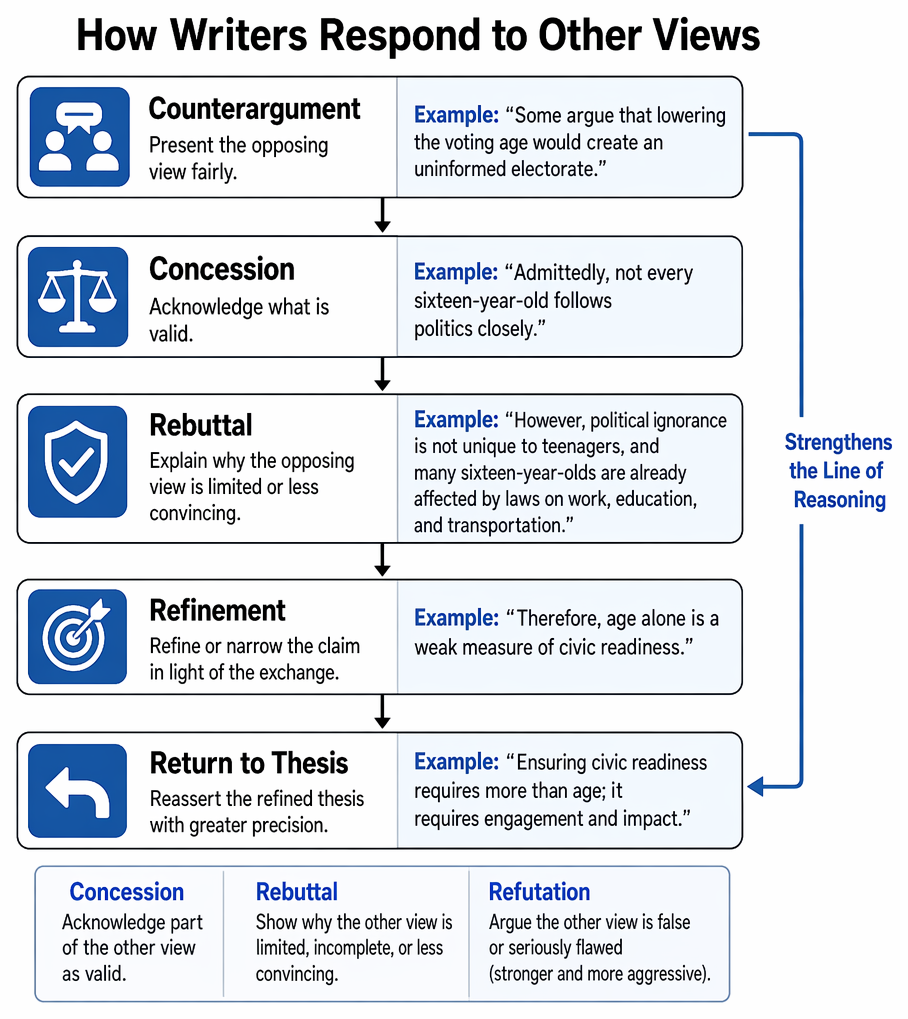
Argument structure distinguishes direct opposition from reframing and shows how concession and rebuttal can produce a more qualified claim.
Concession, rebuttal, and refutation
Once another viewpoint appears, the next question is what the writer does with it. Three terms matter here: concession, rebuttal, and refutation.
Key Term: concession
An acknowledgment that part of another view is valid. Key Term: rebuttal
A response that shows why the opposing view is limited, incomplete, or less convincing. Key Term: refutation
A stronger rebuttal that aims to show an opposing claim is false or seriously flawed.
A concession is not surrender. It is strategic fairness. If you write, “Admittedly, remote work can reduce face-to-face collaboration,” you are conceding a real point. That can make your argument sound more honest. But if you stop there, you have not advanced your own claim.
A rebuttal answers back. For instance: “Admittedly, remote work can reduce face-to-face collaboration; however, many teams now use scheduled in-person meetings for planning while keeping routine tasks remote, which preserves collaboration without requiring daily commuting.” The writer accepts a concern, then explains why it does not destroy the larger argument.
A refutation goes further. It argues that the opposing point is not merely limited but wrong or badly supported. For example: “Critics claim remote work destroys productivity, but this argument assumes supervision is the only source of work quality and ignores cases where output is measured directly.” That is stronger and more aggressive than a rebuttal.
On AP Lang, rebuttal is often safer than total refutation because many prompts involve reasonable disagreement. If you try to destroy an opposing view too completely, you may overstate your case. Concession plus rebuttal often sounds more mature than pure dismissal.
Here is a useful pattern:
- Counterargument: Some argue that lowering the voting age would create an uninformed electorate.
- Concession: Admittedly, not every sixteen-year-old follows politics closely.
- Rebuttal: However, political ignorance is not unique to teenagers, and many sixteen-year-olds are already affected by laws on work, education, and transportation.
- Refined claim: Therefore, age alone is a weak measure of civic readiness.
Notice that the writer does not merely mention the opposing side. The response changes the argument’s shape. It returns to the thesis with more precision.
Test Tip: In rhetorical analysis, do not just label a sentence as a concession. Explain why the writer includes it. Does it build trust? Anticipate criticism? Narrow the claim? Strengthen the rebuttal that follows?
When engaging other views actually improves the line of reasoning
A separate counterargument paragraph is not required by the AP rubric. This is one of the most common misconceptions in the course. You do not get points for following a formula. You get points for presenting a defensible thesis and supporting it with evidence and commentary in a clear line of reasoning.
Key Term: line of reasoning
The logical sequence of claims and commentary connecting the thesis to the conclusion.
That means the real question is not “Did I include a counterargument paragraph?” It is “Did engaging with another view improve my reasoning?”
Sometimes the answer is yes. Sometimes no.
It helps when:
- your original claim is too broad and needs limiting
- the prompt naturally invites multiple perspectives
- the opposing view is strong enough that ignoring it would make your essay seem naive
- the concession leads to a more precise thesis
It hurts when:
- the other view is only added because you think the rubric demands it
- the paragraph does not connect back to your thesis
- you summarise the opposing side but do not answer it
- you invent a weak objection just to knock it down
That last problem is especially common.
If a student argues, “Some people think students should never be challenged in school,” that sounds fake because hardly anyone believes it. That is close to a straw man: a weak or distorted version of an opposing position created to make rebuttal easy.
A stronger move would be: “Supporters of heavy homework loads argue that repeated practice helps students retain material.” That is a fairer version of the other side. Fair representation matters because the AP reader can hear when an essay is avoiding the strongest version of the debate.
Here is the practical drafting sequence that often works well:
- State your claim.
- Give specific evidence.
- Add commentary explaining how the evidence supports the claim.
- Introduce a counterargument or alternative perspective if it deepens the point.
- Concede what is valid.
- Rebut or refine.
- Return to the thesis in a more precise form.
This is not a rigid formula. It is a reasoning pattern. You may do it within one paragraph rather than in a separate section.
Key Term: commentary
The explanation showing how and why the evidence supports the claim and develops the argument.
How to write this in your own essays
Building stronger paragraphs and avoiding common mistakes
The biggest weakness in student argument writing is not lack of evidence. It is lack of explanation. Students often drop in an example and assume the point is obvious. But AP Lang rewards the link between evidence and claim, not just the evidence itself.
Counterarguments and alternative perspectives can help fix that because they force you to explain more carefully. If you are answering another view, you have to say why your evidence matters more, applies more strongly, or works under different conditions.
Compare these two examples.
Weak paragraph: Some argue that school uniforms improve discipline. However, uniforms do not solve real school problems. At one school, students still fought and skipped class even after uniforms were introduced.
This has a counterargument and evidence, but the commentary is thin.
Stronger paragraph: Some argue that school uniforms improve discipline by reducing distractions and encouraging seriousness. Admittedly, uniforms may create a more orderly appearance. However, appearance is not the same as behaviour. If students continue to fight, skip class, or disengage from lessons after a uniform policy begins, the evidence suggests that discipline problems come from deeper causes such as school culture, inconsistent consequences, or weak student support systems. In that case, uniforms may change the image of order without changing its reality.
The second paragraph is better because it:
- concedes fairly
- distinguishes surface change from deeper change
- explains the evidence rather than dropping it
- links back to the larger claim
Common mistakes to avoid:
-
Treating concession as surrender If you concede too much and never return to your own claim, the paragraph drifts.
-
Using fake complexity Adding “on the other hand” without changing the argument is empty balance.
-
Confusing evidence with commentary An example is not self-explanatory. You must state why it proves something.
-
Writing overbroad claims If your claim covers every case, a single exception can weaken it.
-
Creating a straw man A weak opposing view does not make your essay sound smarter. It makes it sound less fair.
-
Forgetting scope Ask: true for whom? under what conditions? to what extent?
A short template can help:
- Some argue that ___.
- Granted, ___.
- However, this view overlooks ___.
- This matters because ___.
- Therefore, the stronger claim is that ___.
Use it as support, not as a script. The goal is not to sound mechanical. The goal is to keep your reasoning clear.
Model analytical paragraph
Suppose the prompt asks whether failure is necessary for growth.
A strong paragraph might look like this:
Some argue that failure is not necessary because people can learn through guidance, observation, and careful planning. This objection has merit: not every skill requires a painful mistake before improvement becomes possible. However, this view treats failure too narrowly, as if it only means disaster. In practice, many of the most useful forms of failure are small corrections that reveal limits in a plan or weakness in an assumption. A student who receives a poor grade on an essay, for instance, may discover not simply that the paper was weak, but exactly where the reasoning lacked evidence or where the commentary stopped short. In that sense, failure supplies information that success often hides. Although growth can occur without major collapse, meaningful development often depends on some encounter with error, resistance, or limitation.
This paragraph does not just “mention the other side.” It uses the other side to refine the definition of failure and improve the thesis.
Key Point Checklist
This article has covered the following key knowledge points:
- A claim is a defensible assertion that requires support
- A counterargument directly opposes the main claim
- An alternative perspective reframes or complicates the issue without always fully opposing the claim
- Concession acknowledges validity in another view
- Rebuttal explains why the opposing view is limited or less convincing
- Refutation is a stronger response that argues the other view is false or badly flawed
- Qualification usually strengthens a claim by making it more precise
- Modifiers such as often and in some cases help control scope
- The AP Lang rubric does not require a separate counterargument paragraph
- Evidence alone is not enough; commentary must explain how it supports the line of reasoning
- Engaging with opposing views helps only when it creates real subtlety or sharper reasoning
- Weak straw-man counterarguments can damage credibility rather than improve it
Key Terms and Concepts
- claim
- counterargument
- alternative perspective
- qualification
- modifier
- concession
- rebuttal
- refutation
- line of reasoning
- commentary