Learning Outcomes
- Understand what a claim is and why AP arguments need defensible rather than absolute claims
- Identify how modifiers refine a claim by adjusting scope, degree, and certainty
- Explain the difference between a qualified claim, an overgeneralized claim, and an overqualified claim
- Use modifiers, counterarguments, and alternative perspectives to strengthen a thesis
- Connect the wording of a claim to the quality and limits of available evidence
- Apply these ideas in argument, synthesis, rhetorical analysis, and multiple-choice tasks
AP English Language and Composition Syllabus
For the AP English Language and Composition, you are expected to understand how writers qualify claims, with a focus on the following syllabus points:
- Know that a claim is a defensible position that requires evidence and explanation
- Identify how a qualified claim adds precision through modifiers, counterarguments, or alternative perspectives
- Explain how modifiers adjust a claim’s scope, degree, or certainty
- Understand the difference between a precise qualification and weak indecision
- Recognise that AP essays earn credit for a thesis that presents a defensible position
- Understand that evidence and commentary must support a clear line of reasoning
- Explain why a claim should not go further than the evidence can actually support
- Apply qualification in thesis writing, body paragraph claims, and commentary
Test Your Knowledge
Attempt these questions before reading this article. If you find some difficult or cannot remember the answers, look more closely at that area during your revision.
- What is the difference between a statement of fact and a claim?
- How can a modifier make a claim stronger rather than weaker?
- What is the difference between a scope qualifier and a certainty marker?
- Why is an absolute claim often harder to defend on the AP exam?
- How can a counterargument qualify a claim without abandoning it?
Introduction
On AP English Language and Composition, strong arguments rarely depend on the loudest claim. They depend on the most accurate one. A writer who says all, always, or never may sound confident, but if the evidence only supports some, often, or in certain cases, the argument becomes easy to challenge.
That is why modifiers matter. They refine claims so the wording matches the evidence. This helps students earn the thesis point, build a stronger line of reasoning, and avoid the common problem of making a claim that commentary cannot fully defend.
Key Term: claim
A defensible position or argument that requires evidence and explanation.Exam Warning: Do not treat similar words, structures, or question types as interchangeable; small wording differences often change what the answer must do.
Modifiers refine claims
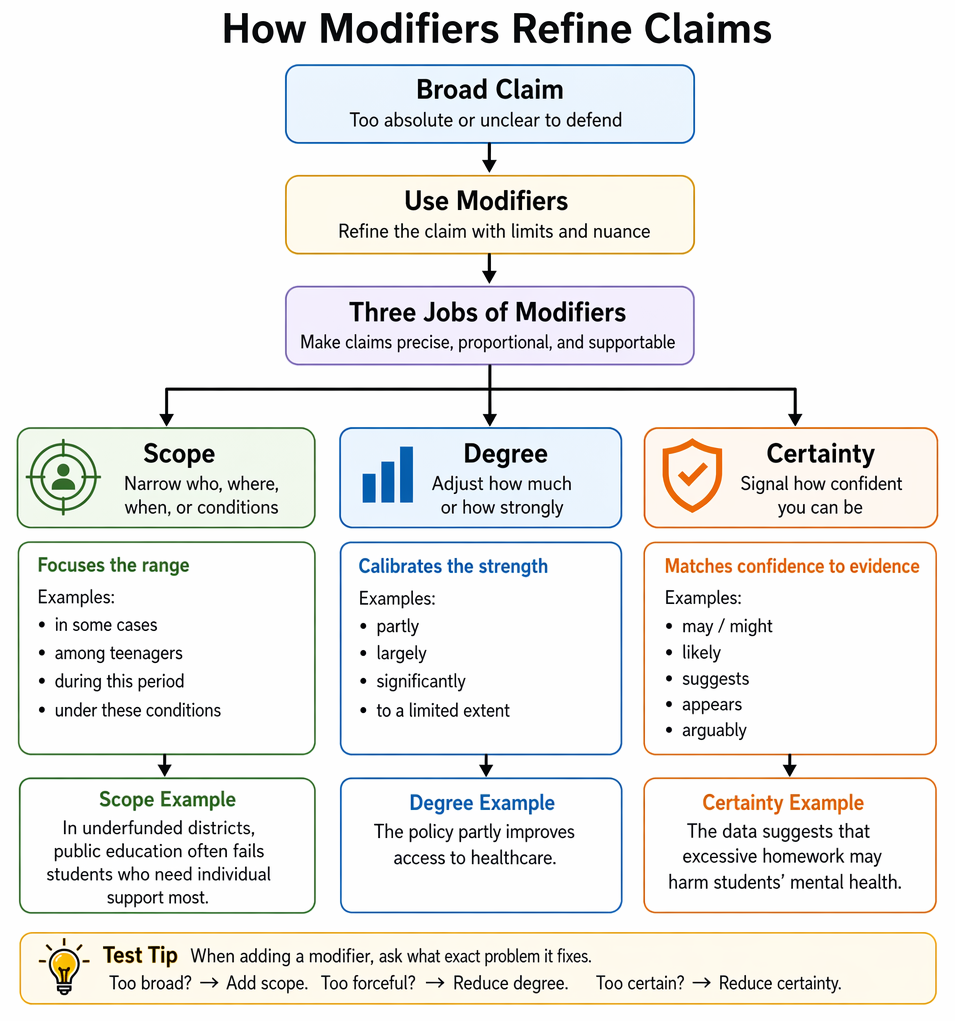
Claim wording is refined through qualifiers that limit applicability, calibrate intensity, and indicate evidential confidence.
Why qualified claims score better than broad claims
A claim is not the same as a fact. “Monday comes before Friday” is a fact. “Friday is better than Monday” is a claim because it can be debated and supported in different ways. On the AP exam, your job is not just to make any claim. Your job is to make one that is defensible.
Key Term: defensible position
A claim or thesis that can reasonably be supported with evidence and explanation.
A broad claim often fails because it promises more than the evidence can deliver. Consider these versions:
- Weak absolute claim: Social media destroys communication.
- Stronger qualified claim: Social media can weaken face-to-face communication when it replaces in-person interaction for long periods.
- Too weak and evasive claim: Social media may perhaps sometimes somewhat affect communication in certain cases.
The first version is vulnerable because one counterexample defeats it. If social media helps long-distance families stay connected, the word destroys looks careless. The second version is much better because it identifies a condition: when it replaces in-person interaction for long periods. That is specific and arguable. The third version collapses because it piles up hedges until the argument barely says anything.
This is the central rule: qualification should increase precision, not reduce meaning.
Key Term: qualified claim
A claim refined with limits or conditions so it becomes more precise, qualifiedd, and supportable.
Students often think that strong writing means sounding absolute. On AP Lang, that is usually false. Strong writing means making a claim proportional to the evidence. If your evidence is mixed, your claim should be mixed. If your evidence applies only to one group, your claim should name that group. If your evidence suggests rather than proves, your wording should signal that.
This matters in all three essays:
- In the argument essay, a qualified thesis can present a “yes, but” position.
- In the synthesis essay, qualifiers help you align your claim with what the sources actually show.
- In the rhetorical analysis essay, you may write that an author suggests, complicates, or partly challenges an idea rather than fully proving it.
Test Tip: If your thesis contains words like all, every, never, proves, or completely, pause and test them. Ask: “Could one clear counterexample break this claim?” If yes, revise the wording.
How modifiers refine scope, degree, and certainty
Modifiers do three main jobs. They narrow scope, adjust degree, and signal certainty. These are not random word choices. They are tools for accuracy.
Key Term: modifier
A word or phrase that limits or refines a claim by adjusting its scope, degree, or certainty.
Scope modifiers
Scope asks: for whom, where, when, or under what conditions is this claim true?
Compare these:
- Public education fails students.
- In underfunded districts, public education often fails students who need individual support most.
- During the early stages of remote learning, many schools struggled to serve students without reliable internet access.
Each revision becomes easier to defend because the claim stops pretending to cover every school, every student, and every situation.
Key Term: scope
The range of people, situations, times, or conditions to which a claim applies.
Scope modifiers include phrases such as:
- in some cases
- among teenagers
- in this context
- during this period
- for many readers
- under these conditions
A common AP mistake is writing a body paragraph with narrow evidence and a broad topic sentence. For instance, if your evidence is about one school district, your claim should not say “American education” unless you explain why that local case represents a wider pattern.
Degree modifiers
Degree asks: to what extent? how much? how strongly?
Compare:
- The speech changes the audience’s mind.
- The speech significantly increases the speaker’s credibility.
- The policy partly improves access to healthcare.
- The novel largely challenges the myth of meritocracy.
These words matter because they stop the writer from overclaiming. A speech may not completely persuade a hostile audience, but it may significantly strengthen ethos. That is still a strong analytical point.
Key Term: degree
The strength, extent, or intensity of a claim.
Useful degree modifiers include:
- partly
- largely
- significantly
- primarily
- somewhat
- to a limited extent
Degree is especially useful in rhetorical analysis. Instead of saying “the author proves,” which is often too strong, you can say “the author strongly reinforces” or “the author partly complicates.” That sounds more accurate and more mature.
Certainty markers
Certainty asks: how confident can the writer reasonably be?
Compare:
- The data proves that homework harms students.
- The data suggests that excessive homework may harm students’ mental health.
- The pattern indicates that the policy is likely to widen inequality.
Key Term: certainty
The level of confidence a writer signals in a claim.
Words such as may, might, likely, suggests, appears, and arguably are sometimes called hedges. Used well, they make a claim more credible because they match what evidence can support. Used badly, they make the writer sound afraid to commit.
The difference is simple:
- Effective hedge: The evidence suggests that many students perform worse when multitasking with digital notifications.
- Weak hedge: Students may perhaps kind of perform worse sometimes.
The first sentence names a real relationship and signals appropriate caution. The second sentence blurs meaning.
Key Term: hedge
A word or phrase that reduces certainty so a claim does not go beyond the available evidence. Test Tip: When adding a modifier, ask what exact problem it fixes. Is the claim too broad in who it covers? Add scope. Too forceful? Reduce degree. Too certain for the evidence? Reduce certainty.
Matching claims to evidence and commentary
Students often separate thesis writing from evidence, but on AP Lang they are linked. The best revision question is: Can my evidence prove this exact claim?
Key Term: evidence and commentary
Evidence is the support a writer provides; commentary explains how that support advances the claim and line of reasoning.
Suppose a student writes:
- Claim: School uniforms improve academic performance.
Evidence:
- One principal reports fewer discipline referrals after uniforms were introduced.
- Students describe less pressure about clothing choices.
This evidence may support a narrower claim, but not the original one. It does not directly prove improved academic performance. A better claim would be:
- Revised claim: School uniforms can improve school focus by reducing visible social distractions.
Now the evidence fits. Commentary can explain the link: fewer appearance-based distractions may improve concentration and school climate, even if test scores are not proven to rise.
This is what AP readers want in Row B: specific evidence plus explanation of how that evidence supports a line of reasoning. If the claim outruns the evidence, commentary becomes vague or false.
Key Term: line of reasoning
The logical progression that connects thesis, claims, evidence, and commentary.
Here is a model progression:
- Overstated claim: Standardized tests fail to measure real intelligence.
- Evidence: Timed tests often disadvantage students with test anxiety; some skills, such as creativity and collaboration, are hard to score on multiple-choice formats.
- Better claim: Standardized tests often measure only part of student ability because timed, fixed-format exams reward some forms of performance more than others.
Notice the improvement. The revised claim gives commentary something real to explain. It can discuss why test anxiety matters, why format shapes results, and why “part of ability” is more accurate than “real intelligence.”
A similar pattern appears in rhetorical analysis. A weak student might write:
- The author proves that technology is bad.
But rhetorical analysis is about how an author builds a message. A better claim is:
- The author suggests that unchecked technology use can erode attention by combining alarming examples with a cautionary tone.
That sentence is better because:
- it avoids the too-strong word proves
- it narrows the issue to unchecked use
- it identifies the rhetorical choices to be analyzed
Using counterarguments and alternative perspectives to qualify a claim
Qualification is not only about single words. It can also happen through structure. A claim becomes more precise when a writer acknowledges another view and then limits, adjusts, or incorporates it.
Key Term: counterargument
A competing viewpoint that a writer acknowledges and addresses.
For example:
- Simple claim: Competition in schools is harmful.
- Qualified through counterargument: Although moderate competition can motivate students, excessive competition often damages collaboration and increases stress.
This is stronger because it avoids a false dichotomy. The writer is not pretending competition is always bad. Instead, the writer distinguishes between moderate and excessive competition.
Key Term: alternative perspective
A different way of understanding an issue that can refine, complicate, or limit a claim.
Another example:
- Simple claim: Cancel culture silences free speech.
- Qualified claim: While public criticism can hold powerful figures accountable, online pile-ons may discourage open discussion when punishment becomes disproportionate to the offense.
This qualified version is much harder to dismiss. It recognizes value in accountability while still defending a clear concern.
This is also where sophistication can begin. A complex argument does not mean being vague. It means understanding tensions and limits. For example:
- Economic growth can improve living standards, but growth alone does not guarantee broad well-being if gains remain concentrated.
- Civil disobedience can be justified when legal systems block reform, but its effectiveness depends on public visibility, moral clarity, and proportional tactics.
In each case, the writer keeps a position while admitting conditions that affect the conclusion.
A brief note from argument theory can help here.
Key Term: qualifier
In argument structure, the part of a claim that states the conditions or limits under which the claim holds true.
In practical AP writing, you do not need formal theory vocabulary often. But knowing that a qualifier is a normal part of argument can help you stop seeing moderation as weakness. Skilled arguers qualify because reality is rarely total.
A useful thesis frame is:
- Although [counterargument], [main claim] because [reason].
Examples:
- Although technology can widen distraction, classroom devices can improve learning when teachers use them for focused, purposeful tasks.
- While protests do not always create immediate policy change, they often reshape public attention and force institutions to respond.
These are stronger than flat agree/disagree theses because they define the claim’s limits from the start.
Key Point Checklist
This article has covered the following key knowledge points:
- A claim is a defensible argument, not just a fact or observation
- AP Lang rewards a thesis that presents a defensible position
- Qualified claims are usually stronger than absolute claims because they are easier to support
- Modifiers refine claims by adjusting scope, degree, or certainty
- Scope modifiers limit who, where, when, or under what conditions a claim applies
- Degree modifiers adjust how strong or extensive a claim is
- Certainty markers show how confidently evidence supports a claim
- Qualification should make a claim more precise, not vague or evasive
- A claim should not go further than the evidence can actually support
- Evidence and commentary must build a clear line of reasoning
- Counterarguments and alternative perspectives can qualify a claim without abandoning it
- Overstatement, underqualification, and overqualification are all common AP mistakes
Key Terms and Concepts
- claim
- defensible position
- qualified claim
- modifier
- scope
- degree
- certainty
- hedge
- evidence and commentary
- line of reasoning
- counterargument
- alternative perspective
- qualifier