Learning Outcomes
- Understand what a qualified claim is and how it differs from a weak, vague thesis
- Identify how qualification strengthens a defensible position
- Explain the difference between qualification, concession, and counterargument
- Build a clear line of reasoning from a qualified thesis
- Use specific evidence and commentary to support a limited or conditional claim
- Avoid common errors such as overgeneralization, fence-sitting, and unsupported complexity
AP English Language and Composition Syllabus
For the AP English Language and Composition, you are expected to understand how writers and student essayists qualify claims effectively, with a focus on the following syllabus points:
- Know that a thesis earns Row A when it presents a defensible position
- Identify a qualified claim as a claim with limits, conditions, exceptions, or extent
- Explain the difference between a qualified thesis and a vague “both sides have merits” response
- Understand how line of reasoning connects thesis, subclaims, evidence, and commentary
- Distinguish concession from counterargument, and both from full qualification
- Explain why qualification can support sophistication but does not automatically earn the sophistication point
- Avoid overgeneralization, especially absolute wording such as “always,” “never,” and “everyone”
- Understand that evidence must be followed by commentary explaining how it supports the specific qualified claim
Test Your Knowledge
Attempt these questions before reading this article. If you find some difficult or cannot remember the answers, look more closely at that area during your revision.
- What makes a claim “qualified” rather than absolute?
- Why can a qualified thesis still earn the thesis point on the AP Lang argument essay?
- What is the difference between a concession and a counterargument?
- Why does a thesis such as “there are benefits and drawbacks on both sides” usually score poorly?
- How does commentary need to change when your thesis includes conditions or limits?
Introduction
In AP English Language and Composition, students often think that stronger writing means sounding more balanced, more complex, or more careful. That is partly true. But on the exam, careful writing only helps if it still makes a clear judgment. This is where qualification matters.
A qualified claim does not dodge the prompt. It answers it with precision. Instead of making an absolute statement that is easy to challenge, a qualified claim explains the extent to which something is true, for whom it is true, or under what conditions it is true. That makes the argument more credible and easier to defend with evidence.
Key Term: qualified claim
A claim that includes limits, conditions, exceptions, or extent rather than making an absolute statement.
Introduction to qualified claims and defensible positions
A claim is an arguable statement, not a fact. “Friday comes after Thursday” is a fact. “Friday is the best day of the week” is a claim. A qualified claim goes one step further by narrowing the judgment: “For most students, Friday is the best school day because it combines lower academic pressure with social anticipation.”
That shift matters. The second claim is stronger because it avoids a weak universal statement. It defines the group, gives a reason, and leaves room for reasonable exceptions.
Key Term: defensible position
A clear stance that responds to the prompt and can reasonably be supported with evidence.
On the argument essay, Row A rewards a thesis that presents a defensible position. A qualified thesis can absolutely do that. In fact, it often does it better than an extreme thesis. Consider these responses to a prompt about whether technology improves education:
- Weak absolute claim: Technology always improves education.
- Weak vague claim: Technology has both benefits and drawbacks.
- Strong qualified claim: Technology improves education when it is used to support strong teaching, but it weakens learning when schools treat devices as substitutes for instruction.
The first is risky because “always” is hard to prove. The second never really decides anything. The third takes a position, limits it, and suggests a path for body paragraphs.
A good test is this: could a reasonable reader disagree with your thesis? If yes, and if the claim is specific enough to support, it is probably defensible.
Key Term: overgeneralization
A broad claim that treats something as always or universally true without enough support.
Students often think qualification just means adding hedge words like “sometimes” or “maybe.” That is not enough. Empty hedging can make a thesis sound timid. Compare these:
- Weak hedge: Social media is maybe sometimes bad for communication.
- Strong qualification: Social media can weaken face-to-face communication when it replaces in-person interaction, though it can strengthen long-distance relationships.
The second version qualifies by explaining conditions. That is the real skill.
Test Tip: If your first draft includes words like “always,” “never,” “everyone,” or “no one,” pause and test whether you can actually prove them in 40 minutes. If not, qualify the claim.
Qualification is not fence-sitting
One of the most common AP Lang errors is confusing qualification with indecision. A student writes, “Both sides have good points,” and thinks that sounds mature. Usually, it sounds unfinished.
A qualified thesis still makes a judgment. It says more than “there are pros and cons.” It says which side is more convincing, and why, while admitting that the issue is not simple.
Here is the difference:
- Fence-sitting thesis: Standardized testing has advantages and disadvantages.
- Qualified thesis: Although standardized testing can provide a common measure of achievement, it should not be treated as the best measure of student ability because it overlooks creativity, context, and unequal access to preparation.
The second thesis concedes a real point, but still argues a position. That is what exam readers want.
A useful frame is:
- Although X, Y because A, B, and C.
This structure works because it does three jobs at once:
- It acknowledges complexity.
- It states a judgment.
- It previews the line of reasoning.
Qualification, concession, and counterargument
Students often mix up three related ideas: qualification, concession, and counterargument. They can work together, but they are not the same thing.
Key Term: concession
An acknowledgment that an opposing view has some validity. Key Term: counterargument
The opposing claim or viewpoint that challenges your position.
A counterargument is the other side’s actual claim. For example: “Some argue that homework is necessary because it builds discipline.”
A concession is your admission that part of that claim is reasonable: “Homework can reinforce learning and teach responsibility.”
A qualification is your refined judgment after considering that concession: “Homework is useful only when it is purposeful and limited; excessive homework often creates stress without improving understanding.”
Notice the movement. Counterargument states the opposition. Concession gives it some credit. Qualification adjusts your thesis without surrendering it.
That is why a concession by itself does not equal sophistication. If you write one sentence beginning with “admittedly” and then ignore it for the rest of the essay, the argument is not truly more complex. The opposing view must affect your reasoning.
A useful pattern is:
- Counterclaim -> Concession -> Rebuttal -> Return to thesis
Example: “Some critics argue that social media damages attention spans. Admittedly, constant notifications can make sustained focus harder. However, the larger issue is not the existence of social media itself but the lack of intentional use; when users set boundaries, digital tools can support learning, collaboration, and access to information.”
This works because the rebuttal directly responds to the counterclaim. It does not just mention it.
Test Tip: Do not add a concession sentence just to sound sophisticated. If the opposing view never changes or sharpens your argument, it will feel decorative rather than analytical.
Why qualification strengthens credibility
Readers trust arguments that avoid lazy absolutes. A claim that admits conditions sounds more thoughtful because it matches how real issues work. Most AP prompts involve topics where context matters: education, ambition, technology, art, freedom, success.
Suppose the prompt asks whether ambition is harmful. An absolute answer like “ambition is harmful” collapses quickly because obvious counterexamples exist. A stronger answer distinguishes types of ambition:
- Self-serving ambition can be destructive when it ignores ethics or public good.
- Communal ambition can be productive when it channels effort toward shared goals.
That distinction is qualification. It strengthens credibility because it shows the writer is thinking, not just reacting.
It also improves evidence choice. Once you define the type, condition, or limit in your thesis, you know what examples fit. Without qualification, students often gather random evidence that points in different directions.
Building a line of reasoning from a qualified thesis
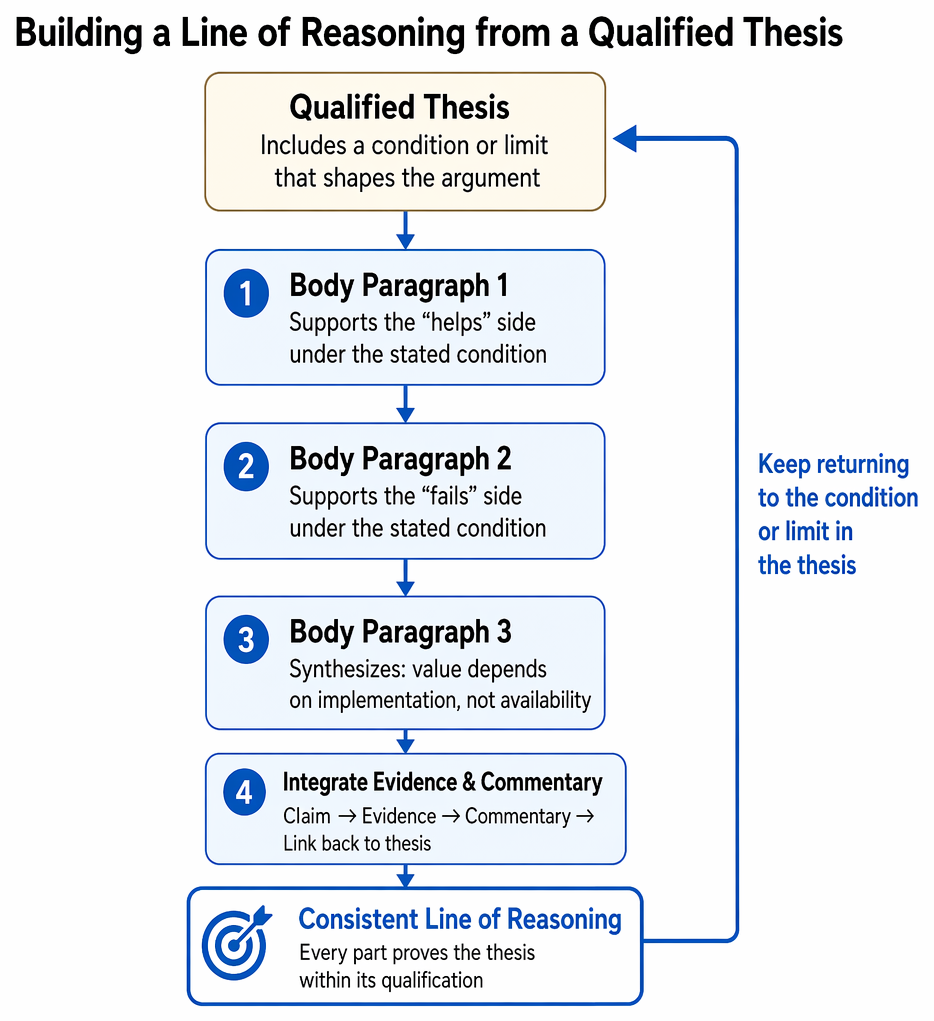
Claim qualification as a precise argumentative stance, showing how conditional wording supports a defensible thesis and guides supporting analysis.
Key Term: line of reasoning
The logical progression that connects the thesis, supporting claims, evidence, and commentary across an essay.
A qualified thesis only helps if the essay develops it consistently. This is where many students lose Row B points. They write a qualifiedd thesis, then produce body paragraphs that contradict it, drift away from it, or treat it as if it were absolute.
Suppose the thesis is: “Technology improves education when it supports skilled teaching, but it does not improve learning when it replaces human instruction.”
A weak essay might include:
- one paragraph about how laptops are useful
- one paragraph about how phones are distracting
- one paragraph about online learning during emergencies
Those ideas are related, but not clearly organized. The essay risks becoming a list.
A stronger line of reasoning would divide the argument by the conditions named in the thesis:
- Technology helps when it allows teachers to personalize pace and access.
- Technology fails when schools use it as a substitute for explanation, discussion, or feedback.
- Therefore, technology is a tool whose value depends on implementation, not mere availability.
That is much stronger because each paragraph grows out of the qualification. The body paragraphs do not just add points; they prove the exact form of the thesis.
How evidence and commentary work with qualified claims
Key Term: commentary
The explanation of how or why evidence supports a claim and advances the line of reasoning.
Evidence does not prove much on its own. It only becomes useful when commentary explains its relevance. This is especially true with qualified claims because the evidence must support the claim under the stated condition.
Look at this example:
Thesis: “Standardized tests may provide useful baseline data, but they should not determine educational quality because they measure only a narrow slice of student ability.”
Weak paragraph: “Standardized tests focus on math and reading scores. Many schools use those scores for accountability.”
This is mostly summary.
Stronger paragraph: “Because standardized tests reduce performance to a limited set of timed tasks, they measure test-taking under pressure more reliably than they measure full educational quality. A school may post strong reading and math scores while still neglecting writing, discussion, creativity, or civic engagement. This matters because the thesis does not deny that tests offer data; instead, it argues that the data are too narrow to stand in for the broader aims of education.”
Notice how the commentary keeps returning to the qualification. It explains not merely what the evidence shows, but why that evidence supports the limited claim.
A simple paragraph frame is:
- claim
- evidence
- commentary
- link back to thesis
For a qualified thesis, the last step is vital. The reader must keep seeing the condition or limit.
Weak vs strong thesis examples
Here are several common prompt types with revisions.
Prompt area: value of failure
- Weak: Failure is good.
- Better: Failure can be valuable when people use it to revise their methods, but failure without reflection often becomes discouragement rather than growth.
Prompt area: role of social media
- Weak: Social media destroys communication.
- Better: Social media can weaken communication when it replaces direct interaction, though it can also preserve relationships across distance.
Prompt area: importance of tradition
- Weak: Tradition is necessary in society.
- Better: Tradition is most valuable when it preserves meaning without preventing needed reform.
Prompt area: ambition
- Weak: Ambition leads to success.
- Better: Ambition leads to success only when it is paired with discipline and ethical restraint.
Each stronger version does two things: it narrows the claim and creates a map for evidence.
How qualification connects to rubric success
Qualification helps all three rubric areas, but in different ways.
For Row A, it can produce a clearer defensible thesis because it avoids empty generalization.
For Row B, it improves coherence because the essay can organize itself around conditions, categories, or limits.
For Row C, it may contribute to sophistication if the complexity is meaningful and sustained.
But students should be careful here. Qualification alone does not earn sophistication. A thesis like “To some extent, yes, but also no” is not automatically sophisticated. Sophistication comes from the depth of the argument: exploring tensions, implications, limits, or broader context in a way that feels earned.
A sophisticated argument might do one of these:
- distinguish short-term from long-term effects
- separate stakeholder perspectives
- show why a principle works in one context but not another
- address an implication of the writer’s own claim
For example: “Civil disobedience is justified when legal systems block peaceful reform, but its moral force weakens when it becomes detached from public accountability.”
That has the potential for sophistication because it raises an internal tension. But the essay still must develop that tension thoughtfully.
Common mistakes students make
-
Vague balance
- “There are pros and cons on both sides.”
- Problem: no judgment.
-
Empty hedging
- “This is maybe sometimes true.”
- Problem: sounds uncertain, not precise.
-
Complex thesis, weak support
- The thesis names three conditions, but the essay only proves one.
- Problem: Row A may score, but Row B drops.
-
Concession without use
- A brief nod to the other side never affects the essay.
- Problem: fake complexity.
-
Evidence without commentary
- Students pile up examples but never explain why they matter under the thesis’s specific limits.
-
Contradictory body paragraphs
- The thesis says “X under certain conditions,” but later paragraphs argue both for and against X without structure.
A good final check is to ask:
- What exactly is my position?
- What are its limits?
- Does each body paragraph prove one of those limits or reasons?
Key Point Checklist
This article has covered the following key knowledge points:
- A qualified claim includes limits, conditions, exceptions, or extent
- A qualified thesis can still earn Row A if it presents a defensible position
- Qualification is not the same as indecision or fence-sitting
- A vague thesis that only says both sides have merits usually does not score well
- Overgeneralization weakens credibility and makes claims harder to defend
- Concession acknowledges some validity in an opposing view
- Counterargument is the opposing claim itself
- Line of reasoning is the logical path connecting thesis, claims, evidence, and commentary
- Commentary explains how and why evidence supports the argument
- Qualified claims need body paragraphs that develop the stated limits or conditions
- Qualification may help sophistication, but it does not automatically earn Row C
- Strong AP Lang essays use precise judgments rather than empty balance
Key Terms and Concepts
- qualified claim
- defensible position
- overgeneralization
- concession
- counterargument
- line of reasoning
- commentary