Learning Outcomes
- Explain why religious toleration expanded in parts of Europe during the seventeenth and eighteenth centuries
- Distinguish between limited toleration and full religious equality
- Identify key thinkers linked to toleration, including John Locke and Voltaire
- Recall major examples such as the Act of Toleration (1689), Joseph II's Patent of Toleration (1781), and the Edict of Fontainebleau (1685)
- Compare philosophical arguments for toleration with the practical policies of rulers such as Frederick II and Joseph II
- Analyse why rulers broadened toleration for reasons of state-building as well as principle
- Use toleration as evidence in SAQs, DBQs, and LEQs on Enlightenment politics and state power
AP European History Syllabus
For the AP European History, you are expected to understand how governments broadened religious toleration in the age of Enlightenment, with a focus on the following syllabus points:
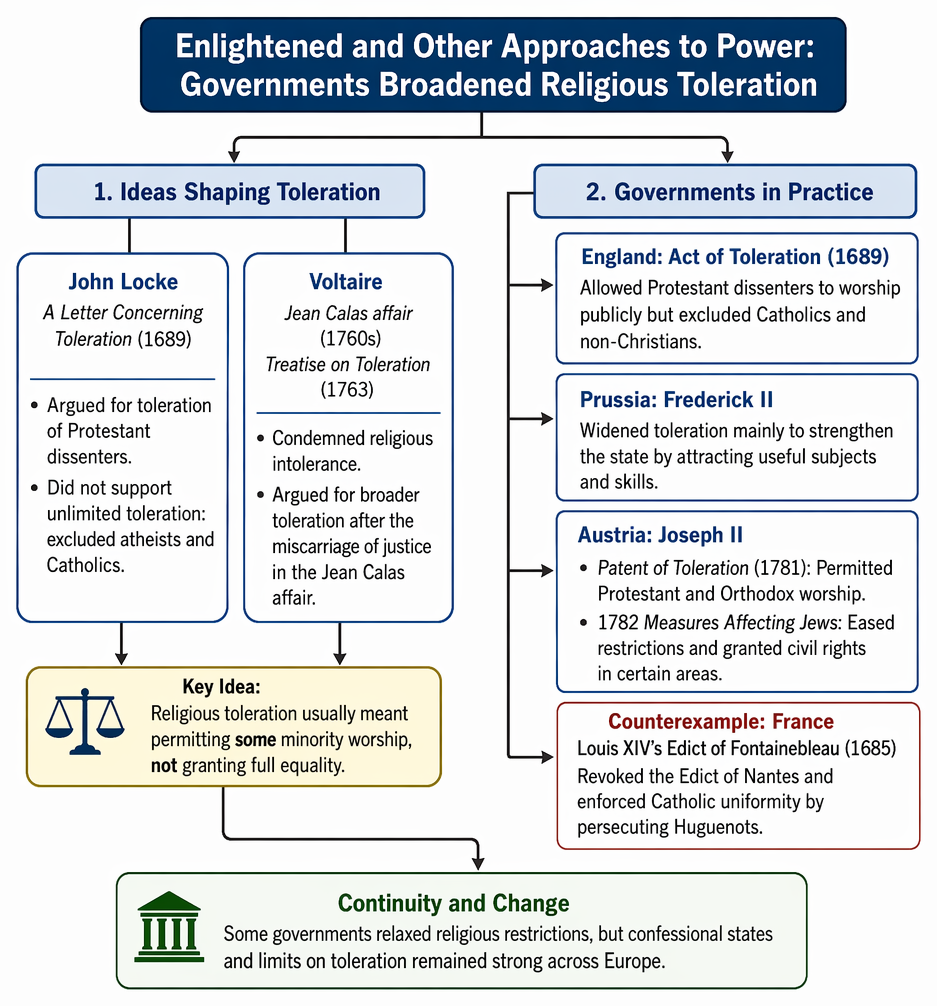
European policies on religious toleration trace the shift from confessional states toward selective legal exemptions for Protestant dissenters, Jews, and other minorities.
- Know that religious toleration usually meant permitting some minority worship, not granting full equality
- Identify the Act of Toleration (1689) in England as an example of limited toleration for Protestant dissenters
- Explain John Locke's A Letter Concerning Toleration (1689) and why Locke did not support unlimited toleration
- Understand Voltaire's criticism of intolerance, especially through the Jean Calas affair and Treatise on Toleration (1763)
- Know that Frederick II of Prussia and Joseph II of Austria widened toleration mainly to strengthen the state
- Recall Joseph II's Patent of Toleration (1781) and the 1782 measures affecting Jews
- Use Louis XIV's Edict of Fontainebleau (1685) as a counterexample showing that some rulers still enforced confessional uniformity
- Understand continuity and change: confessional states remained strong even as some governments relaxed religious restrictions
Test Your Knowledge
Attempt these questions before reading this article. If you find some difficult or cannot remember the answers, look more closely at that area during your revision.
- What is the difference between religious toleration and full religious equality?
- How did the Act of Toleration (1689) broaden rights in England, and who remained excluded?
- Why is John Locke important to the history of toleration?
- Name two rulers associated with broadening religious toleration in the eighteenth century.
- Why is the Edict of Fontainebleau (1685) an important counterexample?
Introduction
In AP European History Unit 4, religious toleration matters because it shows how Enlightenment ideas affected government, but only partly. European rulers and thinkers increasingly criticized persecution and religious violence, yet very few states embraced modern religious freedom. Instead, most governments allowed selected minorities some space to worship while keeping one religion privileged.
This makes the topic ideal for AP analysis. It is about both change and continuity. Change: some governments loosened older rules and reduced persecution. Continuity: states still regulated belief, limited rights, and often treated minorities unequally. A strong exam answer should show both sides at once.
Key Term: religious toleration
Government willingness to permit more than one faith or form of worship, usually with important legal, political, or social limits.
What “broadened toleration” actually meant
Students often make this topic too modern. They hear “toleration” and think of complete freedom of religion. That is usually wrong for the seventeenth and eighteenth centuries. Most states did not accept full equality among religions. They simply moved from strict persecution toward a more selective, managed system.
Key Term: limited toleration
Permission for some religious minorities to worship or live with fewer restrictions, without granting full equality or equal political rights.
A useful distinction is this:
- Full religious liberty means broad freedom of conscience and equal treatment before the state
- Limited toleration means some groups are allowed to worship, but with restrictions
- Confessional uniformity means the state aims for one dominant faith and suppresses rivals
Key Term: confessional state
A state closely tied to one officially favoured religion, often expecting religious conformity from its subjects.
Why did toleration broaden at all? Three linked reasons matter:
First, the memory of the Reformation and wars of religion made many rulers and thinkers doubt whether persecution actually produced unity. Forced conversion often created resistance, exile, or rebellion instead.
Second, Enlightenment writers argued that belief could not be compelled by force. You can force outward behaviour, but not genuine conviction. This was a key intellectual shift.
Third, rulers saw practical benefits. A state with fewer religious conflicts could collect taxes more efficiently, attract skilled migrants, and use minorities in trade, administration, or settlement.
This last point is easy to miss. Toleration was often not mainly about kindness. It was often about utility.
Test Tip: In SAQs and LEQs, do not write that toleration meant “everyone became equal.” A better line is: “Governments broadened toleration selectively, while preserving religious hierarchy and state authority.”
England, Locke, and the idea of toleration after 1689
England is one of the most important examples, but students must classify it correctly. It was not an example of enlightened absolutism. It was a constitutional settlement after the Glorious Revolution.
The Act of Toleration (1689) gave freedom of worship to many Protestant dissenters, often called Nonconformists. These included groups such as Baptists and Congregationalists. This was significant because it reduced the expectation that all Protestants must worship through the Church of England.
Key Term: Act of Toleration (1689)
English law granting public worship to many Protestant Nonconformists, while preserving major restrictions on Catholics and others.
But the law had major limits. It did not create universal toleration. Catholics were excluded. Unitarians were excluded. Atheists were outside the accepted framework. The Test Acts remained, which meant many dissenters, along with Jews and Catholics, still could not hold public office or sit in Parliament. So England broadened toleration while keeping the Church of England privileged.
This is exactly the sort of distinction AP examiners like. England moved toward pluralism, but not equality.
The best known intellectual defence of toleration came from John Locke in A Letter Concerning Toleration. Locke argued that government should deal with civil interests such as life, liberty, health, and property. It should not try to coerce belief. His reasoning was powerful: true religion depends on inward conviction, and force cannot create sincere faith.
Key Term: A Letter Concerning Toleration
Locke’s 1689 argument that government should protect civil interests rather than force religious belief.
Locke helped move religion toward the private sphere. Yet he was not fully modern either. His toleration had limits. In practice, Catholics and atheists were not fully included in his scheme. Catholics were viewed with suspicion because of supposed loyalty to a foreign power, the pope. Atheists were distrusted because they were believed incapable of binding moral oaths.
So Locke matters not because he invented perfect liberty, but because he gave one of the clearest philosophical arguments against forced religious conformity.
Voltaire built on this critical tradition. In Letters on England, he praised English religious diversity as healthier than French intolerance. In Treatise on Toleration (1763), written after the Jean Calas case, he attacked fanaticism and judicial injustice. Calas, a French Protestant, had been wrongly accused and executed. Voltaire turned the case into a wider attack on persecution.
Voltaire is useful on exams because he shows how philosophes connected religious intolerance to backwardness, cruelty, and irrational government.
Test Tip: If a question asks for a comparison, pair Locke with England and Voltaire with France. That lets you show the difference between philosophical criticism and actual state policy.
Enlightened absolutists and state-centred toleration
The clearest rulers for this subtopic are Frederick II of Prussia and Joseph II of Austria. Both widened toleration, but they did so from above and without surrendering absolute power.
Key Term: enlightened absolutism
A form of rule in which monarchs adopted some Enlightenment-inspired reforms while keeping centralized, absolute authority.
Frederick II of Prussia practiced toleration in a practical way. He allowed multiple Christian groups to live in his state and reduced the danger of religious conflict. This was especially useful in mixed territories such as Silesia, which Prussia had seized from Austria. A ruler who had just acquired new lands did not want rebellion from religious minorities. Toleration could create obedience more effectively than coercion.
Frederick also valued population growth, skilled labour, and orderly administration. If religious minorities were useful subjects, he wanted them. That is why his toleration is best described as pragmatic, not egalitarian. He was willing to accommodate difference so long as it strengthened Prussia.
At the same time, Frederick had limits. He did not aim at universal equality. His state remained tightly controlled. Social hierarchy stayed in place. So even here, toleration was real but bounded.
Joseph II of Austria went further. In 1781, he issued the Patent of Toleration, which granted limited freedom of worship to Lutherans, Calvinists, and Orthodox Christians in the Habsburg lands.
Key Term: Patent of Toleration (1781)
Joseph II’s decree granting limited rights of worship and civil participation to non-Catholic Christians in the Habsburg monarchy.
These groups gained practical rights. They could worship more openly, enter some trades and professions, and participate more fully in civil life. But Catholicism remained the favoured religion. Worship was still regulated. Equality was incomplete.
In 1782, Joseph extended toleration in important ways to Jews. This did not amount to emancipation, but it widened access to education, trade, and some professions. Again, the logic was practical. Joseph wanted more useful, productive subjects and a stronger centralized state.
Joseph is a strong AP Euro example because he shows the full pattern of enlightened absolutism:
- reform from above
- criticism of old religious monopoly
- continued state control
- no democracy
- no full equality
He also limited the independent power of the Catholic Church. That matters because toleration was often linked to another goal: reducing rival institutions inside the state. If the Church lost some monopoly power, the monarch gained it.
A careful comparison helps:
- Frederick II tolerated for order, settlement, and usefulness
- Joseph II tolerated for administrative reform and state centralization
- both broadened rights
- neither created modern religious freedom
Limits, counterexamples, and how to use this on the exam
AP questions reward students who resist over-simple stories. This period did not move steadily toward freedom. A major counterexample is Louis XIV’s Edict of Fontainebleau (1685), which revoked the Edict of Nantes.
Key Term: Edict of Fontainebleau (1685)
Decree by Louis XIV revoking toleration for French Protestants and restoring religious repression.
This ended legal toleration for Huguenots, the French Calvinists. Protestant worship was banned, churches and schools were destroyed, and many Huguenots fled France. This matters for two reasons.
First, it shows that some rulers still believed religious uniformity made the state stronger.
Second, it gives you a sharp contrast with later developments. France under Louis XIV pursued confessional unity through repression. Later philosophes like Voltaire attacked exactly this mentality.
Another limit appears in the Edict of Toleration (1787) under Louis XVI. It granted non-Catholics some civil rights, such as legal recognition of births and marriages, but still did not create full religious equality. This fits the same broad pattern: widening toleration, but carefully.
A high-scoring AP answer should therefore make a three-step argument:
- Enlightenment thinkers criticized intolerance and defended broader toleration.
- Some governments adopted these ideas in part, especially England, Prussia, and Austria.
- Toleration remained selective, unequal, and shaped by state interests.
That last point is the judgement. It turns description into analysis.
If you are writing an SAQ, one sentence could identify a thinker and one could identify a ruler. For example: Locke argued that civil government should not force belief, while Joseph II’s Patent of Toleration widened worship rights for non-Catholic Christians in Austria. Then add a final sentence on limits.
If you are writing an LEQ or DBQ, frame the issue as change with continuity. Religious persecution became less rigid in some places, but official churches, legal discrimination, and absolutist power remained.
Test Tip: For essays, a strong thesis is: “Governments in the seventeenth and eighteenth centuries broadened religious toleration, but mostly in limited and state-controlled ways, as shown by England’s 1689 settlement and the reforms of Frederick II and Joseph II, while repression in France under Louis XIV shows that confessional uniformity remained powerful.”
Key Point Checklist
This article has covered the following key knowledge points:
- Religious toleration in AP Euro usually means limited permission for minority worship, not full equality
- England’s Act of Toleration (1689) broadened rights for many Protestant Nonconformists
- The English settlement after 1689 still excluded Catholics, Unitarians, and many dissenters from full political rights
- John Locke’s A Letter Concerning Toleration argued that government should protect civil interests rather than coerce belief
- Locke’s toleration was influential but not universal in scope
- Voltaire praised English pluralism and attacked French religious intolerance
- The Jean Calas affair helped inspire Voltaire’s Treatise on Toleration (1763)
- Frederick II of Prussia practiced pragmatic toleration to strengthen the state
- Joseph II’s Patent of Toleration (1781) widened rights for non-Catholic Christians in the Habsburg lands
- Joseph II’s 1782 measures extended important, but incomplete, rights to Jews
- Louis XIV’s Edict of Fontainebleau (1685) revoked toleration for Huguenots and shows that repression remained a major pattern
- Enlightenment-era toleration was uneven, selective, and closely tied to state power
Key Terms and Concepts
- religious toleration
- limited toleration
- confessional state
- Act of Toleration (1689)
- A Letter Concerning Toleration
- enlightened absolutism
- Patent of Toleration (1781)
- Edict of Fontainebleau (1685)