Learning Outcomes
- Explain why Brandenburg-Prussia rose from a minor state to a major European power
- Identify how the Hohenzollern dynasty used the army, taxation, and noble support to strengthen Prussia
- Understand why the Habsburg Monarchy increasingly focused on eastern and southeastern lands
- Recall the importance of Silesia, the Pragmatic Sanction (1713), and the War of the Austrian Succession
- Distinguish between long-term structural causes of Prussia’s rise and the immediate trigger of war in 1740
- Analyse how this rivalry changed the balance of power in the German states and in Europe more broadly
AP European History Syllabus
For the AP European History, you are expected to understand how Prussia rose as the Habsburgs increasingly focused east and southeast, with a focus on the following syllabus points:
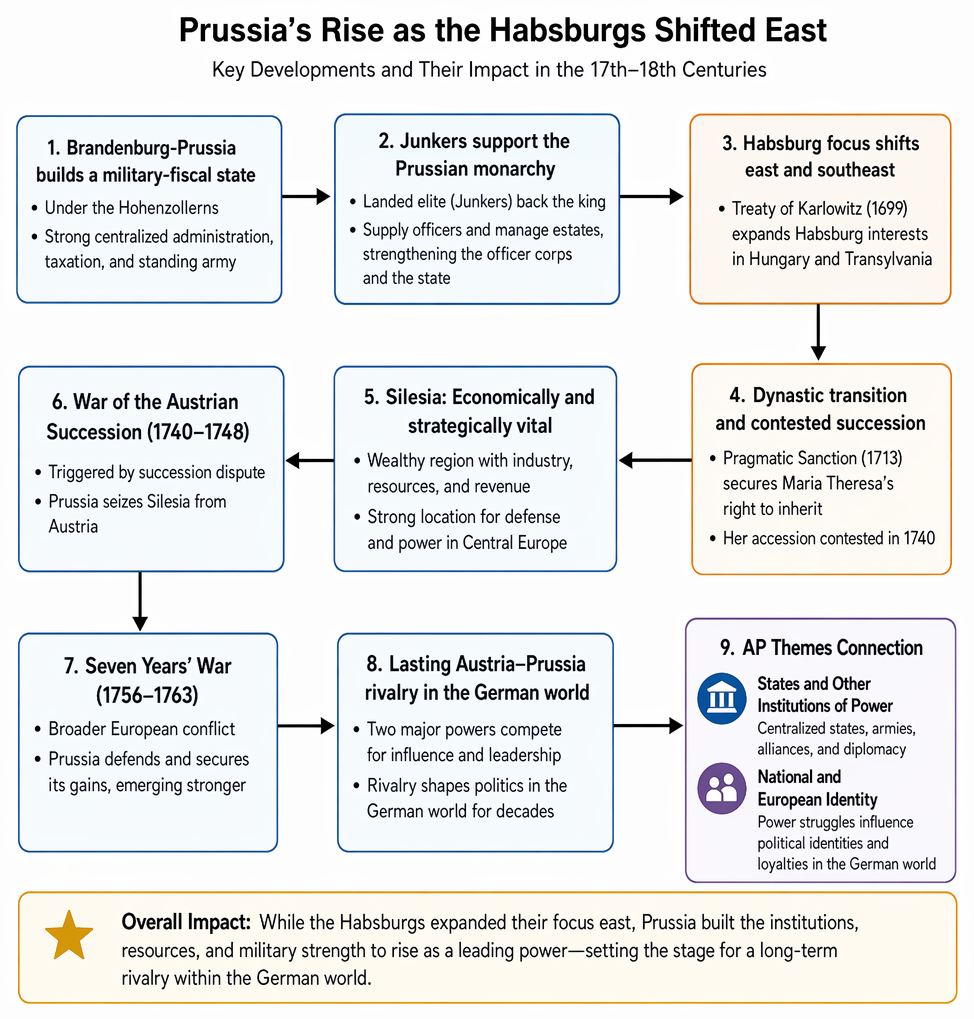
Prussian centralization under the Hohenzollerns and Habsburg expansion into Hungary and Transylvania reshaped the balance of power in Central Europe.
- Know that Brandenburg-Prussia developed into a military-fiscal state under the Hohenzollerns
- Identify the role of the Junkers in supporting the Prussian monarchy and officer corps
- Understand the significance of the Treaty of Karlowitz (1699) in expanding Habsburg interests in Hungary and Transylvania
- Explain the Pragmatic Sanction (1713) and why Maria Theresa’s succession was contested in 1740
- Know why Silesia was economically and strategically important
- Distinguish between the War of the Austrian Succession (1740–1748) and the Seven Years’ War (1756–1763)
- Explain how Prussia’s rise created a lasting Austria-Prussia rivalry within the German world
- Understand this topic as part of broader AP themes of States and Other Institutions of Power and National and European Identity
Test Your Knowledge
Attempt these questions before reading this article. If you find some difficult or cannot remember the answers, look more closely at that area during your revision.
- Why did Prussia become stronger in the late seventeenth and eighteenth centuries?
- What was the Pragmatic Sanction, and why did it matter in 1740?
- Why was Silesia so important to both Austria and Prussia?
- How did Habsburg attention to Hungary and the Ottoman frontier affect politics in the German states?
- What was the main result of the War of the Austrian Succession for Central Europe?
Introduction
This subtopic sits in Period 2, c. 1648–1815, and it is really about a shift in power inside Central Europe. For centuries, the Austrian Habsburgs had dominated the Holy Roman Empire and played the leading role in the German lands. During the eighteenth century, that old pattern changed. Prussia rose rapidly and became Austria’s chief rival.
The key point is not that Austria suddenly collapsed. It did not. The stronger explanation is that Prussia built an unusually efficient military state, while the Habsburg Monarchy had to govern a much larger, more complex empire that increasingly faced east and southeast toward Hungary, Transylvania, and the Ottoman frontier. When the succession crisis of 1740 arrived, Prussia was ready to exploit it.
Key Term: Brandenburg-Prussia
The Hohenzollern state formed from Brandenburg and the Duchy of Prussia under one ruler, which developed into the core of the future Prussian kingdom.Exam Warning: Do not rely on keyword recognition alone; check the precise condition, exception, calculation step, or evidence the question requires.
How Brandenburg-Prussia built the foundations of power
Prussia’s rise did not begin with Frederick the Great marching into Silesia. That conquest mattered hugely, but it rested on decades of earlier state-building.
The first major architect was Frederick William, the Great Elector (r. 1640–1688). Brandenburg-Prussia had been badly damaged by the Thirty Years’ War, and it was geographically awkward: scattered lands, weak natural frontiers, and limited resources. A weak ruler would have been trapped by those conditions. Frederick William instead treated them as reasons to centralize.
He wanted a stronger army, but armies cost money. That meant he needed support from the landed nobility.
Key Term: Junkers
The landed nobility of Prussia, who supported the monarchy and dominated the army officer corps and much of local administration.
The deal between ruler and nobility was simple but powerful. The Junkers accepted stronger royal taxation and military organization. In return, the monarchy protected their control over peasants and serfs. This was not an accidental compromise. It created the social basis of the Prussian state. The king gained revenue and soldiers; the Junkers gained status, offices, and discipline in the countryside.
This arrangement helps explain why Prussia became so militarized without becoming socially revolutionary. The monarchy did not destroy noble privilege. It used noble privilege.
Another part of the story was administration. Prussia became known for an unusually efficient bureaucracy. Tax collection and military organization were linked closely together.
Key Term: military-fiscal state
A state that organizes taxation, administration, and society mainly to support a standing army.
A commonly tested distinction is this: Frederick William, the Great Elector, began the system; Frederick William I, the Soldier King (r. 1713–1740), hardened and expanded it. Students often skip the Soldier King because Frederick II is more famous, but that is a mistake. Frederick William I made the army larger, more disciplined, and more central to the state. He also strengthened bureaucracy and kept court spending relatively frugal. He built the machine his son later used.
The General War Commissariat became especially important because it linked taxation, local administration, and military needs. That mattered because Prussia was not rich enough to win through wealth alone. It had to win through organization.
Test Tip: For AP multiple-choice and SAQ answers, separate the builder from the conqueror. Frederick William I built the army-state; Frederick II used it to seize territory.
Why the Habsburgs “shifted east” and why that mattered
The AP phrase can be misleading if taken too literally. The Habsburgs did not stop caring about Germany. A better phrase is that they increasingly focused on their eastern and southeastern frontier.
The turning point was the long struggle with the Ottoman Empire. After major Habsburg successes, especially the Treaty of Karlowitz (1699), Austria gained much of Hungary and strengthened control over Transylvania. This was a major victory. But success also created new burdens.
Key Term: Treaty of Karlowitz
The 1699 settlement that expanded Habsburg control in Hungary and Transylvania after victories against the Ottomans.
These new lands made the Habsburg Monarchy larger, more diverse, and harder to govern. Austria was not a compact national state like Prussia. It was a composite monarchy with many peoples, traditions, and legal arrangements. Governing Bohemia was not the same as governing Hungary. Defending the Balkans was not the same as managing politics inside the Holy Roman Empire.
The Habsburgs also had to maintain the Military Frontier, a militarized border zone against Ottoman attack. That required troops, money, and attention. So the same eastern expansion that made Austria stronger also pulled resources away from purely German politics.
This is the key causal chain students should know:
- Habsburg victories over the Ottomans expanded Austrian lands.
- Expansion increased Habsburg prestige but also administrative complexity.
- Austria’s strategic concerns increasingly centered on Hungary, Transylvania, and the Balkan frontier.
- That helped create room for a more compact and efficient Prussia to expand inside the German world.
Notice the wording: this eastern focus contributed to Prussia’s rise, but it did not automatically cause it. Prussia still needed strong rulers, noble cooperation, taxes, and an army. Good AP answers avoid one-cause explanations.
A useful comparison is this:
- Prussia: smaller, more centralized, more militarized, mostly German
- Austria: larger, more diverse, harder to centralize, stretched across multiple regions
That contrast became very significant in 1740.
The succession crisis of 1740 and the seizure of Silesia
The immediate crisis came when Charles VI died in 1740 without a male heir.
Key Term: Pragmatic Sanction
The decree issued in 1713 by Charles VI to keep the Habsburg lands indivisible and allow his daughter Maria Theresa to inherit them.
Charles VI had spent years persuading other powers to accept this arrangement. On paper, many did. In practice, several saw his death as an opportunity.
This is where AP causation matters. The immediate cause of war was the disputed succession after Charles VI’s death. The long-term causes were Prussian state-building, Habsburg overextension, and wider balance-of-power rivalry.
Frederick II of Prussia, later called Frederick the Great (r. 1740–1786), moved quickly. He invaded Silesia in 1740.
Key Term: Silesia
A wealthy Habsburg province with valuable agriculture, textiles, and mineral resources, seized by Prussia in 1740.
Why did Silesia matter so much?
First, it was rich. It added population, taxes, and productive industry to Prussia. Second, it was strategically placed near Bohemia and the northeastern Habsburg lands. Third, taking it damaged Austrian prestige and showed that Prussia could challenge Habsburg leadership directly.
That is why the phrase “Silesia made Prussia” is so useful for revision. Prussia was already rising, but possession of Silesia pushed it into the front rank of European powers.
Maria Theresa did not simply surrender. With support from Hungarian elites, she preserved the Habsburg Monarchy and stayed on the throne. That is a crucial point. Austria lost Silesia, but it did not disintegrate.
The resulting conflict became the War of the Austrian Succession (1740–1748). By the Treaty of Aix-la-Chapelle (1748), Prussia kept Silesia.
Students sometimes confuse this with the later Seven Years’ War. Keep the distinction clear:
- War of the Austrian Succession: started by the succession dispute and Prussia’s first seizure of Silesia
- Seven Years’ War: Austria’s later attempt to recover Silesia after alliances shifted
Test Tip: If an essay asks about why Prussia rose, do not write only about Enlightenment reforms under Frederick the Great. The stronger answer starts with military and administrative development, then shows how Frederick used that strength in 1740.
From Silesia to European balance-of-power rivalry
The Prussian seizure of Silesia had effects far beyond one province. It created a durable Austria-Prussia rivalry that would shape German politics for more than a century.
Austria now understood that Prussia was not a temporary nuisance. It was a permanent rival. That is why Maria Theresa and her foreign minister Kaunitz helped engineer the Diplomatic Revolution of 1756, aligning Austria with France against Prussia. Britain, in turn, aligned with Prussia.
This alliance shift shows the importance of balance-of-power politics. States were not choosing friends based on tradition or religion. They chose allies based on strategic interest. Austria hated losing Silesia more than it hated France.
The Seven Years’ War (1756–1763) then became, in European terms, a struggle over whether Prussia would survive as a great power. Frederick did survive, in part because Peter III of Russia withdrew Russian support from the anti-Prussian coalition in 1762. The result confirmed what 1748 had begun: Prussia was now a major power, and Austria could no longer dominate the German lands without challenge.
There is also a continuity-and-change argument here, which AP essays reward:
- Continuity: Austria remained a great power after 1748 and after 1763.
- Change: Austria no longer enjoyed clear leadership in the German world; Prussia now rivalled it.
That shift later fed into the longer story of German dualism, the competition between Austria and Prussia over leadership in Central Europe. By the nineteenth century, that rivalry would shape the path to German unification under Prussian leadership.
So, when AP Euro says “Prussia rose as Habsburgs shifted east,” the best explanation is this: Prussia rose because the Hohenzollerns built a disciplined military-bureaucratic state and then used a succession crisis to seize Silesia, while Austria’s resources and attention were increasingly tied to ruling and defending a sprawling eastern and southeastern empire.
Key Point Checklist
This article has covered the following key knowledge points:
- Brandenburg-Prussia rose through centralization, taxation, bureaucracy, and military strength
- The Junkers supported the monarchy in return for preserved social power over peasants and influence in the army
- Frederick William, the Great Elector laid the early foundations of Prussian power after the Thirty Years’ War
- Frederick William I strengthened the army and bureaucracy and built the Prussian state machinery
- The Habsburg Monarchy increasingly focused on Hungary, Transylvania, and the Ottoman frontier
- The Treaty of Karlowitz (1699) expanded Habsburg control in the east and southeast
- The Pragmatic Sanction (1713) aimed to preserve Habsburg lands and secure Maria Theresa’s succession
- Frederick II invaded Silesia in 1740, using the succession crisis to expand Prussia
- Silesia was valuable because of its wealth, population, and strategic position
- The War of the Austrian Succession (1740–1748) ended with Prussia keeping Silesia
- Prussia’s rise created a lasting rivalry with Austria and changed the balance of power in the German states
- The later Diplomatic Revolution and Seven Years’ War grew directly from the unresolved Silesia question
Key Terms and Concepts
- Brandenburg-Prussia
- Junkers
- military-fiscal state
- Treaty of Karlowitz
- Pragmatic Sanction
- Silesia