Learning Outcomes
- Understand what enlightened absolutism meant in eighteenth-century Europe
- Identify the main policies of Frederick II of Prussia, Joseph II of Austria, and Catherine II of Russia
- Explain why these rulers adopted some Enlightenment ideas without accepting democracy
- Compare the extent to which each ruler fits the label of enlightened absolutist
- Trace cause-and-effect links between reform, state centralization, and resistance from nobles, clergy, and peasants
- Build evidence and comparison points for SAQs and LEQs on enlightened absolutism
AP European History Syllabus
For the AP European History, you are expected to understand enlightened absolutism in eighteenth-century Eastern Europe and Russia, with a focus on the following syllabus points:
- Know that enlightened absolutism was a form of absolute monarchy that adopted selected Enlightenment ideas while preserving royal authority
- Identify the three major rulers usually linked to this topic: Frederick II of Prussia (r. 1740–1786), Joseph II of Austria (r. 1765–1790, sole ruler of Habsburg lands 1780–1790), and Catherine II of Russia (r. 1762–1796)
- Explain how these rulers promoted reforms such as religious toleration, legal reform, education, and state centralization
- Understand the limits of these reforms, especially their failure to establish constitutional rule or broad political participation
- Compare how far each ruler challenged noble privilege, serfdom, and church authority
- Explain why enlightened reforms often came from practical state-building aims rather than pure idealism
- Use specific evidence such as Joseph II’s Edict of Toleration (1781), Catherine II’s Nakaz (1767), and Frederick’s ties to Voltaire
Test Your Knowledge
Attempt these questions before reading this article. If you find some difficult or cannot remember the answers, look more closely at that area during your revision.
- What is meant by enlightened absolutism, and how is it different from democracy?
- Why is Joseph II often seen as the most reform-minded enlightened absolutist?
- How did Catherine II use Enlightenment language while still strengthening autocracy?
- Why does Frederick II fit the label only partly?
- Name one major reform and one major limit for each of the three rulers.
Introduction
During the eighteenth century, some European rulers tried to use ideas associated with the Enlightenment without giving up absolute power. This created a political style often called enlightened absolutism or enlightened despotism. The basic idea was simple: reform the state from above, make it more efficient and rational, but do not let subjects share real power.
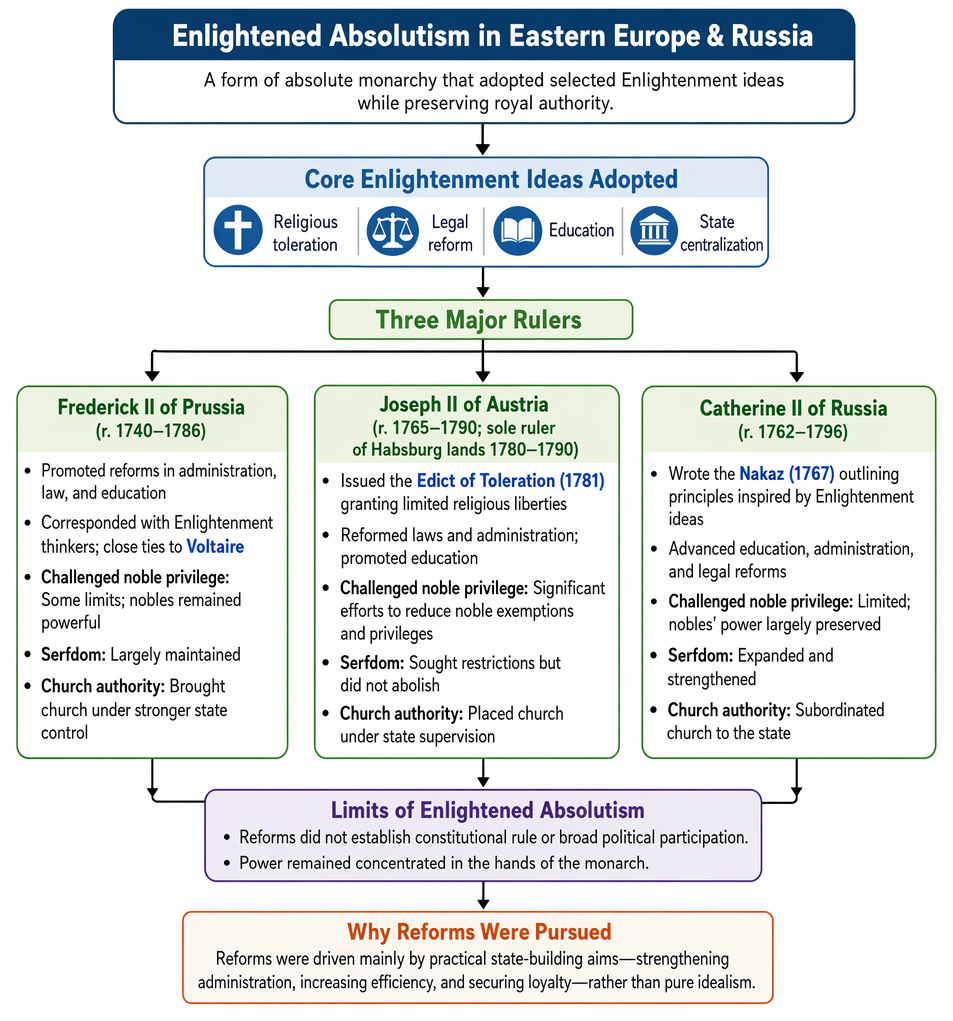
Eighteenth-century rulers Frederick II, Joseph II, and Catherine II are compared by legal, religious, administrative, and social reforms within absolute monarchy.
This topic sits in Period 2 and connects strongly to the AP themes of states and other institutions of power and objective knowledge and subjective visions. It matters because it shows both the influence of Enlightenment thought and its limits. Rulers could praise reason, toleration, and legal improvement, yet still defend serfdom, noble privilege, censorship, and autocracy.
Key Term: enlightened absolutism
A form of absolute monarchy in which rulers adopted selected Enlightenment ideas to reform government, law, religion, or education while keeping full political authority.
What made a ruler “enlightened” and what kept them “absolute”?
To answer AP questions well, you need to keep the tension in the term itself. The word enlightened suggests reason, reform, and criticism of old abuses. The word absolute means the ruler still kept sovereign power and rejected meaningful political participation.
That is why a common summary is “everything for the people, nothing by the people.” Even if that phrase was not the official slogan of one ruler, it captures the pattern well. These monarchs did not want representative government. They wanted better administration, a more obedient bureaucracy, and fewer obstacles from the church or traditional elites.
Key Term: absolute monarchy
A system in which a ruler holds concentrated political power and is not constitutionally limited by representative institutions.
Most leading philosophes did not call for modern democracy. Thinkers such as Voltaire and Diderot often hoped that intelligent monarchs would apply reason to government. That made selective reform attractive to rulers. They could borrow Enlightenment ideas without accepting popular sovereignty.
Key Term: state centralization
The process by which a ruler strengthens control over administration, law, taxation, and local institutions across a state.
This explains why enlightened absolutism often focused on four areas:
- religious toleration
- legal and judicial reform
- education
- administrative efficiency
These were useful reforms because they could strengthen the monarchy. More tolerated religious minorities could become useful officials and taxpayers. More schools could train bureaucrats. More uniform laws could weaken local privilege. Less power for the church could mean more power for the state.
The crucial distinction is this: reform did not equal liberty. A ruler could abolish torture and still censor critics. A ruler could weaken serfdom in one area and still crush political opposition. A ruler could call a commission to rewrite laws and still refuse any constitution.
Test Tip: In SAQs and LEQs, do not confuse enlightened absolutism with constitutional monarchy. If you say these rulers “gave people political rights,” you will weaken your argument.
Frederick II, Joseph II, and Catherine II compared
The three rulers most often used for comparison are Frederick II of Prussia, Joseph II of Austria, and Catherine II of Russia. They were not equally “enlightened,” and that difference is exactly what AP essays often test.
A useful comparison frame is:
- Frederick II = practical, efficient, militarized reformer
- Joseph II = most ambitious and systematic reformer
- Catherine II = most selective and least consistent in practice
Frederick II of Prussia
Frederick II, or Frederick the Great, ruled Prussia from 1740 to 1786. He admired French culture, read Voltaire, and even invited him to court. Frederick also described himself as the “first servant of the state,” which sounds modest, but really meant that the ruler should manage the state efficiently.
Key Term: first servant of the state
Frederick II’s idea that a monarch should govern efficiently in the interests of the state, while still keeping absolute authority.
Frederick did carry out reforms associated with enlightened rule. He supported a measure of religious toleration, improved bureaucracy, promoted education, and worked toward a more rational legal order. He also limited or ended certain harsh judicial practices, including judicial torture. These policies fit Enlightenment concerns with reason and humane government.
Yet the limits are just as important. Prussia remained a military state. Frederick relied heavily on the Junkers, the landed nobility who dominated the army and much of the countryside. He freed serfs on royal estates, but he did not broadly challenge noble power over serfs on private lands. So his reforms stopped where elite support became necessary.
Frederick also showed that enlightened language did not produce peaceful foreign policy. He attacked Silesia, beginning the War of the Austrian Succession. That act looked more like old-style power politics than enlightened international conduct. So Frederick appears enlightened mainly when reform helped state strength.
Joseph II of Austria
If one ruler best fits the label in spirit, it is Joseph II. He was influenced by ideas of toleration, utility, and reform, and he tried to remake the Habsburg lands from above. His rule shows both the greatest promise and the greatest limits of enlightened absolutism.
Joseph issued the Edict of Toleration in 1781, granting greater freedom of worship to Lutherans, Calvinists, and Jews. The reform was not total equality. Protestants gained some access to public life that Jews did not fully receive, and Jews still faced taxes and restrictions. But it was still a major break from strict confessional rule.
Key Term: Edict of Toleration (1781)
Joseph II’s decree that extended limited religious freedom to Protestants and Jews in the Habsburg lands.
Joseph also tried to reduce the power of the Catholic Church. This was partly ideological and partly political. If monasteries, bishops, and Rome controlled too much local life, they stood in the way of central government. So anticlerical reform was also state centralization.
On serfdom, Joseph went furthest of the three rulers. He moved against old peasant restrictions and reduced aspects of serfdom, allowing greater freedom to marry, move, learn trades, and seek education. But students should be careful here: this did not create full rural equality. Peasants still carried burdens, and reform in practice varied across the empire.
Key Term: serfdom
A system in which peasants are legally tied to land and subject to obligations and control by landlords.
Joseph’s weakness was not lack of ambition but too much of it. He tried to impose reforms across a very diverse empire with strong regional identities and entrenched elites. Nobles resisted attacks on their privileges. Clergy resisted church reform. Some peasants also revolted when reforms produced new demands such as taxes or bureaucracy.
After Joseph’s death in 1790, many measures were softened or reversed. That is a major reason why he is both the best example of enlightened absolutism and proof of its limits. Reform from above could move fast, but it depended too much on one ruler.
Test Tip: A strong comparison point is that Joseph II reformed more deeply than Frederick or Catherine, but his reforms proved less durable because they generated broad resistance.
Catherine II of Russia
Catherine II, or Catherine the Great, ruled from 1762 to 1796. She cultivated an enlightened image very effectively. She corresponded with Voltaire, read Diderot, and presented herself as a ruler interested in reason and reform.
Her most famous enlightened document was the Nakaz or Instruction of 1767, a statement influenced by Enlightenment ideas that called for a more rational legal system and criticized torture. She also called a Legislative Commission to consider legal reform.
Key Term: Nakaz
Catherine II’s 1767 Instruction proposing legal and administrative reform in Russia, influenced by Enlightenment thought.
This sounds impressive, but AP students must separate image from results. The Legislative Commission produced little lasting change. Catherine discussed reform, but practical transformation remained limited. Russia’s size, social structure, and dependence on noble support made deep change difficult.
The biggest turning point was Pugachev’s Rebellion (1773–1775), a major uprising that terrified the regime. After that, Catherine became more cautious and conservative. Rather than weakening noble domination, she leaned harder on the nobility.
In 1785, the Charter of the Nobility confirmed and strengthened noble privileges. This widened the gap between enlightened rhetoric and social reality. Serfdom did not improve in any major way; in some respects noble control over serfs became stronger.
Key Term: Pugachev’s Rebellion
A major uprising in Russia from 1773 to 1775 that pushed Catherine II toward more conservative and repressive policies.
So Catherine fits the label least fully. She clearly engaged with Enlightenment thought and used its language. She also pursued some educational and administrative reform. But when reform threatened order or elite support, she chose autocracy. She is the clearest example of selective enlightenment.
Why enlightened absolutism mattered, and why it fell short
Enlightened absolutism matters because it shows how eighteenth-century rulers adapted to new ideas without surrendering old power. These monarchs did change government. They did not rule exactly like Louis XIV or earlier divine-right rulers. They cared more about rational administration, useful education, and better-managed law.
But the continuities were just as strong as the changes:
- monarchy remained absolute
- social hierarchy remained intact
- nobility often kept major privilege
- peasants rarely gained political voice
- constitutions were avoided
- censorship and coercion survived
This makes enlightened absolutism a classic AP argument topic because it rewards qualification. You should not say these rulers were simply enlightened or simply absolutist. They were both, and the tension between those elements shaped their reigns.
A good judgement might look like this:
- Frederick II was enlightened mainly in practical, state-serving ways
- Joseph II was the most genuinely reformist but failed to secure lasting acceptance
- Catherine II used enlightened rhetoric more than deep reform
That comparison gives you balance, evidence, and a clear line of reasoning.
How to structure an evaluative AP answer
For an SAQ, make one direct claim, then attach one specific example. For example: “Joseph II most strongly fit enlightened absolutism because he issued the Edict of Toleration (1781) and moved to reduce noble and church control, though these reforms remained limited and partly reversible.”
For an LEQ, use a comparison thesis that ranks the rulers or distinguishes them by degree. A strong structure is:
- Define enlightened absolutism and set context in the Enlightenment
- Compare reforms in religion, law, education, and serfdom
- Compare limits: noble privilege, autocracy, lack of constitutions
- End with a judgement on which ruler best fits the term
Avoid vague evaluation like “they were kind rulers.” Use specific evidence instead: Edict of Toleration, Nakaz, Pugachev’s Rebellion, Junkers, or the phrase first servant of the state.
Test Tip: To earn stronger analysis, compare by category rather than writing one ruler per isolated paragraph. For example, discuss all three on religion, then all three on serfdom, then all three on political limits.
Key Point Checklist
This article has covered the following key knowledge points:
- Enlightened absolutism combined selected Enlightenment reforms with continued absolute monarchy
- The topic belongs to Period 2 and connects strongly to state power and Enlightenment ideas
- The three main rulers are Frederick II of Prussia, Joseph II of Austria, and Catherine II of Russia
- Enlightened absolutists typically reformed religion, law, education, and administration rather than expanding democracy
- Frederick II promoted efficiency, toleration, and legal reform but preserved noble power and militarized rule
- Frederick described the monarch as the first servant of the state
- Joseph II is often seen as the most reform-minded enlightened absolutist
- Joseph II issued the Edict of Toleration (1781) and reduced aspects of serfdom and church influence
- Many of Joseph II’s reforms faced resistance and were softened after his death
- Catherine II used Enlightenment language through the Nakaz and Legislative Commission but delivered limited practical reform
- Pugachev’s Rebellion pushed Catherine II toward stronger reliance on nobles and more conservative policies
- None of these rulers created constitutional monarchy or broad political participation
Key Terms and Concepts
- enlightened absolutism
- absolute monarchy
- state centralization
- first servant of the state
- Edict of Toleration (1781)
- serfdom
- Nakaz
- Pugachev’s Rebellion