Learning Outcomes
- Understand why a statement of cash flows is needed alongside the income statement and statement of financial position
- Identify the three sections of a statement of cash flows under IAS 7
- Explain how the indirect method converts profit from operations into net cash from operating activities
- Calculate working capital movements, tax paid, and common cash flow figures accurately
- Distinguish between operating adjustments and investing or financing cash flows
- Interpret what a statement of cash flows shows about liquidity, investment, and financing
AQA A-Level Accounting (7127) Syllabus
For the AQA A-Level Accounting (7127), you are expected to understand statements of cash flow for limited companies, with a focus on the following syllabus points:
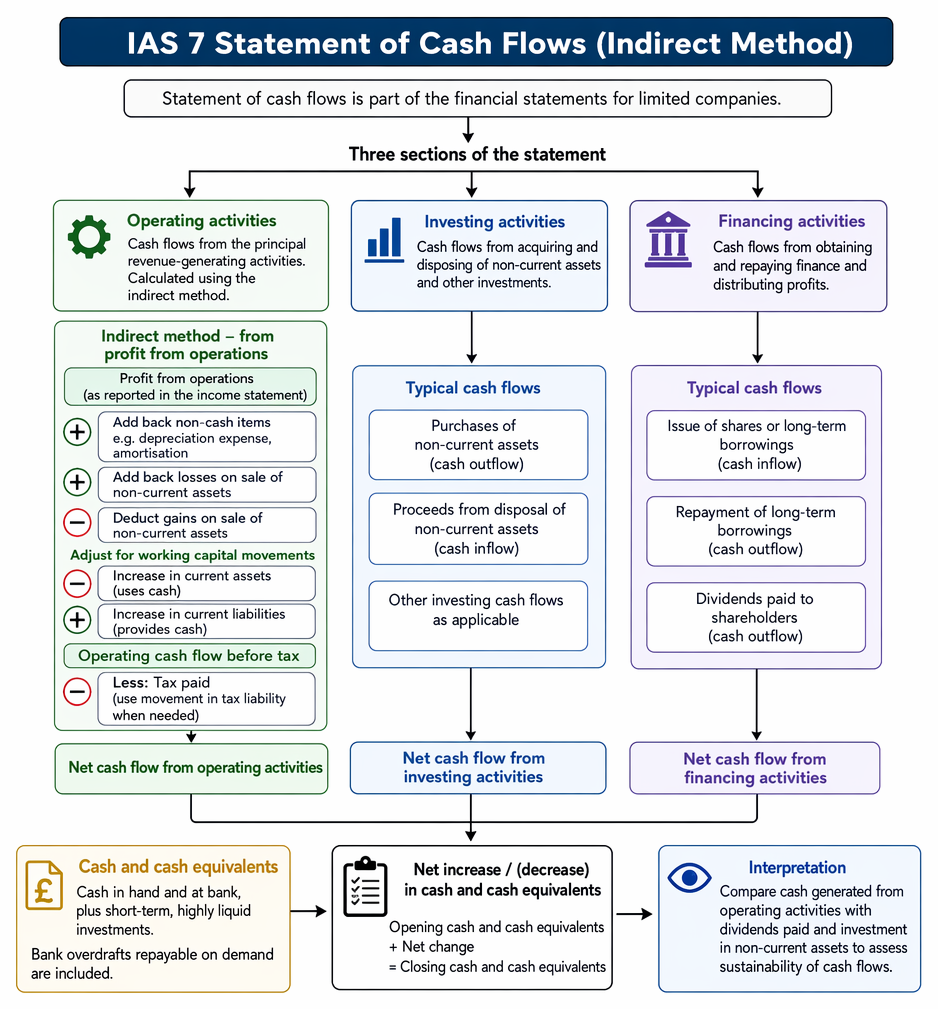
Statement of cash flows classification under IAS 7 and the indirect-method reconciliation of operating profit to operating cash generation.
- Know that IAS 7 Statement of Cash Flows requires a statement of cash flows as part of company financial statements
- Identify the three sections: operating activities, investing activities, and financing activities
- Explain how the indirect method starts from profit from operations and adjusts for non-cash items and working capital changes
- Understand the treatment of depreciation, profit or loss on sale of non-current assets, and working capital movements
- Calculate cash flows for purchases and disposals of non-current assets, dividends paid, and issue or repayment of long-term finance
- Calculate tax paid using the tax liability movement when needed
- Understand the meaning of cash and cash equivalents, including the treatment of qualifying overdrafts
- Interpret whether a company is generating enough cash from operations to support dividends and investment
Test Your Knowledge
Attempt these questions before reading this article. If you find some difficult or cannot remember the answers, look more closely at that area during your revision.
- Why might a company report a profit for the year but still have a falling bank balance?
- What are the three main sections of a statement of cash flows?
- Why is depreciation added back in the operating activities section?
- How does an increase in trade receivables affect cash from operating activities?
- Where are dividends paid shown in the standard AQA statement of cash flows layout?
Introduction
The statement of cash flows is one of the most tested areas in limited company accounting because it brings together information from the income statement and the statement of financial position. It explains how the company’s cash and cash equivalents have changed over the period.
For AQA, you need to be able to prepare the statement using the indirect method and also explain what it shows. This means more than learning a format. You must understand why profit is adjusted, why working capital movements matter, and why some items belong in investing or financing rather than operating activities.
Key Term: statement of cash flows
A financial statement showing cash inflows and outflows during an accounting period, grouped into operating, investing and financing activities.Test Tip: When revising Statements of cash flow (IAS7 indirect method), connect each definition, method, or rule to the kind of question the assessment is likely to ask.
Exam Warning: Do not rely on keyword recognition alone; check the precise condition, exception, calculation step, or evidence the question requires.
Purpose, format and key definitions
The income statement shows profitability. The statement of financial position shows assets, liabilities and equity at a date. But neither shows clearly why cash has increased or decreased. A business can make a profit and still face liquidity problems.
A statement of cash flows solves this by showing actual cash movement.
Key Term: cash flows
Receipts and payments of money flowing into and out of a business during an accounting period.
Under the standard AQA layout, the statement has three sections:
- Operating activities: the main revenue-producing activities of the business, plus tax and usually interest paid in the textbook format
- Investing activities: purchase and sale of non-current assets, plus interest and dividends received
- Financing activities: share issues, loan movements and dividends paid
Key Term: cash and cash equivalents
Cash on hand, bank balances and short-term highly liquid investments that can be quickly converted into known amounts of cash.
Cash equivalents are usually investments with an original maturity of three months or less. A bank overdraft may be included within cash and cash equivalents if it is repayable on demand and forms part of normal cash management.
A good exam habit is to keep asking: is this an actual cash movement, or only an accounting entry? If it is not cash, it should not appear as a cash flow itself.
Examples of non-cash items:
- depreciation
- revaluation gains
- credit sales before payment is received
- bonus issues of shares
Test Tip: Students often lose marks by including non-cash transactions in the main statement. If no cash moved, it does not belong as a cash flow.
Operating activities using the indirect method
The indirect method starts with profit from operations and converts it to cash from operating activities.
Key Term: indirect method
A method of preparing cash flows from operating activities by adjusting profit for non-cash items, working capital movements, and items belonging elsewhere.
The standard AQA sequence is:
- Start with profit from operations
- Add back non-cash expenses such as depreciation
- Add losses on sale of non-current assets or deduct profits on sale
- Adjust for working capital movements
- Arrive at cash from operating activities
- Deduct interest paid
- Deduct tax paid
- Arrive at net cash from operating activities
The logic matters.
- Depreciation reduced profit, but no cash left the business, so add it back
- Profit on sale of non-current assets increased profit, but the sale proceeds belong in investing activities, so deduct the profit from operating activities
- Loss on sale reduced profit, but is not an operating cash outflow, so add it back
Working capital rules are vital:
- increase in inventory = deduct
- decrease in inventory = add
- increase in trade receivables = deduct
- decrease in trade receivables = add
- increase in trade payables = add
- decrease in trade payables = deduct
Why?
- More inventory usually means cash has been spent on stock not yet sold
- More receivables means sales have been made but cash not yet received
- More payables means the business has delayed paying suppliers, so cash is retained
Worked example: operating activities
A company has:
- Profit from operations = £75,000
- Depreciation = £10,000
- Increase in inventory = £2,000
- Increase in trade receivables = £5,000
- Increase in trade payables = £7,000
- Interest paid = £5,000
- Tax paid = £6,000
Step 1: start with profit from operations
- Profit from operations = £75,000
Step 2: add back depreciation
- £75,000 + £10,000 = £85,000
Step 3: adjust working capital
- Increase in inventory: deduct £2,000
- Increase in trade receivables: deduct £5,000
- Increase in trade payables: add £7,000
So:
- £85,000 - £2,000 - £5,000 + £7,000 = £85,000
Cash from operating activities = £85,000
Step 4: deduct interest and tax paid
- £85,000 - £5,000 - £6,000 = £74,000
Net cash from operating activities = £74,000
A neat exam layout would show each step on a separate line.
Common errors in operating activities
Students often:
- start with profit for the year instead of profit from operations
- get the signs for receivables, payables or inventory the wrong way round
- forget to deduct profit on sale or add back loss on sale
- deduct tax liability movement instead of tax actually paid
Test Tip: Learn the working capital sign rule as: increases in current assets use cash; increases in current liabilities provide cash.
Investing and financing activities
Once the operating section is complete, the investing and financing sections are usually more direct. They focus on actual cash movements.
Investing activities
Typical entries:
- purchase of non-current assets
- proceeds from sale of non-current assets
- interest received
- dividends received
The key distinction is this:
- sale proceeds go in investing activities
- profit or loss on sale only appears as an adjustment in operating activities
This is one of the most common AQA traps.
If a machine with carrying amount £8,000 is sold for £9,500:
- investing activities show proceeds from sale £9,500
- operating activities deduct profit on sale £1,500
If sold for £6,500 instead:
- investing activities show proceeds from sale £6,500
- operating activities add loss on sale £1,500
Financing activities
Typical AQA treatment:
- proceeds from issue of shares
- new loans received
- repayment of loans or debentures
- dividends paid
Dividends paid reduce cash and are shown as a financing outflow.
A bonus issue is not shown because no cash is received.
Worked example: investing and financing
Assume:
- Purchase of non-current assets = £125,000
- Proceeds from sale = £15,000
- Proceeds of share issue = £275,000
- Loan repaid = £140,000
- Dividends paid = £22,000
Investing activities:
- Purchase of non-current assets (£125,000)
- Proceeds from sale £15,000
Net cash used in investing activities:
- £15,000 - £125,000 = (£110,000)
Financing activities:
- Proceeds of share issue £275,000
- Loan repaid (£140,000)
- Dividends paid (£22,000)
Net cash from financing activities:
- £275,000 - £140,000 - £22,000 = £113,000
Common errors in investing and financing
Students often:
- put dividends paid in operating activities
- use carrying amount instead of sale proceeds
- include a revaluation gain as investing cash
- forget that share issues are inflows, not operating income
Building full statements and interpreting them
To complete the full statement, total the three sections:
- net cash from operating activities
- net cash from investing activities
- net cash from financing activities
This gives the net increase or decrease in cash and cash equivalents.
Then:
- add opening cash and cash equivalents
- arrive at closing cash and cash equivalents
Tax paid formula
If tax paid is not given directly, use:
Opening tax liability
- tax charge for the year − closing tax liability = tax paid
Example:
- Opening tax liability = £1,000
- Tax charge for year = £1,500
- Closing tax liability = £1,200
Tax paid:
- £1,000 + £1,500 - £1,200 = £1,300
Use the same logic only when the question provides the necessary figures.
How to interpret a statement of cash flows
Good interpretation goes beyond saying "cash went up" or "cash went down".
Strong points to look for:
- positive cash from operating activities
- operating cash strong enough to cover dividends
- investment in non-current assets that supports future growth
- financing used sensibly to fund long-term investment
Warning signs:
- weak or negative operating cash
- dividends paid despite poor operating cash generation
- large rises in inventory or receivables locking cash into working capital
- dependence on loans or share issues just to support day-to-day operations
For exam comments, connect the numbers to liquidity and risk.
Example interpretation:
- if net cash from operating activities is positive, the company’s main business is generating cash
- if investing activities are strongly negative because of asset purchases, that may be positive if funded by operations or long-term finance
- if financing inflows are large while operating cash is weak, the business may be relying too much on external finance
How to structure an evaluative answer
If you get a longer written response on usefulness or interpretation, structure it like this:
- Identify the main operating cash figure
- Compare operating cash with profit
- Comment on working capital changes
- Comment on investment spending
- Comment on financing and dividends
- Give a judgement on liquidity and cash-generating ability
Financial evidence to cite:
- profit from operations
- cash from operating activities
- net cash from operating activities
- movements in receivables, payables and inventory
- investment outflows
- share issues, loans and dividends
Non-financial factors to mention:
- stage of growth
- seasonal trading patterns
- one-off capital investment
- management policy on dividends
Limitations to discuss:
- cash flow statements are historical
- one year alone may not show a trend
- strong closing cash may still hide weak operating performance if raised by finance
Key Point Checklist
This article has covered the following key knowledge points:
- A statement of cash flows shows actual cash inflows and outflows over an accounting period
- IAS 7 requires limited companies to present a statement of cash flows
- The three sections are operating activities, investing activities and financing activities
- The indirect method starts with profit from operations
- Depreciation is added back because it is a non-cash expense
- Profit on sale of a non-current asset is deducted in operating activities, while sale proceeds go in investing activities
- An increase in inventory or trade receivables reduces cash from operating activities
- An increase in trade payables increases cash from operating activities
- Dividends paid are shown as a financing cash outflow in the standard AQA format
- Tax paid is based on actual cash paid, not just the tax charge
- The final section reconciles opening and closing cash and cash equivalents
- A strong statement usually shows positive operating cash and sensible funding of investment
Key Terms and Concepts
- statement of cash flows
- cash flows
- cash and cash equivalents
- indirect method