Learning Outcomes
After reading this article, you will be able to explain the importance of listening actively, asking purposeful questions, and responding constructively to ideas in spoken and written tasks. You will practise how to identify and develop ideas, analyse the effect of questions and answers, and demonstrate confident interaction for AO1 and AO2 in the AQA GCSE English Language exam. Your answers will be focused, clear, and supported by examples.
AQA GCSE English Language 8700 Syllabus
For AQA GCSE English Language 8700, interaction and response—listening, questioning, and developing ideas—relate to how you:
- Identify and interpret both explicit and implicit information and ideas in spoken and written texts (AO1)
- Respond to questions and ideas using clear, well-chosen evidence (AO1)
- Analyse how spoken or written interaction develops ideas (AO2)
- Show clear understanding of how to progress, clarify, or extend a discussion or written answer (AO2)
Test Your Knowledge
Attempt these questions before reading this article. If you find some difficult or cannot remember the answers, look more closely at that area during your revision.
- What is meant by "active listening" and how can it change the outcome of a discussion?
- Give an example of an open question and explain when it is more useful than a closed question.
- How can you demonstrate interaction and response when answering a written English Language question?
- Why is asking follow-up questions important for developing ideas in both speech and writing?
Introduction
Good interaction and response skills are not just used in spoken English—they help you achieve higher marks across reading and writing assessments. Listening carefully, asking relevant questions, and building on ideas are all key ways to show clear understanding and progress the discussion in both Paper 1 and Paper 2 of AQA GCSE English Language 8700. This article covers techniques for listening actively, questioning effectively, and developing and exploring ideas with clear evidence.
Key Term: active listening
Focusing fully on what is being said, showing understanding by giving feedback, summarising, and asking clarifying questions. Key Term: open question
A question that allows for a detailed or thoughtful answer, encouraging explanation or development rather than just a yes/no response. Key Term: follow-up question
A question that builds on something previously said, prompting the speaker or writer to clarify, prove, or expand on their point.
Listening: Showing Understanding and Engagement
Listening well means more than just hearing words—it's about showing you understand and are interested.
- Nod or use short responses ("I see," "Go on," "Can you explain?") to encourage more detail.
- Paraphrase back what you've understood: "So, you think that...?"
- Ask the speaker to elaborate if something is unclear.
- In reading, "listening" means reading with attention and noting key points and possible implicit meanings.
Worked Example 1.1
A student is responding to a classmate explaining a character’s motivation in a novel:
Answer:
"You mentioned that Dave felt angry because of the argument. Can you say what evidence in the story makes you believe anger was his main emotion? Is there another reason he might have acted as he did?"
In this example, repeating the main idea and asking for evidence shows attentive listening and encourages development.
Questioning: Clarifying and Extending Ideas
Effective questions don't just check knowledge—they push discussion or analysis further.
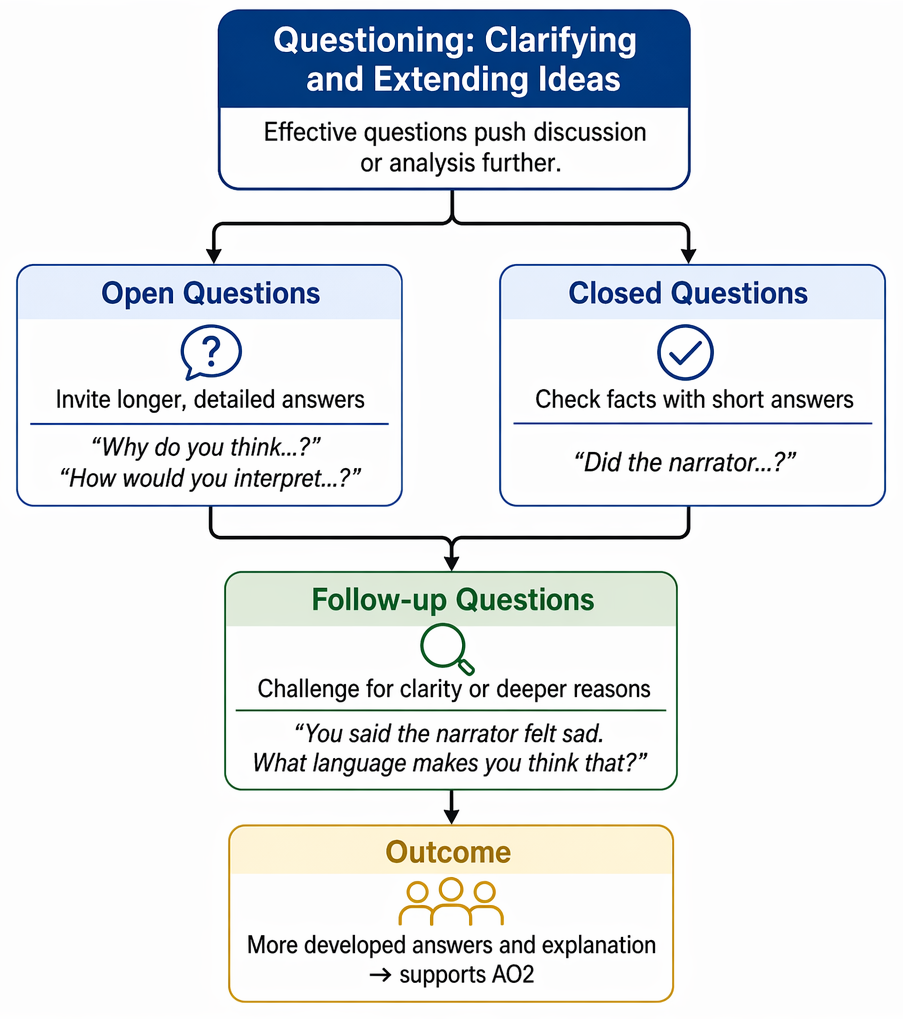
Active listening, purposeful questioning, and supported elaboration are presented as linked components of effective interaction and response.
- Use open questions to invite longer, detailed answers: "Why do you think...?", "How would you interpret...?"
- Closed questions (that can be answered with yes/no or a single word) are sometimes useful for checking facts: "Did the narrator...?"
- Follow-up questions challenge for clarity or deeper reasons: "You said the narrator felt sad. What language makes you think that?"
Worked Example 1.2
In an oral or group discussion about a poem:
“Why do you think the poet compares the city to a ‘machine’? What effect does this have on our understanding of the setting?” Answer:
An open, targeted question like this leads to a more developed answer and invites further explanation, which supports AO2.
Developing Ideas: Building Responses
Developing ideas means responding thoughtfully—adding evidence, building on previous points, and staying focused on the topic.
- Link to what others have said or what you have read: "Adding to what you said..."
- Use evidence: "The text says...which shows..."
- Offer alternatives or suggest new angles: "Another interpretation could be..."
- In writing, develop your ideas in each paragraph, supporting them with quotations and explanation.
Worked Example 1.3
Student’s written answer on a writer’s viewpoint:
“The writer seems frustrated, as shown by ‘she glared at the broken clock.’ An alternative reason for her frustration could be that she fears being late, considering the next sentence, ‘her hands shook as she checked her bag again.’” Answer:
This response develops the idea by supporting it with a quote and then adding an alternative, showing a progression of thought.Exam Warning: Overusing closed questions or simply echoing what was said without developing it limits you to basic marks. Always explain or extend with further evidence or reasoning.
Revision Tip: Practise summarising another person’s explanation in a sentence, then ask a new question about it. In writing, re-read your answer and ask yourself: “Have I used enough evidence and explained my point fully?”
Summary
Good interaction and response means listening for detail, asking purposeful questions, and building on ideas with clear evidence and development. These skills are essential for success in exams and show you can analyse, interpret, and explore meaning effectively.
Key Point Checklist
This article has covered the following key knowledge points:
- What active listening is and how to demonstrate it.
- The difference between open and closed questions, and when to use each in English Language.
- How to develop and extend ideas in both discussion and written responses.
- The importance of using evidence and explanation to achieve higher marks for AO1 and AO2.
Key Terms and Concepts
- active listening
- open question
- follow-up question