Learning Outcomes
This article explains how to interpret and construct option payoff and profit profiles for the most common derivative positions tested at CFA Level 1. It focuses on long and short European calls and puts, showing how to compute payoffs at expiration, translate them into profits or losses after premiums, and represent these relationships on clearly labelled payoff diagrams. It explains how to distinguish exercise value from time (extrinsic) value, identify whether an option is in, at, or out of the money, and relate these states to the shape and position of the payoff line. The article highlights the asymmetry of risk and reward for holders versus writers, including maximum gain, maximum loss, and breakeven levels. It also describes how to read and sketch standard payoff diagrams using the reference asset price on the x-axis and value or profit on the y-axis, with correct kinks at the strike price. Throughout, emphasis is placed on common exam pitfalls, such as confusing payoff with profit, mis-signing the writer’s position, or misinterpreting questions that specify value at expiry versus overall profit.
CFA Level 1 Syllabus
For the CFA Level 1 exam, you are expected to understand option payoffs and the visualization of option positions, with a focus on the following syllabus points:
- Identify the payoff structures for long and short calls and puts at expiry
- Draw and interpret payoff diagrams for basic option positions
- Compute profits and losses for standard option scenarios
- Explain the difference between exercise value and time value
- Understand how the payoff structure of derivatives differs from reference instruments
Test Your Knowledge
Attempt these questions before reading this article. If you find some difficult or cannot remember the answers, look more closely at that area during your revision.
- What is the maximum gain and maximum loss for an investor who buys a European call option and holds it to expiration?
- What is the payoff for a short put option position if the reference asset closes below the strike at expiry?
- How do you compute the exercise value of a European put when the spot price is above the strike?
- Draw and label the profit diagram for the seller of a call option.
Introduction
Options are contractual derivatives that provide asymmetric exposure to the price of a reference asset. The buyer (holder) has the right to buy or sell the asset at an agreed strike price, while the seller (writer) has the obligation. Option payoffs are standardized, and visualizing them with payoff diagrams is essential for examination and practical problem-solving.
Key Term: call option
A contract giving the buyer the right, but not the obligation, to purchase an asset at a preset strike price by or at expiration. Key Term: put option
A contract giving the buyer the right, but not the obligation, to sell an asset at a preset strike price by or at expiration.
Option Payoff Profiles
The payoff of an option describes the value of the position at expiry, ignoring any price paid to acquire the contract.
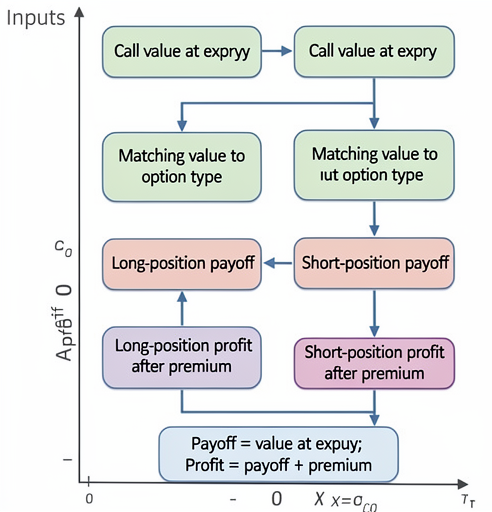
Call and put exercise values feed into long and short position payoffs, then premiums convert expiry value into profit or loss.
Long and Short Call Positions
-
Long (buy) call: The payoff at expiration is the greater of zero or the amount by which the spot price exceeds the strike price.
Where = reference asset’s price at expiry, = strike price.
-
Short (write) call: The writer’s payoff is the negative of the holder’s payoff:
Diagram Features
- The long call payoff diagram is flat at zero for , then rises linearly for .
- The short call is the mirror image: flat at zero then drops as the reference asset price increases.
Key Term: payoff diagram
A visual representation of the value of a derivative position as a function of the reference asset’s price at expiry.
Long and Short Put Positions
-
Long (buy) put: The payoff at expiration is the greater of zero or the strike price minus the spot price.
-
Short (write) put: The writer’s payoff is the negative:
Diagram Features (Puts)
- The long put payoff is flat at zero for , then rises as spot falls below strike.
- The short put is flat then falls as the reference asset price decreases.
Profit and Loss of Option Positions
To obtain the profit on an option position, subtract the premium paid (for buyers) or add the premium received (for writers):
- Long call profit:
- Short call profit:
- Repeat similarly for puts.
Key Term: exercise value
The value if the option were exercised immediately: For a call (if positive):
For a put (if positive):
Key Term: time value
The option premium less exercise value; reflects the probability it will end up in the money by expiry.
Option Payoff Diagram: Quick Guide
- X-axis: reference asset price at expiry ()
- Y-axis: value at expiry (or profit)
- Use a kink at the strike price: calls increase above, puts increase below.
Worked Example 1.1
A European call has strike $100, reference asset closes at $112, premium paid $6. Draw the payoff and calculate profit at expiry.
Answer:
Payoff: = $12 Profit: $12 - $6 = $6 The diagram has a flat segment at
then a slope of 1 above. Short call: profit = -$6
Worked Example 1.2
You sell (write) a European put option with strike $80, receive a premium of $3. At expiry, the reference asset is $74. Calculate your profit and describe the risk.
Answer:
Payoff: = -$6 (since writer must buy at $80, reference asset only worth $74) Profit: = -$3 The writer’s maximum profit is the premium (+3); maximum loss as
is large.
Worked Example 1.3
Question: A long put position has strike $50. At expiry, the spot is $57. Option premium $1.5. What is the exercise value, total payoff, and profit?
Answer:
Exercise value:
Payoff: $0 Profit: $0 - $1.5 = -$1.5 (loss limited to premium)
Option Payoff Symmetry and Risk
- Long call: Unlimited upside, limited downside (premium paid)
- Short call: Unlimited downside, limited upside (premium received)
- Long put: Upside limited to strike minus premium (if ), downside limited to premium
- Short put: Downside (strike less premium), limited upside (premium received)
Exam Warning: A frequent exam error is confusing payoff and profit. Payoff is value at expiry; profit equals payoff minus (or plus) premium, adjusting for long and short. Always clarify if a question asks for payoff or profit.
Revision Tip: Option payoffs are not linear in the reference asset—review the shape of each diagram and memorize their critical points, especially at-the-money:
Summary
Option payoff diagrams clearly summarize the risk and reward exposure of long and short option positions. Calls provide potential for gains with limited loss for buyers; puts offer protection against declines. Writers are exposed to losses if the market moves against them. Understanding the distinction between payoff and profit, and correctly sketching diagrams, is essential for CFA Level 1 exam performance.
Key Point Checklist
This article has covered the following key knowledge points:
- Define and construct payoff diagrams for long/short calls and puts at option expiry
- Compute exercise value and time value for any standard option position
- Calculate payoff and profit for long and short call/put positions given a scenario
- Understand profit/loss asymmetry for buyers and writers of options
- Recognize exam traps in distinguishing payoff with profit
Key Terms and Concepts
- call option
- put option
- payoff diagram
- exercise value
- time value