Learning Outcomes
This article explains the objectives and core concepts of the Global Investment Performance Standards (GIPS) for CFA Level 1 candidates, including:
- Clarifying why the investment industry requires globally consistent, ethical standards for calculating and presenting performance results.
- Detailing the primary objectives of GIPS, such as promoting fair representation, full disclosure, comparability across managers, and increased investor confidence.
- Describing how GIPS addresses common abuses in performance reporting, including cherry-picking accounts, inconsistent calculation methods, and selective time periods.
- Explaining the definition of a GIPS firm and how firm-wide application supports consistent, comprehensive performance measurement.
- Outlining the construction and purpose of composites, and why including all actual, fee-paying, discretionary portfolios is essential for reliability.
- Summarizing key disclosure requirements in a GIPS-compliant report, including calculation methodology, fee information, benchmarks, and material risks or limitations.
- Highlighting the role and scope of independent verification in supporting a firm’s claim of GIPS compliance and enhancing investor trust.
- Distinguishing between a firm’s claim of compliance and independent verification, and recognizing when a performance presentation is non-compliant.
CFA Level 1 Syllabus
For the CFA Level 1 exam, you are required to understand the key objectives, benefits, and core concepts of the GIPS standards, with a focus on the following syllabus points:
- Explain the need for the Global Investment Performance Standards in investment reporting.
- Identify the objectives and benefits of adopting GIPS.
- Recognize and define fundamental GIPS concepts, such as composites, firm definition, required disclosures, and verification.
- Distinguish between compliant and non-compliant performance presentation.
- Describe the scope of GIPS (firm-wide application) and the voluntary nature of compliance.
- Explain the purpose of verification and what is, and is not, assured by verification.
Test Your Knowledge
Attempt these questions before reading this article. If you find some difficult or cannot remember the answers, look more closely at that area during your revision.
-
Which of the following best describes a primary objective of the GIPS standards?
- a) Maximizing investment returns for clients
- b) Ensuring that firms follow all local securities regulations
- c) Promoting fair representation and full disclosure of investment performance
- d) Eliminating all differences in investment performance across managers
-
Under GIPS, what is a composite?
- a) A group of all portfolios managed by a firm, regardless of objective
- b) A grouping of actual, fee-paying, discretionary portfolios with similar investment objectives
- c) A portfolio created using back-tested, model results
- d) A benchmark index used to evaluate portfolio performance
-
Why must all actual, fee-paying, discretionary portfolios that follow a particular strategy be included in a composite?
- a) To ensure returns are always higher than the benchmark
- b) To prevent cherry-picking and provide a complete, unbiased track record for the strategy
- c) To allow firms to exclude terminated accounts from the record
- d) To comply with local tax regulations
-
Which type of information is required in a GIPS-compliant performance presentation for a composite?
- a) Only the best five years of performance and a brief strategy description
- b) Annual composite returns, benchmark information, fee details, and key calculation methods
- c) Only gross-of-fees returns with no benchmark comparison
- d) Only the performance of the single largest portfolio in the composite
Introduction
Investment performance results are often central when investors select an asset manager. Because firms can use different calculation methods and choose what data to report, historical results may be confusing or misleading. To address this, the Global Investment Performance Standards (GIPS) were developed. GIPS sets out a standardized, ethical framework for calculating and presenting investment performance, allowing investors to objectively compare results across managers and strategies.
GIPS is developed and administered by CFA Institute and is intended to be a set of global, voluntary ethical standards. It does not replace local regulations; instead, it is designed to supplement them with best practices in performance measurement and reporting. Where local laws conflict with GIPS, firms must follow the law but disclose the conflict if they still wish to claim GIPS compliance.
Key Term: GIPS Standards
A globally recognized set of voluntary ethical standards that provide consistent requirements and recommendations for calculating, presenting, and disclosing investment performance to ensure fair representation and full disclosure.
The standards focus on how performance is measured and communicated, not on how portfolios must be managed. They are intended to protect investors and prospective clients and to help them make better-informed comparisons of managers’ historical results.
Test Tip: When revising GIPS objectives and key concepts, connect each definition, method, or rule to the kind of question the assessment is likely to ask.
GIPS Objectives and the Need for Standards
The GIPS standards have three core objectives:
- Encourage full disclosure and fair representation of investment performance results.
- Ensure consistent, comparable performance calculation and reporting across investment managers and asset classes.
- Increase investor confidence by establishing ethical best practices in reporting.
The primary goal of GIPS is to eliminate misleading performance reporting, cherry-picking of results, or inconsistent calculation methods that hinder meaningful comparison.
Key Term: Fair Representation
Presenting investment returns in a complete, honest manner—neither selectively emphasizing good results nor omitting material information that would change a user’s interpretation. Key Term: Full Disclosure
Requiring firms to provide all information necessary for investors and prospective clients to understand the presented performance and any relevant limitations, risks, or assumptions.
Why Standards Are Needed
Without common standards, firms might:
- Show only their best-performing accounts or funds.
- Exclude terminated or poorly performing portfolios from historical results.
- Start the track record at a particularly favorable point in time.
- Change calculation methods or benchmarks over time without disclosure.
- Present model or back-tested performance as if it were live, actual performance.
These practices can significantly bias reported returns. GIPS directly addresses such issues by requiring:
- Firm-wide application of the standards, not just at the strategy or fund level.
- Inclusion of all actual, fee-paying, discretionary portfolios in appropriate composites.
- Consistent calculation methods and valuation practices over time.
- Detailed disclosures about fees, benchmarks, calculation methods, and any significant changes.
Adoption of GIPS is voluntary, but it is broadly expected and often required by institutional investors and consultants worldwide. A claim of GIPS compliance signals a firm’s commitment to transparent, consistent, and ethical performance reporting.
Key Term: GIPS Firm
The distinct business entity (which may be an entire legal entity, a subsidiary, or a division) that is held out to clients or prospective clients as a provider of investment management services and to which GIPS compliance is applied on a firm-wide basis.
A key exam point is that GIPS compliance is a firm-wide concept. Individual portfolios, strategies, or composites cannot claim to be “GIPS compliant” on their own. Only the firm can make that claim, and only if all applicable requirements are met.
Common Abuses GIPS Seeks to Prevent
GIPS is designed to reduce or eliminate several common abuses in performance advertising:
- Cherry-picking accounts: Only including portfolios with strong results or excluding those that were terminated.
- Survivorship bias: Presenting only currently existing funds or accounts, ignoring those that closed or merged due to poor performance.
- Selective time periods: Choosing a measurement period that starts after a period of poor performance or ends before a downturn.
- Inconsistent methods: Changing valuation dates, return calculation methods, or treatment of fees and taxes to make results look better.
- Mislabeling results: Presenting back-tested, model, or hypothetical returns as if they were actual, live performance.
GIPS requirements on firm definition, composite construction, calculation methodology, and disclosure are all aimed at limiting these abuses.
Worked Example 1.1
A global asset management firm claims outstanding three-year returns for a growth equity strategy in its marketing materials. However, the results were calculated using methods that exclude terminated accounts and include only the highest-performing portfolios. Is this compliant with GIPS?
Answer:
No, the firm is not compliant with GIPS. By selectively excluding portfolios and failing to aggregate all relevant accounts, the firm is not presenting fair, representative results and is engaging in cherry-picking. GIPS requires that all actual, fee-paying, discretionary portfolios be included in the relevant composite, including terminated portfolios for the periods they were managed, to prevent misrepresentation and survivorship bias.
Key GIPS Concepts
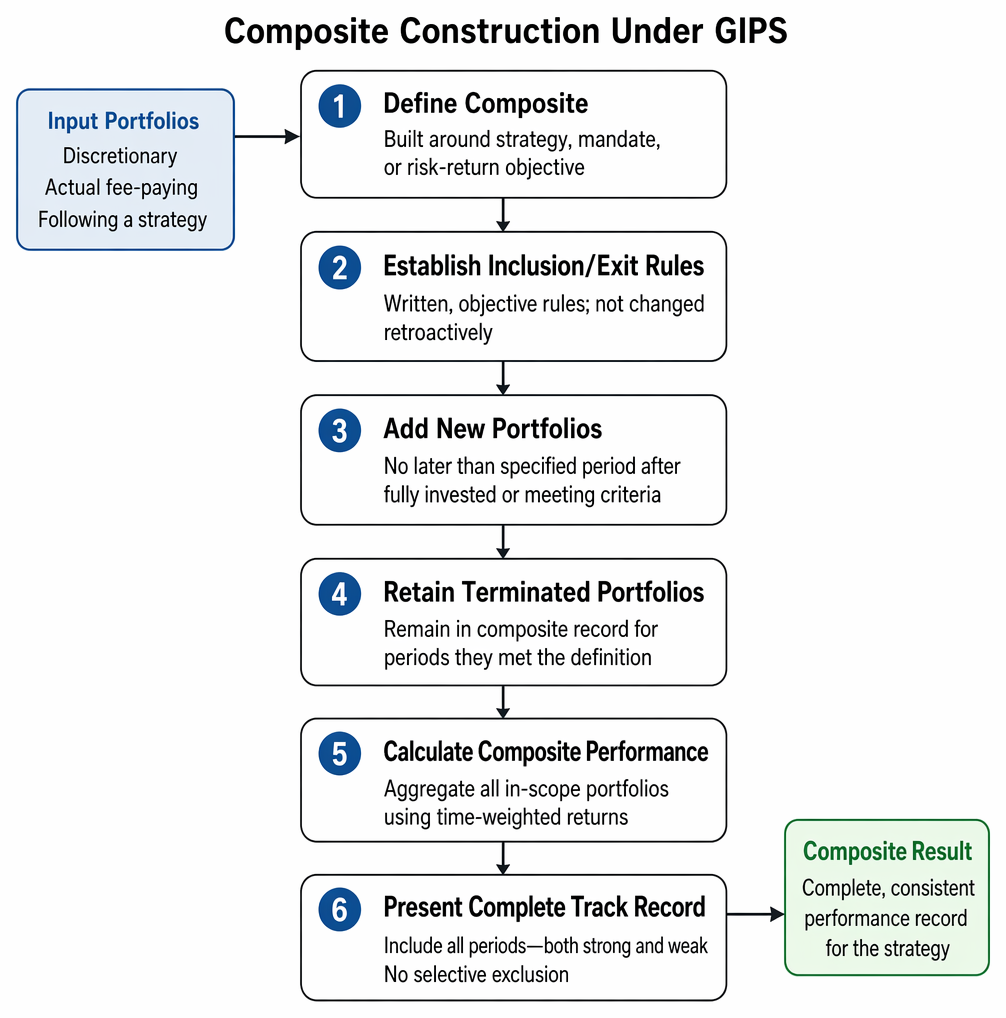
GIPS implementation sequence links firm definition, composite construction, inclusion of actual fee-paying discretionary portfolios, compliant reporting, and optional verification.
Definition of a Firm
Under GIPS, a firm is the entity, subsidiary, or division held out to clients as a distinct business for investment management services. All assets under the firm's management must be included in performance measurement for the purpose of GIPS compliance, even if some assets are not included in specific composites.
In defining the firm, GIPS expects:
- Consistency with how the firm is marketed: The firm definition should reflect how the business is presented to clients and prospective clients (for example, by brand or legal entity).
- Inclusion of all discretionary and non-discretionary assets: All assets the firm manages (e.g., separate accounts, pooled funds, sub-advised portfolios) are part of the firm’s assets under management, although only certain portfolios are included in composites.
- No selective exclusion of offices or product lines: Firms cannot define a “GIPS firm” that excludes underperforming teams, offices, or business lines simply to improve reported results.
Accurate firm definition is important because it determines the scope of GIPS application and the firm’s total assets under management figure, which is a required disclosure.
Composites and Composite Construction
Key Term: Composite
A grouping of discretionary portfolios with similar investment objectives and strategies, managed according to a particular mandate, whose aggregate performance is calculated and presented under GIPS. Key Term: Discretionary Portfolio
A client account or portfolio where the investment manager has the authority to make ongoing investment decisions, within documented guidelines or a stated strategy, without needing client approval for every trade. Key Term: Non-Discretionary Portfolio
A portfolio whose management is significantly constrained by the client (for example, strict restrictions that prevent the manager from fully implementing the intended strategy), such that it does not fairly represent the manager’s investment decision-making. Key Term: Actual Fee-Paying Portfolio
A live portfolio managed for a client that pays a management fee (and possibly performance fees) to the firm, as opposed to a simulated, model, or non-fee-paying account.
All actual, fee-paying, discretionary portfolios following a particular strategy must be included in a composite. This requirement:
- Prevents cherry-picking by ensuring that both strong and weak accounts are included.
- Provides a complete record of performance for each strategy over time.
- Improves comparability among managers, as investors can compare composite results for similar strategies across firms.
Additional key points about composites:
- Strategy-based: Composites are built around investment strategies, mandates, or risk-return objectives—not around marketing vehicles such as funds alone. For example, a “Global Equity” composite may include separate accounts and pooled funds all managed to the same global equity mandate.
- Predefined inclusion rules: Firms must create written, objective rules for when portfolios enter or exit a composite (e.g., minimum asset size, when funded, when terminated). These rules must not be changed retroactively to improve results.
- Terminated portfolios: Terminated portfolios must remain in the composite performance record for the periods during which they were under management and met the composite definition.
- New portfolios: A new portfolio is added to the composite no later than a specified period after it becomes fully invested or meets all criteria (for example, after three full months).
Key Term: Prospective Client
Any person or entity that has expressed interest in hiring the firm for investment management services and is eligible to receive a composite performance presentation under GIPS.
GIPS-compliant composite presentations must be made available to all prospective clients whose investment objectives and risk considerations are similar to the composite.
Return Calculation and Benchmarks
Although this article focuses on objectives and concepts rather than detailed calculation rules, two ideas are important for Level 1:
- GIPS emphasizes time-weighted rates of return for most composites because they minimize the impact of external cash flows (deposits and withdrawals) that are typically controlled by the client, not the manager.
- Returns must be calculated using fair value for portfolio assets and must be based on consistent valuation frequency (at least monthly and on the date of large external cash flows, under current standards).
Key Term: Time-Weighted Return (TWR)
A measure of investment performance that compounds sub-period returns and largely removes the effect of external cash flows, isolating the manager’s investment skill. Key Term: Composite Benchmark
A reference portfolio, index, or combination of indices with risk and return characteristics similar to the composite, used to provide a basis for performance comparison.
GIPS requires that firms present appropriate benchmark information for each composite, or clearly disclose and explain if no benchmark is available or appropriate.
Required Disclosures
A GIPS-compliant report (often called a composite presentation) must include sufficient information for a prospective client to understand the performance results and any limitations. At a high level, required disclosures include:
-
Firm and composite definitions:
- The definition of the firm.
- The name and a description of the composite, including the investment strategy, objective, and key risks.
-
Performance period and history:
- Annual composite returns for each year in the presented period (at least five years, or since inception if shorter, building up to ten years).
- Whether the returns are gross-of-fees, net-of-fees, or both, and which fees are included.
-
Calculation methodology:
- A description of the return calculation method (for example, time-weighted returns, treatment of cash flows and accruals).
- Valuation policies (frequency of valuation, use of fair value, and pricing sources).
-
Fee and expense information:
- The types of fees charged (management fees, performance-based fees, and other expenses).
- The typical fee schedule for the composite (e.g., 1% per year of assets under management).
-
Benchmark data:
- The name and description of the benchmark.
- Annual benchmark returns for the same periods as composite returns.
- Explanation of any benchmark changes or custom benchmarks.
-
Risk measures and dispersion:
- A measure of internal dispersion (e.g., standard deviation of portfolio returns within the composite) for each annual period, if there are enough portfolios.
- A measure of composite risk (e.g., three-year annualized standard deviation of composite and benchmark returns).
-
Other material information:
- Significant changes in the firm or composite (e.g., changes in personnel, strategy, or significant borrowing and derivative use) that would help interpret the track record.
- Any known legal or regulatory issues that materially affect the interpretation of performance.
- Whether the firm has been verified, and the period covered by verification.
Key Term: GIPS-Compliant Presentation
A performance report for a composite that includes all required statistics and disclosures stipulated by GIPS for that composite and is provided to prospective clients whose needs match the composite.
The intent is that a prospective client, after reviewing a GIPS-compliant presentation, can meaningfully compare the composite’s performance and risk to those of other managers and to the benchmark.
Verification
Key Term: Verification
An independent review conducted by a qualified third party to determine whether a firm has complied with all applicable GIPS requirements on a firm-wide basis and whether its composite construction policies and procedures are designed in accordance with GIPS.
Verification is not mandatory for a firm to claim GIPS compliance, but it is strongly encouraged. Key points for Level 1:
-
Verification is performed at the firm level, not at the composite level.
-
A verification engagement tests:
- Whether the firm has complied with all applicable GIPS requirements.
- Whether the firm’s policies and procedures are designed to achieve and maintain compliance.
-
A firm that has been verified must disclose:
- That it has been verified.
- The name of the verifier.
- The period for which verification has been performed.
Verification does not guarantee that every number in every composite presentation is correct, and it does not “certify” or “endorse” the quality of a firm’s investment performance. It provides additional assurance about the firm’s overall GIPS compliance framework.
Some firms may also obtain a separate, composite-specific performance examination (under the latest standards), but this is distinct from firm-wide verification. At Level 1, the emphasis is on understanding that verification is optional and firm-wide.
Worked Example 1.2
Suppose an investment firm is preparing a GIPS-compliant presentation for its Emerging Markets Debt composite. What information must be included in the disclosure?
Answer:
The disclosure must define the firm and clearly describe the Emerging Markets Debt composite, including the strategy, objectives, and key risks. It must state the time period covered and provide annual composite returns, along with annual benchmark returns for a relevant emerging markets debt index. The report must describe the method used to calculate returns (for example, time-weighted returns with fair value pricing), specify whether returns are gross-of-fees or net-of-fees and what types of fees are included, and present the applicable fee schedule. It should include appropriate measures of risk and dispersion (such as three-year annualized standard deviation), disclose any significant changes in personnel, process, or valuation methodology, and indicate whether the firm has been verified and for which period. This composite presentation must be made available to all prospective clients whose objectives align with the Emerging Markets Debt strategy before they make an investment decision.
Worked Example 1.3
A firm states in its marketing materials: “The Global Equity composite has been verified by an independent verifier for the past five years.” The firm has not obtained firm-wide verification. Is this statement appropriate under GIPS?
Answer:
No, this statement is not appropriate. Under GIPS, verification is a firm-wide engagement, not a composite-level one. A firm cannot state that an individual composite is “verified” if the firm as a whole has not been verified. The firm may, under the applicable guidance, obtain a composite-level performance examination, but it must be described using the correct terminology and cannot be presented as verification. In this case, the firm’s statement is misleading and would not be consistent with GIPS.Exam Warning: Failing to include all discretionary, actual fee-paying portfolios in a composite, or omitting negative return periods, violates GIPS and is a common exam pitfall. Always assume that GIPS requires the inclusion of complete track records, consistent composite definitions, and full required disclosures to demonstrate compliance.
Summary
GIPS standards are globally recognized ethical guidelines aimed at honest, comparable, and transparent presentation of investment performance. By standardizing calculation, presentation, and disclosure, GIPS helps ensure fair representation and full disclosure, strengthening trust between managers and investors.
Key concepts for Level 1 include:
- GIPS is a voluntary, globally applicable set of ethical standards for performance measurement and reporting, administered by CFA Institute.
- Compliance is claimed at the firm level and requires that all applicable requirements are met across the entire firm.
- Composites group actual, fee-paying, discretionary portfolios with similar objectives, preventing cherry-picking and creating meaningful strategy-level track records.
- GIPS-compliant presentations require detailed disclosures about methods, fees, benchmarks, risk measures, and firm and composite definitions so that prospective clients can understand and compare performance.
- Independent verification, while not required, provides additional assurance about the firm’s overall compliance with GIPS but does not guarantee the accuracy of each individual number.
These ideas often appear in Level 1 questions that ask you to identify misapplications of GIPS, distinguish compliant from non-compliant performance presentations, or explain why standards like GIPS are important in the global investment industry.
Key Point Checklist
This article has covered the following key knowledge points:
- Describe the objectives of GIPS: transparency, comparability, and investor protection in performance reporting.
- Explain why standardization in calculating and reporting investment performance is essential.
- Identify how GIPS addresses common abuses such as cherry-picking, survivorship bias, and selective time periods.
- Define a GIPS firm and explain why firm-wide application is required.
- Explain the concept of a composite and its importance for accurate strategy representation.
- Distinguish between discretionary, non-discretionary, and actual fee-paying portfolios in the context of composite construction.
- Recognize the role of required disclosures in a GIPS-compliant presentation, including performance history, fees, benchmarks, and risk measures.
- Understand the purpose and scope of independent verification and what it does and does not assure.
- Distinguish between a firm’s claim of GIPS compliance and the separate concept of verification.
Key Terms and Concepts
- GIPS Standards
- Fair Representation
- Full Disclosure
- GIPS Firm
- Composite
- Discretionary Portfolio
- Non-Discretionary Portfolio
- Actual Fee-Paying Portfolio
- Prospective Client
- Time-Weighted Return (TWR)
- Composite Benchmark
- GIPS-Compliant Presentation
- Verification