Learning Outcomes
This article explains how to analyze core option strategies for the CFA Level 1 exam, including:
- identifying and classifying option spreads, straddles, strangles, collars, and other combinations from written descriptions and payoff diagrams;
- constructing long and short strategies step by step, specifying option type, strike, and maturity, and then sketching or interpreting the resulting payoff profile at expiration;
- computing maximum profit, maximum loss, and breakeven price or prices for bull and bear spreads, long and short straddles, and long and short strangles using net premium and strike relationships;
- distinguishing directional trades from volatility trades, and matching each strategy to a stated market view on price, volatility, and time horizon in multiple-choice scenarios;
- assessing the role of delta, gamma, theta, and vega in these positions, including how spreads, straddles, and combinations modify Greek exposures relative to single-option positions;
- evaluating risk–reward trade-offs, margin and capital implications, and typical exam traps when comparing alternative strategies that express the same market view.
CFA Level 1 Syllabus
For the CFA Level 1 exam, you are required to understand how options strategies affect portfolio outcomes, with a focus on the following syllabus points:
- defining and distinguishing between option spreads, straddles, strangles, collars, and other combinations;
- drawing and interpreting basic option payoff diagrams for common strategies;
- calculating maximum profit and loss, breakeven points, and recognizing directional versus volatility trades;
- understanding the relevance and interpretation of option Greeks (delta, gamma, theta, vega) in these strategies;
- comparing chosen strategies to core views about price direction and volatility.
Test Your Knowledge
Attempt these questions before reading this article. If you find some difficult or cannot remember the answers, look more closely at that area during your revision.
-
Compared with a long straddle, a bull call spread most likely has which characteristics?
- a) Lower cost and lower maximum profit, with a directional bullish view.
- b) Higher cost and higher maximum profit, with a directional bullish view.
- c) Lower cost and higher maximum profit, with a volatility view.
- d) Higher cost and unlimited profit, with a pure volatility view.
-
A trader constructs a bull put spread by selling a put with a strike of 50 and buying a put with a strike of 45. The net premium received is $1. What is the maximum profit, and when is it realized?
- a) $1, if the stock price is at or above $50 at expiration.
- b) $5, if the stock price is at or above $50 at expiration.
- c) $4, if the stock price is at or below $45 at expiration.
- d) Unlimited, if the stock price falls below $45 at expiration.
-
Which option strategy is most directly a bet that volatility will be high, regardless of whether the asset price rises or falls?
- a) Bull call spread.
- b) Long straddle.
- c) Short strangle.
- d) Covered call.
-
Compared with a short straddle, a short strangle typically has:
- a) Lower maximum profit, narrower breakeven points, and lower risk.
- b) Higher maximum profit, wider breakeven points, and lower risk.
- c) Lower maximum profit, wider breakeven points, and lower risk.
- d) Higher maximum profit, narrower breakeven points, and higher risk.
Introduction
Option strategies allow investors to reshape risk and return to match specific views on price direction, volatility, and time horizon. Instead of using a single call or put, candidates must be comfortable combining several options into structured payoffs such as spreads, straddles, strangles, and collars.
CFA Level 1 questions typically:
- describe a position in words and ask you to identify the strategy or payoff;
- show a payoff diagram and ask which combination of options creates it;
- ask for maximum profit, maximum loss, or breakeven(s), given strikes and net premiums;
- link a strategy to a view on direction and volatility.
Getting these questions right depends on understanding how options interact and how the Greeks of individual options combine.
Key Term: Option Spread
A position in two or more options of the same type (all calls or all puts) on the same asset, usually with different strikes and/or expiries, designed to limit both risk and reward. Key Term: Straddle
An options strategy combining a call and a put with the same strike price and expiration date, typically at-the-money, used to profit from large price moves in either direction. Key Term: Combination
Any options strategy involving both calls and puts, possibly with different strikes and/or quantities (e.g., strangles, collars, risk reversals, butterflies), to express views on price direction, volatility, or both. Key Term: Option Greeks
Quantities that measure how an option’s price responds to key risk factors such as the asset price (delta, gamma), time to expiration (theta), and volatility (vega).
These definitions provide the framework for the strategies discussed below.
Option Spreads
Option spreads involve simultaneously buying and selling options of the same type (either both calls or both puts) on the same asset. By combining a long and a short option in the same position, spreads reduce both the maximum gain and maximum loss, creating defined risk/return profiles.
Key Term: Vertical Spread
A spread constructed with options of the same expiration date but different strike prices (e.g., bull and bear spreads).
Vertical spreads are the main focus at Level 1.
Bull and Bear Spreads
Bull and bear spreads express modest directional views with limited risk.
Key Term: Bull Spread
A vertical spread designed to profit from a moderate rise in the asset price, with both maximum gain and maximum loss limited. Key Term: Bear Spread
A vertical spread designed to profit from a moderate decline in the asset price, with both maximum gain and maximum loss limited.
There are two main ways to build each view.
-
Bull Spread:
-
Bull Call Spread (debit spread):
- Buy a call at a lower strike .
- Sell a call at a higher strike .
- Net premium is usually a debit (cash outflow).
- Directional view: moderately bullish.
- Maximum profit ≈ net premium paid.
- Maximum loss = net premium paid.
-
Bull Put Spread (credit spread):
- Sell a put at a higher strike .
- Buy a put at a lower strike .
- Net premium is usually a credit (cash inflow).
- Directional view: moderately bullish (you want the price to stay at or above the higher strike).
- Maximum profit = net premium received.
- Maximum loss ≈ net premium received.
-
-
Bear Spread:
-
Bear Call Spread (credit spread):
- Sell a call at a lower strike .
- Buy a call at a higher strike .
- Net premium is usually a credit.
- Directional view: moderately bearish (you want the price to stay at or below the lower strike).
- Maximum profit = net premium received.
- Maximum loss ≈ net premium received.
-
Bear Put Spread (debit spread):
- Buy a put at a higher strike .
- Sell a put at a lower strike .
- Net premium is usually a debit.
- Directional view: moderately bearish.
- Maximum profit ≈ net premium paid.
- Maximum loss = net premium paid.
-
In all vertical spreads, the difference between the strikes sets the spread’s maximum possible payoff value at expiration. Whether you pay or receive net premium determines whether you are long (debit) or short (credit) the spread.
Worked Example 1.1
Suppose stock ABC is trading at $50. An investor sets up a bull call spread by buying a $48 call for $3 and selling a $52 call for $1. What is the maximum profit and maximum loss?
Answer:
Net premium paid = $3 − $1 = $2 (a net debit).
- Maximum profit = (higher strike − lower strike) − net premium = ($52 − $48) − $2 = $2.
- Maximum loss = net premium paid = $2.
The maximum profit of $2 occurs if ABC is at or above $52 at expiry, where both calls are in the money but the payoff is capped at $4, leaving $2 after subtracting the $2 net premium. The maximum loss of $2 occurs if ABC is at or below $48 at expiry, where both options expire worthless and the premium is lost.
Worked Example 1.2
A trader expects a modest decline in stock XYZ, currently at $60. She buys a $62 put for $4 and sells a $54 put for $1, forming a bear put spread. What are the maximum profit, maximum loss, and breakeven price?
Answer:
Net premium paid = $4 − $1 = $3.
- Maximum profit = (higher strike − lower strike) − net premium = ($62 − $54) − $3 = $5.
- Maximum loss = net premium paid = $3.
- Breakeven price = higher strike − net premium paid = $62 − $3 = $59.
At prices below $54, both puts are in the money but the payoff difference is fixed at $8; after deducting $3, profit is $5. At prices above $62, both options expire worthless and the trader loses the $3 premium. At $59 the long put is $3 in the money and exactly offsets the premium.
Exam Warning: Exam Warning: Always distinguish between payoff at expiration (exercise value only) and profit or loss (payoff adjusted for net premium). Many Level 1 questions test whether you correctly add or subtract the initial net premium.
Straddles and Strangles
These strategies combine calls and puts and are primarily used to trade volatility rather than pure direction.
- Long positions (buy options) are bets on high volatility.
- Short positions (sell options) are bets on low volatility but can involve very high risk.
Key Term: Strangle
A combination of a call and a put with the same expiration but different strikes, with the put strike below and the call strike above the current price, used to trade volatility with a lower cost than a straddle.
Long and Short Straddles
A standard straddle uses at-the-money options.
-
Long Straddle:
- Buy a call and buy a put, both at the same strike (usually at-the-money) and same expiration.
- Net premium = call premium + put premium (debit).
- Directional view: none; you expect a large move in either direction.
- Maximum loss = total premium paid.
- Potential profit: large on both upside and downside (unlimited on the upside, substantial on the downside, limited only by the stock not falling below zero).
- Breakeven prices:
- Upper breakeven = total premium.
- Lower breakeven = total premium.
-
Short Straddle:
- Sell a call and sell a put, same strike and expiration.
- Net premium = total premium received (credit).
- View: asset price will stay near the strike, and realized volatility will be low.
- Maximum profit = total premium received.
- Risk: large losses for big moves up or down (unlimited on the upside).
Worked Example 1.3
A stock trades at $40. A trader buys a $40 call for $3 and a $40 put for $2. What is the maximum loss, and what are the breakeven prices for this long straddle?
Answer:
Net premium paid = $3 + $2 = $5.
- Maximum loss = $5 (if the stock is exactly at $40 at expiration and both options expire worthless).
- Upper breakeven = strike + total premium = $40 + $5 = $45.
- Lower breakeven = strike − total premium = $40 − $5 = $35.
The position is profitable if the stock price at expiration is above $45 or below $35. Between $35 and $45, the loss is between $0 and $5.
Strangles
A strangle moves the strikes away from the current price:
-
Long Strangle:
- Buy an out-of-the-money put (strike below current price) and an out-of-the-money call (strike above).
- Cheaper than a straddle (total premium is lower) but requires a larger price move to be profitable.
- Loss is limited to total premium paid; profit potential is again large in both directions.
-
Short Strangle:
- Sell an out-of-the-money put and an out-of-the-money call.
- Receives less premium than a short straddle but has wider breakeven points and is slightly less likely to incur a loss.
- Still exposes the seller to large losses if the price moves far beyond either strike.
Worked Example 1.4
A stock is trading at $60. You buy a $58 put for $2 and a $62 call for $2. What are your breakeven prices for a long strangle?
Answer:
Total premium paid = $2 + $2 = $4.
- Lower breakeven = put strike − total premium = $58 − $4 = $54.
- Upper breakeven = call strike + total premium = $62 + $4 = $66.
The loss is limited to $4 if the stock finishes between $58 and $62 at expiry. Profits increase as the price moves below $54 or above $66.
Revision Tip: For the CFA exam, always explicitly show your calculation of net cost and all breakeven points in practice problems—marks are awarded for the steps, not just the answer.
Combinations and Common Strategies
Combinations include any mix of calls and puts, potentially with the asset itself. Some of the most testable combinations at Level 1 are collars, covered calls, protective puts, and butterflies.
Vertical spread choices map moderate bullish and bearish views to call or put positions with defined premium, profit, and loss.
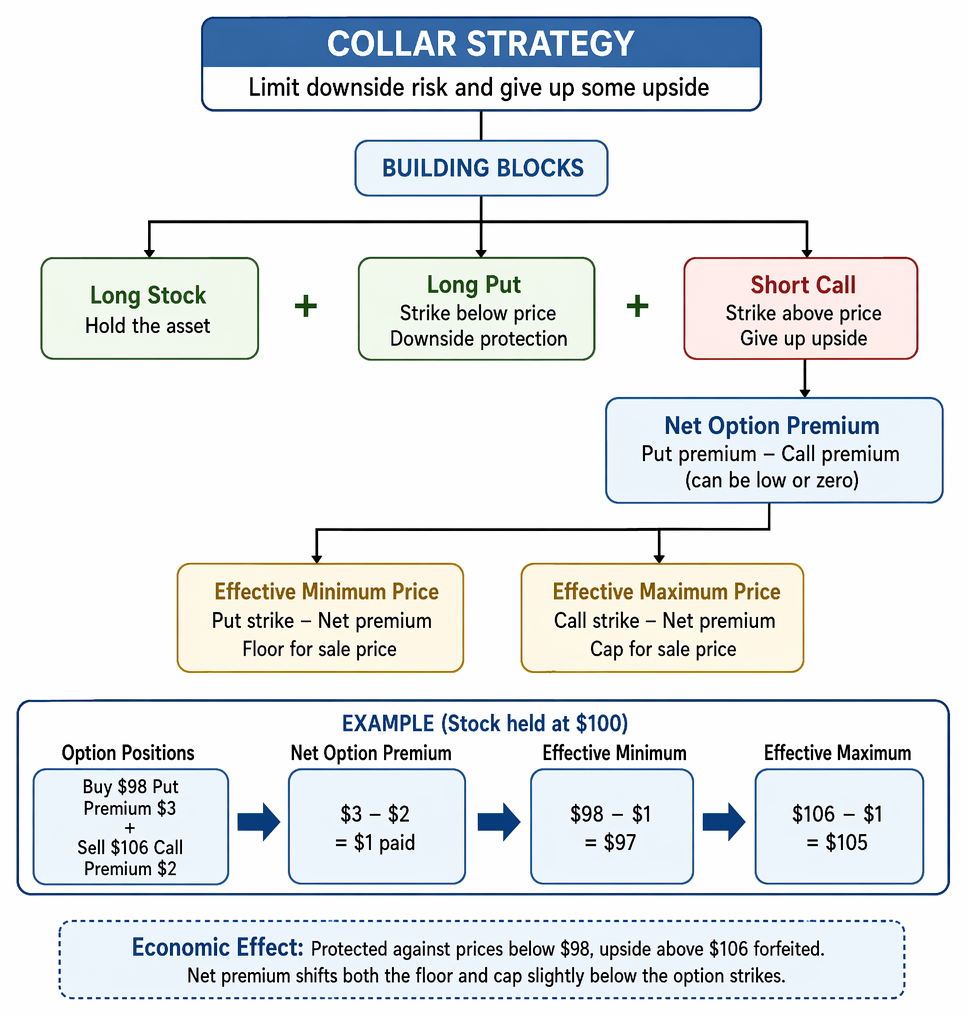
Key Term: Collar
A strategy combining a long position in the asset, a long put at a lower strike, and a short call at a higher strike, used to limit downside risk and give up some upside. Key Term: Covered Call
A strategy in which an investor holds the asset and sells a call option on that asset, generating premium income but capping upside. Key Term: Protective Put
A strategy in which an investor holds the asset and buys a put option on that asset, creating downside protection similar to insurance. Key Term: Butterfly Spread
A limited-risk, limited-profit strategy constructed from options at three strikes (low, middle, high), typically designed to profit if the price stays near the middle strike at expiration.
Collars
A collar is widely used in practice to protect gains on a stock:
- Long the stock.
- Long a put with a strike below the current price (downside protection).
- Short a call with a strike above the current price (giving up upside).
If the put premium is roughly offset by the call premium, the collar can be implemented at low or zero net cost.
Worked Example 1.5
You hold a stock at $100. To protect against downside, you buy a $98 put for $3 and finance it by selling a $106 call for $2. What is your effective minimum and maximum sale price?
Answer:
Net option premium paid = $3 − $2 = $1.
- Effective minimum sale price ≈ put strike − net premium = $98 − $1 = $97.
- Effective maximum sale price ≈ call strike − net premium = $106 − $1 = $105.
You are protected against prices below $98, but gains above $106 are sacrificed. The net premium shifts both the floor and cap slightly below the option strikes.
Economically, this collar is similar to holding the stock and selling off extreme upside and downside in exchange for reducing risk.
Covered Calls and Protective Puts
- A covered call (long stock + short call) is suitable when the investor is mildly bullish to neutral and wishes to earn extra income from the call premium, accepting that upside beyond the call strike is forfeited.
- A protective put (long stock + long put) is appropriate when the investor is bullish long term but wants insurance against a sharp short-term decline. It creates a payoff similar to a long call (limited downside, unlimited upside).
Both are building blocks for collars.
Butterflies
A butterfly spread uses either all calls or all puts at three strikes:
- Buy one option at a lower strike .
- Sell two options at a middle strike .
- Buy one option at a higher strike .
The result is:
- Small maximum loss (the net premium or net outlay).
- Maximum profit if the asset price finishes near the middle strike .
- Very little exposure to large moves far away from (loss is again limited).
Butterflies are low-cost, low-reward strategies that profit from low volatility around a target price.
Option Greeks and Strategies
The option Greeks help explain how these strategies behave as market conditions change.
Key Term: Delta
The sensitivity of an option’s price to small changes in the asset price. Key Term: Gamma
The sensitivity of delta to small changes in the asset price; it measures the curvature (convexity) of the option’s price with respect to the asset price. Key Term: Theta
The sensitivity of an option’s price to the passage of time, holding other factors constant; it is typically negative for long options. Key Term: Vega
The sensitivity of an option’s price to changes in the volatility of the asset.
A strategy’s Greeks are just the sum of the Greeks of its component options and any position in the asset.
Greeks of Spreads
- Bull and Bear Spreads (vertical spreads):
-
Delta:
- Bull spreads (call or put) have positive delta (benefit from price increases).
- Bear spreads have negative delta (benefit from price decreases).
- The magnitude of delta is smaller than for a single long option because part of the exposure is offset by the short option.
-
Gamma:
- Lower than for a single long option (since long and short options partially offset).
-
Theta:
- For debit spreads (net buyer of options), theta is typically negative but smaller in magnitude than for a single long option.
- For credit spreads (net seller of options), theta is typically positive, as time decay benefits the seller, again with smaller magnitude than a naked short option.
-
Vega:
- Long debit spreads usually have positive vega (benefit from higher volatility), but less than a single long option.
- Short credit spreads usually have negative vega (prefer stable volatility).
-
Greeks of Straddles and Strangles
-
Long Straddle:
- Delta: near zero when the asset price is at the strike (call delta ≈ +0.5, put delta ≈ −0.5).
- Gamma: high and positive—delta changes rapidly with the asset price.
- Theta: strongly negative—you own two time-decaying options.
- Vega: high and positive—this is a pure long-volatility position; rising implied volatility increases both options’ value.
-
Short Straddle:
-
Opposite sign of the long straddle:
- Negative gamma and vega.
- Strongly positive theta.
-
Highly sensitive to large price moves; risk is high because losses grow rapidly when the price moves away from the strike.
-
-
Long and Short Strangles:
- Similar sign of Greeks as straddles but with smaller magnitudes because the options are out-of-the-money.
- Long strangles: cheaper than straddles, with lower theta and vega exposure but requiring larger moves to profit.
- Short strangles: receive less premium than short straddles but have slightly more distance to the strikes before losses occur.
Greeks of Collars, Covered Calls, and Protective Puts
-
Covered Call (long stock + short call):
- Overall delta: less than 1, because the short call reduces upside exposure.
- Theta: typically positive (the call’s time decay benefits the seller).
- Appropriate when the investor is moderately bullish but comfortable capping upside.
-
Protective Put (long stock + long put):
- Overall delta: close to 1 when far above the put strike; approaches 0 as the stock falls toward the strike (downside is protected).
- Gamma and vega: positive (like a long call).
- Theta: negative (you pay for downside protection).
-
Collar (long stock + long put + short call):
- Delta: between that of the covered call and the protective put; upside and downside are both reduced.
- Theta: often near zero if structured with low net cost, as time decay from the long put is partially offset by the short call.
- Vega: modest; long put and short call vega partially offset.
Exam Warning 2
Exam Warning: Strategies that involve naked short options (e.g., short straddles without offsetting stock or other options) have potentially unlimited losses. Unless explicitly stated, CFA exam scenarios typically favor defined-risk positions such as spreads and collars.
Summary
Spreads, straddles, strangles, and other combinations allow investors to tailor payoff profiles to specific views on direction and volatility. Vertical spreads (bull and bear) are primarily directional trades with limited risk and reward. Straddles and strangles are primarily volatility trades: long positions profit from big moves; short positions profit from stability but can be very risky.
Understanding how to calculate maximum profit, maximum loss, and breakeven points, and how Greeks such as delta, gamma, theta, and vega behave in each strategy, is essential for interpreting derivatives questions at CFA Level 1.
Key Point Checklist
This article has covered the following key knowledge points:
- Define and distinguish option spreads, straddles, strangles, collars, covered calls, and protective puts.
- Construct bull and bear spreads using calls or puts and interpret their payoff diagrams.
- Calculate maximum gain, maximum loss, and breakeven price or prices for vertical spreads, straddles, and strangles.
- Recognize when a strategy is primarily directional (spreads, covered calls, protective puts) versus a volatility trade (straddles, strangles, butterflies).
- Describe how combining options changes Greek exposures (delta, gamma, theta, vega) compared with single-option positions.
- Identify exam traps related to forgetting net premiums, confusing payoff with profit, and misclassifying long versus short strategies.
- Compare “tight” volatility trades (straddles) with “wide” trades (strangles) in terms of cost, risk, and breakeven points.
Key Terms and Concepts
- Option Spread
- Straddle
- Combination
- Option Greeks
- Vertical Spread
- Bull Spread
- Bear Spread
- Strangle
- Collar
- Covered Call
- Protective Put
- Butterfly Spread
- Delta
- Gamma
- Theta
- Vega