Learning Outcomes
This article explains how robust due diligence and governance structures support effective risk management in investment contexts for the CFA Level 1 exam. It clarifies the objectives and scope of due diligence, from initial pre‑investment reviews to ongoing monitoring, and highlights the main stages in assessing managers, service providers, operations, legal structures, and regulatory compliance. The article distinguishes due diligence as a process from governance as a framework of oversight, showing how they interact to protect investors from operational, legal, and reputational risks. It examines the core features of sound governance arrangements—board independence, segregation of duties, clear escalation procedures, and transparent reporting—and links these features to exam-style scenarios involving investment funds and other pooled vehicles. The article also analyzes common failures arising from weak due diligence or governance, such as mispricing, fraud, and misaligned fee structures, and demonstrates how appropriate controls and accountability mechanisms mitigate these risks. Finally, it reinforces the importance of continuous oversight, emphasizing how periodic reviews, independent assurance, and responsive governance help maintain the integrity of investment structures over time.
CFA Level 1 Syllabus
For the CFA Level 1 exam, you are expected to understand how robust due diligence and governance practices protect investors, mitigate operational risks, and maintain integrity within investment structures, with a focus on the following syllabus points:
- Understand the objectives, processes, and best practices of due diligence in investment analysis and selection.
- Describe the core components of governance frameworks—controls, oversight, and accountability—in investment structures.
- Identify the principal risks arising from poor or inadequate due diligence and weak governance.
- Explain the responsibilities of managers, directors, and service providers in maintaining sound governance.
- Evaluate the impact of due diligence and governance on asset protection, regulatory compliance, and risk management.
Test Your Knowledge
Attempt these questions before reading this article. If you find some difficult or cannot remember the answers, look more closely at that area during your revision.
- What are the main objectives of a due diligence process when considering investment structures?
- Which features characterize an effective governance framework for investment funds?
- How can weak governance contribute to operational risk in an investment structure?
- Explain the role of independent oversight in reducing risks for investors.
Introduction
Proper due diligence and strong governance underpin sound investment decision-making and risk management. Investors and analysts must evaluate not just what assets a structure holds, but how risks—including operational, legal, and strategic—are identified, assessed, and monitored. Weaknesses in either can lead to financial loss or regulatory failure. This article outlines the aims, scope, and key elements of due diligence and governance as assessed in the CFA Level 1 exam.
Key Term: due diligence
The systematic investigation and review of an investment, manager, or structure to identify and assess risks, verify representations, and inform decision-making by investors or fiduciaries. Key Term: governance
The set of controls, policies, procedures, and oversight structures put in place to ensure accountability, transparency, and adherence to regulations and investment mandates.
Due Diligence: Scope and Process
Due diligence is an in-depth, structured review across multiple dimensions before making or recommending an investment. Its purpose is to uncover potential risks or issues that may not be evident from surface-level information. The process covers:
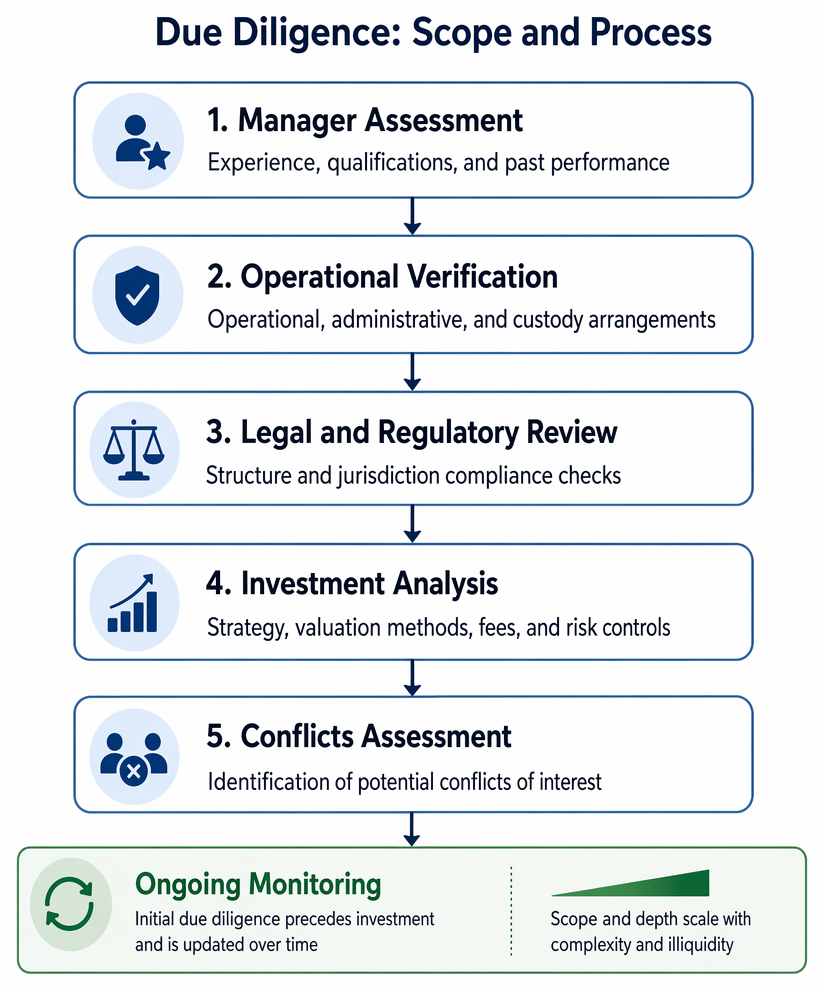
Due diligence encompasses manager assessment, operational controls, custody arrangements, legal documentation, valuation methodology, fee alignment, and related-party conflicts.
- Assessment of the investment manager’s experience, qualifications, and past performance.
- Independent verification of operational, administrative, and custody arrangements.
- Legal and regulatory compliance checks for both the structure (e.g., fund, trust, company) and jurisdiction.
- Review of investment strategy, valuation methodologies, fee structures, and risk controls.
- Identification of potential conflicts of interest.
The scope and depth of due diligence scale with the complexity and illiquidity of the subject structure or assets. Initial due diligence precedes the investment and is updated by ongoing monitoring.
Key Term: operational risk
The risk of loss due to failures in internal processes, people, systems, or external events, including fraud, error, or mismanagement.
Worked Example 1.1
Question: A pension fund is considering an allocation to a new real estate fund. What due diligence steps should it prioritize?
Answer:
The fund should (i) verify legal structure and regulatory status, (ii) review the track record and references of management, (iii) check internal controls, valuation methods, and custody arrangements for assets, (iv) ensure compliance with investor protections, and (v) evaluate the governance, including board independence and reporting requirements.
Governance: Key Principles and Structures
Governance establishes the oversight and control environment within which investment management occurs. It ensures that interests of all investors are protected, conflicts are minimized, and decision-makers are held to account. Effective governance arrangements typically include:
- A governing board or committee with independent, qualified members.
- Clear, documented policies and procedures for risk management, compliance, and escalation of issues.
- Segregation of duties between those who execute, oversee, and control activities.
- Transparent reporting to investors and regulators.
- Mechanisms for regular review and independent audit.
For pooled investment structures, governance integrity depends on the independence and competency of the board, the robustness of internal controls, and regular external assurance.
Key Term: board independence
The condition where a majority of the board or governing body has no material relationship with management, thereby supporting objective oversight and reducing potential conflicts. Key Term: escalation procedures
Established steps for reporting, investigating, and resolving issues or breaches identified during operations or monitoring.
Worked Example 1.2
Question: An investment committee discovers that the fund manager has delegated significant asset valuation authority to an affiliated service provider. Why is this problematic under sound governance?
Answer:
This arrangement creates a conflict of interest and weakens independent oversight, increasing the risk of inaccurate pricing, fraud, or manipulation. Strong governance requires sufficient independence in valuation and service providers, with the board having ultimate oversight.Exam Warning: Examiners may test whether you can distinguish between due diligence (the process) and governance (the framework). Many candidates confuse the two or overlook operational risk—the most frequent source of loss in investment failures.
Common Failures and Risk Implications
Failure to implement adequate due diligence or governance can result in:
- Asset misappropriation, fraud, or regulatory breach.
- Investment structures that lack accountability or transparency.
- Mispricing of fund units or NAV.
- Unmanaged conflicts of interest.
- Increased risk of loss from errors, failure of internal controls, or fraud.
Notably, high-profile organisational scandals often have roots in weak governance or superficial due diligence, allowing management override, collusion, or errors to go undiscovered.
Key Term: conflict of interest
A situation where a person or entity is in a position to exploit a professional or official capacity for their personal benefit, at the expense of integrity or investor interest.
Worked Example 1.3
Question: What governance mechanism can help mitigate a conflict of interest between fund managers and investors regarding fee structures?
Answer:
A well-structured independent board or oversight committee can review, approve, and monitor fee arrangements to ensure they are aligned with investor interests and that disclosures are full and fair. This reduces the potential for division between the interests of management and investors.
Due Diligence and Governance: Ongoing Oversight
Effective governance extends to ongoing monitoring of both the investment and the structure post-investment. This includes:
- Periodic reviews of controls, accounting, and reporting.
- Reevaluation of service provider independence and competence.
- Response to operational, compliance, or performance issues as they arise.
- Annual review of mandates, contracts, and delegated authorities.
Due diligence is not a one-time activity, but a continuous process for ensuring that the expected controls and behaviours are observed throughout the life of the investment.
Revision Tip: Remember that exam questions may present a scenario where an operational or compliance failure could have been prevented by stronger due diligence or by improved governance controls. Review the correct escalation and reporting lines, and be precise in your description of who is responsible for what.
Summary
Achieving strong due diligence and robust governance are essential in modern investment structures to mitigate operational, legal, and reputational risks. Investors must understand the purpose and elements of each, recognise the consequences of failure, and ensure continuous monitoring and oversight.
Key Point Checklist
This article has covered the following key knowledge points:
- Due diligence is a structured, ongoing process designed to identify and assess risks before and after investing.
- Governance frameworks establish controls, independent oversight, and escalation procedures for sound investment management.
- Operational risk is a key exposure mitigated by both due diligence and governance controls.
- Lack of independence, conflicts of interest, and poor oversight are leading contributors to investment risk in inefficient structures.
- Ongoing monitoring and clear escalation procedures are critical to effective risk management.
Key Terms and Concepts
- due diligence
- governance
- operational risk
- board independence
- escalation procedures
- conflict of interest