Learning Outcomes
This article explains GIPS composite creation, maintenance, and input data requirements, including:
- Defining composites in line with GIPS, distinguishing between strategies, mandates, and portfolio types.
- Applying eligibility and discretion criteria to determine when portfolios must enter or exit a composite.
- Evaluating firm policies and documentation for composite formation, rebalancing, and membership changes.
- Identifying appropriate controls for input data integrity across returns, valuations, benchmarks, and cash flows.
- Distinguishing significant errors from routine updates and determining the required GIPS-compliant response.
- Assessing how retroactive changes to composites or data can lead to misrepresentation and exam‑relevant violations.
- Interpreting worked examples that test composite inclusion, error correction, and disclosure requirements.
- Linking each element of composite and data policy to the overarching GIPS objectives of fairness, consistency, and comparability in performance reporting.
- Practicing how to approach typical Level II exam questions that combine composite design, data quality, and error evaluation under time pressure and with multi-part prompts.
CFA Level 2 Syllabus
For the CFA Level 2 exam, you are required to understand GIPS standards in greater depth, focusing on how composites are constructed and maintained while ensuring integrity in input data, with a focus on the following syllabus points:
- Explaining firm policies for the creation, definition, and maintenance of composites under GIPS.
- Recognizing procedures for including and excluding portfolios in composites.
- Assessing the importance of accurate, consistent, and complete input data within GIPS-compliant reporting.
- Evaluating procedures for error correction, updates, and firm documentation.
- Applying composite and data principles to examples and recognising exam pitfalls.
Test Your Knowledge
Attempt these questions before reading this article. If you find some difficult or cannot remember the answers, look more closely at that area during your revision.
Use the following vignette to answer Questions 1–4.
Kensington Asset Management is a GIPS-compliant firm specialising in global equity strategies. The firm has the following situations:
- The “Global Growth” composite includes all fee‑paying, discretionary portfolios with at least $2 million and invested at least 80% in global equities.
- A new client, Portfolio A, funded on 15 March, meets the mandate and size criteria from day 1, but is only added to the composite from 1 July.
- Portfolio B has a client‑imposed restriction prohibiting emerging market equities. The composite’s strategy normally allows up to 25% in emerging markets, and the manager typically uses this flexibility.
- For December year-end, Kensington initially uses preliminary custodian estimates for two portfolios, then receives final valuations two weeks later. Updating the valuations changes the annual composite return from 10.21% to 10.19%.
- In a later internal review, Kensington discovers that for the prior year it excluded one terminated portfolio from the composite history because it underperformed significantly.
-
Which of the following is the most accurate assessment of Kensington’s treatment of Portfolio A and the timing of its inclusion in the composite?
- a) Correct, because firms may wait up to six months before including a new portfolio.
- b) Incorrect, because portfolios must be included as of the start of the first full period after they become eligible.
- c) Correct, because firms may only include portfolios once they have a 3‑month track record.
- d) Incorrect, because new portfolios must be included retroactively from the funding date, regardless of the valuation period.
-
How should Kensington treat Portfolio B in relation to the Global Growth composite?
- a) Include Portfolio B because the client restriction is minor and still fits the broad strategy.
- b) Exclude Portfolio B because the client restriction is substantive and removes normal strategy flexibility.
- c) Include Portfolio B but classify it as non‑discretionary within the composite.
- d) Exclude Portfolio B and also remove all historically similar restricted portfolios from the composite.
-
Regarding the year‑end valuation update (10.21% to 10.19%), which statement best describes the appropriate GIPS treatment?
- a) This is a significant error requiring correction, redistribution of all reports, and client notification.
- b) This is a routine update because improved data became available, with no requirement to reissue prior reports.
- c) This is a significant error because any change in annual return, regardless of size, must be disclosed to all clients.
- d) This is a violation of GIPS because firms must never use preliminary valuations, even if disclosed.
-
How should Kensington address the discovery that a terminated portfolio was excluded from the composite in the prior year?
- a) Treat it as a significant error, correct composite history, and consider client notification depending on materiality.
- b) Ignore the issue because terminated portfolios are not required to be included in composite performance.
- c) Correct the composite going forward only, without changing any historical figures.
- d) Retroactively exclude all other terminated portfolios for consistency, then restate the composite.
Introduction
GIPS standards require firms to present performance results that are both accurate and comparable by standardizing how composites are created, maintained, and reported. Firms must have written policies covering composite and portfolio inclusion rules, as well as controls for input data quality. These policies ensure that reported results fairly represent the firm’s actual investment process and preclude performance cherry-picking.
Key Term: Composite
A group of portfolios with a similar investment mandate, objective, or strategy, whose total performance is presented collectively. Key Term: Input Data Integrity
The principle that all performance figures and portfolio information used in GIPS calculations must be consistent, accurate, and complete.
At Level II, you are expected not just to recall definitions, but to analyse whether specific firm practices are compliant. That involves:
- Translating high‑level GIPS principles (fair representation, full disclosure) into concrete composite rules.
- Evaluating ambiguous situations (partial discretion, unusual restrictions, late valuations) and deciding how they should be treated.
- Distinguishing between innocent mistakes that require process improvement and misrepresentations that undermine the credibility of performance.
Composites are central to GIPS. They are the unit at which performance is presented and audited, so composite design and data quality directly influence how prospective clients perceive a firm’s capabilities.
Key Term: GIPS‑Compliant Firm
An investment firm that has adopted and implemented all applicable GIPS requirements on a firm‑wide basis and claims compliance in accordance with the Standards.
Composite Creation and Definition
Firms must define composites around a particular strategy or mandate before any performance is known, and assign portfolios to these composites according to objective, written criteria.
- All fee-paying, discretionary portfolios must be included in appropriate composites.
- Composite definitions must be comprehensive, cover all strategies offered, and be documented in firm policies.
- Composites should reflect how the firm actually manages money, not how it wishes to market itself.
Key Term: Discretionary Portfolio
An account for which the firm has authority to make investment decisions and implement the portfolio strategy without client approval for each trade.
At an advanced level, there are several nuances to composite definition that often drive exam questions:
-
Strategy‑based, not performance‑based: Composite definitions must not depend on how portfolios performed. For example, defining a “Top Quintile Global Equity” composite that only includes accounts that beat the benchmark would clearly violate GIPS.
-
Complete coverage of strategies: Every actual, fee‑paying discretionary portfolio must fall into at least one composite. If a firm runs three distinct equity strategies and one fixed‑income strategy, there should be at least four corresponding composites.
-
Single‑portfolio composites: GIPS allows composites with only one portfolio (for niche mandates), but this fact and the reason should be clear in the composite description. Exam questions may test whether a firm improperly delays creating a composite until there are multiple accounts, which is not allowed.
-
Mandate versus sub‑mandate: Composites must be tied to full mandates, not to subsets of securities within accounts (for example, “only the equity sleeve” of balanced accounts) unless the firm is legitimately managing that sleeve as a separate mandate with its own cash allocation.
Key Term: Composite Definition
The formal, written description of a composite’s investment mandate, objective, or strategy, including key characteristics and eligibility criteria.
Practical exam angle
Given a case vignette, you should be able to:
- Read a strategy description and infer an appropriate composite structure.
- Spot missing composites (for example, a firm markets a “Global Quality Equity” product, but there is no corresponding composite).
- Identify inappropriate segmentation (for example, “best ideas” composites that cherry‑pick from client accounts).
Ongoing Maintenance and Portfolio Inclusion
After creation, composites require robust maintenance to ensure that all eligible portfolios are included on a timely basis and excluded promptly if they cease to qualify.
- Portfolios must be added to a composite no later than the end of the first full calculation period after becoming eligible (for most firms, this is the first full month after funding and mandate alignment).
- Portfolios must exit the composite immediately upon failing eligibility (loss of discretion, substantive client-imposed restrictions, mandate change, etc.).
- Changes to composite membership must be based on criteria defined in advance—not to alter past performance.
Key Term: Composite Membership Rules
Documented firm guidelines setting the criteria for when a portfolio should be added to or removed from a composite.
Beyond these basic rules, several more subtle issues often appear on the exam:
-
Terminated portfolios: Performance of portfolios that leave the firm or terminate the mandate must remain in the composite history up to the last full performance period that the portfolio was managed. Removing underperforming terminated accounts from past periods is a classic misrepresentation.
-
Mandate changes: If a client changes from a “Core Equity” to a “Dividend Equity” mandate, the portfolio should leave one composite and join the other from the effective date of the change. The historical performance remains with the original composite for the periods when that mandate applied.
-
Discretion changes: Loss of discretion can occur when client restrictions or client‑directed trades prevent the manager from implementing the strategy. The firm’s policies must define what constitutes loss of discretion (for example, “client must pre‑approve all trades”) and when the portfolio should be reclassified as non‑discretionary and removed from the composite.
Key Term: Significant Cash Flow (GIPS Context)
A firm‑defined level of external cash flow that is large enough to temporarily disrupt the strategy implementation, often triggering special treatment such as temporary removal from a composite or an additional valuation.
Some firms choose to define “significant cash flows.” For example:
- If external cash flows exceed 10% of beginning market value, the portfolio is temporarily removed from the composite for that period.
- GIPS allows—but does not require—this approach, provided it is fully documented and applied consistently across composites.
Worked Example 1.1
A firm discovers that a portfolio was not added to a composite when it became eligible, resulting in understated composite returns. What must the firm do under GIPS?
Answer:
The firm must correct the error by including the portfolio’s performance retroactively from its eligibility date, adjusting all affected composite returns. If the error is significant (for example, it changes a 5‑year annualised return by a meaningful amount or alters rankings versus the benchmark or peers), the firm must disclose the correction to all parties who received the original data and update all affected reports, with disclosure of the change, the reason for it, and its quantitative impact. The firm should also review and strengthen its membership controls to prevent recurrence.
Worked Example 1.2
A small-cap equity composite has the following events:
- Portfolio X, funded on 10 January, meets all criteria from that date.
- The firm calculates monthly time‑weighted returns with valuations at month‑end.
- Portfolio X is only included in the composite from 1 April onward because the performance team prefers to see “at least two months of data” before inclusion.
Is this treatment compliant, and if not, what is the correct approach?
Answer:
This treatment is not compliant. Portfolio X becomes eligible as soon as it meets the composite definition (mandate, discretion, minimum size). Because the firm values portfolios at month‑end, Portfolio X must be included in the composite no later than the first full calculation period after eligibility, which is February. The firm should:
- Recalculate composite returns including Portfolio X from February.
- Assess whether the omission is a significant error that requires client notification.
- Update its written policies to clarify that portfolios may not be excluded simply to build a track record or for convenience.
Exam Warning: Failing to clearly document composite inclusion/exclusion criteria—or retroactively altering composites after seeing returns—will result in a clear GIPS violation and is a common exam pitfall. In case vignettes, be suspicious of:
- Delayed inclusion “until performance stabilises.”
- Removal of “outlier” portfolios with poor returns.
- Redefinition of composites to drop weaker accounts.
Policies, Procedures, and Documentation
Written policies covering composite construction, inclusion/exclusion, and rebalancing are a GIPS requirement.
- Policies must specify how portfolios are classified, what qualifies as discretion, and exactly how inclusion/exclusion is applied.
- Composites must be defined around a full investment mandate, not just subsets of client accounts.
- Policies must be applied consistently across all portfolios and over time.
All key decisions—composite definitions, inclusion/exclusion, rebalancing methodology, and calculation methodology—must be documented and retained.
Key Term: Composite Policy Document
The internal document that outlines a firm’s composite structure, definitions, membership rules, calculation methods, and responsibilities for maintaining compliance.
Stronger policies will typically cover:
-
Composite definitions and objectives: Including typical asset allocation ranges, use of derivatives, borrowing, and short selling, as well as the appropriate benchmark and why it was chosen.
-
Minimum portfolio size: If a minimum is used (for example, $1 million), it must be set in advance and applied uniformly. Changing the minimum retroactively to drop weak performers is not allowed.
-
Carve‑outs and segments: If the firm presents segment returns (for example, the equity portion of balanced accounts), policies must define when this is allowed and how cash is allocated to the carve‑out.
-
Responsibilities and oversight: Who assigns portfolios to composites, who reviews membership changes, and how often reconciliations are performed between portfolio lists, billing systems, and composites.
Good documentation reduces the risk of errors and provides evidence in case of verification or regulatory review—points that exam questions sometimes emphasise.
Key Term: Significant Error (GIPS)
A mistake in a GIPS composite or report that impacts a material number or causes a misleading representation of performance, requiring disclosure and correction.
Input Data Quality and Control
GIPS-compliant performance relies fundamentally on accurate and consistent input data for returns (both gross and net), valuations, and cash flows.
- Input data must be based on actual trades, using fair market value at measurement dates.
- Firms must implement controls and checks to detect, correct, and document input data errors.
- Firms must establish clear responsibility for data ownership, with documented procedures for correction and notification.
Key Term: Fair Value (GIPS Context)
The price at which an investment could be exchanged in an orderly transaction between willing market participants, reflecting current market conditions.
Core input data requirements
Advanced exam questions often test your understanding of the following:
-
Valuation frequency and methodology:
- Portfolios must be valued in accordance with fair value.
- Valuations must occur at least monthly and on the date of large external cash flows.
- Pricing sources (for example, independent pricing services versus manager quotes) must be specified and used consistently.
-
Trade‑date accounting: GIPS requires trade‑date, not settlement‑date, accounting. This ensures that performance reflects economic exposure when trades are executed.
-
Accrual accounting:
- Interest income on fixed‑income securities must be accrued.
- Dividends on equities should be recorded on the ex‑dividend date.
- Accruals must be aligned with how the benchmark is calculated to support comparability.
-
Gross‑of‑fees and net‑of‑fees returns:
Key Term: Gross‑of‑Fees Return
The return on a portfolio after deducting transaction costs but before deducting investment management fees. Key Term: Net‑of‑Fees Return
The return on a portfolio after deducting transaction costs and all investment management fees (and, if the firm chooses, certain other costs as defined in policy).
Firms must be clear and consistent about what is included in each return type. For example:
-
All actual trading expenses must be deducted in both gross and net returns.
-
Net returns must deduct management fees; performance‑based fees must be treated consistently.
-
Benchmarks:
- Benchmark returns should be calculated using a methodology consistent with the composite (for example, time‑weighted returns, same currency, similar valuation timing).
- If the benchmark changes, reasons and dates must be disclosed.
Controls and data governance
Robust data controls commonly include:
- Daily or monthly reconciliations between portfolio accounting systems and custodian data.
- Reasonability checks (for example, flagging returns outside a pre‑set band, such as ±20% for a monthly equity return).
- Access controls and audit trails for manual overrides of pricing or classification.
- Periodic reviews of benchmark data sources and methodologies.
Worked Example 1.3
A fixed‑income composite is valued monthly. For one month, the firm uses settlement‑date accounting due to a system issue, causing a small difference in the reported monthly return. The annual composite return changes by 0.01%. How should this be treated?
Answer:
Using settlement‑date accounting breaches GIPS requirements, even if the numerical impact is small. The firm should correct the calculation using trade‑date accounting and assess whether the change is significant. A 0.01% change in annual return will typically be considered non‑significant, so:
- The corrected data should be used in all future presentations.
- There is usually no need to reissue prior reports, but the firm should document the issue and remediation.
- The more serious concern is control weakness—a one‑off system issue should lead to process enhancements to prevent recurrence.
Error Correction and Required Updates
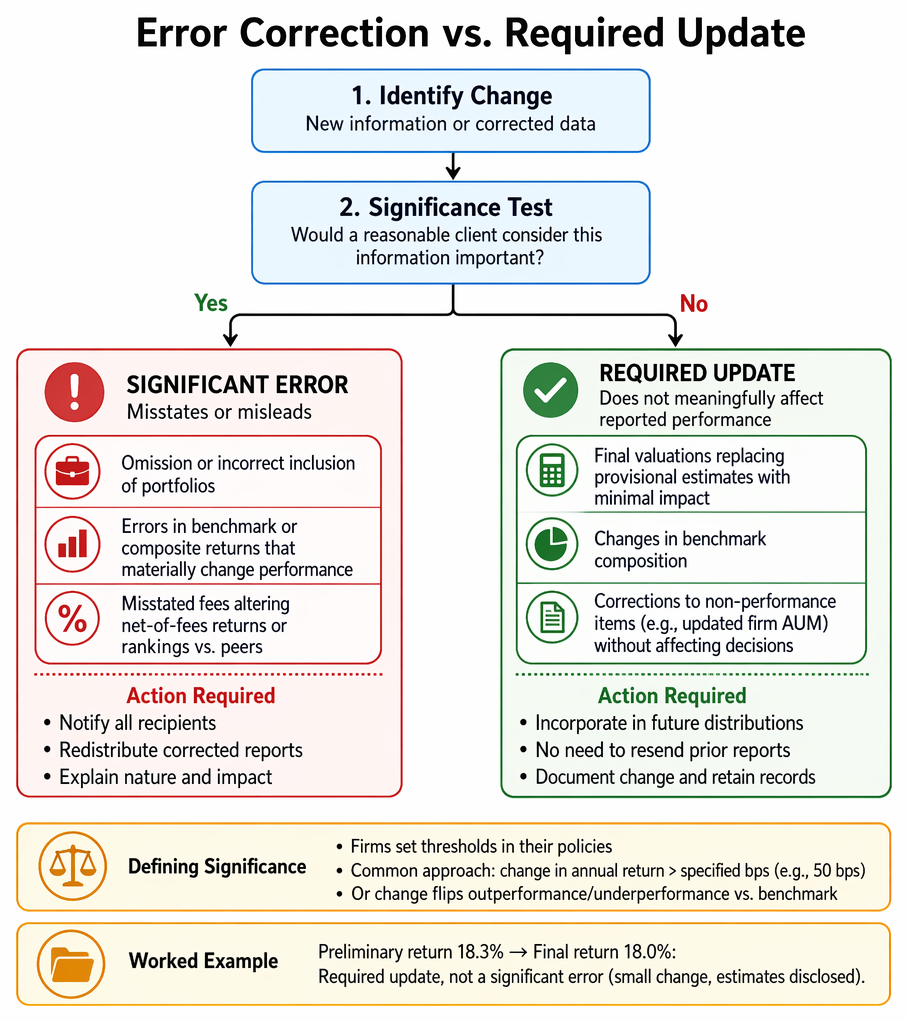
Significant errors, meaning mistakes that misstate or mislead, must be corrected and disclosed. The firm must notify all recipients of the erroneous report and redistribute the corrected version with an explanation of the nature and impact.
Composite formation under GIPS proceeds from mandate identification to predefined inclusion rules, portfolio membership, and documented characteristics for compliant reporting.
Required updates, such as routine data corrections that do not meaningfully affect reported performance, only need to be incorporated in future distributions.
Key distinctions:
-
Significant errors generally include:
- Omission or incorrect inclusion of portfolios in a composite.
- Errors in benchmark returns or composite returns that materially change performance.
- Misstated fees that alter net‑of‑fees returns or rankings versus peers.
-
Routine updates typically include:
- Replacement of provisional valuations with final values that have minimal impact on returns.
- Changes in benchmark composition published by an index provider.
- Corrections to non‑performance items (for example, updated firm AUM figures) that do not change client decisions.
GIPS does not prescribe a universal numeric threshold for significance; firms must define thresholds in their policies. A common approach is to treat as significant:
- Any error that changes an annual composite return by more than a specified number of basis points (for example, 50 bps).
- Any error that changes whether the composite outperformed or underperformed its benchmark over a key period.
Key Term: Required Update (GIPS Context)
A non‑error change to information, usually due to more complete data becoming available, that does not require reissuing prior reports but must be reflected in future presentations.
Worked Example 1.4
A private equity composite reports a preliminary annual return based on estimated year‑end valuations. Three months later, final audited valuations become available, changing the annual return from 18.3% to 18.0%. The firm had disclosed that returns were based on estimates and subject to revision. What is the appropriate treatment?
Answer:
This is a required update, not a significant error. The firm used the best available data and disclosed the use of estimates. When final valuations become available:
- The composite return should be updated in all future reports to 18.0%.
- There is no requirement to resend prior reports to all recipients, as the change is small and was anticipated.
- The firm should maintain documentation of the change and ensure its valuation and disclosure policies clearly cover such situations.
Revision Tip: When evaluating an error, ask: Would a reasonable client consider this information important in deciding to hire the firm, or in understanding composite risk and return? If so, treat as significant. If not, and the change arises from normal data finalisation (for example, audited valuations), treat as a required update.
Summary
Composites are the building blocks of GIPS-compliant reporting, demanding objective, documented membership criteria and rigorous maintenance. All input data must be accurate, timely, and supported by strong internal controls. Material mistakes require full disclosure and client communication, ensuring that performance reporting remains credible and comparable.
For Level II, you should be prepared to:
- Map specific portfolios to composites based on mandate and discretion.
- Judge whether portfolio additions/removals and timing are compliant.
- Evaluate data processes and determine whether issues are significant errors or routine updates.
- Identify misrepresentation risks from retroactive composite changes or selective portfolio inclusion.
Key Point Checklist
This article has covered the following key knowledge points:
- Composite formation must be based on documented, pre-defined strategies, not realized performance.
- All eligible discretionary, fee-paying portfolios must be included in composites as soon as eligible and excluded when no longer eligible, based on written rules.
- Terminated portfolios must remain in composite history up to the last period they were managed; removing them retroactively is a serious violation.
- Firms may define significant cash flows and use them to trigger additional valuations or temporary removal from composites, but policies must be clear and consistently applied.
- Firms must implement written policies covering composite construction, portfolio inclusion/exclusion, rebalancing, and responsibilities for data governance.
- Input data for returns, valuations, and cash flows must be accurate, timely, and controlled, with documented correction procedures, including trade‑date accounting and accrual treatment.
- GIPS distinguishes between significant errors (requiring prompt disclosure and reissuance of reports) and routine updates (incorporated in future distributions).
- Retroactive changes to composite definitions or portfolio membership that are motivated by performance outcomes constitute misrepresentation and breach GIPS.
Key Terms and Concepts
- Composite
- Input Data Integrity
- GIPS‑Compliant Firm
- Discretionary Portfolio
- Composite Definition
- Composite Membership Rules
- Significant Cash Flow (GIPS Context)
- Composite Policy Document
- Significant Error (GIPS)
- Fair Value (GIPS Context)
- Gross‑of‑Fees Return
- Net‑of‑Fees Return
- Required Update (GIPS Context)