Learning Outcomes
This article explains how to evaluate the sustainability of a country’s balance of payments current account in an exam context, including:
- Assessing how the current account, capital/financial account, and reserve movements fit together to finance external deficits or absorb surpluses.
- Distinguishing between sustainable and unsustainable current account positions using external debt ratios, export capacity, and the composition, maturity, and currency of capital inflows.
- Evaluating the relative stability of different financing sources, such as foreign direct investment, portfolio flows, bank lending, and official financing.
- Explaining key adjustment mechanisms—exchange rate changes, interest rate movements, and fiscal policy shifts—and how they restore or undermine sustainability.
- Identifying quantitative warning indicators of mounting risk, including rapid external debt growth, declining reserve adequacy, widening fiscal deficits, and real exchange rate overvaluation.
- Analyzing how sudden stops in capital flows, shifts in investor confidence, or policy mistakes can trigger abrupt external adjustment and currency crises.
- Applying these concepts to numerical examples and case-style scenarios similar to those encountered in the CFA Level 2 exam.
CFA Level 2 Syllabus
For the CFA Level 2 exam, you are required to understand the major concepts and risks related to balance of payments (BOP) accounts, capital flows, and the sustainability of the current account with a focus on the following syllabus points:
- Explain the structure and components of the balance of payments, with emphasis on the current account and its financing.
- Assess the sustainability of prolonged current account deficits or surpluses.
- Describe the mechanisms through which external balances adjust and the indicators that signal potential vulnerabilities.
- Identify risks associated with international capital flows and BOP imbalances.
- Relate BOP developments to exchange rate movements and potential currency crises.
Test Your Knowledge
Attempt these questions before reading this article. If you find some difficult or cannot remember the answers, look more closely at that area during your revision.
Use the following vignette to answer Questions 1–4.
Country X is a small, open emerging economy with a freely floating exchange rate. Over the past five years it has run a current account deficit averaging 4% of GDP. Key data for the most recent year are:
- Real GDP growth: 5%
- Current account balance: –5% of GDP
- Net foreign direct investment inflows: 3% of GDP
- Net portfolio debt inflows (mainly bonds): 4% of GDP
- Net official borrowing from multilaterals: 0.5% of GDP
- External debt-to-GDP: 70% (up from 45% five years ago)
- External debt-to-exports: 200%
- Short-term external debt (remaining maturity < 1 year): 40% of total external debt
- Official FX reserves: equal to 4 months of imports and 80% of short-term external debt
- Fiscal deficit: 6% of GDP and rising
- Real effective exchange rate (REER): estimated 15% overvalued relative to history
Global risk appetite has recently deteriorated, leading to rising global interest rates and reduced flows to emerging markets. Bond spreads on Country X’s external debt have widened sharply.
-
Which feature of Country X’s external position most strongly supports the view that the current account deficit has been reasonably sustainable so far?
- a) External debt-to-exports ratio of 200%
- b) Net FDI inflows of 3% of GDP
- c) Fiscal deficit of 6% of GDP
- d) Short-term debt equal to 40% of total external debt
-
Given the change in global conditions, which channel poses the most immediate risk of a disruptive adjustment in Country X?
- a) Decline in FDI inflows leading to slower productivity growth
- b) Sudden stop in portfolio debt inflows forcing reserve loss or currency depreciation
- c) Gradual fall in exports due to a global recession
- d) Rise in remittance outflows as migrant workers leave the country
-
Which indicator best captures Country X’s short-term external liquidity risk when assessing current account sustainability?
- a) External debt-to-GDP ratio
- b) Current account balance as a percentage of GDP
- c) Ratio of FX reserves to short-term external debt
- d) Real GDP growth rate
-
Regarding the balance of payments identity for Country X, which statement is most accurate?
- a) A current account deficit must be exactly offset by an equal-sized capital/financial account deficit
- b) A current account deficit must be financed by a capital/financial account surplus and/or a fall in official reserves
- c) A current account deficit is unsustainable unless the currency is pegged
- d) A current account deficit implies that the country is accumulating foreign assets
Introduction
International trade and the flow of capital are recorded in a country’s balance of payments accounts. The sustainability of a nation’s current account—its balance of exports and imports of goods, services, and income—affects exchange rates, investment, and long-term economic growth. Persistent imbalances can present risks for currency stability and overall financial health. Understanding when a country’s deficit or surplus becomes unsustainable is essential for sound investment decision-making.
Key Term: balance of payments (BOP)
The official record of all economic transactions between residents of a country and the rest of the world, including trade, income, transfers, and capital flows. Key Term: current account
The BOP component measuring a country's trade in goods and services, net primary income (e.g., interest and dividends), and net current transfers (e.g., remittances, aid). Key Term: capital account (financial account)
The section of the BOP that records cross-border flows of financial capital, including foreign direct investment, portfolio flows, bank lending, and changes in official reserves.
From an analyst’s standpoint, current account sustainability is not simply about whether the account is balanced in a given year. The key questions are:
- How is the current account position being financed or absorbed?
- How is it likely to change given growth, interest rates, and policy choices?
- How vulnerable is the country to changes in investor sentiment or global conditions?
Key Term: current account sustainability
The ability of a country to finance its current account deficit (or absorb its surplus) over the medium to long term without triggering excessive foreign debt accumulation, abrupt policy shifts, or major economic volatility.Test Tip: When revising Balance of payments current account sustainability, connect each definition, method, or rule to the kind of question the assessment is likely to ask.
BALANCE OF PAYMENTS: STRUCTURE AND IMPACT
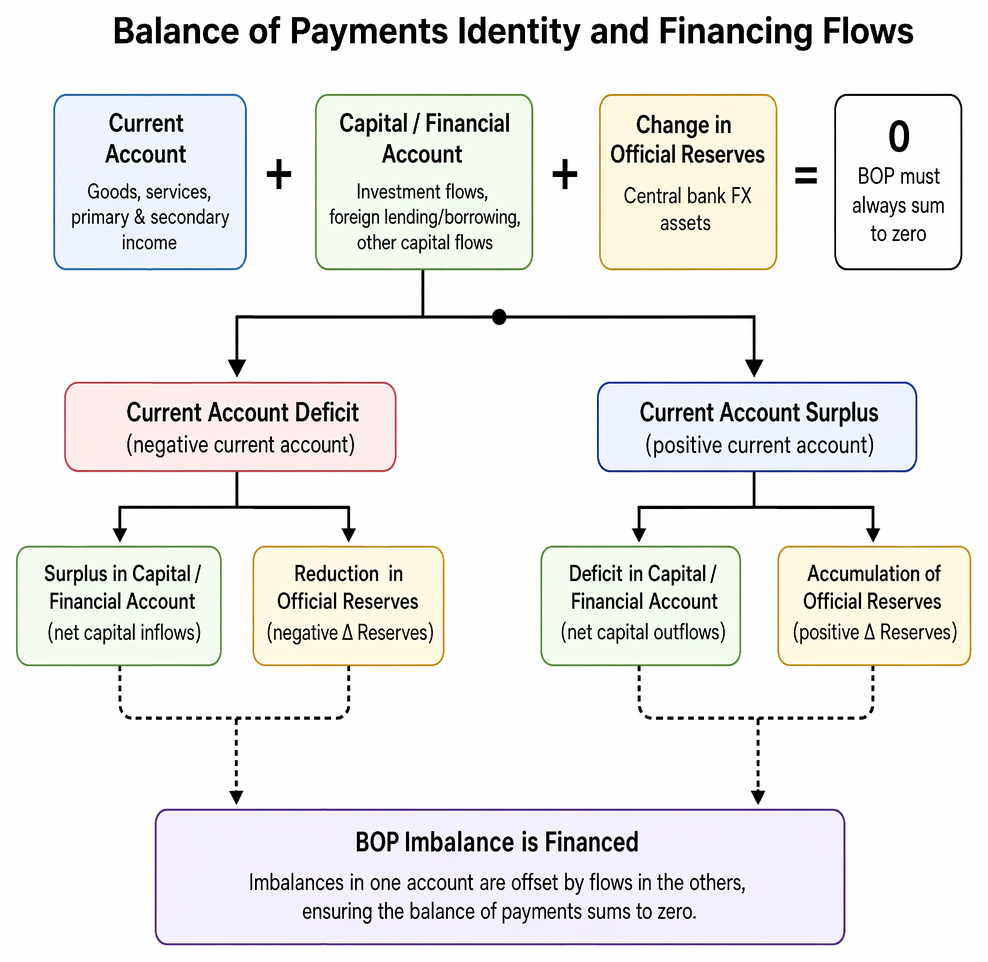
The balance of payments records all cross-border movements of money involving a country’s residents. Its main sections are:
Current account adjustment channels link import-driven currency supply, investor asset sales, and rising external debt to depreciation and risk premia.
- The current account (trade in goods, services, primary, and secondary income)
- The capital/financial account (investment flows, foreign lending/borrowing, and other capital flows)
- Official reserve transactions by the central bank
At an accounting level, the BOP must always sum to zero:
-
A current account deficit (negative current account) must be financed by:
- A surplus in the capital/financial account (net capital inflows), and/or
- A reduction in foreign exchange reserves (negative ).
-
A current account surplus must be matched by:
- A deficit in the capital/financial account (net capital outflows), and/or
- An accumulation of reserves.
Key Term: official foreign exchange reserves
Foreign currency assets (and sometimes gold and SDRs) held by a country’s central bank, used to intervene in FX markets, pay external obligations, and provide a buffer against external shocks.
Current account deficits and exchange rates
When a country’s current account shows a deficit, it must be matched by a surplus in the financial account, either through capital inflows (foreign investment or borrowing) or drawing down reserves.
In the CFA curriculum, three mechanisms link persistent current account deficits to exchange rate movements:
-
Flow supply–demand mechanism: A deficit implies the country is buying more foreign goods and services than it sells, increasing the supply of its currency in FX markets as importers sell domestic currency to buy foreign currency. This tends to put downward pressure on the domestic currency. Depreciation, in turn, can help restore balance by making exports cheaper and imports more expensive—provided trade volumes respond sufficiently.
-
Portfolio balance mechanism: Countries running current account surpluses often accumulate financial claims on deficit countries. Over time, investors may become uncomfortable with the concentration of their portfolios in the deficit country’s currency and assets, leading them to rebalance away. Sales of those assets can cause the deficit country’s currency to depreciate and its interest rates to rise.
-
Debt sustainability mechanism: If a deficit is financed by external borrowing, external debt rises. When debt becomes high relative to GDP or exports, investors may doubt the borrower’s ability to service it. Risk premia and required yields increase, capital inflows may slow or reverse, and the borrower’s currency can depreciate sharply.
Key Term: external debt
The stock of outstanding debt owed by residents of a country to non-residents, typically measured in foreign currency and evaluated relative to GDP or export receipts.
In the short run, capital flows tend to dominate exchange rate movements because they are large and can change quickly compared with trade flows. High relative interest rates or expected returns can attract capital and support the currency even in the presence of large current account deficits—until sentiment changes.
Surpluses and capital outflows
A persistent current account surplus has the mirror image issues:
- Domestic savings exceed domestic investment.
- The country accumulates claims on the rest of the world (net foreign assets).
- If the exchange rate is flexible, upward pressure on the currency can erode competitiveness over time.
- Authorities may accumulate reserves or encourage outward investment to mitigate appreciation.
Persistent imbalances in the current account—especially if large relative to GDP—can raise sustainability concerns, lead to higher borrowing costs, and put pressure on the domestic currency or on policy frameworks.
ASSESSING CURRENT ACCOUNT SUSTAINABILITY
A moderate current account deficit, financed by stable long-term capital inflows, is often benign for developed economies. Problems emerge when deficits are large, persist over time, or are funded by volatile flows. Investors must analyze:
- The sources and types of capital inflows (short-term vs. long-term, debt vs. foreign direct investment)
- The country’s ability to service foreign debt (external debt/GDP, external debt/exports ratios, debt-service ratios)
- The flexibility of the exchange rate and adequacy of official reserves
- The broader policy mix and growth prospects
Key Term: foreign direct investment (FDI)
Cross-border investment where the investor acquires a lasting interest and significant influence (often defined as ≥10% voting stake) in a foreign enterprise; typically long term and relatively stable. Key Term: portfolio investment
Cross-border holdings of equity and debt securities that do not confer significant control; generally more liquid and potentially more volatile than FDI. Key Term: net international investment position (NIIP)
The difference between a country’s external financial assets and liabilities; a negative NIIP indicates a net debtor to the rest of the world. Key Term: debt sustainability
The condition under which a country's external debt does not grow faster than its capacity to pay interest and principal, typically assessed relative to GDP, export receipts, or other resource bases.
Size and persistence of the imbalance
Key questions include:
-
How large is the current account deficit or surplus relative to GDP? A 2–3% of GDP deficit can be manageable for a fast-growing, creditworthy economy. A 6–8% of GDP deficit, particularly if persistent, is more concerning—especially for emerging markets with weaker institutions.
-
Is the imbalance cyclical or structural?
- Cyclical deficits may reflect temporary commodity price swings or a domestic investment boom.
- Structural deficits may stem from chronically low savings, persistent fiscal deficits, or a misaligned real exchange rate.
The exam often expects you to differentiate between “good” deficits (e.g., financing productive investment in a young, fast-growing economy) and “bad” deficits (e.g., financing consumption booms or large fiscal deficits).
Composition, maturity, and currency of financing
Not all capital inflows are equal from a sustainability standpoint.
-
FDI inflows are generally the most stable form of financing:
- Investors share in risk via equity.
- Cash flows (dividends, reinvested earnings) adjust with economic conditions.
- FDI often boosts export capacity and productivity, supporting future debt-servicing ability.
-
Portfolio equity flows are more volatile than FDI but still do not create fixed debt service obligations.
-
Long-term foreign-currency debt adds fixed servicing needs and currency risk, but rollover risk is lower than for short-term debt.
-
Short-term external debt and interbank lending are the riskiest:
- They can be withdrawn quickly.
- A large stock of short-term debt relative to reserves is a classic crisis warning sign.
Key Term: short-term external debt
External debt with remaining maturity of one year or less, including short-term bank loans and maturing long-term obligations. Key Term: debt-service ratio
The ratio of annual interest and principal payments on external debt to export receipts or current account receipts; a measure of the burden of servicing foreign debt.
Analysts look closely at:
- External debt-to-GDP
- External debt-to-exports
- Debt-service ratio
- Short-term external debt-to-reserves
The higher these ratios, the more vulnerable the country is to interest rate increases, growth disappointments, or capital flow reversals.
Growth–interest rate interaction and external debt
A simple debt sustainability condition relates the required primary current account balance (excluding interest payments) to growth and the interest rate on external debt:
where:
- = nominal effective interest rate on external debt
- = nominal GDP growth rate
- = stock of external debt
- = nominal GDP
If , a country can often sustain even a small primary deficit without the debt-to-GDP ratio exploding. If and the country runs persistent primary deficits, the debt ratio will tend to rise, raising concerns about sustainability.
Exchange rate regime, policy mix, and BOP sustainability
The exchange rate regime and the scope for monetary and fiscal policy adjustment matter:
- Under a flexible exchange rate with high capital mobility:
- Expansionary monetary policy tends to lower domestic interest rates, reduce capital inflows, weaken the currency, and potentially improve the current account.
- Expansionary fiscal policy (larger budget deficits) tends to raise domestic interest rates, attract capital inflows, and appreciate the currency, often worsening the current account even as financing becomes easier.
These effects are consistent with the Mundell–Fleming model, which links interest rates, capital flows, and exchange rates in the short run.
- Under a fixed or tightly managed exchange rate, the central bank must use reserves and/or adjust interest rates to defend the peg. A large current account deficit under a peg can rapidly drain reserves, making sustainability more challenging and increasing crisis risk.
Worked Example 1.1
A middle-income country runs a current account deficit of 4% of GDP, financed as follows:
- Net FDI inflows: 3% of GDP
- Net long-term external borrowing: 1.5% of GDP
- Net short-term external borrowing: –0.5% of GDP (short-term debt is being reduced)
External debt-to-GDP has been stable at 40%, and GDP is growing at 6% nominal while the average interest rate on external debt is 4% nominal. Reserves cover six months of imports and 120% of short-term external debt.
Is the current account position likely to be considered sustainable?
Answer:
The current account deficit appears sustainable. It is moderate in size (4% of GDP), largely financed by stable FDI, and external debt ratios are stable with growth exceeding the interest rate:
Short-term debt is being reduced, and reserves are adequate relative to imports and short-term obligations. Absent signs of currency overvaluation or fiscal mismanagement, this configuration is usually viewed as manageable.
ADJUSTMENT MECHANISMS FOR SUSTAINABILITY
If a country’s current account deficit begins to exceed sustainable levels, several outcomes or adjustment mechanisms may occur:
-
Currency depreciation or re-pricing: A weaker currency makes exports more competitive and imports more expensive, helping to narrow the current account deficit over time. However, if external debt is largely in foreign currency, depreciation can worsen the domestic currency value of debt and interest payments, at least initially.
-
Interest rate changes: Central banks may raise interest rates to attract more stable capital inflows and support the currency. This can ease external financing pressures but may slow domestic growth and investment. Conversely, cutting rates risks undermining the currency if external confidence is fragile.
-
Fiscal policy tightening: Reducing fiscal deficits via higher taxes or lower spending can:
- Lower domestic demand and import growth.
- Reduce the need for external financing.
- Improve investor confidence in debt sustainability.
-
Market-led correction: If investors lose confidence, capital inflows may slow or reverse. The country may be forced to:
- Draw down reserves.
- Allow sharp currency depreciation.
- Accept a recession as imports and domestic demand compress.
Conversely, a persistent current account surplus may:
- Put upward pressure on the domestic currency, potentially eroding competitiveness.
- Lead to reserve accumulation and low domestic interest rates.
- Encourage authorities to stimulate domestic demand (e.g., via fiscal expansion) or to liberalize outward investment.
Key Term: sudden stop
A situation where foreign investors abruptly reduce or reverse capital flows to a country, forcing rapid and often painful adjustment through currency depreciation, reserve loss, and demand compression. Key Term: reserve adequacy
The extent to which a country’s foreign exchange reserves are sufficient to cover imports and meet short-term external debt obligations, providing a buffer against external shocks.
Worked Example 1.2
A small open economy runs a current account deficit of 6% of GDP for several years, financing this mostly via short-term bank loans. Suddenly, global credit conditions tighten and capital inflows stop. What risks does this country now face?
Answer:
With capital inflows drying up, the country can no longer finance its deficit easily. It may be forced to draw down foreign exchange reserves, sharply raise interest rates (slowing growth), or allow its currency to depreciate. If reserves are insufficient or lenders fear default, the result could be a sudden stop in financing, a steep currency fall, and a potential external and banking crisis.
Excessive capital inflows and boom–bust cycles
In emerging markets, large capital inflows can themselves create vulnerabilities:
- Excessive real appreciation of the domestic currency, undermining tradable sectors.
- Asset price bubbles in equity or real estate.
- Rapid growth of external debt by firms and banks.
- Credit-fueled consumption booms.
Authorities may respond with:
- Capital controls on short-term inflows.
- Macroprudential measures (e.g., tighter lending standards).
- FX intervention (accumulating reserves to resist appreciation).
These policies aim to reduce the risk that a current account deficit financed by “hot money” ends in a disorderly adjustment.
Worked Example 1.3
Country Y has:
- Current account deficit: 3% of GDP
- Net FDI inflows: 1% of GDP
- Net portfolio equity inflflows: 1% of GDP
- Net short-term external borrowing: 1% of GDP
- External debt-to-GDP: 55% (up from 30% in three years)
- Short-term external debt: 50% of external debt
- Reserves: 60% of short-term external debt
Which feature is most concerning from a sustainability standpoint?
Answer:
The large and rapidly rising short-term external debt relative to reserves (short-term debt equals 50% of external debt and reserves cover only 60% of short-term debt) is most worrying. Even though the overall current account deficit is moderate, reliance on short-term borrowing creates rollover risk and makes the country vulnerable to a sudden stop, particularly if global conditions worsen.
INDICATORS OF UNSUSTAINABILITY AND WARNING SIGNS
Warning signs that a current account deficit is becoming unsustainable include:
-
Rapid growth in external debt-to-GDP or external debt-to-exports ratios: Rising leverage without commensurate growth in export capacity or GDP indicates that debt servicing will strain future resources.
-
Deteriorating debt-service ratios: When interest and principal payments absorb a rising share of export or current account receipts, the margin for adverse shocks shrinks.
-
Declining share of FDI in total inflows: A falling FDI share and growing reliance on short-term bank lending or portfolio debt suggests increased vulnerability to reversals.
-
High and rising levels of short-term foreign currency debt: Especially dangerous if:
- A large portion is unhedged in the domestic currency, and
- Reserves are low relative to short-term obligations (e.g., reserves < 100% of short-term external debt).
-
Widening fiscal deficits and lack of fiscal discipline: Twin deficits (large fiscal and current account deficits) can compound each other, prompting concerns about overall macroeconomic sustainability.
-
Overvalued real effective exchange rate (REER): A REER significantly above its long-term average or implied by fundamentals indicates loss of competitiveness and potential for a sharp depreciation.
Key Term: real effective exchange rate (REER)
A trade-weighted average of a country’s exchange rate against its trading partners, adjusted for relative inflation; used to gauge international price competitiveness.
-
History of frequent capital flow reversals or policy instability: Weak institutions, policy unpredictability, and past crises raise the risk that new deficits will end badly.
-
Falling reserve adequacy: For many emerging markets, analysts look for:
- At least three months of import cover, and
- Reserves at or above 100% of short-term external debt.
Exam tip: Do not focus solely on the current account ratio to GDP. The financing structure, debt metrics, exchange rate valuation, and policy credibility are equally important in judging sustainability.
Worked Example 1.4
An analyst compares two countries with equal current account deficits of 5% of GDP.
-
Country A:
- External debt-to-GDP: 30%
- FDI financing: 4% of GDP
- Short-term external debt: 20% of total external debt
- Reserves: 150% of short-term external debt
- REER close to its 10-year average
-
Country B:
- External debt-to-GDP: 80%
- FDI financing: 1% of GDP
- Short-term external debt: 60% of total external debt
- Reserves: 60% of short-term external debt
- REER 20% above its 10-year average
Which country’s current account deficit is more likely to be unsustainable, and why?
Answer:
Country B’s deficit is more likely to be unsustainable. It has much higher external debt, a larger share of short-term debt with weak reserve coverage, and an overvalued REER—all classic warning signs. In contrast, Country A has lower debt, mainly FDI financing, strong reserve adequacy, and a competitive exchange rate.Exam Warning: Do not assume that the presence of large foreign capital inflows always implies sustainability. Short-term or speculative inflows can reverse quickly and worsen problems. Deficits funded mainly by long-term FDI or stable equity flows are more sustainable than those funded by short-term foreign-currency debt or leveraged carry trades.
POLICY IMPLICATIONS AND RESPONSIBILITIES
Policymakers monitor the sustainability of the current account and the mix of capital flows. Tools to support sustainability include:
-
Exchange rate flexibility: Allowing the currency to move can help absorb shocks and maintain external balance. Very rigid pegs with large deficits and limited reserves are high risk.
-
Building adequate FX reserves: Reserves provide insurance against sudden stops and can buy time for orderly adjustment. However, accumulating very large reserves may entail fiscal costs and sterilization challenges.
-
Encouraging stable, long-term capital flows: Policies that improve the business environment, protect property rights, and support structural reforms tend to attract FDI rather than volatile short-term borrowing.
-
Discouraging excessive foreign-currency borrowing: Macroprudential tools, minimum reserve requirements, and prudential limits on banks’ FX exposures can reduce currency mismatches.
-
Maintaining sound fiscal policy: Sustainable fiscal deficits reduce pressure on the current account and on external borrowing. When external conditions deteriorate, countries with stronger fiscal positions can respond more flexibly.
Failure to address unsustainable external deficits or surpluses often results in sharp currency devaluation, loss of investor access, and recession or even crisis. From an investor’s viewpoint, monitoring BOP trends and policy responses is critical for:
- Forecasting exchange rate moves.
- Assessing sovereign and corporate credit risk.
- Anticipating potential valuation shocks in local assets.
Summary
The sustainability of a country’s current account depends on:
- The size and persistence of the imbalance relative to GDP and exports.
- The nature of its financing (FDI vs. portfolio, long-term vs. short-term, domestic vs. foreign currency).
- The country’s capacity to service external obligations, as reflected in external debt and debt-service ratios, and in the NIIP.
- The exchange rate regime, reserve adequacy, and overall policy credibility.
Persistent large deficits, especially if financed by short-term or unstable capital flows, raise the risk of currency crises and abrupt adjustment. On the exam, you should be able to read a mini-country case, evaluate external debt and reserve metrics, identify vulnerable financing structures, and predict likely adjustment paths and exchange rate implications.
Key Point Checklist
This article has covered the following key knowledge points:
- Structure of the balance of payments, including the current account, capital/financial account, and official reserves, and the BOP identity.
- Definition and assessment of current account sustainability, including size, persistence, and key drivers.
- Role of capital flow composition, maturity, and currency in determining sustainability.
- Key external debt and liquidity ratios used to assess debt and current account sustainability.
- Adjustment mechanisms for resolving external imbalances: exchange rate shifts, interest rate moves, and fiscal policy changes.
- Risks associated with persistent deficits, volatile financing, and excessive capital inflows, particularly in emerging markets.
- Warning indicators for unsustainable current account positions, including real exchange rate overvaluation and declining reserve adequacy.
- Policy approaches to maintain BOP sustainability and manage the risk of sudden stops and currency crises.
Key Terms and Concepts
- balance of payments (BOP)
- current account
- capital account (financial account)
- current account sustainability
- official foreign exchange reserves
- external debt
- foreign direct investment (FDI)
- portfolio investment
- net international investment position (NIIP)
- debt sustainability
- short-term external debt
- debt-service ratio
- sudden stop
- reserve adequacy
- real effective exchange rate (REER)