Learning Outcomes
This article explains international trade and capital flows in the CFA Level 2 context, including:
- distinguishing between absolute and comparative advantage using opportunity cost analysis and production possibility data;
- evaluating how specialization and trade based on comparative advantage influence global resource allocation, efficiency, and welfare;
- classifying major types of trade barriers—tariffs, quotas, subsidies, and regulatory measures—and assessing their impacts on prices, output, employment, and government revenue;
- interpreting changes in a country’s terms of trade and explaining their implications for real income and the distribution of gains from trade;
- analyzing how trade liberalization and protectionist policies affect domestic producers, consumers, and external competitiveness;
- assessing the role of cross-border capital flows in financing investment, influencing interest rates, and shaping long-run growth prospects;
- discussing key policy motivations for promoting or restricting international trade and capital mobility in both advanced and emerging economies and evaluating their consequences for overall financial markets and macroeconomic stability.
CFA Level 2 Syllabus
For the CFA Level 2 exam, you are expected to understand the drivers and consequences of cross-border trade and investment, with a focus on the following syllabus points:
- Explaining the concepts of absolute and comparative advantage in international trade
- Assessing different forms of trade barriers, including tariffs, quotas, and subsidies, and their economic consequences
- Evaluating the terms of trade and its effects on countries' gains from exchange
- Describing effects of free trade and capital mobility on resource allocation and economic welfare
- Analyzing the impact of removing trade barriers on capital investment, wages, employment, and growth
- Discussing policy motivations for restricting or promoting international trade and capital flows
Test Your Knowledge
Attempt these questions before reading this article. If you find some difficult or cannot remember the answers, look more closely at that area during your revision.
-
What distinguishes comparative advantage from absolute advantage?
- a) Cost differences
- b) Resource endowment differences
- c) Relative opportunity costs
- d) Output per worker
-
Which of the following is NOT a trade barrier?
- a) Tariff
- b) Export subsidy
- c) Currency appreciation
- d) Quota
-
If the terms of trade for a country improve, this means:
- a) The country's export prices have fallen relative to import prices
- b) The country can obtain more imports per unit of exports
- c) The country is importing less
- d) The trade balance must be positive
-
Briefly describe how capital flows can affect domestic investment and growth.
Introduction
International trade and cross-border capital flows affect economic performance by reallocating goods, services, and resources internationally. For the CFA exam, you must be able to distinguish between absolute and comparative advantage, analyze the effects of trade barriers, and understand the concept of terms of trade. These concepts underpin the rationale for global trade, inform policy decisions, and explain the distributional impacts of opening or restricting international markets.
Key Term: Absolute Advantage
The ability of a country to produce a good or service using fewer resources or at lower absolute cost than another country. Key Term: Comparative Advantage
The ability of a country, individual, or firm to produce a good at a lower relative opportunity cost than another producer. Key Term: Trade Barriers
Government-imposed policies or restrictions (such as tariffs, quotas, and subsidies) that limit or distort international trade. Key Term: Terms of Trade
The ratio of a country's export prices to its import prices; measures a country's ability to acquire imports for a given quantity of exports.
THE PRINCIPLE OF COMPARATIVE ADVANTAGE
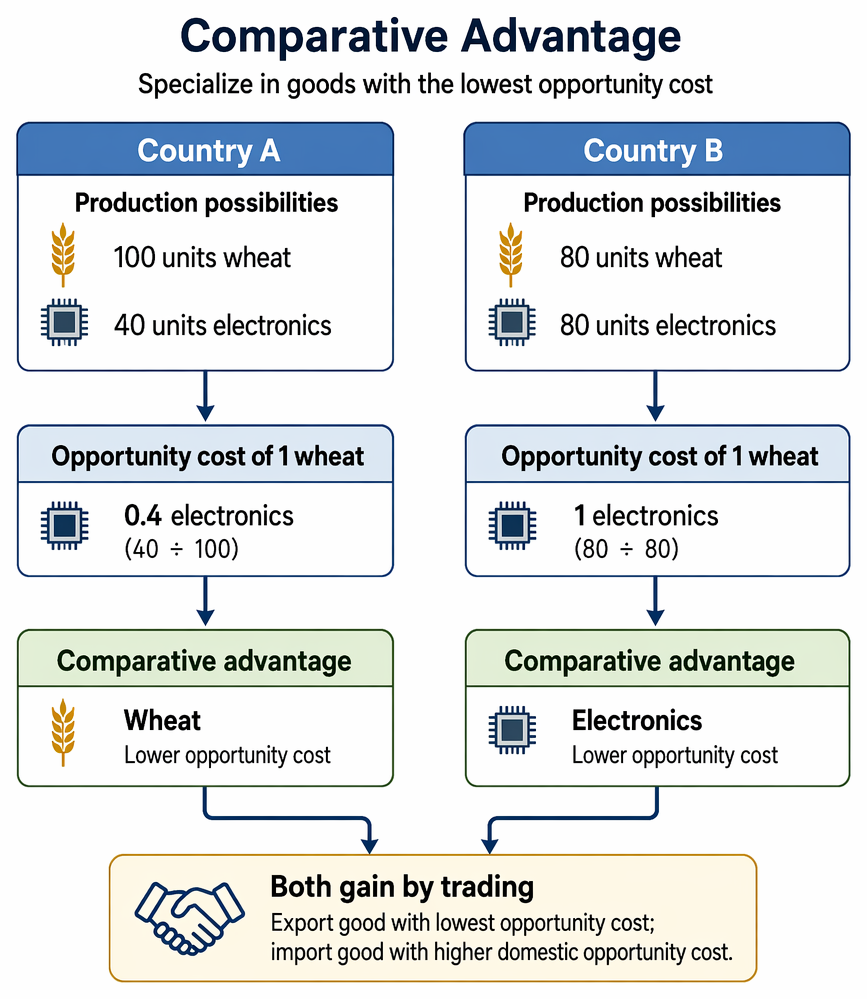
Countries can benefit from trade even if one nation is less efficient in producing all goods. The source of trade gains is comparative, not absolute, advantage. A nation should specialize in and export goods for which it has the lowest opportunity cost, while importing goods with a higher domestic opportunity cost.
Tariffs, quotas, subsidies, and regulatory restrictions are categorized by their effects on domestic prices, government revenue, quota rents, and welfare.
Worked Example 1.1
A small country can produce either 100 units of wheat or 40 units of electronics with its resources, while a trading partner can produce 80 units of wheat or 80 units of electronics. Who has the comparative advantage in each good?
Answer:
The first country's opportunity cost of 1 wheat = 0.4 electronics; for the partner, 1 wheat = 1 electronics. The first country has comparative advantage in wheat; the partner in electronics. Both gain by trading.
UNDERSTANDING TRADE BARRIERS
Trade barriers are policies designed to protect domestic industries from foreign competition or raise government revenue. They include tariffs (taxes on imports), quotas (quantity restrictions), subsidies (direct support for domestic producers), and regulatory restrictions.
Trade barriers reduce total welfare by raising prices, distorting resource allocation, and inviting retaliation. They may protect jobs in specific sectors but raise costs for consumers and reduce export competitiveness.
Worked Example 1.2
A government imposes a 10% tariff on imported steel. What is the likely effect on domestic steel users (such as car manufacturers)?
Answer:
Domestic steel prices rise, increasing costs for local car manufacturers, who may lose price competitiveness both at home and abroad. Consumer welfare falls.Exam Warning: Many candidates confuse the effects of tariffs and quotas. Both restrict imports and raise domestic prices, but tariffs generate government revenue, while quotas can transfer economic gains to foreign exporters.
TERMS OF TRADE AND THE DISTRIBUTION OF GAINS
Terms of trade (TOT) measure how much import goods a country can obtain per unit of exported goods. When TOT improves, the country can obtain more imports for each unit of exports, increasing real purchasing power. Changes in global markets, technology, or policies can affect the TOT.
TOT = (Export Price Index) / (Import Price Index) × 100
If export prices rise relative to import prices (TOT increases), a country gets more imports for its exports. However, improvements for one country may reflect worsened TOT for another.
Worked Example 1.3
Country A's export price index rises from 100 to 120, while its import price index remains at 100. What is the new terms of trade, and what does it mean?
Answer:
TOT = 120 / 100 × 100 = 120. Country A can import more for each exported unit. Real income rises, all else equal.
CAPITAL FLOWS AND ECONOMIC GROWTH
Free movement of capital allows savings to flow from countries with excess capital to countries with higher marginal returns, increasing investment, employment, and growth. Restrictions on capital flows may be used to protect domestic markets but can limit access to financing and technology.
Trade liberalization and capital mobility historically lead to productivity gains, wage growth, and overall welfare improvements, despite some sectoral dislocations.
Revision Tip: For CFA exam questions, always identify whether a country's trade or capital flows policy affects relative opportunity costs, consumer prices, or resource allocation. Focus on the direction of comparative advantage and the presence or absence of barriers.
Summary
International trade generates gains for countries by allowing specialization based on comparative advantage, not absolute advantage. Trade barriers reduce global welfare by raising prices and distorting markets, while terms of trade indicate the real purchasing power gained from exports. Free capital flows support investment and growth, but also expose economies to external shocks and competition.
Key Point Checklist
This article has covered the following key knowledge points:
- Define absolute advantage and comparative advantage in trade
- Explain why comparative advantage, not absolute advantage, drives trade benefits
- Identify main types and consequences of trade barriers
- Interpret terms of trade as a measure of trade gains or losses
- Assess how trade liberalization and capital flow mobility affect investment and growth
Key Terms and Concepts
- Absolute Advantage
- Comparative Advantage
- Trade Barriers
- Terms of Trade