Learning Outcomes
This article explains value at risk (VaR), expected shortfall (ES), and stress/scenario testing for CFA Level 2 portfolio risk management, including:
- distinguishing definitions, intuition, and exam-standard terminology for VaR, ES, and conditional VaR
- interpreting parametric, historical simulation, and Monte Carlo VaR numbers in both percentage and currency terms
- outlining step-by-step VaR and ES estimation under simple distributional assumptions
- analyzing how ES complements VaR by capturing the severity of tail losses beyond the VaR cutoff
- evaluating strengths and weaknesses of VaR and ES as downside risk measures, including issues of back-testing, model risk, and coherence
- applying stress tests, historical scenarios, and hypothetical scenarios to identify portfolio vulnerabilities not revealed by baseline VaR or ES
- using sensitivity analysis (e.g., duration, delta) alongside VaR, ES, and scenarios to monitor risk factor exposures
- relating these techniques to regulatory capital, risk limits, and performance evaluation so you can recognize how exam questions frame practical applications
- practicing interpretation-focused reasoning required on CFA Level 2 items, such as explaining what a quoted VaR or ES figure implies about loss probabilities and magnitudes
- extending VaR to incremental, marginal, and relative VaR for risk budgeting and capital allocation decisions
CFA Level 2 Syllabus
For the CFA Level 2 exam, you are required to understand risk evaluation techniques for investment portfolios, including recognizing, calculating, and interpreting value at risk and expected shortfall and applying stress and scenario analysis as part of market risk management, with a focus on the following syllabus points:
- explain the calculation, interpretation, and application of value at risk (VaR) for portfolio risk assessment
- describe approaches for estimating expected shortfall (ES) and its significance compared to VaR
- differentiate between parametric, historical simulation, and Monte Carlo simulation methods for VaR and ES estimation
- identify advantages and limitations of VaR and ES as risk measures
- explain the use of sensitivity analysis, scenario analysis, and stress testing in risk monitoring and regulatory capital allocation
- describe incremental, marginal, and relative VaR and their role in risk budgeting and performance evaluation
Test Your Knowledge
Attempt these questions before reading this article. If you find some difficult or cannot remember the answers, look more closely at that area during your revision.
An investment bank’s risk committee reviews the following summary risk report for its trading portfolio:
- 1‑day 5% VaR: $2 million
- 1‑day 5% expected shortfall (ES): $3.5 million
- Historical scenario: “Global crisis 2008”
- Hypothetical stress scenario: “Equities −30%, government yields +200 bps, credit spreads +300 bps”
-
The chief risk officer states: “Our 1‑day 5% VaR of $2 million means that over a one‑day horizon we are 95% confident that the portfolio will not lose more than $2 million.” How should this statement be interpreted?
- a) It is correct: there is a 95% confidence that the portfolio will not lose more than $2 million in a day.
- b) It is incorrect because VaR gives the most probable loss, which is $2 million.
- c) It is incorrect because VaR gives the minimum daily loss, which is $2 million.
- d) It is incorrect because VaR gives the 5% chance that any gain will exceed $2 million.
-
The report states that the 1‑day 5% ES is $3.5 million. Which description best matches this measure?
- a) It is always less than the corresponding VaR.
- b) It is the average of losses exceeding the VaR threshold.
- c) It is the standard deviation of returns in the left tail.
- d) It is the probability of a loss greater than VaR.
-
The committee wants to complement VaR and ES with stress and scenario analysis. Which statement best describes stress testing relative to scenario analysis?
- a) Stress tests assess only typical market changes.
- b) Scenario analysis uses hypothetical changes exclusively.
- c) Stress tests examine the portfolio impact of extreme or adverse changes in risk factors.
- d) Scenario analysis cannot be based on historical events.
-
The equity desk head argues that VaR alone is sufficient for market risk management. Which combination best describes one advantage and one limitation of VaR?
- a) Advantage: simple single-number summary; limitation: does not describe losses beyond the VaR cutoff.
- b) Advantage: captures all forms of risk exactly; limitation: difficult to compute.
- c) Advantage: always subadditive across portfolios; limitation: not used by regulators.
- d) Advantage: forward-looking with no model assumptions; limitation: cannot be expressed in currency terms.
Introduction
In investment risk management, accurately quantifying the potential for large portfolio losses is essential. Value at risk (VaR) and expected shortfall (ES) are industry standards for measuring downside risk. Along with stress and scenario testing, these tools help risk managers and regulators assess market risk, allocate capital, set risk limits, and evaluate performance on a risk‑adjusted basis.
At Level 2, you are expected not just to know definitions, but to interpret what a reported VaR or ES number actually implies about loss probabilities and magnitudes, and to recognize where these measures can give a misleading sense of security if used in isolation.
Key Term: value at risk (VaR)
The minimum loss expected over a given time period at a specified probability (or confidence) level, expressed as a currency amount or portfolio percentage. It is a quantile of the loss distribution: a threshold such that losses will exceed this amount only with a specified small probability.
VaR, ES, and scenario-based measures answer related but distinct questions:
- VaR: “How bad can losses get, with a given probability, over a given horizon?”
- ES: “If we are in that worst-probability tail, what is our average loss?”
- Stress/scenario tests: “What happens to the portfolio under specific extreme market environments, regardless of probability?”
These concepts appear in multiple readings: VaR and ES in market risk measurement; stress/scenario analysis and sensitivity analysis in broader risk management and simulation.
VALUE AT RISK (VAR)
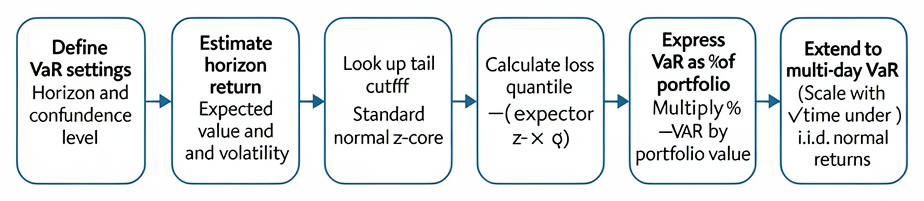
Parametric VaR is calculated from selected horizon and confidence, portfolio mean and volatility, and square-root-of-time scaling under independent normal returns.
Definition and Interpretation
VaR answers the question: “What is my worst expected loss at a given probability level, over a specified period, under normal market conditions?”
For example, a 1‑day 5% VaR of $2 million for a trading portfolio means:
- There is a 5% chance (i.e., roughly 1 day in 20) that the portfolio will lose more than $2 million over one day.
- Equivalently, there is a 95% confidence that the loss will be no greater than $2 million over that day.
Note the three essential elements of any VaR statement:
- a time horizon (e.g., 1 day, 10 days, 1 month)
- a probability level or confidence level (e.g., 1%, 5%, or 99%)
- a loss amount (in currency or percentage terms)
VaR can be phrased either as:
- “The 5% 1‑month VaR is 3% of portfolio value”; or
- “There is a 5% probability that the portfolio will lose at least 3% over one month.”
Both refer to the same quantile of the loss distribution.
Estimation Methods
There are three principal approaches to estimating VaR:
- Parametric (variance–covariance) method
- Historical simulation
- Monte Carlo simulation
Each uses a different way of modeling the distribution of possible future portfolio returns.
Key Term: parametric VaR
An approach to estimating VaR by assuming a specific parametric distribution for returns (commonly normal), and using estimated means, variances, and covariances of risk factors to compute the loss quantile. Key Term: historical simulation VaR
VaR calculated from the empirical distribution of actual historical portfolio returns over a lookback window, without imposing a parametric distribution. Key Term: Monte Carlo simulation VaR
VaR determined by simulating a large number of future return scenarios using assumed stochastic models for underlying risk factors, then computing the empirical loss quantile.
1. Parametric (variance–covariance) VaR
Under the simplest parametric approach, you:
- estimate the expected portfolio return and standard deviation for the chosen horizon
- assume returns are normally distributed and (often) that the expected return over short horizons is negligible
- choose a tail probability (e.g., 5% or 1%) and look up the corresponding ‑score from the standard normal distribution
- compute VaR in percentage terms as: where is the tail probability (e.g., 0.05) and is the corresponding quantile (e.g., 1.65 for 5%)
Then multiply by current portfolio value to convert to a currency amount.
For multi‑day VaR, if you assume daily returns are independent and identically distributed (i.i.d.) and normally distributed, you can scale standard deviation by the square root of time. For example, a 10‑day VaR is often approximated as:
On the exam, be aware that this time scaling is a model assumption, not a general law. It can fail badly when volatility clusters or correlations change.
The reading emphasizes that parameter estimates (means, standard deviations, correlations) are based on a lookback period. The choice of lookback window is judgmental and can materially affect VaR.
Worked Example 1.1
A portfolio manager estimates the daily mean return as zero and standard deviation as 1%. What is the 1‑day 5% VaR for a $100 million portfolio using the parametric method?
Answer:
For a normal distribution, the 5% left‑tail cutoff is 1.65 standard deviations below the mean. VaR (in percentage terms)
VaR in currency terms = $100 million × 1.65% = $1.65 million Interpretation: there is a 5% chance that the portfolio will lose more than $1.65 million in one day.
Strengths and weaknesses of the parametric method
-
Advantages:
- computationally simple when portfolios are approximately linear in risk factors
- easy to update as parameter estimates change
- transparent link between input parameters (volatility, correlation) and VaR
-
Limitations:
- normality assumption often violated (fat tails, skewness)
- poor for portfolios with strong non‑linear instruments (e.g., options), unless you linearize exposures (e.g., via delta‑normal VaR)
- sensitive to covariance estimates, which can change quickly in stress periods
2. Historical simulation VaR
Historical simulation proceeds as follows:
- choose a lookback window (e.g., last 1,000 trading days)
- for each day in the window, compute the actual portfolio return that would have occurred given that day’s market moves and the current portfolio composition
- assemble this set of historical returns into an empirical distribution
- sort the returns from worst to best; read off the chosen quantile:
- for 5% VaR with 1,000 observations, the 50th worst return is the VaR
This method automatically captures any non‑normality and non‑linearities present in the historical data and portfolio structure, because you are revaluing the actual portfolio under past risk‑factor moves.
Advantages:
- no explicit distributional assumption
- naturally incorporates fat tails and skewness if they existed in the lookback period
- well suited to portfolios with options, credit derivatives, and other non‑linear instruments
Limitations:
- implicitly assumes “the past is representative of the future”; fails if market regimes change
- cannot generate losses more extreme than those observed in the sample (unless you supplement with hypothetical scenarios)
- choice of lookback period is subjective; too short and estimates are noisy, too long and they may mix different regimes
3. Monte Carlo simulation VaR
Monte Carlo VaR uses simulated future risk‑factor paths:
- specify stochastic models for the relevant risk factors (e.g., equity index levels, interest rates, FX rates, credit spreads), including distributions, volatilities, and correlations
- simulate a large number (e.g., 10,000+) of joint risk‑factor moves over the chosen horizon
- fully revalue the portfolio under each simulated set of risk factors
- construct the empirical distribution of simulated portfolio returns and read off the required quantile as VaR
Advantages:
- highly flexible: can incorporate path‑dependent instruments, complex payoffs, and non‑normal risk factors
- can incorporate time‑varying volatility (e.g., GARCH), jumps, and correlation structures
Limitations:
- model‑intensive: results depend heavily on the correctness of assumed dynamics and parameter estimates
- computationally demanding for large, complex portfolios
- can be opaque to senior management, which may make communication and governance more difficult
On the exam, you are not expected to program a Monte Carlo simulation. You should, however, be able to compare these three methods conceptually, and identify when each is more or less appropriate.
Interpreting VaR
VaR is a quantile-based risk measure: it identifies a loss threshold so that the probability of experiencing a greater loss is the chosen tail probability.
For example, if a portfolio has a 1‑month 1% VaR of 8%, you can interpret this as:
- 1% of the time (roughly 1 month in 100), the portfolio loss will exceed 8%
- 99% of the time, the loss will be no more than 8% (but it may still be substantial, e.g., 5–7%)
Subtle but important points for the exam:
- VaR says nothing about how large losses can be beyond the VaR threshold. A 5% VaR of $2 million does not tell you whether the worst 5% losses average $2.1 million or $20 million.
- VaR is not the “maximum loss.” It is a minimum loss conditional on being in a low‑probability tail.
Exam Warning (VaR)
VaR provides no information about the potential size of losses beyond the VaR cutoff. Large losses in the left tail are not captured. Questions often test your ability to recognize this limitation.
EXPECTED SHORTFALL (ES)
Definition
Expected shortfall (ES), also known as conditional VaR (CVaR), measures the average loss assuming that the loss exceeds the VaR threshold over a specified period. ES thus quantifies the expected severity of losses in the worst of scenarios.
Key Term: expected shortfall (ES)
The average portfolio loss, over a given horizon, conditional on losses being equal to or worse than the VaR at a specified tail probability. Key Term: conditional VaR (CVaR)
Another name for expected shortfall; the mean loss conditional on being in the loss tail beyond the VaR level.
If the 1‑day 5% VaR is $3 million and the average loss among the worst 5% of days is $5 million, then:
- VaR (5%) = $3 million
- ES (5%) = $5 million
ES directly answers: “If we are unlucky enough to be in the worst 5% of days, what loss should we expect on average?”
Importance
ES addresses a key limitation of VaR by providing a measure of tail loss severity, not just tail loss frequency. Regulators and practitioners increasingly favor ES because:
- ES is a coherent risk measure: it satisfies desirable properties (including subadditivity), meaning the ES of a diversified portfolio is no greater than the sum of ESs of sub‑portfolios. VaR can violate this property and understate diversification benefits.
- ES is more informative for setting economic capital and assessing solvency, because extreme tail losses, not just quantile thresholds, threaten survival.
In the current Basel framework for market risk, regulators have moved from 99% VaR to 97.5% ES for capital calculation, reflecting this preference.
Estimating ES
Under historical simulation or Monte Carlo approaches, ES is straightforward to estimate:
- compute the VaR quantile (e.g., the 5% worst loss)
- take the average loss of all observations worse than or equal to that VaR threshold
Under parametric assumptions, ES can sometimes be computed analytically (e.g., for normal distributions), but the formulas are more involved. Exam questions usually keep ES estimation at a conceptual or simple historical level.
Worked Example 1.2
A portfolio’s 1‑day 5% VaR is $3 million. Historical data show that, on the 5% worst days, the average portfolio loss is $5 million. What is the 1‑day 5% ES?
Answer:
The 5% expected shortfall (ES) is $5 million. Interpretation: on the worst 5% of days, losses average $5 million, even though the 5% VaR threshold is $3 million.
VaR vs ES in practice
- VaR is simpler to explain and compute and remains common for risk limits and reporting.
- ES is more informative about tail risk and preferred when assessing solvency, capital adequacy, and “going‑concern vs default” scenarios.
However, ES estimation can be less stable than VaR when data on extreme tail losses are scarce, because it averages over relatively few observations.
Comparing VaR and Expected Shortfall
- VaR tells you how bad losses can get at a given probability level (a loss threshold).
- Expected shortfall tells you the average loss when that threshold is breached (loss severity in the tail).
ES is always greater than or equal to VaR at the same confidence level for continuous loss distributions, because it averages over losses that are at least as bad as VaR.
Exam Warning: On the CFA exam, do not state that VaR and ES are “the same.” VaR is a quantile (threshold); ES is an average beyond that threshold. Confusing the two is a common distractor.
Extensions of VaR for Risk Budgeting
Beyond basic portfolio VaR, the curriculum introduces extensions used for risk budgeting and capital allocation.
Key Term: incremental VaR (IVaR)
The change in portfolio VaR resulting from adding or removing a specific position or changing its size by a finite amount.
If increasing the weight of a position by 2% raises portfolio VaR from $1.35 million to $1.56 million, the IVaR of that 2% change is $0.21 million.
Key Term: marginal VaR (MVaR)
The approximate change in total VaR associated with a very small increase in the size of a position; effectively, the slope of the VaR–position size relationship at the current weight.
MVaR can be interpreted as a position’s contribution to overall portfolio VaR per unit of capital invested, and is widely used in risk budgeting.
Key Term: relative VaR
Also called tracking‑error VaR or ex‑ante tracking error. The VaR of the difference between a portfolio’s return and its benchmark’s return over a given horizon.
For example, a 1‑month 5% relative VaR of 2.5% means that, 5% of the time, the portfolio is expected to underperform the benchmark by at least 2.5% over a month.
Worked Example 1.3
A portfolio currently has a 1‑month 5% VaR of $10 million. If the manager proposes adding a new position that increases VaR to $11.2 million, what is the incremental VaR of this position? How might a risk manager use this information?
Answer:
Incremental VaR = $11.2 million − $10 million = $1.2 million. The risk manager can compare this incremental VaR to the expected incremental return or P&L from the new position. If the additional expected return does not adequately compensate for the additional VaR, the manager may scale down or reject the position. IVaR also helps ensure that individual desks or strategies stay within their allocated risk budgets.
In practice, IVaR and MVaR help tie capital allocation and performance evaluation together: desks that consume more VaR (or ES) must generate commensurate risk‑adjusted returns.
Limitations and Uses of VAR and ES
Advantages
- Single-number summary: Both VaR and ES condense complex risk exposures into a single, intuitive number in currency or percentage terms.
- Comparability: VaR facilitates comparison of risk across positions, business units, and asset classes; ES extends this to tail severity.
- Regulatory acceptance: VaR (and increasingly ES) is embedded in regulatory capital frameworks for banks and is widely used by asset managers and insurers.
- Integration with limits and budgeting: VaR/ES‑based limits (e.g., “desk VaR must not exceed $X”) and risk budgets are standard tools in institutional risk management.
Limitations and pitfalls
- Tail blindness of VaR: VaR ignores the shape and severity of losses beyond the cutoff. ES mitigates this but still relies on model assumptions.
- Model risk: Estimates depend heavily on assumptions about distributions, volatilities, correlations, and dynamics. Mis‑specification can lead to severe underestimation of risk.
- Historical dependence: Historical simulation VaR/ES are, by construction, backward-looking. They may fail to anticipate new types of stress events.
- Parameter instability: Volatility and correlations often spike in crises. VaR calibrated on benign periods may understate risk just before a downturn; VaR calibrated on crisis periods may overstate risk afterwards.
- Subjectivity: Choice of horizon (1 day vs 10 days vs 1 month) and tail probability (1% vs 5%) is judgmental and can materially change the numbers.
- Non‑subadditivity of VaR: VaR can violate subadditivity: the VaR of a combined portfolio can exceed the sum of stand‑alone VaRs, complicating diversification assessment. ES, by contrast, is subadditive and coherent.
- Back‑testing challenges: For very low tail probabilities (e.g., 1% daily VaR), violations are rare, so statistical tests of accuracy have low power. It can take years of data to meaningfully assess model performance.
In exam questions, you may be asked to judge whether a manager is over‑relying on VaR/ES, or whether additional tools like stress testing and sensitivity measures are warranted. The correct answer almost always emphasizes complementarity: VaR/ES are useful, but incomplete, risk measures.
Stress and Scenario Testing
Definitions and Purpose
Stress and scenario analysis assess the potential losses from extreme or adverse market moves and multi‑factor shocks.
Key Term: stress testing
Analysis focusing on the impact on portfolio value (or firm solvency) from severe, but often plausible, changes in one or more risk factors, typically emphasizing extreme downside conditions. Key Term: scenario analysis
Analysis method that examines portfolio outcomes under specified joint changes in risk factors, which may be hypothetical or based on historical episodes.
Scenario analysis can be used for both “bad” and “good” environments, but in risk management it typically focuses on adverse outcomes.
Types of Scenario Analysis
Key Term: historical scenario
A scenario analysis that uses actual past market movements over a defined period (e.g., the 2008 crisis or the 1987 crash) as the joint risk‑factor changes applied to the current portfolio. Key Term: hypothetical scenario
A scenario constructed by risk managers, representing a plausible set of simultaneous risk‑factor changes (e.g., equity −30%, rates +200 bps), regardless of whether such a combination has occurred before.
-
Historical scenarios:
- Example: Replaying the joint changes in global equity indices, interest rates, credit spreads, and FX rates from September–October 2008 to today’s portfolio.
- Advantage: anchored in reality; uses an actual stress episode.
- Limitation: assumes that future crises will resemble past ones.
-
Hypothetical scenarios:
- Example: Designing a “stagflation shock” with surging inflation, rising yields, and falling equities, even if no exact historical analog exists.
- Advantage: can explore risks not yet observed in data.
- Limitation: requires judgment; may be mis-specified.
Key Term: reverse stress test
A type of stress test that starts from an adverse outcome (e.g., insolvency or a specified capital shortfall) and works backward to find combinations of risk‑factor changes that would produce that outcome.
Reverse stress testing helps identify “failure” scenarios that traditional VaR or forward‑looking scenarios might miss.
Worked Example 1.4
A risk manager models the portfolio loss in a scenario where equity markets fall by 30% and interest rates rise by 200 basis points, based on a macroeconomic shock that has not previously occurred in exactly this form. What is this testing method called?
Answer:
This is a hypothetical scenario analysis. It examines portfolio sensitivity to plausible but not necessarily historical market moves. If the moves are extreme, it may also be described as a stress test.
Stress Testing vs VaR/ES
Stress/scenario analysis and VaR/ES are used together:
- VaR/ES focus on the distribution of losses under “normal” or modeled conditions, delivering probabilities and average tail losses.
- Stress/scenario analysis focuses on specific states of the world, often extreme, without attaching precise probabilities.
Advantages of stress and scenario testing:
- reveal vulnerabilities to particular combinations of risk‑factor changes (e.g., equity–rates correlation breakdown) that VaR, which averages over many states, may understate
- allow incorporation of expert judgment and forward‑looking hypotheses
- directly support governance discussions: management can see P&L impacts of named scenarios, not just abstract quantiles
Limitations:
- scenarios may be incomplete or miss key risks
- no explicit probability is attached: you know the impact if the scenario occurs, but not how likely it is
- results can be sensitive to modeling assumptions for complex instruments
Sensitivity Analysis
Sensitivity analysis estimates how changes in individual risk factors affect portfolio value.
Key Term: sensitivity analysis
A technique that quantifies the change in portfolio value resulting from a small change in a single risk factor, holding others constant.
Sensitivity analysis answers questions such as:
- “If interest rates rise by 50 bps, how much will our bond portfolio fall in value?”
- “If the equity index drops by 5%, what loss should we expect on the equity book?”
- “If implied volatility rises by 10 percentage points, how will our option positions move?”
Sensitivity measures depend on asset class.
Equity exposure: beta
Key Term: beta
A measure of an asset’s sensitivity to movements in the overall equity market; the slope of the regression of the asset’s returns on market returns.
A portfolio with beta 1.2 is expected to lose roughly 1.2% when the market falls 1%, all else equal. Beta can be used to build equity‑factor stress tests (“What if the market drops 5%?”).
Fixed-income exposure: duration and convexity
Key Term: duration
A measure of a bond’s (or bond portfolio’s) sensitivity to small parallel shifts in the yield curve; approximately the percentage price change for a 1% (100 bp) change in yield. Key Term: convexity
A measure of the curvature of the price–yield relationship for bonds, capturing how duration itself changes as yields move; used to improve the accuracy of price change estimates for larger yield moves.
For a fixed‑income portfolio, an approximate percentage price change for a yield change is:
Duration captures the first‑order effect, convexity the second‑order effect.
Options exposure: delta, gamma, and vega
Key Term: delta
The sensitivity of an option’s price to small changes in the price of the underlying asset; the change in option value per unit change in the underlying price. Key Term: gamma
The sensitivity of delta to changes in the underlying asset price; a second‑order measure capturing the curvature of the option value with respect to the underlying price. Key Term: vega
The sensitivity of an option’s price to changes in the expected volatility of the underlying asset’s returns.
For an option position, an approximate change in option value can be written as:
where:
- = change in underlying price
- = change in implied volatility
These greeks enable option portfolios to be managed in a “delta‑neutral,” “gamma‑controlled,” or “vega‑controlled” way, supplementing VaR/ES.
Worked Example 1.5
A bond portfolio has a modified duration of 6 and convexity of 80. If yields rise by 50 bps (0.5%), estimate the percentage price change.
Answer:
Use the duration–convexity approximation:
First term: −0.03 (−3%) Second term:
Net change: −3.0% + 0.1% = −2.9% This shows how convexity slightly offsets the loss predicted by duration alone for an upward yield move.
Sensitivity analysis does not provide probabilities. It complements VaR/ES by clarifying which risk factors drive risk and by how much.
Practical Applications: Limits, Capital, and Performance
VaR, ES, sensitivity measures, and stress/scenario analysis are used together to manage and evaluate risk across different institutions.
Risk budgeting and limits
Key Term: risk budgeting
The process of allocating a total acceptable risk level (often measured by VaR, ES, or volatility) across portfolios, desks, or strategies to maximize expected return for the given risk. Key Term: position limit
A constraint that caps the size of exposure to a particular security, issuer, sector, or asset class, typically expressed as a maximum currency amount or percentage of portfolio value. Key Term: stop-loss limit
A rule requiring that a position be reduced, hedged, or closed if cumulative losses over a specified period exceed a pre‑set threshold. Key Term: scenario limit
A constraint that caps the acceptable loss under a specified scenario; the portfolio must be adjusted so that the modeled loss under that scenario does not exceed a certain amount.
Examples:
- A bank might set a total trading VaR limit (e.g., 1‑day 99% VaR must not exceed $50 million) and allocate VaR sub‑limits to trading desks using MVaR/IVaR.
- A pension fund might impose a scenario limit: “Under a 2008‑style equity crisis, the funding ratio must not fall below 90%.”
- An asset manager might use stop‑loss limits on active positions: if a position loses more than 3% in a month, it must be reviewed or cut.
These limits directly tie into performance evaluation: a manager who consistently uses up a large share of the risk budget (high VaR or ES contribution) but delivers poor risk‑adjusted returns would be viewed negatively.
Institution-specific risk measures
The curriculum also highlights that different institutions emphasize different risk measures:
- Banks: focus on trading VaR/ES, stress tests, and economic capital, as well as asset–liability mismatches and leverage.
- Asset managers: emphasize relative risk (tracking error, relative VaR) versus benchmarks and information ratios.
- Pension funds and insurers: focus on asset–liability risk (surplus at risk), scenario analysis that includes liability shocks (e.g., longevity, catastrophe events), and solvency under regulatory frameworks.
VaR, ES, and stress tests are common threads, but how they are interpreted and used in performance evaluation differs.
Worked Example 1.6
A pension fund’s risk report shows:
- Total 1‑year 5% surplus VaR (assets minus liabilities) = 12% of current surplus
- Stress test: “Equities −30%, yields −100 bps, credit spreads +200 bps” implies a 25% surplus loss
What do these numbers suggest about the fund’s risk profile?
Answer:
The VaR indicates that, under modeled “normal” conditions, there is a 5% chance that the surplus will fall by more than 12% over a year. However, the stress scenario reveals that under a severe but plausible joint shock (equity bear market plus falling yields and wider credit spreads), the surplus could fall by 25%. Management should recognize that solvency risk is driven primarily by equity and credit exposures under adverse macro scenarios, not just by typical fluctuations captured by VaR. Strategic hedging or de‑risking may be warranted if this degree of surplus loss is unacceptable.Revision Tip: For CFA Level 2, focus on interpreting what VaR and expected shortfall numbers mean, recognizing their limitations, and explaining why stress/scenario and sensitivity analysis are necessary complements. Detailed programming of Monte Carlo simulations is outside the scope; conceptual comparisons and simple calculations are not.
Summary
VaR and expected shortfall provide standardized measures of portfolio downside risk for specified probabilities and periods:
- VaR describes a loss threshold: the minimum loss you expect to exceed with a given small probability.
- Expected shortfall summarizes the average loss when that threshold is breached, capturing tail loss severity.
Extensions such as incremental, marginal, and relative VaR support risk budgeting and capital allocation. However, VaR (and to a lesser extent ES) have important limitations, particularly around tail risk, model dependence, and parameter instability.
Stress testing and scenario analysis complement these measures by modeling portfolio performance under specific extreme environments, including both historical crises and hypothetical shocks. Sensitivity analysis using beta, duration/convexity, and option greeks adds another dimension, helping risk managers understand which risk factors drive losses and how small changes in those factors propagate through portfolios.
For Level 2 candidates, the key is to:
- interpret reported VaR and ES numbers correctly
- recognize when they might be misleading or incomplete
- articulate how stress tests, scenarios, and sensitivities are used alongside VaR/ES in risk limits, capital allocation, and performance evaluation
Key Point Checklist
This article has covered the following key knowledge points:
- value at risk (VaR) estimates the minimum loss for a specified probability and time frame
- VaR requires a horizon, a tail probability (or confidence level), and a loss amount
- three main VaR estimation methods: parametric, historical simulation, and Monte Carlo simulation
- expected shortfall (ES)/conditional VaR measures the average loss given losses worse than VaR
- ES addresses VaR’s inability to account for tail loss severity and is a coherent risk measure
- incremental VaR (IVaR), marginal VaR (MVaR), and relative VaR extend VaR for risk budgeting and tracking error analysis
- VaR and ES have important limitations, including model risk, parameter instability, and limited information about extreme tails
- stress testing examines portfolios under extreme or adverse market shocks, using historical, hypothetical, and reverse stress tests
- scenario analysis evaluates specific multi‑factor changes and can be historical or hypothetical
- sensitivity analysis measures portfolio value change for small movements in a single risk factor (e.g., beta, duration, delta)
- equity, fixed‑income, and options exposures are commonly summarized by beta, duration/convexity, and greeks (delta, gamma, vega)
- risk budgeting, position limits, stop‑loss limits, and scenario limits translate risk measures into practical constraints
- different institutions (banks, asset managers, pension funds, insurers) emphasize different combinations of VaR/ES, sensitivity, and scenario measures in risk management and performance evaluation
Key Terms and Concepts
- value at risk (VaR)
- parametric VaR
- historical simulation VaR
- Monte Carlo simulation VaR
- expected shortfall (ES)
- conditional VaR (CVaR)
- incremental VaR (IVaR)
- marginal VaR (MVaR)
- relative VaR
- stress testing
- scenario analysis
- historical scenario
- hypothetical scenario
- reverse stress test
- sensitivity analysis
- beta
- duration
- convexity
- delta
- gamma
- vega
- risk budgeting
- position limit
- stop-loss limit
- scenario limit