Learning Outcomes
This article explains the main types and mandates of sovereign wealth funds (SWFs) and related institutional investors, including:
- Differentiating the five primary SWF types—budget stabilization, savings, reserve, pension reserve, and development funds—based on purpose, funding source, and liability structure.
- Describing typical investment objectives, risk tolerance, and time horizons for each SWF type, and linking these features to appropriate benchmark choices.
- Relating fund mandates to liquidity requirements and to the ability to hold illiquid or higher-risk assets such as private equity, infrastructure, and real estate.
- Comparing typical asset allocation patterns across SWFs, endowments, and private foundations, and interpreting the rationale for their differing exposures to growth and defensive assets.
- Identifying key legal, regulatory, tax, and reporting constraints that affect portfolio construction and implementation for SWFs and similar institutions.
- Assessing how governance structures, spending rules, and political considerations can support or conflict with stated investment objectives.
- Applying these distinctions to CFA Level 3–style case vignettes that test investment policy statements, risk assessment, and recommended portfolio adjustments for institutional investors.
CFA Level 3 Syllabus
For the CFA Level 3 exam, you are required to understand the characteristics, mandates, and investment implications of different types of sovereign wealth funds, as well as how such mandates shape investment policy, asset allocation decisions, and regulatory constraints, with a focus on the following syllabus points:
- Describing the main types of sovereign wealth funds and their primary investment objectives
- Explaining how the type and mandate of a SWF influence its risk profile, investment horizon, and liquidity needs
- Evaluating how legal, regulatory, and tax constraints affect SWFs, endowments, and private foundations
- Comparing typical asset allocations across SWF types and understanding the rationale for those differences
Test Your Knowledge
Attempt these questions before reading this article. If you find some difficult or cannot remember the answers, look more closely at that area during your revision.
-
A resource‑rich country experiencing large swings in fiscal revenues from oil exports wants to insulate its annual budget from commodity price collapses. Which type of sovereign wealth fund best matches this primary objective?
- a) Savings fund
- b) Budget stabilization fund
- c) Pension reserve fund
- d) Development fund
-
Compared with a reserve fund SWF, a pure savings fund SWF is most likely to have which combination of investment horizon and liquidity needs?
- a) Shorter horizon and higher near‑term liquidity needs
- b) Shorter horizon and lower near‑term liquidity needs
- c) Longer horizon and lower near‑term liquidity needs
- d) Longer horizon and higher near‑term liquidity needs
-
A Level 3 item set describes an SWF considering a large allocation to private equity and infrastructure. Which of the following is least likely to be an external (legal, tax, regulatory) constraint that the portfolio manager must consider?
- a) Host‑country restrictions on foreign state‑owned investors acquiring strategic assets
- b) Domestic legislation requiring a minimum proportion of assets in government bonds
- c) Internal policy guidelines on maximum allocation to illiquid assets
- d) Tax treaties affecting withholding tax on income from foreign investments
Introduction
Sovereign wealth funds (SWFs) sit alongside endowments, private foundations, and pension plans as some of the largest and most influential institutional investors. Their mandates are shaped by national objectives rather than by the goals of a single sponsoring institution or group of beneficiaries. For CFA Level 3, you are expected to classify SWFs correctly, infer their investment objectives and constraints from a brief case description, and recommend appropriate asset allocations and portfolio adjustments consistent with their mandates.
Key Term: sovereign wealth fund (SWF)
A state‑owned investment fund that invests in financial and/or real assets, often for long‑term national goals such as stabilization, savings, or economic development.
Unlike many other institutional investors, SWFs may have:
- Very long or even indefinite time horizons
- No clearly defined contractual liabilities (for example, when the purpose is intergenerational wealth transfer)
- Direct connections to fiscal policy, exchange‑rate policy, or national development strategy
- Political oversight that can strengthen or undermine the formal investment mandate
These features create a wide range of risk tolerances and allowable asset allocations across different SWF types. Many exam vignettes will implicitly test whether you recognize:
- When an SWF can rationally hold illiquid, higher‑risk assets (private equity, infrastructure, real estate, hedge funds)
- When it should emphasize liquid, capital‑preserving assets (short‑term government bonds, reserves)
- When a liability‑relative or surplus‑oriented framework is appropriate (for example, pension reserve funds)
Key Term: intergenerational equity
The principle that a country should convert finite or windfall revenues (such as from natural resources) into diversified financial assets so that both current and future citizens benefit fairly over time.
Understanding these distinctions allows you to translate qualitative descriptions—such as “pre‑funding future pensions” or “smoothing volatile oil revenues”—into specific implications for investment horizon, risk capacity, and strategic asset allocation.
Test Tip: When revising Sovereign wealth fund types and mandates, connect each definition, method, or rule to the kind of question the assessment is likely to ask.
TYPES OF SOVEREIGN WEALTH FUNDS
Sovereign wealth funds vary widely in purpose and investment mandate. The International Monetary Fund identifies five primary types:
Key Term: budget stabilization fund
An SWF set up to stabilize fiscal budgets, especially in commodity‑dependent economies, by mitigating the impact of revenue volatility. Key Term: savings fund
An SWF designed to convert finite resource revenues into diversified financial assets, with the objective of intergenerational wealth transfer. Key Term: reserve fund
An SWF created to manage excess foreign currency reserves more efficiently by investing for higher expected return than traditional short‑term government securities. Key Term: pension reserve fund
An SWF established to pre‑fund public sector pension liabilities and meet demographic‑driven spending needs. Key Term: development fund
An SWF dedicated to supporting economic or strategic development through investment in national infrastructure, innovation, or priority sectors.
Budget Stabilization Funds
These are established to smooth national budgets against external shocks—typically commodity price fluctuations. They hold highly liquid assets and focus on capital preservation, since withdrawals may be needed at short notice to offset fiscal shortfalls.
Typical characteristics:
- Purpose: Short‑ to medium‑term fiscal stabilization when commodity or other cyclical revenues fall.
- Funding source: Volatile revenues (often oil, gas, or other commodities) when prices are above a reference level, or general budget surpluses in good times.
- Liability structure: Implicit, contingent liabilities—future budget deficits that arise when revenues fall below expected levels.
- Risk tolerance: Low. The political and economic cost of losses is high because funding may be required exactly when markets are stressed.
- Investment horizon: Effectively short to medium term, because withdrawals can be large and sudden, linked to the business and commodity price cycles.
- Liquidity needs: High. The fund must be able to convert assets to cash quickly without significant loss.
From a portfolio standpoint, stabilization funds resemble a combination of a government cash reserve and a short‑duration fixed‑income portfolio. They typically benchmark to high‑quality sovereign bond indexes, money‑market indexes, or inflation plus a small spread.
Key Term: capital preservation objective
An investment goal that prioritizes avoiding nominal losses over maximizing returns, often leading to a focus on high‑quality, short‑duration fixed‑income and cash‑like assets.
Savings Funds
Savings funds convert natural resource or surplus revenues into diversified investments, aiming to preserve and grow national wealth for future generations. Their investment horizons are very long, emphasizing growth and risk assets.
Typical characteristics:
- Purpose: Intergenerational savings—transforming a finite natural resource endowment into a diversified financial portfolio.
- Funding source: Resource revenues (for example, oil, gas, minerals) or large structural fiscal surpluses.
- Liability structure: No explicit contractual liabilities; implicit objective is to maintain or grow real wealth per capita over multiple generations.
- Risk tolerance: High, because there are no near‑term spending commitments and the horizon is very long.
- Investment horizon: Multi‑decade or effectively perpetual.
- Liquidity needs: Low in the near term; withdrawals are typically governed by formal fiscal rules or long‑term spending policies.
Savings funds often resemble large university endowments in their asset mix: high allocations to global equities, private equity, real estate, infrastructure, and other alternatives, with only a modest allocation to high‑quality bonds for diversification and opportunistic rebalancing.
Reserve Funds
Reserve funds are established from excess central bank reserves. They target higher returns on sovereign assets than would be achieved through traditional reserves, typically investing in a mix of global equities and bonds.
Typical characteristics:
- Purpose: Earn a higher return on foreign exchange reserves that are not needed for day‑to‑day currency management or balance‑of‑payments support.
- Funding source: Foreign currency reserves beyond what the central bank considers “precautionary.”
- Liability structure: Implicit and uncertain—related to potential currency interventions or external financing needs.
- Risk tolerance: Moderate. These funds can accept higher risk than official reserves but must preserve the ability to support currency policy in stress scenarios.
- Investment horizon: Medium to long term but with uncertainty around potential large withdrawals linked to macroeconomic shocks.
- Liquidity needs: Moderate. A portion must remain liquid and investment‑grade; another portion can be invested in higher‑return assets.
Reserve funds often employ a “tranche” approach: a liquid, low‑risk tranche aligned with official reserves and a return‑seeking tranche invested in global equities and longer‑duration bonds.
Key Term: negative carry
The situation where the cost of funding (for example, interest paid on foreign borrowing) exceeds the return earned on reserve assets, creating an incentive to seek higher‑yielding investments.
A key motivation for reserve funds is to reduce negative carry by taking some duration, credit, and equity risk on surplus reserves, while still maintaining acceptable liquidity.
Pension Reserve Funds
Pension reserve funds are dedicated to meeting future pension, health care, or other contingent state liabilities. They accumulate assets for upcoming demographic expenditures and usually follow prudent, diversified investment policies with long time horizons.
Typical characteristics:
- Purpose: Pre‑fund promised public‑sector pension or social security benefits, smoothing the future tax burden.
- Funding source: Budget contributions, payroll taxes, or transfers from other government accounts.
- Liability structure: Explicit, long‑dated liabilities driven by demographic and benefit formulas; analogous to a large defined benefit pension plan.
- Risk tolerance: Moderate to high, depending on the funded status, risk‑sharing with beneficiaries, and the government’s fiscal capacity.
- Investment horizon: Long term but finite—often linked to the projected demographic bulge or time profile of benefits.
- Liquidity needs: Limited in the early accumulation phase; increasing as the population ages and net outflows begin.
Because of their explicit liabilities, pension reserve funds are well suited to liability‑relative frameworks such as surplus optimization or hedging/return‑seeking portfolio splits. They often hold:
- Long‑duration government and inflation‑linked bonds (to hedge real benefit obligations)
- Global equities and alternatives (to generate growth and improve the surplus position)
Development Funds
Development SWFs invest to advance national economic development, frequently by supporting infrastructure projects, innovation, or major industries. They may have less clearly defined or longer‑dated liabilities.
Typical characteristics:
- Purpose: Support domestic economic development, diversification away from resource dependence, or strategic sectors (for example, technology, energy transition).
- Funding source: Budget transfers, resource revenues, or reallocated reserves.
- Liability structure: Very diffuse; benefits are realized via higher GDP, employment, and tax revenues rather than contractual payouts.
- Risk tolerance: Highly variable. Financial return objectives can be subordinated to strategic or social goals.
- Investment horizon: Project‑specific, often long term (for example, infrastructure and venture capital).
- Liquidity needs: Project‑driven. Many investments are illiquid, but some funds maintain a liquid component for flexibility.
Development funds are closest to a state‑sponsored private equity or infrastructure fund. They concentrate risk in domestic assets and can be heavily exposed to political and execution risk.
Key Term: development mandate
An SWF mandate that explicitly seeks to advance domestic economic or strategic goals, potentially accepting below‑market financial returns in exchange for broader national benefits.
Worked Example 1.1
A country with volatile oil revenues wants to protect its budget from drops in oil prices. Which type of SWF is most appropriate, and what is its main investment goal?
Answer:
The country should create a budget stabilization fund. Its main goal is risk management—specifically, to maintain liquidity and capital stability so that it can cover unexpected budget deficits caused by commodity price drops. This implies a conservative strategic asset allocation dominated by short‑term government bonds and high‑quality liquid instruments, with benchmarks such as a short‑duration sovereign bond index or cash plus a small spread.
Typical Mandates and Investment Implications
SWF mandates drive key investment policy features. For Level 3, focus on linking type → mandate → risk profile → asset mix → benchmark.
- Budget stabilization funds require capital preservation and high liquidity; returns are often benchmarked to short‑term government securities or inflation. Tactical risk‑taking is limited because losses would coincide with periods when withdrawals are highest.
- Savings and reserve funds accept higher investment risk, emphasizing long‑term growth and asset diversification. Savings funds in particular aim for real returns above inflation sufficient to maintain intergenerational equity.
- Pension reserve funds balance growth objectives with meeting future social obligations, allocating to a mix of global equities, bonds, and alternatives. Their benchmarks often reflect a combination of liability‑hedging assets (for example, long nominal and inflation‑linked bonds) and return‑seeking global equity indexes.
- Development funds invest in projects with national strategic value, potentially making concentrated or illiquid investments. Performance may be measured partly by financial returns and partly by economic impact metrics (for example, job creation, infrastructure provision).
- Endowments and private foundations (for context) have objectives similar to SWF savings funds, often focused on long‑term spending power and intergenerational equity. They typically target a real return equal to the spending rate plus inflation and costs.
Key Term: spending rule
A policy that determines the amount that can be withdrawn from a fund each year, often expressed as a percentage of a smoothed asset value to balance current spending with preservation of real capital.
Many savings SWFs and endowments implement formal spending rules (for example, 3–4% of a multi‑year moving average of assets) to reduce political pressure for opportunistic withdrawals and to stabilize annual budget transfers.
Worked Example 1.2
A reserve SWF is mandated to reduce the negative carry from excess foreign currency reserves while preserving adequate liquidity for potential currency interventions. What kind of asset mix might it choose?
Answer:
Reserve funds will typically hold a substantial proportion of global equities and investment‑grade credit to increase expected returns, while maintaining enough liquid fixed income—such as high‑quality sovereign and agency bonds in major reserve currencies—for central bank flexibility. A common structure is a core liquidity tranche (for example, short‑term Treasuries) plus a return‑seeking tranche benchmarked to a diversified global equity and bond index.
INVESTMENT HORIZON, LIQUIDITY, AND CONSTRAINTS
The type and mandate of a SWF determine its time horizon, allowable risk, and liquidity profile. The greater the expected stability of liabilities (for example, savings funds with low, distant, or no defined liabilities), the higher the potential to invest for growth and illiquidity premia.
Key Term: investment horizon
The expected period over which assets are invested to meet future spending or obligations. Long horizons allow greater risk‑taking and less demand for liquidity.
Key distinctions:
-
Budget stabilization funds
- Uncertain, near‑term liabilities linked to commodity or business cycles
- High liquidity requirement; ability to sell assets quickly at reasonable prices is critical
- Limited capacity for private assets, long‑lockup hedge funds, or other illiquid exposures
-
Savings and pension reserve funds
- Very long‑term obligations and low immediate liquidity needs
- Can hold significant allocations to illiquid assets (private equity, infrastructure, real estate) to harvest illiquidity premia
- Can tolerate interim volatility, provided long‑term real return targets are met
-
Reserve funds
- Moderate liquidity needs due to central bank/sovereign demands
- Some capacity for less liquid investments, but a meaningful share must remain in liquid, investment‑grade securities
-
Development funds
- Liquidity tailored to the project pipeline; core activities often involve illiquid, long‑dated investments
- May still maintain a liquidity buffer to ensure ongoing project funding and commitments
Key Term: risk‑bearing capacity
The ability of an investor to withstand financial losses without jeopardizing its objectives, driven by factors such as time horizon, liability structure, and the sponsor’s balance sheet strength or fiscal capacity.
In exam questions, distinguishing between an SWF’s risk‑bearing capacity (what it can rationally tolerate) and its risk tolerance (what is politically acceptable) is important. For example, a savings fund may have high economic risk‑bearing capacity, but a history of political backlash to large drawdowns might imply a more conservative de facto risk tolerance.
Worked Example 1.3
A case vignette describes a savings SWF whose government has recently drawn heavily on the fund to finance current spending, contrary to the formal rule limiting withdrawals to 3% of the fund’s moving average market value. The investment committee is considering reducing the equity allocation from 65% to 40%. How should you evaluate this proposed change?
Answer:
Economically, the savings fund’s long horizon and lack of near‑term liabilities justify a high equity and alternatives allocation. However, the actual behavior of the sponsor—large, ad hoc withdrawals—effectively shortens the horizon and increases the importance of liquidity and drawdown control. In IPS terms, the political and behavioral constraints have reduced the fund’s risk tolerance, even though its risk‑bearing capacity remains high. A moderate reduction in equity exposure and a clearer enforcement mechanism for the spending rule would better align the strategic asset allocation with the true, revealed constraints.
ASSET ALLOCATION: ILLUSTRATIVE PROFILES
Asset allocation patterns for each SWF type reflect fundamental objectives and constraints:
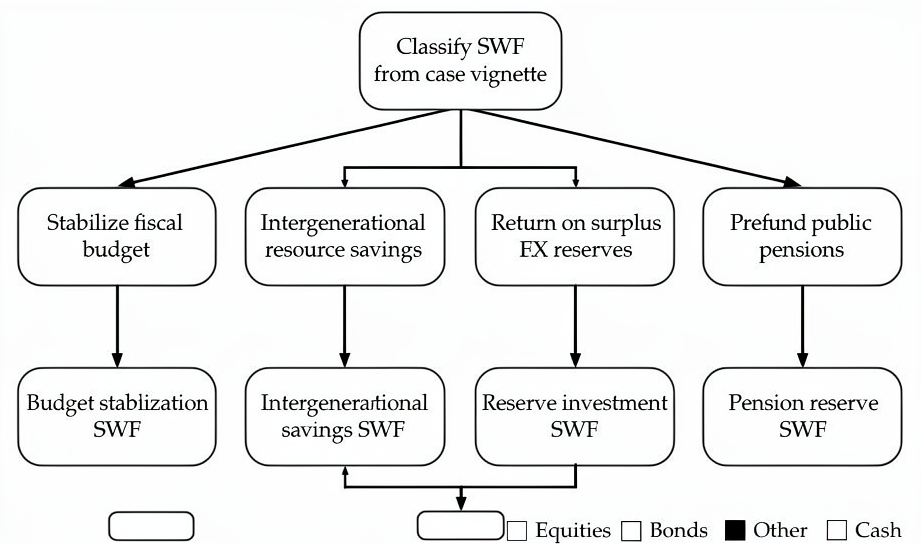
Sovereign wealth fund mandates are matched from case characteristics to budget stabilization, savings, reserve, pension reserve, and development fund types.
| Fund Type | Typical Allocations |
|---|---|
| Budget stabilization | Mostly government bonds, cash, and short‑term fixed income |
| Savings | Global equities, private equity, real assets, alternatives, some bonds |
| Reserve | Mix of equities, high‑grade bonds, some alternatives |
| Pension reserve | High in equities, real assets, infrastructure, alternatives; some bonds |
| Development | Concentrated in domestic assets or national projects; liquidity tailored to project needs |
For exam purposes, think through why these patterns are rational:
- Role of fixed income: For stabilization and reserve funds, high‑quality bonds provide diversification, regular cash flows, and liquidity. They may include inflation‑linked bonds to hedge domestic spending in real terms.
- Role of equities and alternatives: For savings and pension reserve funds, equities, private equity, hedge funds, and real assets drive long‑term real returns and diversify against domestic economic risk.
- Home versus foreign bias:
- Stabilization and savings funds often invest primarily abroad to reduce domestic overheating and currency appreciation (mitigating “Dutch disease”).
- Development funds intentionally concentrate in domestic projects and sectors, accepting higher correlation with the home economy.
Key Term: illiquidity premium
The additional expected return demanded by investors for holding assets that are difficult or costly to trade quickly, such as private equity, infrastructure, or real estate.
Long‑horizon SWFs are among the few investors able to systematically harvest illiquidity premia, but only if their mandates and governance genuinely allow them to ride out market stress without forced sales.
Worked Example 1.4
A pension reserve SWF currently holds 30% domestic long‑dated government bonds, 40% global equities, 20% global real estate and infrastructure, and 10% cash. Actuarial projections show a significant increase in pension payments starting in 15 years. The government is considering using part of the fund to finance near‑term public works spending. What are the portfolio implications?
Answer:
The pension reserve fund’s current allocation is broadly consistent with its long‑dated liabilities: a mix of long‑duration bonds (hedging) and growth assets (return‑seeking). Redirecting assets to near‑term public works effectively introduces short‑horizon, high‑liquidity liabilities, reducing risk‑bearing capacity. The fund would need to reassess its IPS, likely increasing liquid fixed income and reducing illiquid alternatives. From a Level 3 exam standpoint, you should highlight the conflict between pension prefunding and fiscal stimulus objectives and recommend that any development spending be clearly separated from the pension reserve mandate, possibly via a distinct development fund.
Worked Example 1.5
A development SWF is considering allocating 40% of its assets to a global systematic futures hedge fund strategy to diversify away from domestic project risk. The fund has a long‑term horizon but politically sensitive reporting on annual returns. Is this allocation appropriate?
Answer:
Systematic futures strategies can provide diversification and potentially improve risk‑adjusted returns, but they typically exhibit higher short‑term volatility and complex risk profiles. For a development fund whose mandate is to support domestic projects and whose performance is judged politically year‑by‑year, a large allocation (40%) to such a strategy is inconsistent with the core development mandate and may create communication challenges. A smaller, well‑explained allocation for diversification could be justified, but the majority of assets should remain aligned with domestic development objectives.
EXTERNAL CONSTRAINTS: LEGAL, REGULATORY, AND TAX
All institutional investors, including SWFs, endowments, and foundations, face constraints that affect asset allocation and operations. These constraints often explain why an apparently suitable investment is not permissible in a case vignette.
- Legal and regulatory constraints:
- Many SWFs and foundations must comply with laws limiting certain investments, borrowing, and risk—generally to ensure prudent management, transparency, and governance.
- Some SWFs are legally prohibited from investing domestically to avoid distortions and political favoritism; others are required to devote a minimum portion to domestic development.
- Host countries may impose screening or restrictions on foreign state‑owned investors acquiring stakes in strategic sectors (for example, defense, critical infrastructure).
- Endowments and foundations are typically subject to “prudent investor” rules, limiting leverage and concentrated positions.
Key Term: legal/regulatory constraint
A rule, ordinance, or law that restricts investment options, asset allocation, or operations—for example, prohibiting borrowing or certain securities.
-
Tax constraints:
- Many SWFs benefit from sovereign immunity or bilateral treaties granting tax‑exempt status on certain investments, but this is not universal.
- Withholding taxes, stamp duties, and local taxes on real assets can affect net returns and may influence the choice between direct investment and external managers or vehicles.
- Private foundations can face excise taxes on investment income or penalties for failing to meet minimum payout requirements.
-
Spending or payout rules:
- US private foundations must typically distribute at least 5% of assets annually; failure to do so triggers penalties.
- University endowments often follow board‑approved spending rules (for example, 4–5% of a smoothed asset base).
- Many savings SWFs and pension reserves are governed by fiscal rules that cap annual withdrawals or link them to structural budget balances. Breaking those rules in practice (as sometimes occurs) is an important qualitative constraint.
-
Accounting and reporting:
- Requirements for fair‑value accounting and regular reporting can increase the perceived risk of volatile assets, reducing political tolerance for high equity or alternative allocations.
- Development funds may face pressure to demonstrate visible domestic projects rather than less visible, diversified financial investments.
Key Term: political interference risk
The risk that investment decisions will be influenced by short‑term political considerations or changes in government rather than by the fund’s stated long‑term objectives and IPS.
For the exam, always ask: “Even if the fund could bear this risk economically, is it allowed to do so given its legal and political environment?”
Exam Warning: Many candidates underestimate the effect of legal and regulatory constraints on SWF asset allocation, especially for development or stabilization funds. For the exam, always consider both the statutory objectives and the real‑world liquidity and risk restrictions imposed by the fund's legal framework. If a proposed allocation conflicts with explicit law (for example, domestic investment caps) or would materially increase political interference risk, it is unlikely to be appropriate.
COMPARISONS: SWFs, ENDOWMENTS, AND PRIVATE FOUNDATIONS
All three institutional investor types aim for long‑term purchasing power, but practical differences arise. Level 3 questions frequently ask you to compare and contrast their IPS elements.
-
SWFs:
- Government‑owned, politically sensitive, and sometimes very large relative to national wealth.
- Objectives can combine macro‑stabilization, intergenerational wealth, and development, sometimes in tension.
- Risk tolerance depends not only on economic factors (time horizon, liabilities) but also on fiscal capacity and political acceptance of volatility.
- Asset allocation varies widely by type: from cash‑heavy stabilization funds to equity‑ and alternatives‑heavy savings funds.
-
Endowments:
- Generally perpetual, non‑governmental institutions (for example, universities, charities).
- Annual spending is determined by a policy rate or board decision, often 4–5% of a smoothed market value.
- Typically high risk tolerance and long horizons, leading to aggressive allocations to equities, hedge funds, private equity, real estate, and other alternatives.
- Governance structures (investment committees, professional staff) often support sophisticated asset allocation and manager selection.
-
Private foundations:
- Funded by individuals or families; may also be perpetual but often have a narrower mission.
- Often face minimum payout rules and, in some jurisdictions, excise taxes on net investment income.
- May have somewhat lower risk tolerance than large endowments, due to reputational concerns and donor preferences.
- Asset allocations are often balanced between growth and income, with some but usually lower allocation to illiquid alternatives compared with large endowments and savings SWFs.
From a portfolio construction standpoint:
- SWF savings funds and large endowments are the closest peers: both can hold large illiquid allocations and target high real returns.
- Stabilization SWFs resemble liquidity portfolios or short‑duration fixed‑income funds managed for capital preservation.
- Pension reserve SWFs sit between corporate DB plans and savings SWFs, combining liability‑hedging exposures with growth assets.
- Development SWFs are unique in their emphasis on domestic real projects and strategic sectors, often taking concentrated, idiosyncratic risk.
Worked Example 1.6
A Level 3 case describes three investors:
- Investor A: A large university endowment with a 5% spending rule, high governance quality, and no explicit debt.
- Investor B: A savings SWF funded by oil revenues, with no near‑term spending commitments but significant political concern after a recent drawdown.
- Investor C: A budget stabilization SWF for the same country as Investor B.
You are asked to rank their appropriate target allocation to illiquid alternatives (private equity, infrastructure, real estate) from highest to lowest.
Answer:
Conceptually, the ordering should be: Investor A (endowment) and Investor B (savings SWF) at the top, followed by Investor C (stabilization fund) at the bottom. Endowment A has a perpetual horizon and strong governance, supporting a large illiquidity budget. Savings SWF B also has high risk‑bearing capacity, but political concern after a drawdown may justify a slightly lower illiquid allocation than A. Stabilization SWF C has high, uncertain liquidity needs and thus should have minimal illiquid alternative exposure. In the exam, you would explicitly refer to time horizon, liquidity needs, and effective risk tolerance when justifying your ranking.
Summary
Sovereign wealth funds are state‑owned investment pools with mandates reflecting five broad purposes: budget stabilization, intergenerational savings, enhanced return on excess reserves, pension prefunding, and national development. Each type’s mandate determines its investment objectives, risk profile, and asset allocation:
- Budget stabilization funds emphasize capital preservation and liquidity, investing mainly in short‑term sovereign bonds and cash‑like instruments.
- Savings and pension reserve funds have long horizons and, when governance permits, can pursue higher‑risk, higher‑return strategies with significant allocations to global equities and illiquid alternatives.
- Reserve funds balance liquidity for currency and external‑financing needs with a desire to reduce negative carry by taking some duration, credit, and equity risk.
- Development funds focus on domestic infrastructure and strategic sectors, often accepting more concentrated and illiquid risk and sometimes subordinating financial returns to developmental objectives.
All SWFs, like endowments and private foundations, operate under legal, regulatory, tax, and political constraints that must be reflected in the investment policy statement and strategic asset allocation. For the CFA Level 3 exam, you should be able to:
- Correctly classify SWFs by type based on short case descriptions
- Infer their risk tolerance, horizon, and liquidity needs from their mandates and behavior
- Recommend asset allocations and portfolio adjustments that are consistent with their objectives and constraints, including governance and political realities
Key Point Checklist
This article has covered the following key knowledge points:
- Identify and differentiate the five main types of sovereign wealth funds.
- Recognize how the mandate influences investment horizon, risk‑bearing capacity, and liquidity needs.
- Relate SWF type to typical asset allocation patterns, including the role of illiquid alternatives.
- Understand legal, regulatory, tax, and political constraints on SWFs, endowments, and foundations.
- Distinguish between economic risk‑bearing capacity and actual risk tolerance for SWFs.
- Compare SWFs with endowments and private foundations in terms of objectives, spending rules, and asset allocation.
- Evaluate whether proposed portfolio changes are consistent with an SWF’s mandate and constraints in Level 3‑style case vignettes.
Key Terms and Concepts
- sovereign wealth fund (SWF)
- intergenerational equity
- budget stabilization fund
- savings fund
- reserve fund
- pension reserve fund
- development fund
- capital preservation objective
- negative carry
- development mandate
- spending rule
- investment horizon
- risk‑bearing capacity
- illiquidity premium
- legal/regulatory constraint
- political interference risk