Learning Outcomes
This article explains manager selection and monitoring for CFA Level 3 candidates, including:
- describing the structure of a formal ongoing manager monitoring program and linking it to the investment policy statement
- identifying key quantitative and qualitative metrics used to assess manager performance, risk, style consistency, and operational soundness
- evaluating evidence of style drift, compliance weaknesses, or organizational instability and determining whether they warrant enhanced review
- distinguishing between appropriate long-term evaluation horizons and misleading short-term performance signals
- outlining clear, policy-based triggers for initiating a termination review and the due process steps that must follow
- assessing legal and fiduciary duties when monitoring and terminating managers, with emphasis on prudence, fairness, and documentation
- designing communication, reporting, and record-keeping practices that support transparency and legal defensibility of monitoring and termination decisions
- applying the monitoring and termination framework to exam-style scenarios, avoiding common pitfalls such as reactionary terminations or vague policy language
- integrating transition risk, transaction costs, and market conditions into final termination and replacement decisions.
CFA Level 3 Syllabus
For the CFA Level 3 exam, you are expected to understand the policies and procedures for manager selection, ongoing monitoring, and termination, with a focus on the following syllabus points:
- Defining quantitative and qualitative metrics for ongoing manager evaluation
- Identifying appropriate triggers and process for manager termination
- Discussing the legal and fiduciary responsibilities when removing a manager
- Explaining best practice documentation and communication standards
Test Your Knowledge
Attempt these questions before reading this article. If you find some difficult or cannot remember the answers, look more closely at that area during your revision.
-
Which of the following is not a common quantitative metric in ongoing manager monitoring?
- a) Tracking error vs. benchmark
- b) Portfolio turnover
- c) Manager’s office location
- d) Risk-adjusted returns
-
True or false? Manager termination should be triggered by recent short-term underperformance alone.
-
What is the primary legal duty governing termination of an investment manager by a pension fund trustee?
Introduction
Manager selection is not a one-off decision. It requires ongoing monitoring to ensure that managers continue to meet the objectives for which they were hired and to mitigate operational, performance, and legal risks. Terminating a manager must be based on a clear, consistent policy and due process. Both monitoring and termination involve significant legal duties, documentation, and communication.
Ongoing Manager Monitoring: Process and Metrics
Ongoing monitoring is critical to detect changes in manager behaviour, performance, and risk. It is also required to fulfil fiduciary obligations and to maintain best execution of clients’ investment policy. Monitoring combines quantitative and qualitative assessment, guided by a formal policy.
Quantitative Metrics
Quantitative monitoring uses objective measures, updated regularly. Key metrics include:
- Performance (absolute, relative, and risk-adjusted) against benchmarks and stated mandates
- Tracking error and standard deviation
- Value at risk (VaR) and downside risk statistics
- Style drift, measured via attribution analysis
- Portfolio turnover and transaction costs
- Adherence to investment guidelines and restrictions
Key Term: Tracking error
The standard deviation of the difference between manager return and benchmark return over a defined period; measures active risk. Key Term: Style drift
A change in a manager’s investment style away from their stated or expected approach, often identified using factor and attribution analysis.
Qualitative Assessment
Qualitative monitoring focuses on factors that may not be immediately visible in portfolio statistics:
- Changes in key personnel (portfolio managers, analysts)
- Ownership or organizational structure changes
- Shifts in investment philosophy or team decision making
- Compliance breaches, regulatory issues, or litigation
- Client service, reporting standards, and transparency
Key Term: Qualitative monitoring
The process of systematically evaluating non-performance factors such as personnel, process changes, and compliance related to an asset manager. Key Term: Compliance breach
A violation of legal, regulatory, or contractual mandates by an asset manager, potentially triggering review or termination.
Documentation and Reporting
Monitoring must be documented with:
- Regular review reports (quarterly or as stated in policy)
- Meeting minutes, notes on discussions, and action items
- Escalation procedures for incidents or exceptions
Regular reporting maintains transparency and supports legal defensibility should a termination or dispute occur.
Termination Policy: Principles and Due Process
A termination policy sets clear criteria and safeguards procedural fairness. Poorly managed terminations may expose the sponsor to legal or operational risk.
Ongoing oversight criteria separate quantitative indicators from qualitative factors, including performance, active risk, style consistency, organizational changes, and compliance matters.
Triggers for Termination
Termination may be initiated (but never triggered solely) by issues such as:
- Sustained underperformance vs. benchmark and/or peers over an evaluation period defined in policy (e.g., 3–5 years)
- Persistent style drift away from mandate
- Material compliance breach or regulatory censure
- Key person departure without sufficient transition planning
- Organizational changes undermining stability or fiduciary confidence
- Deterioration of reporting, transparency or client service standards
Key Term: Termination trigger
A pre-defined event or set of criteria in the monitoring policy that, if met, requires a formal review and possible removal of the manager. Key Term: Due process
A stepwise procedure ensuring fair assessment, notification, and documentation before making termination or major monitoring decisions.
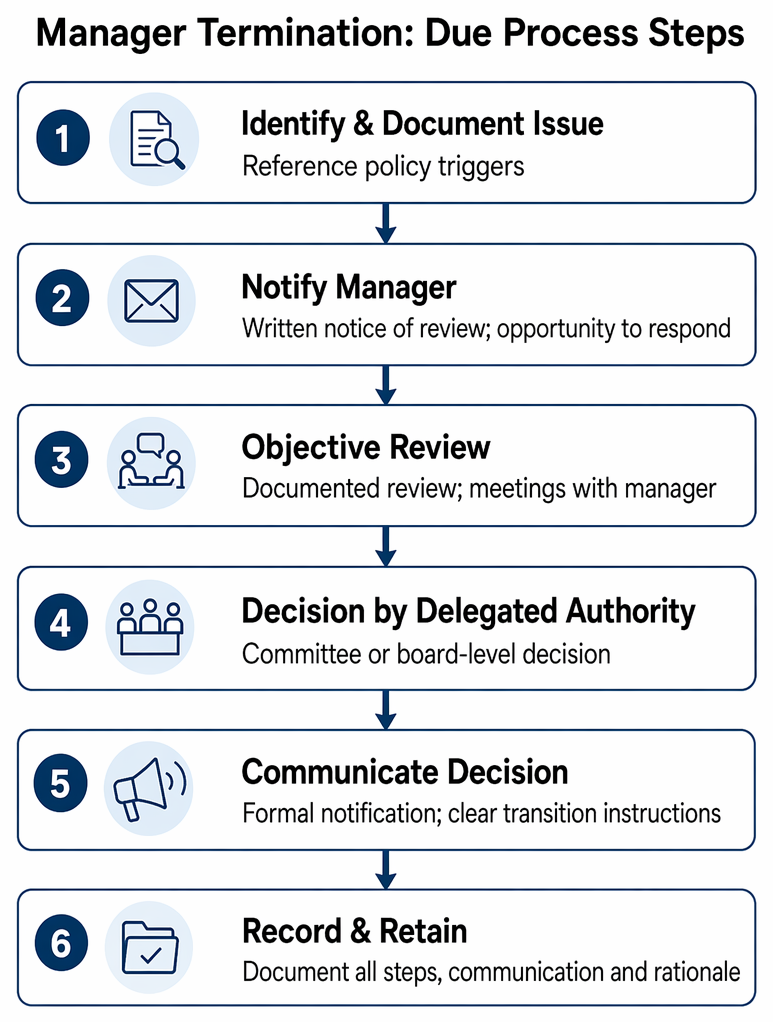
Due Process Steps
- Identify and document the issue, referencing policy triggers.
- Notify the manager in writing of the review, giving an opportunity to respond.
- Complete an objective, documented review (often including meetings with the manager).
- Make a decision according to delegated authority, typically at committee or board level.
- Communicate the decision formally, with clear transition instructions.
- Record all steps, communication, and rationale.
Legal and Fiduciary Duties
The legal duty governing monitoring and termination is the duty of care. Investors and trustees must act prudently, always in the beneficiaries’ best interests. Actions must be defensible, consistent, and well documented.
Termination process should consider:
- Transition risk and cost, including trading and market impact
- Market and liquidity conditions
- Continued safeguarding of client assets during the transition
Worked Example 1.1
Question: A charity’s investment committee is worried about an external equity manager who underperformed the benchmark by 5% in the past year. Portfolio attribution analysis reveals style drift, and there have been two compliance near-misses in the last year. What steps should the committee take under a robust monitoring and termination policy?
Answer:
The committee should initiate a formal manager review, documenting the performance, style drift, and compliance concerns as per the monitoring policy. The manager should be notified and given a chance to respond. After a documented review, following due process, and if warranted, the committee may decide to terminate and formally notify the manager, ensuring an orderly asset transition and keeping records throughout.Exam Warning: Manager termination based on short-term underperformance alone, without evidence of persistent issues or process breach, is not sufficient or prudent. Policies must prevent reactionary or arbitrary removals.
Revision Tip: Always reference formal monitoring policy before initiating discussion or action on managerial underperformance or organizational changes.
Summary
Ongoing manager monitoring is a systematic process that combines quantitative and qualitative assessment. Termination policies set clear prespecified triggers and require due process with legal documentation. Fiduciary duty requires prudent, fair, and documented decision-making to protect beneficiaries and ensure that investment managers deliver ongoing value in line with mandate objectives.
Key Point Checklist
This article has covered the following key knowledge points:
- List the core quantitative and qualitative factors used to monitor managers
- Explain triggers and due process for termination
- Recognize the importance of formal documentation and communication
- Identify legal and fiduciary considerations during monitoring and termination
- Understand transition, risk, and cost implications of manager change
Key Terms and Concepts
- Tracking error
- Style drift
- Qualitative monitoring
- Compliance breach
- Termination trigger
- Due process