Learning Outcomes
After reading this article, you will be able to identify and use formal register required for IELTS Writing and Speaking. You will distinguish between formal, semi-formal, and informal tone, structure logical paragraphs, and apply academic conventions such as referencing and clear linking strategies. You will understand how to write with accuracy and conciseness, avoiding colloquial language and ensuring coherence throughout your tasks.
IELTS Academic, General & UKVI Syllabus
For IELTS, you are required to demonstrate coherent, well-organized arguments and a formal, academic writing style in both Tasks 1 and 2. For revision, focus on these syllabus points:
- Select and use formal register and avoid informal or colloquial expressions in academic writing and speaking.
- Construct paragraphs with clear topic sentences and logically connected ideas.
- Use a variety of linking words and referencing devices to create coherence between sentences and paragraphs.
- Apply academic conventions regarding tone, pronoun usage, and structured organization.
- Write in a style appropriate for a university or professional context, following formal conventions for grammar and vocabulary.
Test Your Knowledge
Attempt these questions before reading this article. If you find some difficult or cannot remember the answers, look more closely at that area during your revision.
- What is formal register, and why is it essential for IELTS Writing Task 2?
- Name two techniques for linking ideas and achieving coherence in an academic essay.
- Which of the following is most appropriate in IELTS Writing Task 2: “kids”, “children”, or “guys”? Why?
- True or false: Using personal stories and informal expressions improves your IELTS Academic Writing score.
Introduction
Effective communication in IELTS requires formal and academic style, clear organization, and accurate linking of ideas. Examiners look for essays and reports that are structured, objective, and consistent in tone. The ability to achieve coherence—where ideas flow logically—and to follow academic conventions is directly tied to your overall band score in both the Academic and General Training modules.
Key Term: Coherence
The logical arrangement of ideas so the whole text is easy to follow and understand. Each sentence and paragraph builds upon the last, creating clarity for the reader. Key Term: Formal Register
The use of language that is suitable for academic or professional settings, including precise vocabulary, objective tone, and correct grammar. It avoids slang, contractions, and overly personal expressions. Key Term: Paragraph Focus
The principle that each paragraph focuses on a single main idea, which is introduced by a topic sentence and expanded with supporting details.
Establishing Coherence and Academic Conventions
Achieving coherence begins with planning each paragraph so it presents one main idea. Each paragraph should start with a topic sentence, followed by supporting details and logical links to the next idea.
Formal Register: What It Is and Why It Matters
Formal register is essential for IELTS Writing and Speaking. It requires you to:
- Avoid contractions (write "do not" instead of "don't").
- Use standard grammar and precise vocabulary ("children" instead of "kids"; "numerous" instead of "lots of").
- Avoid personal anecdotes in academic essays unless asked for specific personal examples.
- Remain objective and avoid emotional or exaggerated expressions.
Key Term: Academic Convention
Accepted practices in academic writing, such as using impersonal pronouns, referencing sources accurately, and organizing arguments logically.
Paragraph Structure and Referencing
Each paragraph in academic writing should focus on one point, introduced by a clear topic sentence. Coherence is supported by referencing—using words like "this," "these," and "such" to connect ideas smoothly.
Linking Ideas for Interconnection
Strong essays use a range of linking words and phrases (e.g., “however,” “in addition,” “nonetheless,” “as a result”) to connect sentences and paragraphs. Be careful not to overuse linking devices—interconnection comes from both links and clearly stated logic.
Key Term: Reference Word
A word (such as 'this', 'these', 'which', or pronouns) that refers back to an idea or noun previously mentioned, creating a link between sentences or paragraphs.
Appropriate Academic Style
- Use passive voice when appropriate to maintain an objective tone.
- Consistently refer to information and ideas, not just personal views (“The data suggest...” rather than “I think...”).
- Ensure verb tenses are consistent.
- Present balanced, well-reasoned arguments, particularly in Task 2.
Register: Formal, Semi-formal, and Informal
Formality in English is a scale:
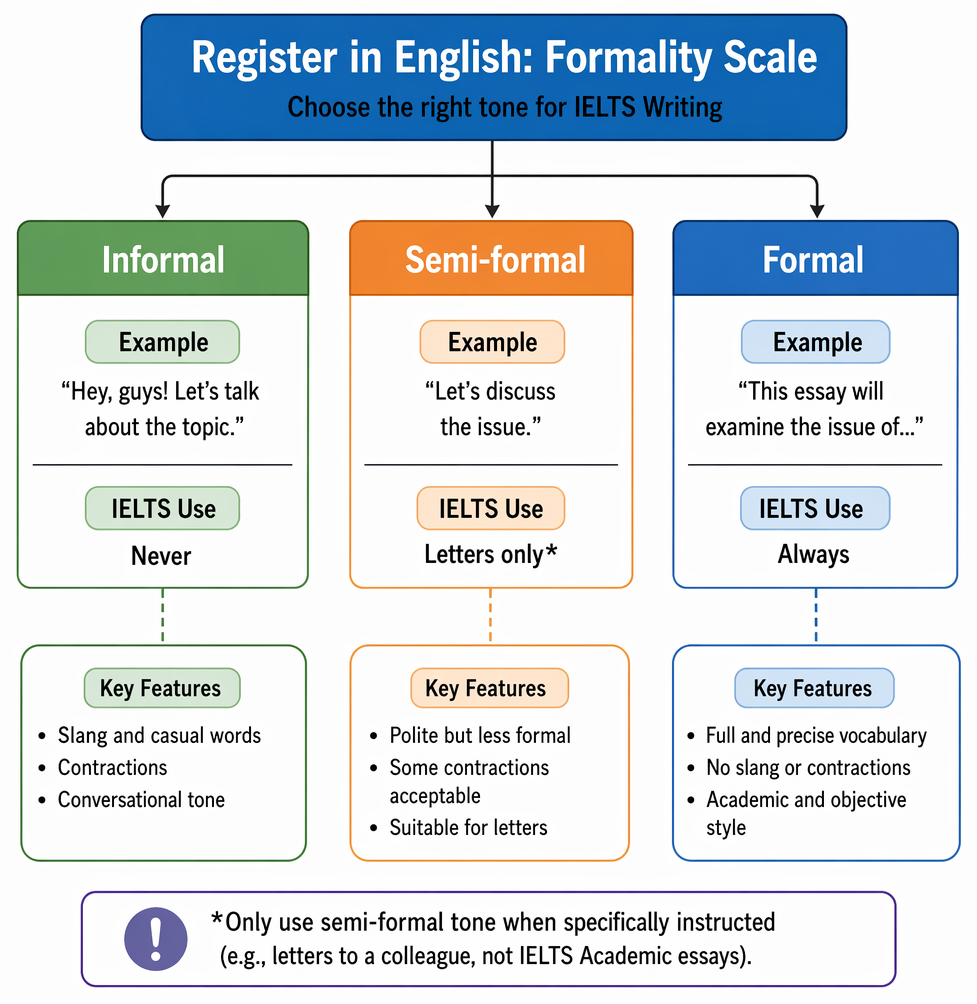
Register choice according to text type and recipient leads to non-colloquial language and a clear introduction-body-conclusion structure.
| Level | Example | IELTS Use |
|---|---|---|
| Informal | "Hey, guys! Let's talk about the topic." | Never |
| Semi-formal | "Let's discuss the issue." | Letters only* |
| Formal | "This essay will examine the issue of..." | Always |
*Only use semi-formal tone when specifically instructed (e.g., letters to a colleague, not IELTS Academic essays).
Worked Example 1.1
Read the paragraph and identify the style:
Some kids these days spend loads of time on their phones, so teachers gotta try new methods.
Question: What is inappropriate about this style for IELTS Writing Task 2?
Answer:
The sentence uses informal terms ("kids," "loads of," "gotta," and so on). IELTS requires formal register, so expressions like "children," "a significant amount of time," and "must attempt" should be used instead. The writing must avoid slang, contractions, and conversational tone.
Worked Example 1.2
Paragraphs:
(1) Many experts agree that physical activity is important for the health of young people. (2) Nevertheless, there is ongoing debate regarding the most effective way to encourage physical activity at school. (3) One solution is to increase the number of compulsory sports classes. This approach may lead to an overall improvement in student health outcomes, as shown by recent studies.
Question: How does this paragraph achieve coherence and formal style?
Answer:
Each sentence relates to the main idea (the value of physical activity in education). The use of phrases like "nevertheless," "there is ongoing debate," and "as shown by recent studies" are formal. The sentences flow logically from one to the next, ensuring coherence.
Worked Example 1.3
Task: Write a short conclusion to the following essay, ensuring formal register and appropriate linking.
Essay: "There are both advantages and disadvantages to using public transport. On one hand, it can reduce traffic and pollution. On the other, it may not be convenient or comfortable for all users."
Answer:
In conclusion, although public transport offers clear benefits for society, its limitations must be addressed to increase usage among all sectors of the population.Exam Warning: In IELTS, using informal words, personal anecdotes, or inconsistent tense can lower your band score. Always check that your writing is formal and that your arguments maintain a logical order.
Revision Tip: Before submitting your writing, underline or highlight topic sentences in each paragraph. Verify that each paragraph develops one clear idea and that your links and references make the progression of ideas explicit.
Summary
In IELTS, a formal, objective, and structured style is essential. Coherence is built by organizing each paragraph around one idea, using linking words and referencing, and following academic conventions such as impersonal tone. Consistent use of formal register enhances clarity and maximizes your score.
Key Point Checklist
This article has covered the following key knowledge points:
- Explain the importance and features of formal register in IELTS Writing and Speaking.
- Understand and apply paragraph focus, using one idea per paragraph.
- Build coherence with clear referencing and appropriate linking.
- Follow academic conventions: avoid contractions, use passive where suitable, maintain objective tone.
- Recognize and avoid informal language, colloquialisms, and inconsistent style.
Key Terms and Concepts
- Coherence
- Formal Register
- Paragraph Focus
- Academic Convention
- Reference Word