Learning Outcomes
After reading this article, you will be able to organize your writing into clear, logical paragraphs with strong progression for IELTS tasks. You will understand how coherence and connectedness are achieved, how to link sentences and ideas within and between paragraphs, and how to use appropriate style for academic writing. These skills will improve both your IELTS Writing and Reading performance.
IELTS Academic, General & UKVI Syllabus
For IELTS, you are expected to write in clear, well-structured paragraphs, using appropriate linking words and phrases to show the relationships between ideas. For revision, focus on these syllabus points:
- Structure written work into logical, appropriately sized paragraphs.
- Use connecting words and referencing to clarify how ideas relate.
- Ensure smooth progression both within and between paragraphs.
- Link supporting details and examples to central ideas.
- Write in an academic style suitable for IELTS Writing and, in Reading, recognize paragraph progression and logical connection.
Test Your Knowledge
Attempt these questions before reading this article. If you find some difficult or cannot remember the answers, look more closely at that area during your revision.
- What is the main difference between coherence and connectedness in academic writing?
- Give one example of a referencing word and explain its purpose within a paragraph.
- True or false: Using transition words such as "however" or "for example" is necessary only at the start of a paragraph.
- Why should each paragraph in your IELTS essay have a clear topic sentence?
Introduction
Clear, effective paragraphs are essential for high marks in IELTS Writing. Paragraphs should present a single main idea, link supporting details clearly, and follow a logical order that makes your answer easy for the examiner to follow. In Reading, understanding how paragraphs build and progress helps answer summary and matching questions efficiently.
Key Term: Coherence
The logical organization and flow of ideas within and between paragraphs so the reader easily follows the writer’s argument. Key Term: Connectedness
The use of linking words, referencing, and grammar to show relationships between sentences and connect ideas smoothly. Key Term: Progression
The orderly and logical movement from one idea or paragraph to the next, guiding the reader through the writer’s message or argument.
Paragraph Structure and Progression
Each paragraph in IELTS Writing should focus on a single central theme, usually introduced by a topic sentence at the beginning. The remainder of the paragraph should develop this idea with explanation, evidence, and examples.
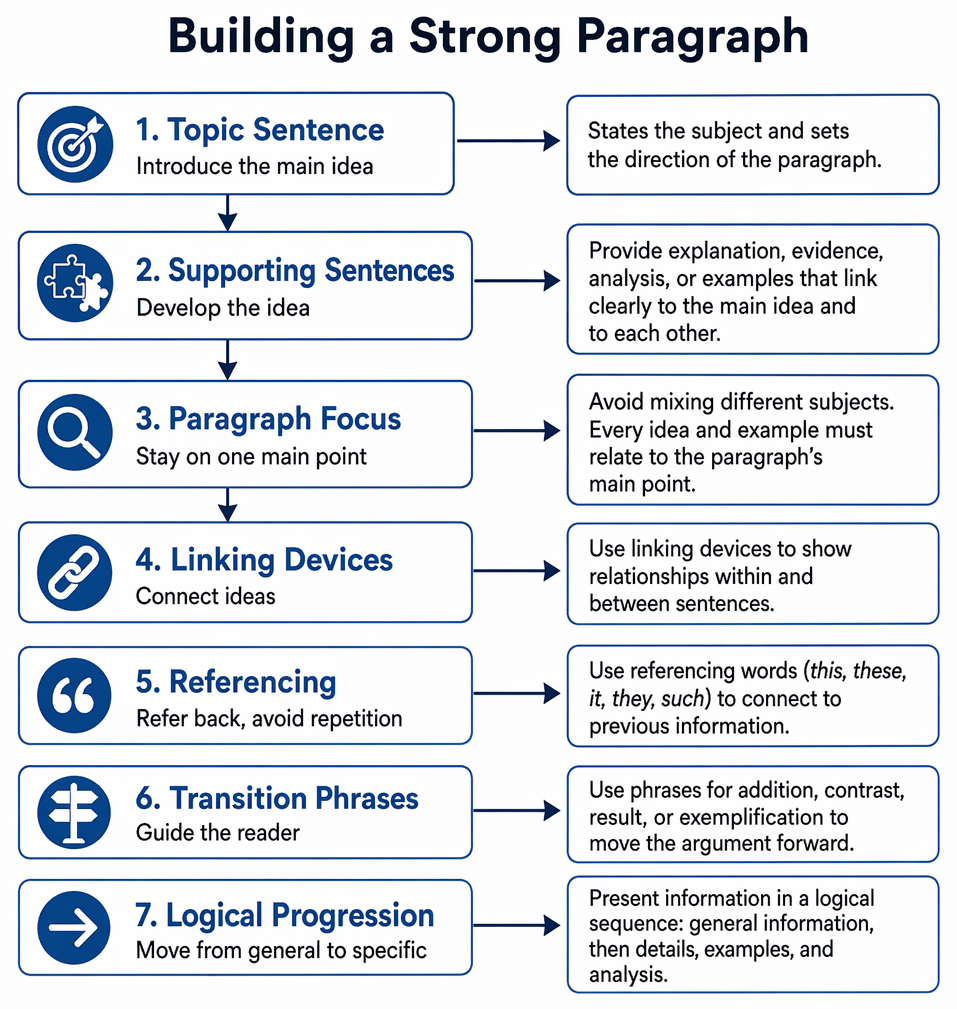
Paragraph organization is presented as a progression from topic-sentence formulation to explanation, exemplification, cohesive devices, and final coherence checks.
Topic Sentences
A topic sentence introduces the subject of the paragraph. It helps the reader and examiner quickly understand the direction of your discussion.
Supporting Sentences
Each sentence after the topic sentence provides explanation, evidence, analysis, or examples to develop the main idea. These sentences must link clearly to both the topic sentence and each other.
Paragraph Focus
Avoid mixing different subjects within a single paragraph. Every supporting idea and example should relate directly to the paragraph's main point.
Linking Within and Between Paragraphs
Linking devices and referencing words connect your sentences, giving your writing connectedness.
Key Term: Linking Device
A word or phrase (such as "however," "therefore," or "in addition") that shows the relationship between ideas or steps in a sequence.
Referencing for Connectedness
Use referencing words—such as "this," "these," "it," "they," or "such"—to refer back to previous information and avoid repetition. This creates variety and tightens your writing.
Key Term: Referencing
The use of pronouns or short phrases to refer to previously mentioned information, helping maintain connectedness and avoid unnecessary repetition.
Transition Phrases
Transition phrases guide the reader through your argument. Use them to show addition ("furthermore," "also"), contrast ("however," "by contrast"), result ("therefore," "as a result"), or exemplification ("for example," "such as").
Logical Order and Progression
Arrange your paragraphs and sentences so information moves in a logical sequence. For IELTS essays, this typically involves starting with the most general information, then moving to details, examples, and analysis.
Style Considerations
Use an objective, formal tone, avoid contractions, and prefer concise sentences. Vary your language but use clear pronouns and linking phrases for connectedness. In IELTS Writing Task 2, provide clear progression from the introduction, through the main body paragraphs, to a summary or conclusion.
Paragraph Progression in IELTS Reading
In the IELTS Reading test, be able to spot main ideas, paragraph topics, and how they relate to each other. Paragraphs are often structured to indicate cause and effect, problem and solution, comparison, or chronological development. Recognizing paragraph focus and progression will help you identify where specific information is located.
Worked Example 1.1
Paragraph sample (Task 2 Writing):
Many cities are facing severe traffic congestion. The most significant cause of this issue is the increasing number of private vehicles. As more people move into urban areas, car ownership rises, which results in crowded roads and frequent delays. For example, in London, daily rush hours often extend for several hours, causing loss of productivity and increased air pollution.
Question: Identify the topic sentence and at least one supporting detail in the paragraph above.
Answer:
Topic sentence: "The most significant cause of this issue is the increasing number of private vehicles." Supporting detail: "As more people move into urban areas, car ownership rises, which results in crowded roads and frequent delays." Further support: The specific example of London.
Worked Example 1.2
IELTS Reading Passage expository sample:
(Partial passage)
Organic farming methods have increased in popularity over the past decade. Proponents claim that organic crop cultivation is environmentally friendly, but critics argue that yields are often lower than with conventional agriculture. This has led some scientists to question whether organic farms can meet the demands of a growing population.
Question: Which sentence in the passage functions as a linking sentence between two contrasting views?
Answer:
"This has led some scientists to question whether organic farms can meet the demands of a growing population." Explanation: This sentence links the previous argument (criticisms about yields) with the next topic (scientists' concerns).Exam Warning: A frequent error is to list unrelated facts within one paragraph, or to jump from one idea to another without any linking phrases. Each paragraph must focus on one main point and make the connection between ideas explicit.
Revision Tip: When planning your essay, write brief notes outlining your main points. Sequence them so each paragraph builds naturally on the last. Then add linking phrases to connect paragraphs and steps in your argument.
Key Point Checklist
This article has covered the following key knowledge points:
- Distinguish between coherence (logical structure) and connectedness (effective linking) in your writing.
- Construct each paragraph around a single main idea with a clear topic sentence.
- Support each topic sentence with logically related details and academic linking phrases.
- Use referencing and transition words to show relationships and progression.
- Maintain a clear, academic style and objective tone.
- Recognize paragraph and progression structures when answering IELTS Reading questions.
Key Terms and Concepts
- Coherence
- Connectedness
- Progression
- Linking Device
- Referencing