Learning Outcomes
After reading this article, you will understand how diagram label completion questions work in the IELTS Reading test. You will be able to identify common formats, interpret visual information efficiently, and apply effective strategies to choose correct answers from texts and diagrams. You will be prepared to avoid frequent errors and optimize your time during the exam.
IELTS Academic, General & UKVI Syllabus
For IELTS, you are required to understand and efficiently answer diagram label completion questions found in the reading paper. For revision, focus on these syllabus points:
- Identify diagram label completion question types and their formats in the IELTS Reading section.
- Accurately match information from the text to parts of a diagram.
- Extract and select appropriate words and phrases from the passage to label a diagram correctly.
- Follow instructions regarding word limits, and recognize whether labels should be chosen from a box or found in the passage.
- Interpret visual elements of a diagram, such as arrows, labels, and symbols, in order to answer the question.
Test Your Knowledge
Attempt these questions before reading this article. If you find some difficult or cannot remember the answers, look more closely at that area during your revision.
- In a diagram label completion task, where should you usually look for the correct words to label each part?
- True or false: You may use your own words when labeling an IELTS diagram if the diagram is very simple.
- What is one effective strategy for matching information in the passage to the correct position in a diagram?
- How can you quickly identify whether the answers need to be chosen from a box, from the passage, or both?
Introduction
Diagram label completion is a common question type in the IELTS Reading test, especially in Academic modules. These tasks require you to add missing labels to parts of a diagram, flowchart, or other visual based on information found in the reading passage. Diagrams often illustrate scientific processes, objects, cycles, or descriptions.
Success in this question type demands that you combine reading skills with the ability to interpret visual data. You must carefully follow the instructions about word limits and about where to select your answers from. Understanding the typical structure and applying reliable strategies can significantly increase your accuracy and speed.
Key Term: Diagram Label Completion
An IELTS Reading question type where you must fill blanks on a diagram, flowchart, or picture using information from a reading passage. Answers may be selected from a list or from the passage text itself. Key Term: Word Limit
The maximum number of words and/or numbers permitted for each answer according to the instructions. Extra words, hyphens, or spelling errors will result in lost marks. Key Term: Visual-Text Matching
The ability to connect parts of a diagram to particular phrases, sentences, or information in the reading passage, ensuring that the label describes the diagram accurately.
Typical Diagram Label Completion Formats
IELTS diagram label completion questions use a few basic structures. Each requires you to fill missing information into blanks on or near the diagram. There are two main answer formats:
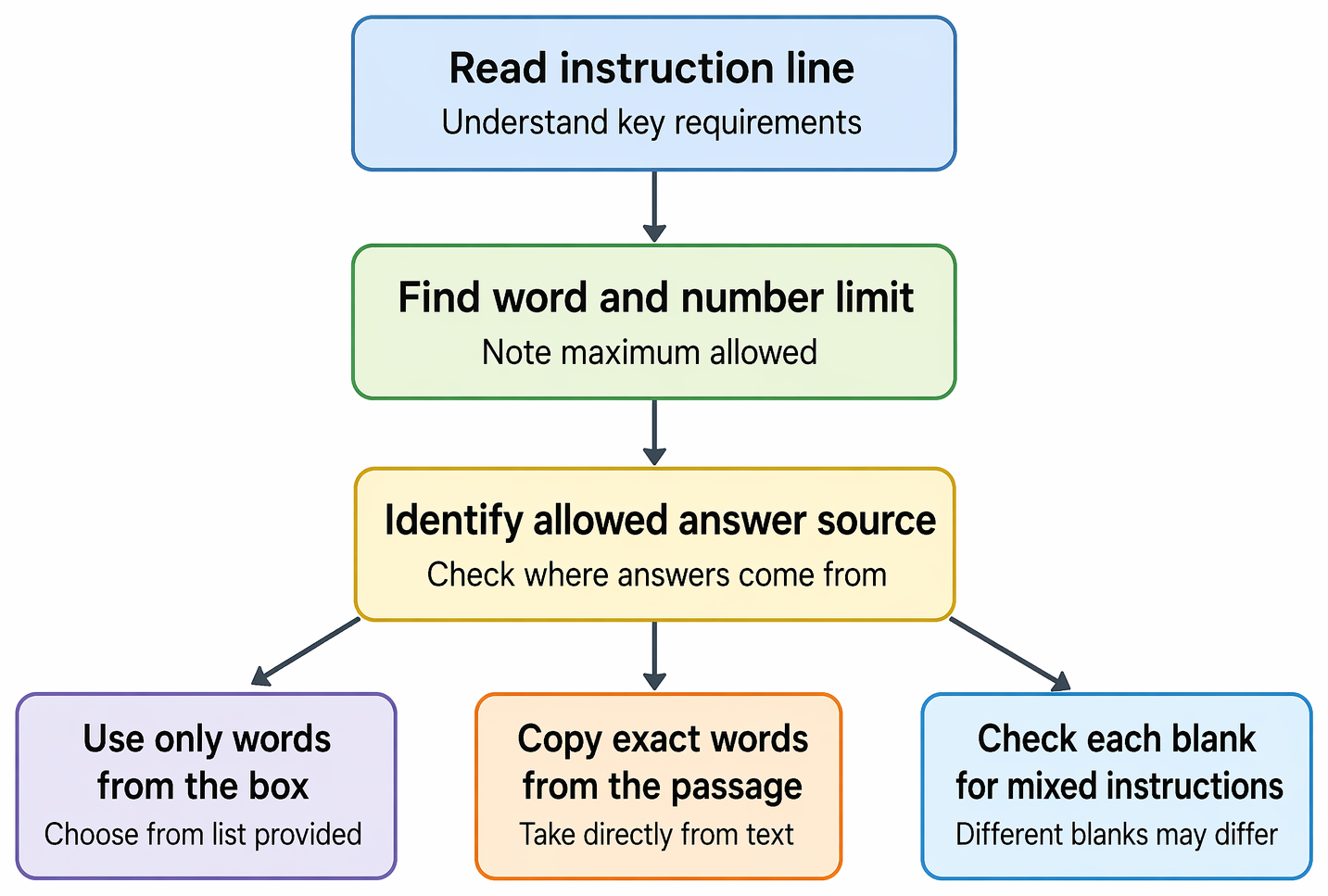
Instruction checking for diagram label completion follows a decision sequence covering response limits, source restrictions, and blank-specific answer requirements.
- Answers must be selected from a given list of options (in a box).
- Answers must be found directly from words in the passage.
Sometimes, both formats appear in the same question.
Reading the Instructions Carefully
Carefully read the question instructions before you begin. They will specify:
- The maximum number of words and/or numbers allowed per answer (e.g., "NO MORE THAN TWO WORDS AND/OR A NUMBER").
- Whether you must choose your answers from the provided box of words/phrases, or select them only from the passage.
Matching Text to Diagram
To correctly complete diagram labels, you need to match specific locations, parts, or processes shown in the diagram with information found in the reading passage.
Key Term: Scan
To move your eyes quickly through a passage to locate particular words, numbers, or information relevant to the question.
When matching, focus on keywords such as names of parts, actions, materials, or significant numbers. Sometimes, the passage uses synonyms or paraphrases for the words shown on the diagram.
Answering in the Correct Format
Each blank label in a diagram must be filled with the correct word(s) according to the instructions. If you exceed the word or number limit, use the wrong form, misspell, or copy extra words, your answer will not be marked correct.
Key Term: Paraphrase
Different wording that has the same meaning. In IELTS, information in a diagram may be worded differently from the passage.
Common Strategies for Diagram Label Completion
Use these steps to improve your performance:
- Quickly preview the diagram: Note what is being shown (object, process, or place) and the location of the blanks.
- Read labeling instructions: Check word limits and where to select answers.
- Identify keywords in blanks: Consider what type of information is needed (noun, process, material, number, etc.).
- Skim relevant passage sections: Focus on where the diagram's subject is mentioned.
- Scan for matching words or phrases in the passage or answer box.
- Check for synonyms or paraphrasing: The passage may rephrase information found in the diagram.
- Write answers exactly as required: Only use permitted words/numbers, spell them correctly, and observe the word or number limit.
Worked Example 1.1
The diagram below shows the process of making olive oil. Use NO MORE THAN TWO WORDS from the reading passage for each answer.
Passage extract: First, olives are picked from the trees. After harvesting, the olives are washed to remove any dirt or leaves. Next, the clean olives are placed in a large grinder, which crushes them to release the oil. The resulting paste is then spread onto mats. These mats are pressed under pressure to separate the liquid oil from any remaining solids. Finally, the oil is collected and stored in bottles.
Diagram labels (sample): Blank 1: **__** (where olives have something done to remove dirt) Blank 2: **__** (the stage after grinding, before pressing) Blank 3: **__** (where oil is kept after collection)
Questions:
- What is done to olives immediately after harvesting?
- What is spread onto mats before pressing?
- Where is the olive oil kept after collection?
Answers:
Answer:
- washed
- paste
- bottles
Each answer uses no more than two words from the passage, directly describing the correct diagram stage or part.
Worked Example 1.2
The diagram shows a cross-section of a simple electric circuit. Label each numbered part using words from the answer box.
Passage (extract): A complete electric circuit includes a power source, such as a battery, connected to a bulb and a switch by wires. When the switch is closed, electricity flows through the wires, lighting the bulb. If the switch is open, the circuit is broken and the bulb will not light.
Answer box:
- bulb
- wire
- switch
- battery
Diagram labels (numbers): (1) Power source (2) On-off control (3) Lighting device (4) Connection lines
Task: Label the diagram using the correct words from the box.
Answer:
(1) battery (2) switch (3) bulb (4) wireExam Warning: A frequent error is exceeding the allowed number of words/numbers or using your own words instead of the required words from the passage or box. Always write the answer exactly as specified in the instructions.
Revision Tip: If you cannot find a matching phrase immediately, look for paraphrased words describing the same part or process in both the text and diagram. Matching meaning is more important than matching exact wording.
Summary
Diagram label completion requires using information from the reading passage to label parts of a diagram or process. You must carefully follow instructions regarding word or number limits, select words only from the passage or given list, and check for synonymous wording.
Key Point Checklist
This article has covered the following key knowledge points:
- Recognize the structure and requirements of diagram label completion questions in IELTS Reading.
- Identify keywords and analyze the diagram before reading the passage in detail.
- Match diagram labels to the corresponding information in the passage, allowing for paraphrased wording.
- Select your answers according to the instructions for word/number limit and permitted source (box or passage).
- Record answers precisely, using correct spelling and form.
- Be aware of frequent mistakes, such as using too many words or words not allowed by the instructions.
Key Terms and Concepts
- Diagram Label Completion
- Word Limit
- Visual-Text Matching
- Scan
- Paraphrase