Learning Outcomes
After reading this article, you will be able to accurately identify and answer IELTS Reading questions using the matching features and matching sentence endings formats. You will learn how these tasks are structured, how to approach them efficiently, and how to recognise common distractors. You will also develop proficiency in methods to find and connect information between lists and passages, avoiding frequent errors with partial matches or misleading answer choices.
IELTS Academic, General & UKVI Syllabus
For IELTS, you are required to understand the structure and purpose of Matching Features and Matching Sentence Endings questions. For revision, focus on the following syllabus points:
- Distinguish between different question types involving matching items or list choices to information in a text.
- Apply strategies for matching names, characteristics, causes, effects, or descriptions to relevant people, events, or ideas.
- Accurately complete partial sentences by selecting the correct ending from a provided list.
- Recognise and avoid common distractors and partial matches in answer choices.
- Extract key information, synonyms, or paraphrased ideas from the passage to make correct matches.
- Practice time-efficient methods for linking lists and passages in complex reading tasks.
Test Your Knowledge
Attempt these questions before reading this article. If you find some difficult or cannot remember the answers, look more closely at that area during your revision.
- What are you required to match in a Matching Features question on the IELTS Reading test?
- In a Matching Sentence Endings question, should the sentence be grammatically correct once you have chosen your answer?
- Why is it important to check for partial matches or distractor phrases in matching questions?
Introduction
Matching Features and Matching Sentence Endings are common IELTS Reading question types. Both test your ability to connect ideas, facts, or phrases from a list to corresponding information in the passage. These questions often rely on synonyms, paraphrases, and subtle distinctions. Effective strategies are required to recognise answer patterns, avoid “trap” options, and match accurately, even when the passage uses different wording.
Key Term: Matching Features
A reading question format where candidates must link items (such as names, events, or concepts) with a set of features, characteristics, or statements, usually by finding relevant evidence from the passage. Key Term: Matching Sentence Endings
A reading question format that requires candidates to complete a sentence by choosing the appropriate ending from a list, ensuring grammatical correctness and logical meaning.
What is Matching Features?
Matching Features tasks ask you to link options (for example, names of people, countries, or theories) with a set of features (such as claims, achievements, dates, or properties). These options may appear in any order in the passage, and features might use synonyms or reworded phrases, requiring careful scanning and matching.
What is Matching Sentence Endings?
Matching Sentence Endings tasks provide the first part of a sentence and a list of possible endings. Your task is to select the best ending from the list so that each sentence is complete, logical, and grammatically correct. The meaning must fit the content in the passage and not simply “sound right” in English.
Key Term: Distractor
A plausible but incorrect answer option designed to test if you can distinguish between similar or partially matching ideas.
Types of Matching Features Questions
Typical Matching Features variants include:
- Matching people with their opinions, discoveries, or actions.
- Matching events or places to their significance, outcomes, or features.
- Matching theories with examples, supporting evidence, or effects.
These questions do not always follow the order of the passage; targeted scanning is often required.
Types of Matching Sentence Endings Questions
For these, you match the beginning (stem) of a sentence to one logical and grammatical ending. Some endings may partly fit multiple sentence stems but only one is fully correct for each based on context and meaning.
How to Approach Matching Features
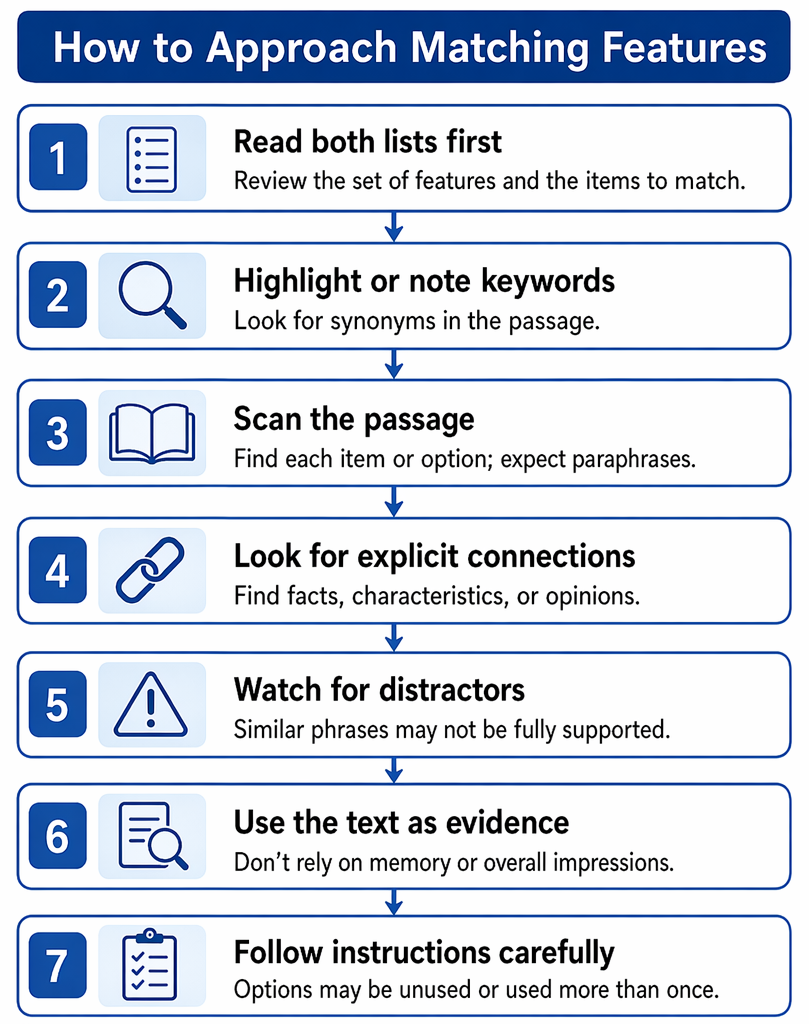
Matching sentence endings workflow includes prediction, passage verification, grammatical and logical testing, elimination of alternatives, and final consistency review.
- Read both lists first: the set of features and the items to match.
- Highlight or note keywords. Look for synonyms in the passage.
- Scan the passage for each item or option. Remember features and names may be paraphrased.
- Look for explicit connections—facts, characteristics, or opinions.
- Be wary of distractor phrases or statements that seem similar but are not fully supported by the text.
- Avoid relying on memory or overall impressions; always refer back to evidence in the passage.
- Some options may not be used or may be used more than once—always follow the question instructions.
Worked Example 1.1
Passage:
Researchers recently compared various pain relief methods for children after minor surgery. Dr. Hayes believes that offering choices helps children feel calmer. Dr. Perez disagrees, stating that only professional recommendations are best. Dr. Lee noticed that giving children little information reduced their anxiety. The hospital now allows families to select pain relief methods from a shortlist.
Features:
A. Believes children should actively choose B. Thinks too many options create confusion C. Supports less information for less anxiety D. Feels only doctors should choose
Question: Which opinion matches each person?
Answer:
Dr. Hayes – A (Believes children should actively choose) Dr. Perez – D (Feels only doctors should choose) Dr. Lee – C (Supports less information for less anxiety)
How to Approach Matching Sentence Endings
- Quickly read all sentence beginnings (stems) and all possible endings.
- Predict possible endings before reading choices. This helps you focus on meaning rather than just language that “sounds” correct.
- Skim the passage for the meaning, then locate each stem in the text. Underline supporting details, paraphrases, or evidence.
- Test each ending—does it create a grammatically correct, logical, and complete sentence with the stem?
- Eliminate endings that create grammatical errors or illogical statements.
- Check for similar endings: some may almost fit, but only one will match both meaning and grammar.
- Avoid answer choices that strongly contradict the passage or only partly match the meaning.
Worked Example 1.2
Sentence Beginnings:
- The expansion of city transport has resulted in
- Building extra cycling lanes leads to
- A recent survey in central Leeds showed
Possible Endings:
A. reduced traffic congestion for most commuters. B. a preference for buses over trains. C. more road safety incidents during poor weather. D. a slight decrease in cycling accidents.
Question: Match each beginning with the correct ending.
Answer:
1 – A (The expansion of city transport has resulted in reduced traffic congestion for most commuters.) 2 – D (Building extra cycling lanes leads to a slight decrease in cycling accidents.) 3 – B (A recent survey in central Leeds showed a preference for buses over trains.)
Common Traps and Distractors
- Partial matches: Endings or features may seem relevant based on a single key word, but do not fully answer the stem or correspond with all details in the passage.
- Overlapping endings/features: Sometimes, two options could fit in terms of topic or subject, but only one is supported by evidence.
- Misleading word order: Do not choose an answer just because the word order seems correct; always check the logic based on passage content.
Worked Example 1.3
A reading passage describes three historical inventions:
- The 'Typewright'—a device that allowed office workers to print text quickly.
- The 'Sonotube'—an early record player that used wax cylinders.
- The 'Storm Lantern'—a lamp that could withstand strong winds.
Features:
A. Provided a way to listen to music at home B. Was important for business efficiency C. Allowed people to travel further at night D. Used wax for sound reproduction
Question: Match each invention to its feature(s).
Answer:
1 – B (The 'Typewright' was important for business efficiency.) 2 – A and D (The 'Sonotube' provided a way to listen to music at home; it also used wax for sound reproduction.) 3 – C (The 'Storm Lantern' allowed people to travel further at night.)Exam Warning: Candidates often get Matching Features wrong by matching options based only on one key word and not the full meaning or context. Confirm every answer with clear evidence from the passage—not just memory or surface similarity.
Revision Tip: Practice by extracting synonyms and paraphrased statements from texts, as questions rarely use the same wording across features, stems, and endings.
Summary
Matching Features and Matching Sentence Endings require you to link items from lists based on meaning, logic, and passage content, not just direct word matches. Using careful scanning, awareness of distractors, and grammatical sense will improve your accuracy and save time.
Key Point Checklist
This article has covered the following key knowledge points:
- Recognise Matching Features and Matching Sentence Endings question types on IELTS Reading.
- Apply scanning methods and synonym recognition for efficient matching.
- Test for full meaning, context, and grammar when making sentence endings or feature links.
- Identify and avoid distractors and partial matches in answer choices.
- Always consult the passage for confirmation—not just memory or guesswork.
Key Terms and Concepts
- Matching Features
- Matching Sentence Endings
- Distractor