Learning Outcomes
After reading this article, you will be able to accurately distinguish between Matching Headings and Matching Information question types in IELTS Reading. You will practise identifying main ideas, efficiently locating details, recognising paraphrased content, and applying specific skimming and scanning strategies. These skills will help you answer both question types quickly and correctly on exam day.
IELTS Academic, General & UKVI Syllabus
For IELTS, you are required to apply focused reading techniques to answer Matching Headings and Matching Information question types. For revision, concentrate on these syllabus points:
- Recognise and summarise the main idea or topic of a paragraph, not just supporting detail.
- Skim text to identify the general subject and understand paragraph structure.
- Differentiate between headings (general summaries) and factual details.
- Match paraphrased information and synonyms rather than relying on identical words.
- Use scanning to quickly find specific facts or examples in the text.
- Manage your time by applying quick, targeted reading instead of reading every word.
Test Your Knowledge
Attempt these questions before reading this article. If you find some difficult or cannot remember the answers, look more closely at that area during your revision.
- What is the main difference between a Matching Headings and a Matching Information question in IELTS Reading?
- If a paragraph contains several examples, but only one sentence introduces the overall subject, which part should you focus on for Matching Headings?
- Why is it important to look for paraphrased wording when tackling Matching Information questions?
- How can skimming and scanning save you time when answering these question types on exam day?
Introduction
Matching Headings and Matching Information are two frequent question types in the IELTS Reading paper. Both require you to identify connections between paragraphs and statements, but each type targets a different reading skill. Understanding their differences and learning key strategies will help you answer each quickly and with confidence.
Key Term: Matching Headings
A task where you match each paragraph or section of a passage to the most suitable heading from a list, based on its overall topic or main idea. Key Term: Matching Information
An IELTS task where you are given specific details or facts and must identify which section or paragraph of the passage contains each piece of information.
Matching Headings – Main Idea Focus
Matching Headings questions test your ability to identify the main idea of each paragraph. You are given a list of short headings, each summarising a subject or theme. You must decide which heading best fits each paragraph or section of the passage.
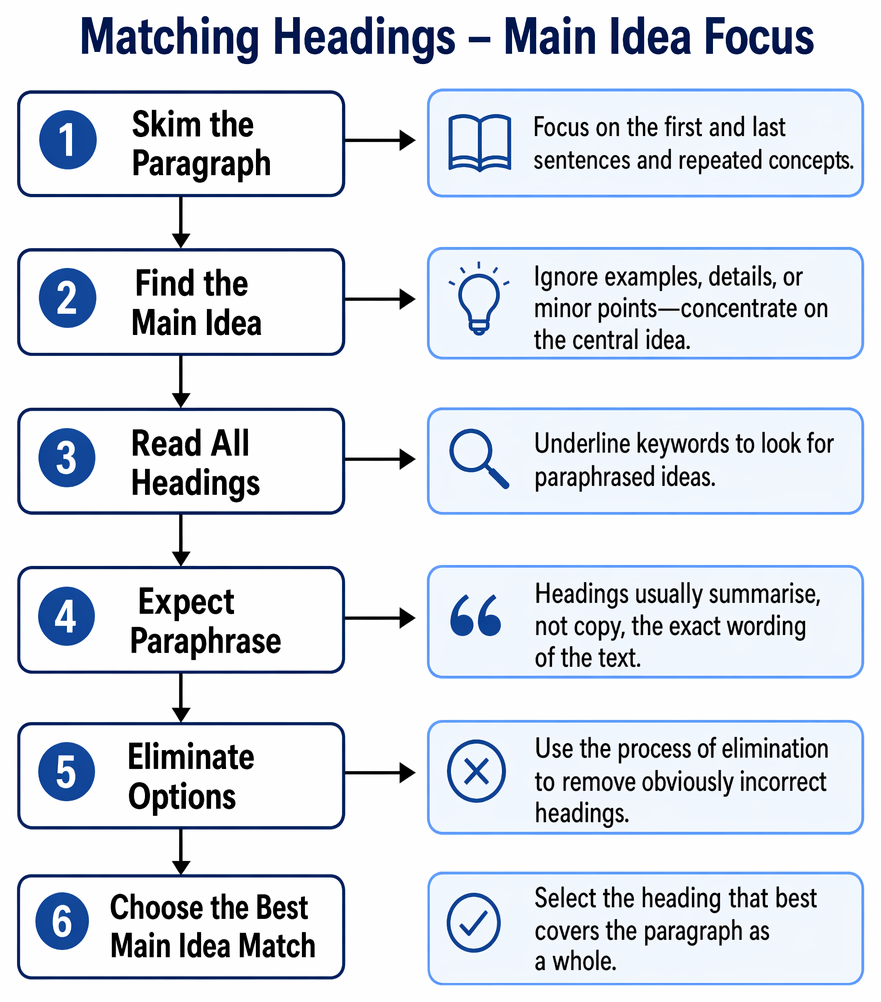
Paragraph-to-heading matching sequence shows keyword marking, comparison with the paragraph's overall meaning, removal of weak headings, and final verification.
How to approach Matching Headings
- Skim each paragraph, focusing on the first and last sentences and any repeated concepts.
- Ignore examples, details, or minor points—concentrate on the central idea.
- Read all headings carefully, underlining keywords to look for paraphrased ideas.
- Remember: Headings usually summarise, not copy, the exact wording of the text.
- Use the process of elimination to remove obviously incorrect headings.
Key Term: Main Idea
The central subject or principal message that a paragraph communicates—the 'big picture', not supporting details.
Common Mistakes to Avoid
- Choosing a heading just because it shares a word with the paragraph.
- Matching headings to paragraphs based on a detail or example instead of the overall topic.
- Overlooking the introductory or concluding sentence, where the main idea is often stated.
Worked Example 1.1
Read the following paragraph:
Rail travel continues to expand in many countries, with significant investment in high-speed trains and modern stations. However, some critics still argue that upgrading existing bus networks would benefit more people for lower cost. Despite this, several governments have chosen to prioritise the development of national train systems as a way to reduce emissions and traffic jams.
Which heading fits this paragraph best?
a) The advantages of bus travel b) Environmental reasons for supporting train expansion c) Improvements in public transport and policy debate d) Investment mistakes in the transport sector
Answer:
c) Improvements in public transport and policy debate The paragraph mainly discusses ongoing changes in public transport, including arguments about whether to invest in trains or buses, making this heading the most appropriate.Exam Warning: Matching headings by focusing on a repeated word or example, instead of the whole topic, is a common error. Never match a heading based solely on matching vocabulary—always check if it covers the paragraph as a whole.
Matching Information – Finding Details
Matching Information questions require you to identify which section or paragraph contains a specific piece of factual information, example, or opinion. You are given a set of statements or facts and must locate the paragraph that includes each.
How to approach Matching Information
- Use scanning to look for keywords or synonyms from each statement.
- Identify not only exact matches but also paraphrased content—IELTS often rewords details.
- Pay attention to facts, figures, reasons, or names rather than the general topic.
- Remember that a single paragraph can contain more than one matching detail, or sometimes none.
- Work through statements one by one, checking across the passage instead of reading every word.
Key Term: Scanning
Quickly searching a text for a specific word, number, or piece of information, without reading all the text in detail.
Common Mistakes to Avoid (Matching Information)
- Focusing only on identical words instead of considering synonyms or similar meanings.
- Assuming a statement will be in the paragraph where a topic first appears—look for it wherever relevant.
- Missing a match because the information is presented as an example, statistic, or description rather than in the exact words used in the question.
Worked Example 1.2
Passage extract:
Recycling programmes in major cities now include both plastics and paper, with households expected to separate materials for weekly collection. Environmental surveys show that participation is highest in areas where councils supply clear instructions and large containers, but remains low where facilities are absent.
Question: In which paragraph is the idea that greater clarity leads to more recycling mentioned?
Answer:
The relevant section is the sentence stating that participation is highest where councils supply clear instructions and large containers. This matches the statement about clarity improving recycling.
Key Differences – Summary Table
| Question Type | Skill Tested | Best Strategy |
|---|---|---|
| Matching Headings | Identify main idea/topic | Skim for key concept |
| Matching Information | Locate details/examples | Scan for facts, synonyms |
Revision Tip: When answering Matching Headings, make a quick note of each paragraph's main topic alongside the letter. This helps reduce confusion when reviewing the headings list.
Key Point Checklist
This article has covered the following key knowledge points:
- The difference between Matching Headings (main idea) and Matching Information (detail) question types in IELTS Reading.
- How to identify a paragraph's main idea by skimming and focusing on key sentences.
- Scanning techniques to find specific facts or examples connected to Matching Information questions.
- The importance of paraphrasing and synonyms in both question types.
- Common pitfalls to avoid—for example, matching based on repeated words or minor details.
Key Terms and Concepts
- Matching Headings
- Matching Information
- Main Idea
- Scanning